Consumers can no longer be easily fooled, please bring out some real stuff at the auto show.
What cars do Chengdu residents love to buy the most? Even people who have lived in Chengdu for years would probably be surprised by the following statistics. To set a baseline for comparison, let's look at the general performance of Chengdu's auto market in the first half of 2021: the top-selling brands were Volkswagen, Toyota, Changan, BMW, Mercedes-Benz, Audi, Geely, and Buick in sequence.
In some months, the three BBA luxury brands even ranked among the top 5. Overall, domestic independent brands took up roughly one third of the market share, which means joint-venture brands and luxury brands were more favored by Chengdu consumers. This also led to the industry-wide consensus in the past that Chengdu was a market with extremely strong automobile consumption power.
But in the first half of this year, the situation has changed completely. The "Chengdu Automobile Market Analysis Report" jointly released by Qiuxin Consulting, Jitu Consulting and 361ci shows that the combined market share of the top 20 domestic passenger vehicle manufacturers in Chengdu reached 78.45% in the first half of 2026. Geely took a slight lead, BYD ranked second, and the three BBA brands have already fallen out of the top 10.
However, these traditional automakers all saw collective sales declines, while new energy startups are accelerating their upward growth. NIO's sales in the first half of the year surged 65.13% year on year, jumping directly from the edge of the ranking to the 8th place. Leapmotor's sales rose 34.61%, Zeekr's sales rose 51.60%, with their rankings climbing sharply. In addition, Xiaomi also maintained positive growth.
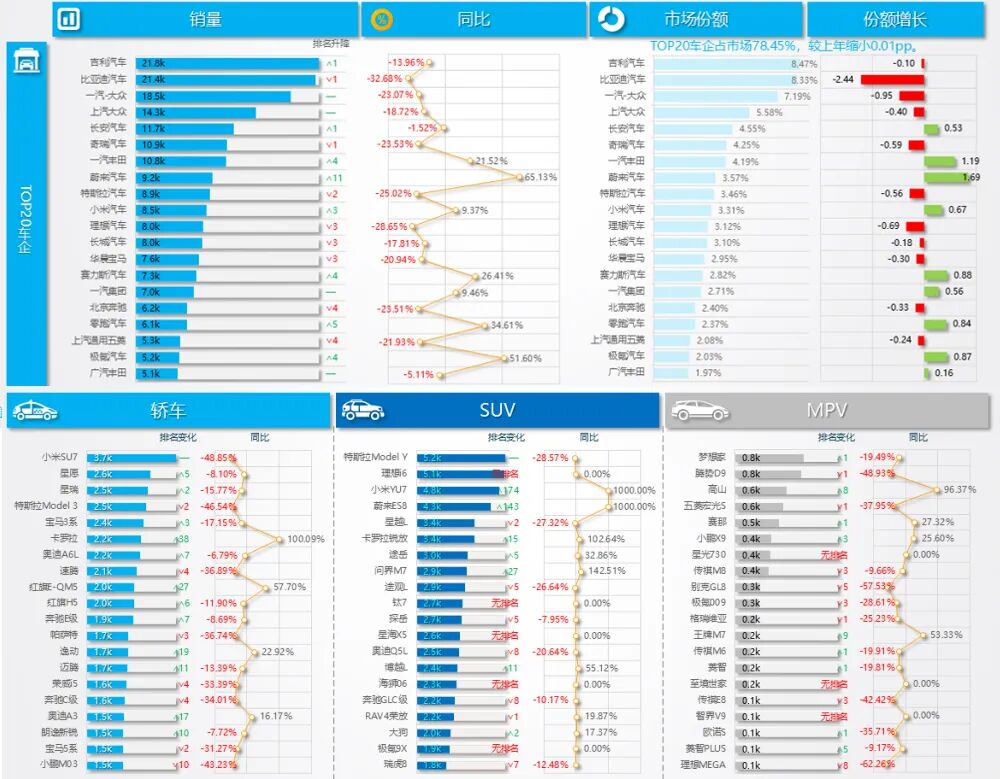
Breaking down by vehicle segments, in the sedan market, the Xiaomi SU7 leads the sales chart, Tesla Model 3 saw a 46.54% drop, and the BMW 3 Series fell 17.15%. In the SUV market, the Xiaomi YU7 took the top spot, Li Auto i6 stayed firmly in the leading tier, and NIO ES8 saw a sharp surge. In the MPV market, the Voyah Dreamer and Denza D9 tied for first place, the Wey Gaoshan rose 96.37%, and the Xpeng X9 rose 25.6%, while many fuel-powered MPVs saw severe declines.
The best-selling models are still mid-to-high-end products, which shows that Chengdu has remained the same as we all know. It is worth noting that Chengdu is a megacity with no license plate lottery restrictions and no purchase limits on vehicles. Moreover, in the first half of this year, Chengdu sold 261,700 units, outperforming Shanghai, Beijing and Guangzhou to secure the first place in national urban auto sales.
However, the overall sales still fell 13.12% year on year. Even though the city's new energy vehicle sales ranked third nationwide, the figure still dropped 9.55% year on year. This trend is consistent with the overall performance of China's auto market this year. In July, the national retail sales of passenger vehicles reached 1.461 million units, down 20.9% year on year and 8.8% month on month.
In July, the retail sales of new energy passenger vehicles reached 951,000 units, a slight drop of 3.9% year on year, far smaller than the 20% decline of the overall market. The penetration rate of new energy vehicles in the total domestic passenger vehicle retail sales reached 65.1% in July, hitting an all-time high. On the contrary, the retail sales of fuel vehicles plummeted 41% year on year. Among the top 10 best-selling passenger vehicle models in July, 9 positions were taken by new energy vehicles.
It is not hard to see that the market is still shrinking, but the shrinkage varies drastically across different segments. Most of the market share vacated by fuel vehicles is being rapidly captured by new energy brands. This means that as the market is contracting, it is more critical to figure out whose sales are being squeezed. It can be said that Chengdu is a both special and typical market, where traditional fuel vehicle demand is weakening while high-end new energy vehicles are rising rapidly.
Essentially, consumers' car purchasing logic is changing. However, the chaos in China's auto market in recent years has also deepened the confusion of consumers across the country including those in Chengdu when they buy cars. A series of industry ills such as price wars, hastily developed vehicles, pseudo-innovation and exaggerated marketing have come to the surface, making consumers lose trust in products, official guide prices, and even automakers themselves.
This collapse of trust has become a fatal straw in the vicious cycle of the auto market. Certainly, neither consumers nor automakers want to see such a result. For this reason, it is reasonable to speculate that this year's Chengdu Auto Show may demonstrate different significance.
As an important auto exhibition in the southwest China market, the Chengdu Auto Show is positioned between high-end auto shows in Beijing and Shanghai, and sales-oriented auto shows in Chongqing, Wuhan and other cities. It can connect top brands while staying close to ordinary consumers, which means it allows consumers to experience every auto brand and every product in person and truly amid the noise of the market.
Auto Show as a Magnifying Glass for Consumers
The term "hastily developed vehicle" has emerged only recently, but its terrifying nature is enough to make everyone who plans to buy a car feel worried.
At the 2026 China Auto Forum held earlier this year, Li Fenggang, General Manager of Beijing Hyundai Motor Co., Ltd., publicly criticized that some brands cut necessary testing links to speed up the product launch cycle, making consumers act as test drivers in disguise and bringing hidden safety hazards. After that, many senior executives of automakers also joined the discussion one after another.
When the issue of hastily developed vehicles is brought to the table for public discussion, it indicates that there are major problems behind it. As the R&D cycle of new vehicles is accelerated, some automakers in the rapid expansion of the new energy track have drastically shortened the R&D and testing cycle that used to take several years, and launched products to the market without sufficient verification.
Although this statement does not point to any specific target, and many auto industry leaders hold different opinions, we can see that a large number of complaints stem from this problem. For example, some automakers cut corners in key parts such as battery consistency, body painting and steering system, leading to a sharp rise in complaints about failures of the three core new energy electric systems.
As many people have said, some automakers manufacture durable consumer goods with the logic of fast-moving consumer goods. Therefore, these problems not only bring many hidden driving safety hazards, but also continuously erode consumers' trust in automakers.
But the problem is, on days without auto shows, how can ordinary consumers distinguish responsible automakers from those who treat consumers as test subjects? Rely on evaluation videos online? How much truth can those KOLs who have received sponsorship fees from manufacturers tell? Rely on car owners' complaints on forums? The survivor bias magnifies negative information infinitely, while positive and correct voices are drowned out.
In other words, most of the time, consumers are faced with massive, hard-to-distinguish true-or-false information on the internet.
Therefore, compared with auto shows in Beijing and Shanghai that focus on building brand image, the Chengdu Auto Show better reflects the connection and interaction between consumers and automakers. Although many automakers will not participate in this year's Chengdu Auto Show, many other manufacturers are preparing to showcase their core strengths here. For consumers, this is the best opportunity to meet and communicate directly with manufacturers.
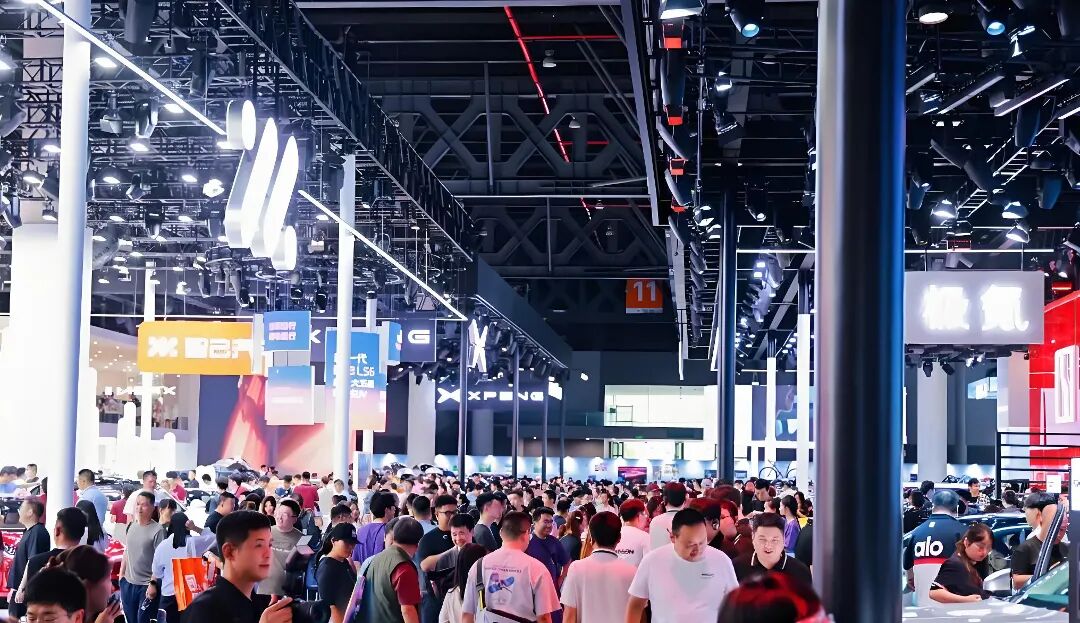
To cite several very practical examples: at the very least, consumers can touch the interior materials of different models from various brands in person, and sit in the driver's seat to experience the space. They can even experience the Denza Z9GT's autonomous drifting and Yangwang U8's emergency floating and 45-degree slope challenge at BYD's tech open day, check out the real all-new Tank 300 that has undergone hundreds of optimizations at Great Wall's booth, and so on.
These hands-on experiences cannot be replaced by any text reviews or video unboxing content.
In particular, this year's Chengdu Auto Show has adopted a group-style exhibition layout, such as the BYD Group dedicated pavilion, Chery Group's "AI Technology City", and Geely Galaxy's immersive themed booth "Galaxy Technology Park". Consumers can compare the product texture, workmanship details and intelligent level of different brands horizontally at the same location. The pros and cons of products become obvious at a glance.
More importantly, the auto show provides consumers with a direct way to resolve doubts. They can ask any questions to the factory staff or sales consultants at the booth, and even get information about multiple competing products directly from one brand to verify the information gaps. These face-to-face communications are the most precious first-hand information that cannot be obtained on the internet.
Without offline platforms like the Chengdu Auto Show, consumers can only passively accept fragmented information online. The Chengdu Auto Show, for ordinary consumers, can expose those shoddy products that pass off as genuine. Who is making cars earnestly and who is doing things perfunctorily will become clear after walking around the exhibition hall.
Automakers Can Reach Users Directly Here
In the past two years, the only keyword for China's auto market is "involution". The market share of fuel vehicles has been declining steadily, while the penetration rate of new energy vehicles keeps rising, and the fierce involution has pushed price wars to an extreme.
For example, in the fuel vehicle market, even if luxury brands offer huge discounts, their products are still widely criticized. Joint-venture brands cut their prices to a level lower than domestic independent brands, but still attract few buyers. The new energy market is also facing tough times: to seize market share, the starting prices of new models from different manufacturers are getting lower and lower, promotion methods are increasingly diverse, and the iteration cycle of new vehicles is getting shorter and shorter.
At the end of the day, the price war damages the entire industry's trust foundation. Consumers no longer trust temporary price cuts, no longer believe in brand promises, let alone those exaggerated descriptions hyped by manufacturers. When it comes to buying a car, no one can be sure whether the price will drop by 30,000 or 50,000 yuan the next day, or whether the new features after OTA updates are useful to them.
As a result, car owners who have just bought their vehicles start to mock themselves as being "backstabbed" or "harvested as leeks". Eventually, the problem comes back: consumers no longer trust manufacturers, and there is no brand loyalty for auto brands.
In fact, the entire industry and automakers have realized that endless price wars will only make the auto market increasingly unhealthy. Therefore, the industry has reached a consensus that the competition should shift from price to technology and quality. Coincidentally, the most notable change at this year's Chengdu Auto Show is that leading brands no longer focus on who offers the biggest price cut, but on who has the most solid technology.
It is reported that BYD will showcase its core technologies such as flash charging and Divine Eye intelligent driving system in its dedicated pavilion at Hall 9. Chery will present two technology scenarios for "Rhino Battery" and "AI Intelligence". Great Wall Motors will bring its carbon fiber lightweight process, super V8 engine and mid-engine layout. A number of debut models equipped with new technologies will also be showcased collectively.
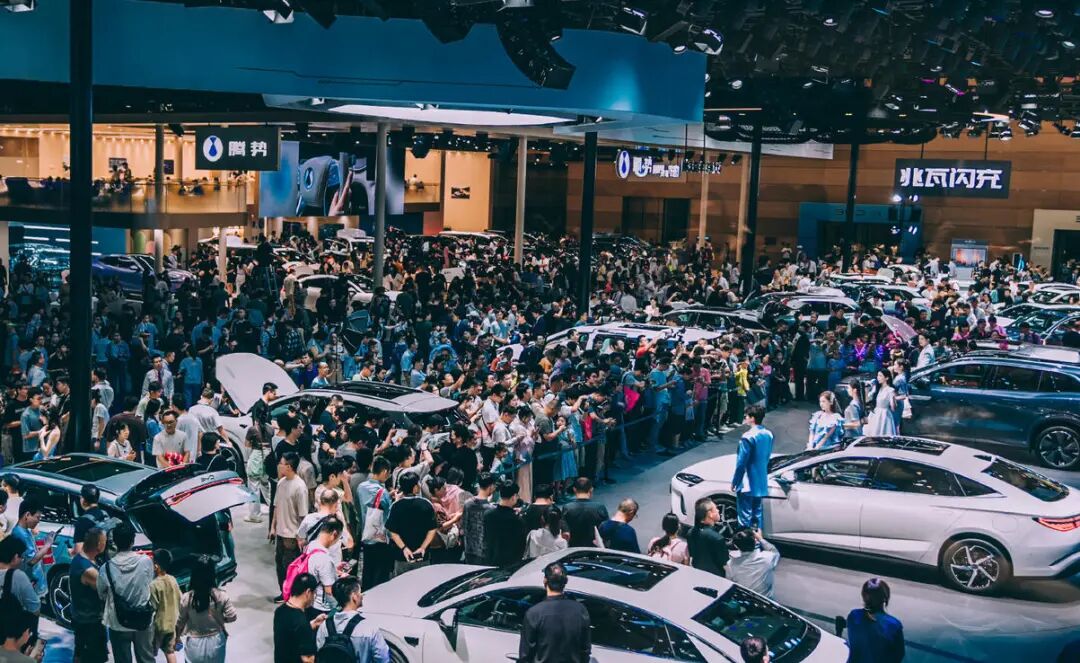
Undoubtedly, these technologies are no longer PPT materials or concept videos. Each of them is a solid demonstration of technical strength, which can be truly felt and experienced by consumers. Therefore, the greater value of this year's Chengdu Auto Show is that it has re-established a direct two-way platform between automakers and consumers.
Thanks to the mass production and real presentation of these technologies in vehicles, they have become a kind of certainty that consumers can truly see, touch and feel. When consumers see these technologies in person at the auto show, they will realize that a brand that is willing to invest real money in R&D and willing to demonstrate its core technologies publicly instead of hiding them must have full confidence in its products.
Brands with full confidence in their products are unlikely to damage their own reputation by launching price wars. Instead, they want to rely on their solid strength to pursue better long-term development.
For example, between a brand that dares to disassemble its battery and show the internal structure at the booth, and a brand that only shouts "direct 50,000 yuan discount" in live streaming rooms, which one do you think is more trustworthy? Between a booth that arranges engineers to stand by and answer technical questions, and a booth that only arranges sales consultants to rush you to place orders, which one makes you feel more assured?
Therefore, when automakers realize this point and are willing to do a good job in communication, it is possible to rebuild the trust that has been eroded by price wars little by little.
From this perspective, this is the irreplaceable value of the 2026 Chengdu Auto Show. As the saying goes, it provides a channel for automakers to jump out of the quagmire of price wars. In a physical venue where they can meet consumers face to face, they can re-communicate with consumers through technology and quality, and lay a solid foundation for subsequent development.
Of course, a single Chengdu Auto Show cannot completely reverse the industry's trust crisis. But at the very least, after consumers who are planning to buy a car walk around the exhibition, they will form their own subjective judgment on all automakers and products. Maybe they will develop trust in a certain brand later, because they have seen and experienced it in person.
From another perspective, automakers should also cherish this opportunity. The technical demonstrations on the stage, the service attitude at the booth, and the professional quality of sales staff will all be magnified at the auto show, and every detail will be noticed by consumers. Instead of consuming each other in the quagmire of price wars, it is better to make efforts to make every consumer who walks into the exhibition hall have a good impression and trust in the brand, which is more valuable than launching a hundred price wars.
Can Joint-Venture Brands Prove Themselves Again?
In fact, there are only two main parties in the auto market: automakers and consumers. The fact that consumers spend money to buy cars remains constant, while the variables lie with automakers. After all, automakers are divided into domestic independent brands and joint-venture brands. The changes of joint-venture brands are also a microcosm of the huge changes that have taken place in China's auto market in recent years.
On the eve of the Chengdu Auto Show, the team of "Auto Commune" also discussed a topic: on the road of new energy transformation, some joint-venture brands have entered the "3.0" era. The 1.0 era refers to fuel-to-electric converted models, the 2.0 era refers to the introduction of global models, and the 3.0 era refers to fully China-localized models. So in the 3.0 era, can these joint-venture brands prove themselves once again?
Before answering this question, we need to clarify another issue. That is the role reversal between joint-venture brands and domestic independent brands, which contains three levels of meaning: first, market share, second, brand value, and third, product strength.
It is worth noting that in 2014, the market share of joint-venture brand vehicles exceeded 70%, and the figure was still over 60% in 2020. In the first half of this year, the market share of domestic independent brands reached 71.8%. The continuous expansion of domestic independent brands' market share is mainly driven by the continuous rise of new energy vehicle penetration rate.
Inevitably, joint-venture brands have suffered huge impacts. The impact not only comes from the continuous decline in sales, but also from the second point mentioned above: their brand value has been re-evaluated by the Chinese auto market. On the one hand, consumers no longer have blind faith in the aura of foreign brands. On the other hand, the high-end transformation of domestic independent brands is advancing at a very fast pace.