Beating Neuralink, the world's first commercial visual brain-computer interface has been approved.
On July 22, U.S. neurotechnology enterprise Science Corporation announced that its PRIMA retinal implant system has officially obtained EU CE MDR certification, and will enter the commercialization stage in about 30 countries across the European Union and the European Economic Area.
This is the world's first brain-computer interface device to obtain CE certification and restore functional "form vision", which also makes Science Corporation the first enterprise in the United States to launch commercial BCI products on a large scale — reaching this milestone earlier than Elon Musk's Neuralink.
01 A 2mm Chip to Restore Central Vision
Age-related dry macular degeneration is one of the leading causes of irreversible vision loss in the elderly. The advanced stage of this disease is called geographic atrophy (GA), in which the photoreceptor cells in the patient's retina gradually undergo apoptosis.
Patients often do not lose their vision completely: their peripheral vision remains, allowing them to perceive the surrounding environment and movement, but a blind spot appears in the central vision, making it impossible to see the characters, faces or object details directly in front of them.
Data from the U.S. National Center for Biotechnology Information shows that there are more than 5 million GA patients worldwide. Existing drugs such as complement inhibitors can only delay the progression of the disease and cannot restore the lost central vision.
Visual prostheses have thus become another technical approach.
Traditional visual prostheses usually require electrodes implanted in the eye, connection to external camera equipment, and signal transmission and power supply through internal wires or coils. The complex implantation structure, long-term power supply and implanted hardware in the body have all become challenges for the clinical application of such devices.
PRIMA adopts a completely different design idea. Its hardware has an extremely simple composition, consisting of only two parts.
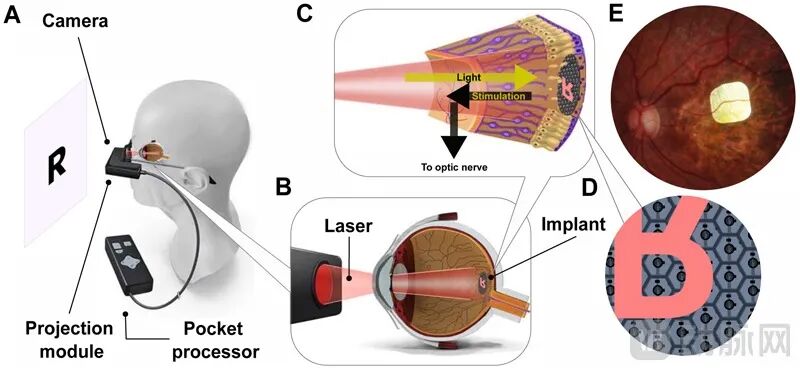
Schematic diagram of the PRIMA system
The first part is a subretinal implant, measuring only 2×2 mm with a thickness of about 30 microns, containing 378 independently controlled photovoltaic pixels. Doctors implant it into the atrophic macular area through subretinal surgery.
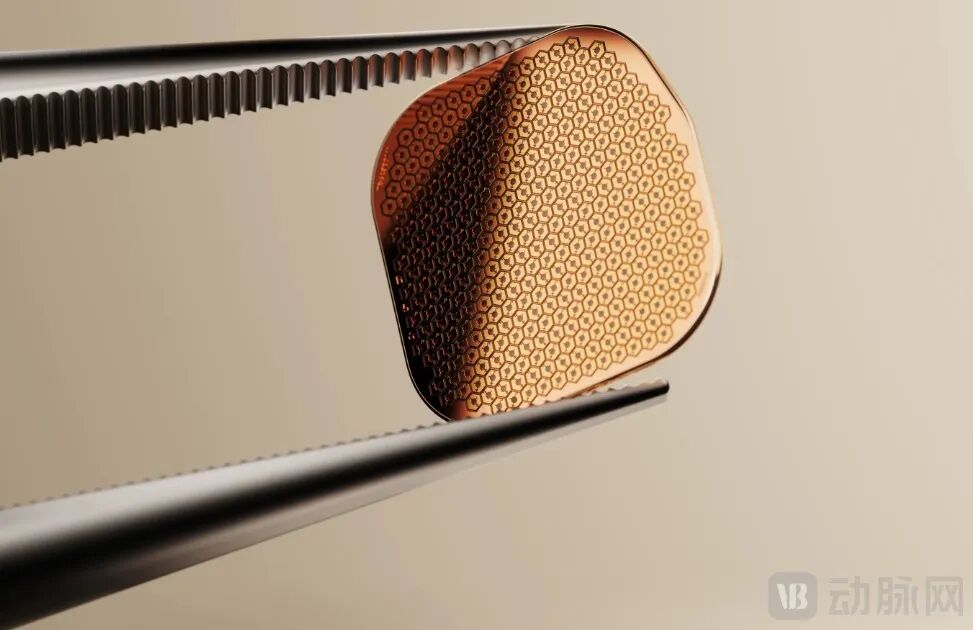
PRIMA subretinal implant
The second part is an external smart glasses. The camera on the frame is responsible for capturing external images, which are processed and converted into near-infrared light, and then projected onto the implanted chip in the eye.
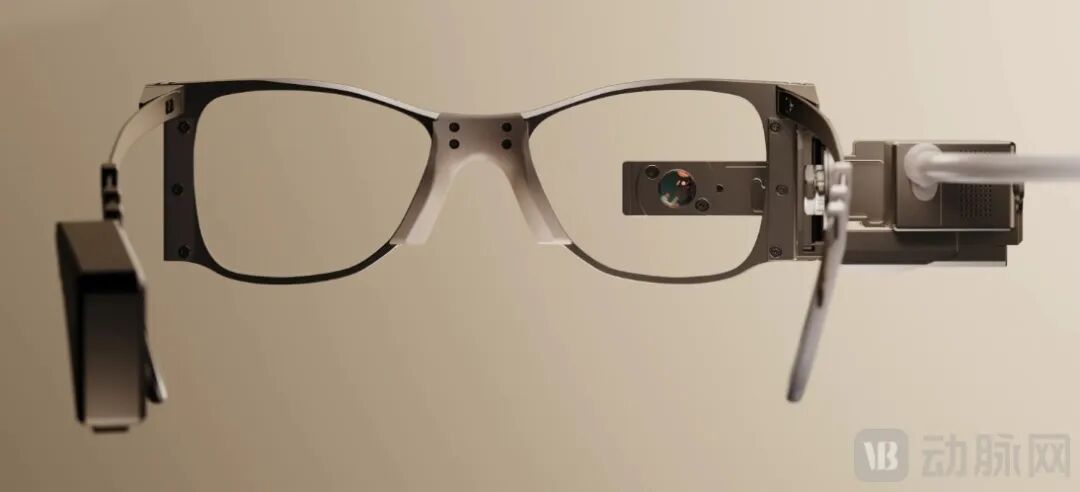
PRIMA external smart glasses
The photovoltaic pixels in the chip convert near-infrared light into local current, stimulating the surviving retinal neurons in the atrophic area, and then transmit the signals to the brain through the patient's original visual pathway.
In this process, the implant itself does not require a battery or internal wires. Both power supply and data transmission are completed by external equipment through near-infrared light.
As for what exactly this design allows patients to see, clinical data gives the answer.
02 84% of Subjects Can Read Letters Again
In October 2025, the New England Journal of Medicine published the results of the PRIMAvera multi-center study. The study was conducted at 17 clinical centers in 5 European countries, enrolling 38 GA patients and completing 12 months of follow-up.
Clinical data shows that subjects achieved an average improvement of 25.5 letters on the ETDRS visual acuity chart, exceeding 5 lines. 84% of patients reported that they could read letters, numbers and words at home, and recovered functional central vision. 80% of patients had a prosthesis vision improvement of ≥logMAR 0.2 at 12 months.
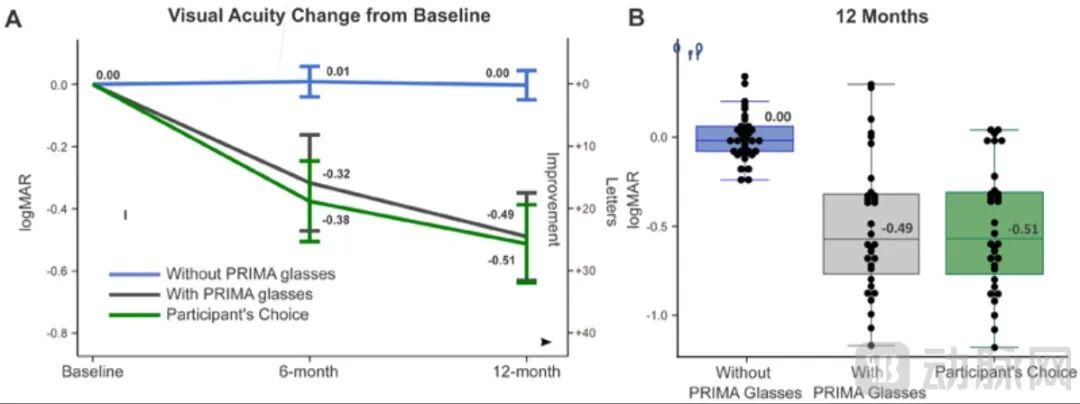
Change in visual acuity from baseline (ETDRS)
In terms of safety, serious adverse events were mainly concentrated in the early stage after surgery. A total of 26 serious adverse events were recorded in the study, 21 of which occurred within two months after surgery, and most of them were resolved. Meanwhile, the study did not find that the implant caused a continuous decline in the patient's original peripheral vision.
The conclusion of the study is prudent: PRIMA does not restore normal vision, nor does it cure geographic atrophy. What it does is re-establish artificial visual input in the macular area where photoreceptor cells have been lost, allowing some patients to regain the central visual function they had previously lost.
But for visual prostheses, this is already an important watershed. This is also the most noteworthy part of PRIMA's CE certification this time.
03 Next Step: Higher Pixels, Broader Indications
The people and company behind PRIMA are of landmark significance in the BCI track.
Max Hodak, founder of Science Corporation, is the co-founder and former president of Neuralink. He left Neuralink in 2021 and founded Science Corporation.
In the past five years, the company has raised nearly 500 million U.S. dollars in total financing. After completing a 230 million U.S. dollars Series C financing in March 2026, its valuation reached 1.5 billion U.S. dollars, making it the second largest brain-computer interface enterprise in the United States after Neuralink.
While Neuralink's Blindsight is still in the pre-clinical stage, PRIMA has already obtained CE certification.
However, for Max Hodak, this is only the first step.
The current 378 pixels of PRIMA provide low-resolution black and white vision. Science Corporation is already developing the next-generation chip, aiming for higher pixel density; the external glasses are also iterating from an external battery pack to an integrated lightweight device.
In terms of indications, the company is expanding PRIMA trials to genetic diseases such as Stargardt disease and retinitis pigmentosa. If successful, the potential patient population will expand from GA, which mainly affects the elderly, to a younger group of patients with inherited retinal diseases.
In the longer term, Science Corporation is collaborating with Murat Günel, Chair of the Department of Neurosurgery at Yale University School of Medicine, to explore "bio-hybrid BCI", which cultivates engineered neurons on the chip to form a direct biological connection with the brain, avoiding brain tissue damage caused by long-term implantation of metal electrodes.
04 After Approval, the Real Test Has Just Begun
At present, Science Corporation has launched its commercial launch in Europe. The first commercial implantation is scheduled for August, in Germany. The company's internal goal is to complete dozens of cases this year, and expand the number to about 200 cases next year.
However, the CE mark only solves the problem of market access, which does not mean that patients can receive implantation in any hospital immediately. Subretinal implant devices require professional surgical centers, trained doctors, and supporting visual rehabilitation systems, all of which need to be implemented country by country.
A more practical issue is payment. The CE certification obtained by Science Corporation this time only grants the qualification to enter the European market. For different countries, it is still necessary to further promote the procedures of hospital procurement, medical payment and reimbursement.
Therefore, the business model of PRIMA is different from that of ordinary medical devices. It not only requires selling a set of equipment, but also requires patients to undergo a complex ophthalmic implantation surgery, wear external visual equipment for a long time, and receive training.
Therefore, whether the product can be widely adopted in the end depends on the equipment price, surgery cost, rehabilitation cycle and the actual benefits of patients after long-term use.
The promotion of PRIMA in the United States is also underway simultaneously. The company has obtained FDA Breakthrough Device Designation and Humanitarian Use Device eligibility, but it is still in the investigational use stage in the United States and has not yet entered commercial sales.
Obtaining CE certification can only be regarded as finishing the first leg of the race. What really needs to be verified next is: how many hospitals are willing to carry out the surgery, how many patients can afford the equipment, how many payers are willing to cover the cost, and whether patients are still willing to use it five or ten years later.
These real-world data are the key to determining how far PRIMA can go.
This article is from the WeChat official account "vcbeat" (ID: vcbeat), written by Chen Maoyu, and published with authorization from 36Kr.