2025–2026 Coffee Shop Closure Rate Released: Jilin Has the Highest Figure, Beijing the Lowest, Shanghai Only 6.8%
Recently, NCBD (Catering Dictionary) released 2025-2026 White Paper on Catering Store Closure Rate. The white paper points out that the overall closure rate of coffee stores in 2025-2026 is 10.8%, which is far lower than the average level of the catering industry. Over the past three years, the closure rate of the coffee category has remained at a relatively low level, and the overall closure rate of coffee stores is lower than that of tea drink stores. After several consecutive years of rapid expansion, China's coffee industry has officially entered a new stage of development.
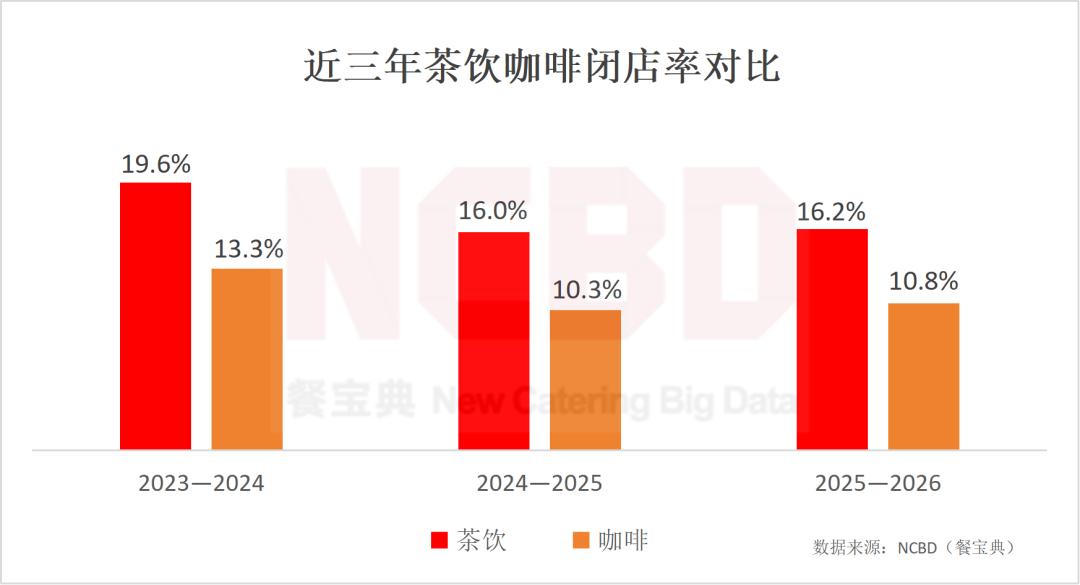
Overall Interpretation
From the perspective of overall distribution, the closure rate range of coffee stores in all provinces across China in 2025-2026 is 4.9% - 15.7%, with an average closure rate of 10.8%. This figure means that the coffee industry as a whole is in a stage of moderate reshuffle, and there has not been an industry-wide wave of store closures.
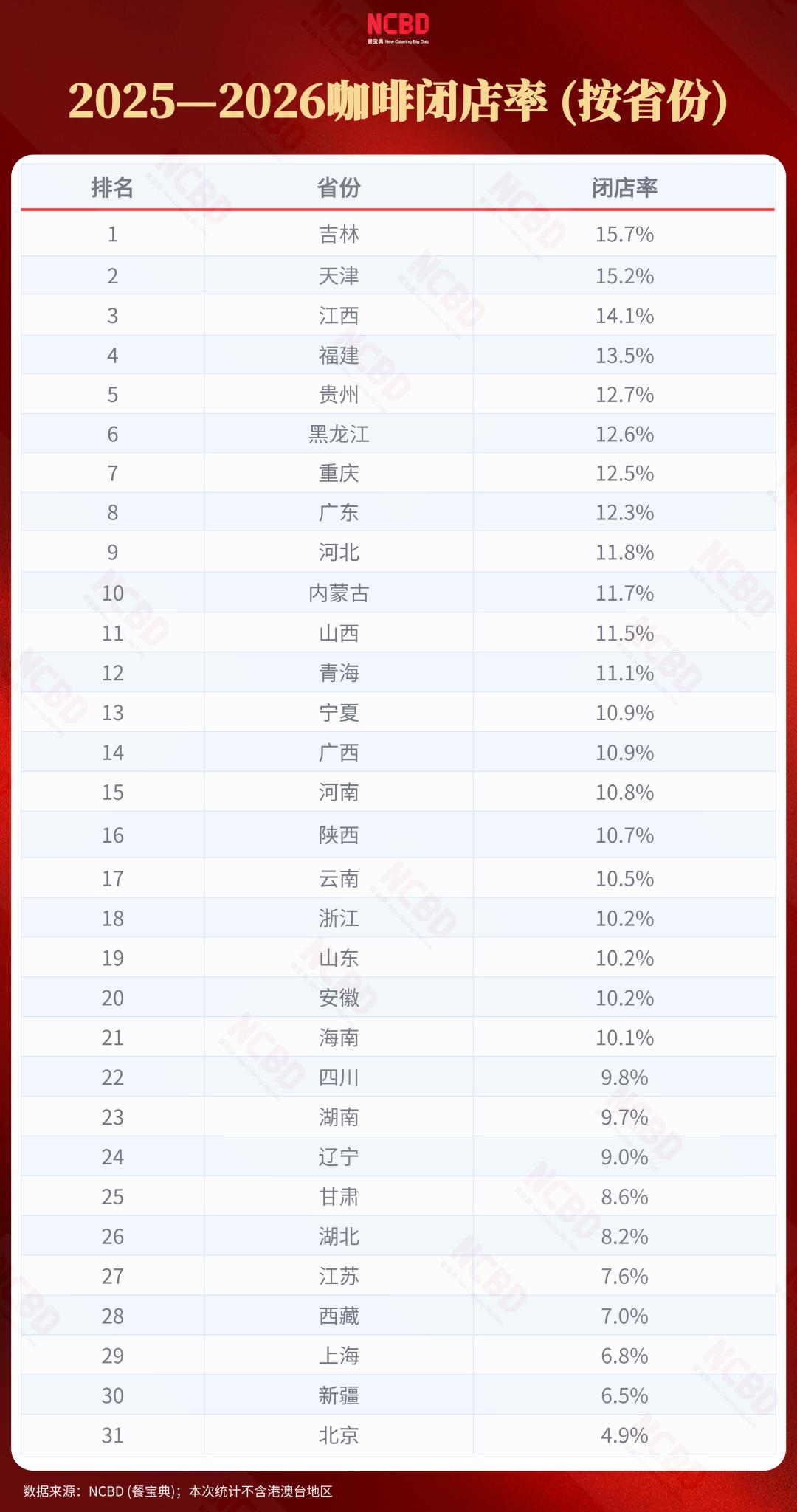
From the perspective of the differentiation degree between provinces, the difference between Jilin with the highest closure rate (15.7%) and Beijing with the lowest (4.9%) is 10.8 percentage points, and there is a significant gap in the development stage and competition pattern of regional markets. According to the level of store closure rate, all provinces in China can be divided into two tiers (there is no obvious high closure rate tier for the coffee category at present):
1. Medium Closure Rate Tier (above 10%)
This tier includes 21 provinces in total, ranked from highest to lowest by store closure rate: Jilin (15.7%), Tianjin (15.2%), Jiangxi (14.1%), Fujian (13.5%), Guizhou (12.7%), Heilongjiang (12.6%), Chongqing (12.5%), Guangdong (12.3%), Hebei (11.8%), Inner Mongolia (11.7%), Shanxi (11.5%), Qinghai (11.1%), Ningxia (10.9%), Guangxi (10.9%), Henan (10.8%), Shaanxi (10.7%), Yunnan (10.5%), Zhejiang (10.2%), Shandong (10.2%), Anhui (10.2%), Hainan (10.1%).
This tier has the largest number of provinces across the country, covering most non-core cities and provinces in North China, Northwest China, South China, Central China, Southwest China and East China, representing the mainstream state of China's coffee market: it is in a stage where rapid penetration and mild reshuffle coexist. The market as a whole is still expanding, but local oversupply has emerged, and the industry is beginning to transition from blind growth to rational development.
2. Low Closure Rate Tier (below 10%)
This tier includes 10 provinces in total, ranked from highest to lowest by store closure rate: Sichuan (9.8%), Hunan (9.7%), Liaoning (9.0%), Gansu (8.6%), Hubei (8.2%), Jiangsu (7.6%), Tibet (7.0%), Shanghai (6.8%), Xinjiang (6.5%), Beijing (4.9%).
The store closure rate of this tier is significantly lower than the national average level, and the market living environment is relatively loose. It can be divided into two categories: one is the mature markets represented by Beijing and Shanghai, with solid consumer foundation and orderly market development; the other is the low-penetration and low-competition markets represented by Tibet, Xinjiang and Gansu, where the popularity of coffee is not high, the density of coffee stores is low, and the competition intensity is weak.
Characteristics of Regional Store Closure Rate
1. Northeast China: Internal differentiation in coffee industry, full pressure on tea drink industry
The coffee store closure rate in the three northeastern provinces shows obvious differentiation characteristics: Jilin ranks first in the country with 15.7%, Heilongjiang ranks sixth in the country with 12.6%, and Liaoning is only 9.0%.
In the same period, the store closure rates of the tea drink category in the three northeastern provinces are 19.1% in Jilin, 19.6% in Heilongjiang, and 20.2% in Liaoning, all in the high range; Liaoning has the highest tea drink store closure rate among the three provinces, which is completely opposite to the pattern of the coffee industry.
From the perspective of the coffee category, the store closure rate of Jilin and Heilongjiang is relatively higher than that of Liaoning, which is essentially the release of the expansion bubble of coffee in the sinking market. The coffee consumption foundation of Jilin and Heilongjiang is relatively weak, the business scenarios are limited, the daily drinking habits have not been fully developed, and the market capacity is limited. While Liaoning has two core cities, Shenyang and Dalian, the coffee consumption culture was cultivated earlier, the business and leisure scenarios are relatively rich, and the market bearing capacity is stronger.
Compared with the tea drink category, it can be found that the store closure rate of tea drinks in the three northeastern provinces is much higher than that of coffee, and the overall level is in the upper middle of the country. This shows that the market competition of tea drinks in Northeast China is more sufficient, and it has entered the stage of stock game; while the coffee category as a whole is still in the early reshuffle stage of industry development, and the market survival pressure is significantly less than that of tea drinks.
2. North China: Extreme differentiation between core and peripheral regions
North China is the region with the most extreme differentiation of coffee store closure rate in China. Beijing has the lowest coffee store closure rate in the country at 4.9%, while Tianjin ranks second in the country at 15.2%. The straight-line distance between the two places is less than 150 kilometers, and the store closure rate differs by more than twice. The coffee store closure rates of Hebei, Inner Mongolia and Shanxi are 11.8%, 11.7% and 11.5% respectively, all at the national medium level.
In the same period, the performance of the tea drink category in North China is completely reversed: Beijing ranks first in the country with 24.2%, Tianjin is 19.6%, Hebei is 21.7%, Inner Mongolia is 22.0%, and Shanxi is 16.4%. The tea drink store closure rate of all provinces is much higher than that of coffee, and the pressure on tea drinks in core cities is far greater than that in peripheral areas.
The extreme differentiation of North China's coffee market is the epitome of the difference in market capacity between China's first-tier cities and surrounding regional markets. As the national political, cultural and commercial center, Beijing has dense business scenarios and a huge white-collar population. Coffee has changed from a leisure drink to a daily necessity, and its consumption frequency and unit price are at the top level in the country. At the same time, after years of development, Beijing's coffee market has a relatively stable brand pattern, with a clear hierarchy between leading chain brands and boutique coffee shops. The store closure rate remains at a low level, and the market is in a stage of steady development.
The high store closure rate in Tianjin is related to the siphon effect of Beijing. As a municipality directly under the Central Government adjacent to Beijing, Tianjin's commercial resources and consumption capacity are diverted to a certain extent by Beijing, and the necessity of local coffee consumption is weaker than that of Beijing.
The coffee markets in Hebei, Shanxi and Inner Mongolia have typical characteristics of sinking markets: the consumption foundation is weak, the stores are mainly sinking stores of chain brands and local small and medium-sized stores, and the revenue of a single store is limited. With the accelerated layout of brands in recent years, oversupply has appeared in some local areas, the store closure rate is in the middle of the country, and the market is in a stage where cultivation and reshuffle are carried out simultaneously.
In sharp contrast to coffee, Beijing's tea drink store closure rate reaches 24.2%, the highest in the country, which is almost five times its coffee store closure rate. This data reflects the difference in the life cycle of the two categories in first-tier cities: tea drinks in Beijing have entered a highly mature stage of stock competition, with a large number of brands and serious homogenization. Nearly a quarter of the stores are eliminated every year, while the demand for coffee in Beijing is still growing.
3. East China: Strong resilience of the core market
East China is one of the most economically developed regions and the most active coffee consumption regions in China. From the data of store closure rate, the East China coffee market presents a distribution of "low in the core and high on both sides": Shanghai (6.8%) and Jiangsu (7.6%) have store closure rates at the low level of the country, with strong market resilience; Zhejiang (10.2%), Shandong (10.2%) and Anhui (10.2%) are at the national middle level; while Jiangxi (14.1%) and Fujian (13.5%) are relatively high.
In the same period, the store closure rates of the tea drink category in East China are: Fujian 23.0% (third in the country), Shanghai 19.0%, Jiangxi 17.1%, Shandong 15.2%, Jiangsu 14.3%, Anhui 13.7%, Zhejiang 12.9%, all of which are significantly higher than coffee as a whole, and the competition intensity of tea drinks in Fujian and Shanghai is among the highest in the country.
As the birthplace of Chinese coffee culture, Shanghai's coffee market maturity is leading the country, and its store density, consumption frequency and category richness are all in the first tier. Although Shanghai has a large number of coffee stores, the huge white-collar group, active business atmosphere and mature consumption habits jointly support the huge market capacity, with strong anti-risk ability, and the store closure rate is only 6.8%, which is at the low level of the country.
The low store closure rate in Jiangsu benefits from its balanced county economy and strong consumption capacity. Jiangsu not only has core cities such as Nanjing and Suzhou, but also has a very developed county economy. In the process of sinking of chain coffee brands, it can get effective support from local consumption capacity, and there is no obvious oversupply.
The high store closure rate in Jiangxi and Fujian is closely related to the local entrepreneurial environment and category foundation. Fujian has a strong atmosphere of beverage entrepreneurship. A large number of tea drink practitioners and entrepreneurs cross the border to enter the coffee industry, leading to a surge in the number of stores in a short period of time. However, there are differences between coffee's consumption habits and operation logic and tea drinks. The local consumers' acceptance and consumption frequency of coffee are far lower than tea drinks, resulting in a large number of follow-up stores closing due to profit difficulties. Jiangxi is similar to Fujian. The coffee consumption foundation is relatively weak, and the superposition of brand sinking and entrepreneurial boom leads to the supply growth rate exceeding the demand growth rate.
Compared with tea drinks, it can be found that Fujian's tea drink store closure rate is as high as 23.0%, ranking third in the country, far higher than the 13.5% of coffee. This shows that even in Fujian, where the tea drink industry is relatively developed, the competition pressure of the coffee track is significantly less than that of tea drinks.
4. South China: Intensified competition in major consumption provinces
South China is one of the core markets for beverage consumption in China. In terms of coffee store closure rate, Guangdong ranks eighth in the country with 12.3%, Guangxi is 10.9%, and Hainan is 10.1%, all in the medium store closure rate tier.
In the same period, the store closure rates of the tea drink category are: Guangdong 20.1%, Guangxi 14.2%, Hainan 14.6%, all of which are higher than coffee, and Guangdong's tea drink store closure rate exceeds 20%, entering the first tier of the country.
As the largest province in terms of economy in China, Guangdong is also a major coffee consumption province. It has two first-tier cities, Shenzhen and Guangzhou, with a dense young population and advanced consumption concepts, and a huge coffee market capacity. But at the same time, Guangdong is also the core battlefield of coffee entrepreneurship and brand layout. Not only national chain brands open stores intensively, but also a large number of local small and medium-sized brands and single stores pour in, leading to very fierce market competition. After several consecutive years of rapid expansion, the local areas of Guangdong's coffee market have become saturated, especially the core business districts of the Pearl River Delta, where the excessive density of stores leads to serious diversion.
Coffee consumption in Guangxi is mainly concentrated in core cities such as Nanning, the acceptance of sinking markets is limited, the overall market capacity is small, the number of stores grows steadily, and the store closure rate remains at the middle level. Hainan's coffee consumption has obvious tourism attributes, with significant differences between peak and off-seasons, and large fluctuations in store operation. However, due to the small number of overall stores, the competition intensity is limited.
In Guangdong, the 20.1% tea drink store closure rate shows that in the core market of South China, the stock competition of tea drinks has entered a white-hot stage; although the 12.3% coffee store closure rate is much lower than that of tea drinks, it needs to be noted that this figure is still at the forefront of the country, the reshuffle speed of Guangdong's coffee market is accelerating, and the era of extensive expansion may have ended.
5. Central China: Moderate market expansion rhythm
The coffee store closure rates in Central China are 10.8% in Henan, 8.2% in Hubei, and 9.7% in Hunan, which are generally in the medium and low store closure rate range, and are the regions with relatively small risks in the national coffee market.
In the same period, the store closure rates of the tea drink category are 9.3% in Henan and 14.0% in Hunan. Compared with coffee, it can be seen that the tea drink store closure rate in Hunan is significantly higher than that of coffee, while Henan is one of the few provinces where the tea drink store closure rate is slightly lower than that of coffee.
On the whole, the expansion rhythm of the coffee market in Central China is relatively moderate, there is no coffee entrepreneurial boom and large-scale brand sinking as in East China and South China, and the growth of market supply and demand is basically synchronized. As a large population province, Henan's coffee market is mainly concentrated in core cities such as Zhengzhou, the penetration of sinking markets is slow, and the store closure rate is in the middle of the country. The situation of Hubei and Hunan is relatively similar, and the coffee consumption atmosphere in provincial capitals such as Wuhan and Changsha is good.
Compared with tea drinks, the tea drink store closure rate in Hunan reaches 14.0%, which is significantly higher than 9.7% of coffee, indicating that tea drinks penetrated earlier and competed more fully in Hunan, and the market elimination pressure of coffee is less. The situation in Henan is special, the tea drink store closure rate of 9.3% is slightly lower than the coffee store closure rate of 10.8%, which shows that the tea drink market pattern in Henan is relatively stable; while the coffee market is in the adjustment period after expansion, but it is still in a reasonable range as a whole.
6. Southwest China: The core market remains stable
The coffee store closure rate in Southwest China presents a pattern