Anthropic: For the Ideal "Rebels"
Recently, it was revealed that Anthropic had confidentially submitted IPO-related documents to the U.S. Securities and Exchange Commission, and is expected to go public at a valuation of over $2 trillion in October this year. Once the listing is successful, Anthropic will not only pull ahead of OpenAI and is poised to become the first U.S. AI large model stock to go public, but also claim the crown of the largest IPO in human history.
All of this was accomplished by Anthropic within seven years — in 2021, Dario Amodei and Daniela Amodei, the brother and sister pair, broke with Sam Altman and left OpenAI in frustration to found Anthropic, hoping to use "safe and controllable" technology to beat their former employer OpenAI which prioritizes commercial gains.
Ultimately, this AI company founded when OpenAI was at the peak of its success has overtaken OpenAI in terms of technology, revenue and capital. It can be said that Anthropic is just like a "rebel" — a rebel that walked out from under the shadow of OpenAI, bided its time amid widespread doubts, and finally defied fate and achieved success with "safety" and "focus".
1. Divergent Paths Due to Misaligned Values
"If we extrapolate the future based on the excellent performance of GPT-3, the answer to life, the universe and everything is no more than 4.398 trillion parameters". In June 2020, Geoffrey Hinton, the father of deep learning, spoke highly of GPT-3 released by OpenAI, stating that this product means artificial intelligence is about to usher in the "eve of the singularity".
GPT-3 brought sufficient shock to humanity. It can write articles, create stories and answer questions, outperforming all previous large language models. However, amid the widespread praise across the industry, Dario Amodei, then Vice President of Research and Development and the lead of GPT-3, fell into anxiety.
"Our development speed has outpaced the growth of our risk control capabilities. Most people underestimate both the potential of AI and its risks."
For Amodei, AI needs to change humanity in tangible ways, such as partnering with biotech and pharmaceutical companies to cure previously incurable diseases; partnering with energy companies to make energy cheaper and more efficient with AI; partnering with universities to allow people in remote areas to access better educational resources... This is the vision of part of OpenAI's R&D team represented by Amodei.

(Source: Internet)
But at that time, OpenAI took a completely different path due to the huge cost of computing power consumption — it pushed for commercial application of AI when the technology was just starting to show its potential.
For example, in September of that year, Altman facilitated an in-depth tie-up with Microsoft, under which Microsoft obtained the exclusive license to the underlying code of GPT-3. This means Microsoft can directly integrate and modify the core technology into its own products, thus securing an exclusive competitive edge for its offerings.
One side hoped to solve tangible human problems at a macro level, while the other kept pushing the company to tie up with tech giants to realize commercial monetization. A fierce collision of two philosophies between the technical lead and the company's helmsman emerged inside OpenAI.
Finally in early 2021, Amodei, who could no longer turn the tide, submitted his resignation to Altman: "Then why keep arguing? The solution is: you do your thing, they do their thing, and we will see who wins in the market, and who wins in public opinion."
It can be said that in the battle for control of OpenAI's future direction, the idealists lost to practical commercial demands, and had to leave to start their own venture. Two months after resigning, Amodei founded Anthropic together with some of his former R&D colleagues from OpenAI, hoping to "put human interests and values at the center of AI development".
2. Facing Suppression and Struggling to Catch Up
Since all early members were R&D personnel of GPT-3, Anthropic was called OpenAI's "strongest challenger" from the very beginning of its establishment — it secured $124 million in Series A financing at its inception.
With large capital injection and R&D experience in AI large model products, everyone expected that Anthropic could replicate or even surpass GPT-3 with its own AI products, and become another safety-focused OpenAI.
But reality dealt a heavy blow to Anthropic. After losing core members such as Amodei, OpenAI successively launched blockbuster products:
In November 2022, OpenAI released the new-generation large model ChatGPT, which reached 100 million monthly active users in 2 months, becoming the fastest-growing consumer application in history; in March of the following year, OpenAI made another strong move and released the ace large model product GPT-4, which dominated the rankings for a whole year afterwards and became the most powerful AI large model.
In contrast, Anthropic, which aimed to change the world, did not launch its first large model product Claude until March 2023. Compared with GPT-4 of the same period, the performance gap between the two was as huge as that between an old weak man and a playful child.
In the comprehensive capability test, GPT-4 scored 95.5 points, while Claude only scored 87.2 points. It was close to GPT-4 only in the two tests of ethics and literary tasks, and lagged behind in all other aspects.
It can be said that with the stunning performance of the two ace products GPT-4 and ChatGPT, OpenAI became the most standout player in the AI large model era at that time:
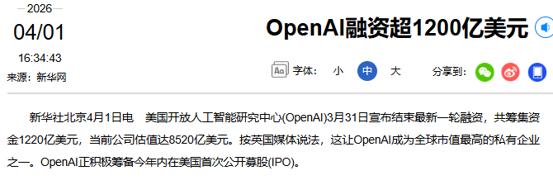
In terms of financing, in 2023, 2024 and 2025, OpenAI obtained excess financing of $10.3 billion, $6.6 billion and $40 billion respectively, and secured $122 billion in financing in March 2026.
(Source: Xinhua News)
In terms of revenue, OpenAI's total annual revenue in 2022 was only $28 million, but it surged to $2 billion in 2023, and its total revenue reached $28 billion within the two years from 2023 to 2025.
Unlike OpenAI's glorious highlights, Anthropic fell directly from high expectations into a low ebb.
From 2023 to 2025, Anthropic completed multiple rounds of financing with a total amount of $17 billion, which was only 30% of OpenAI's total financing in the same period; its total revenue over the three years was $10.1 billion, about 36% of OpenAI's total revenue in the same period.
It can be said that no matter in terms of capital recognition, large model product performance or commercialization progress, the gap between Anthropic, which wants to change the direction of AI development, and OpenAI is getting wider and wider.
3. Sudden Outbreak and Dramatic Comeback
At that time, both the Anthropic management and the outside world regarded OpenAI as the synonym for AI innovation, and no one could shake the "king's" position in the short term. After all, OpenAI at that time not only had abundant capital, top talents and mature products, but more importantly, it was tied up with giants such as NVIDIA and Microsoft, becoming a part of the ecosystem of these industry leaders.
But entering 2026, Anthropic, which had been suppressed all along, staged an upset comeback, which is reflected in the following aspects:
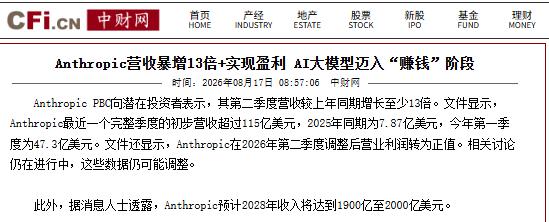
First, in terms of revenue, previously, Anthropic's commercialization capability was far inferior to that of OpenAI, only a fraction of the latter's. But in the second quarter of this year, Anthropic's revenue reached $14 billion, a year-on-year increase of 140%, while OpenAI's revenue in the same period was only $6.7 billion, with a year-on-year growth of 18%.
More importantly, Anthropic posted a profit of $560 million, while OpenAI was still mired in a huge loss of $12.3 billion.
(Source: China Finance Online)
Second, in terms of listing process, in June this year, Anthropic had already submitted its listing application, and is expected to become the first AI large model company listed in the United States in October, while OpenAI's listing date is scheduled for mid-2027.
Third, in terms of products, the performance of Claude on its first generation was far inferior to GPT, but afterwards the two sides took the lead alternately. In May this year, in the Artificial Analysis Intelligence Index ranking, Claude Opus 4.8 surpassed GPT-5.5 to top the list; in July, Claude Opus 5 was released, outperforming OpenAI's GPT-5.6 Sol in key benchmark tests such as coding.
Why could Anthropic completely defy fate in 2026, overtaking OpenAI in products, capital process and even commercialization?
The reason is very simple: at the stage of commercial implementation of AI large models, users are concerned not only about functions, but also about security, and Anthropic has natural advantages in this regard.
When developing Claude, Anthropic embedded an "AI Constitution" at its underlying level, which means Claude must first ensure that it does no harm, then avoid lying, and finally meet user needs.
How big is this difference? Take M&A contracts in the capital market as an example: when a company wants to acquire another, Anthropic will require all AI inferences to be traceable and verifiable, and never fabricate clauses; in clinical trials, any AI inference must be supported by valid data.
It is precisely this logic of putting safety first and functions second that makes Claude very popular among many enterprises. As of the second quarter of 2026, Anthropic's share in the enterprise large language model market has reached 32%, exceeding OpenAI's 25%; 8 of the Fortune Top 10 companies have become its paying customers.
In 2021, when Dario Amodei left OpenAI, he left a sentence: "We will see who wins in the market, and who wins in public opinion."
At that time, this sentence sounded more like the unwilling monologue of a loser. Everyone stood by OpenAI, believing it was an invincible king.
Five years later, as he stands at the threshold of IPO, with an annualized revenue of over $65 billion, 32% of the enterprise market share, and the title of "the first U.S. AI large model listed stock" behind him, that sentence finally gets its long-awaited echo.
This article is from WeChat Official Account "Siku Finance", written by Vincent, edited by Jiajia, authorized for release by 36Kr.