Both e-commerce and the real economy are essentially working for the traffic platforms.
What is truly bypassed in that debate is who holds the more upstream traffic, who distributes it, and according to what rules it is priced.
Recently, a well-known entrepreneur from a "real enterprise" once again talked about the topic he has mentioned many times before. His core view remains unchanged, still taking e-commerce as the opposite of the real economy, and believing that e-commerce has taken away the profits of brick-and-mortar businesses.
Discussions about "intermediaries" are very heated, but a more upstream issue has never been fully discussed: whether it is online e-commerce or offline "brick-and-mortar" businesses, all are actually subject to traffic. As for traffic itself, who sets its price and on what basis?
Traffic Pricing: An Upstream Issue Obscured by Downstream Debates
Traffic platforms themselves are not bad things. Where attention gathers, business grows naturally.
Every generation of traffic entry gathers real business opportunities. In the PC era, search engines made information retrievable for the first time, and small and medium-sized enterprises could be seen across the country only by relying on keyword rankings. In the mobile era, social and content applications took over the baton of entry, and for the first time in theory, a small store could compete for exposure on the same stage as a mall flagship store.
When a certain traffic platform obtains a huge amount of attention and grows from one of many tools to a de facto mainstream channel, traffic will have a pricing foundation, which is a natural stage that every generation of entry will go through.
From the perspective of platforms, the attention of Chinese netizens is actually highly concentrated. According to QuestMobile data, as of June 2026, the monthly active users across the whole network are 1.282 billion, and the average monthly usage time per person is 189.3 hours, of which 60.6 hours, that is, one third of the online time, is spent on short videos, followed by medium and long videos and social tools.
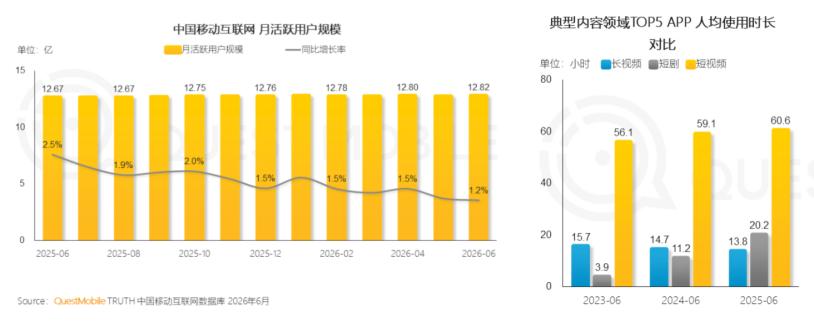
The total amount of attention is limited and tends to be concentrated, while the demand side's demand for reach continues to grow. This structure has a two-sided impact on the real economy. On the one hand, digital entries have greatly reduced the cost of reach, and a large number of supplies that were previously difficult to see have obtained exposure opportunities; on the other hand, when traffic becomes a general customer acquisition cost item in almost all industries, its price fluctuation will be transmitted to the entire value chain.
But the reality is that the right to supply and distribute traffic is increasingly concentrated in a few entry platforms. When traffic becomes more and more expensive and increasingly concentrated at the top, everyone's customer acquisition cost is raised together, and who has business and who does not is all decided by traffic. This is a more worthy issue to discuss.
Business Operations, Online and Offline, Are All Competing for Traffic
At present, traffic platforms not only dominate people's entertainment and social life, but also almost dominate most businesses. In essence, traffic provides a set of logic parallel to commercial value. No matter online or offline, whoever has exposure can do business better.
Many people think that offline brands, factories and physical stores are not affected by traffic, but the actual situation is the opposite. E-commerce and the real economy are ultimately downstream of traffic platforms.
The production scheduling decisions of the manufacturing industry begin to depend on the law of traffic, compressing costs for price competition, stocking a large number of goods before intensive traffic investment, and also facing the risk of inventory backlog.
The gross profit structure of the physical retail industry is beginning to be affected by traffic. Some offline retail businesses even need online drainage more than e-commerce, because physical businesses need continuous exposure more. Many brands spend 30% to 50% of their turnover on online marketing, and some unbranded merchants even spend as high as 80%.
A report released by the Institute of China International Electronic Commerce Center in June 2026 shows that among the 151 brand merchants in 9 industries surveyed, 47.68% said that the traffic cost is too high, 44.37% are facing the situation that "traffic stagnates if no investment is made and sales drop sharply if investment is stopped", and 45.03% are in the state of "having scale but no profit".
This kind of influence on offline merchants is even more prominent. The customer acquisition budget of the service industry is also affected by traffic prices to varying degrees. In the past, a restaurant could be well-known even hidden in a deep alley as long as its food was delicious, but now it is difficult to attract customers without paying for internet celebrities to promote it.
For them, traffic is no longer an optional "icing on the cake", but a rigid expense of "no customers if you don't buy it". No matter how delicious the food is or how durable the goods are, they have to pass the test of "whether they can afford the exposure".
What is most easily ignored by traffic is quality and long-term value. For example, the recently popular animated film *Bull Coming* has sparked controversy. Some netizens think that its plot is simple and its production is rough, but it has won tens of millions of box office just because it won the "traffic lottery".
The real distribution takes place upstream: who holds the traffic, who it is distributed to according to what rules, and how much it is sold for.
Don't Let Traffic Dominate the Orientation of Commercial Value
To see this clearly, there is no need to set any party as the opposite. As infrastructure that connects supply and demand and reduces information costs, the value of traffic platforms should be recognized. E-commerce, as the digital form of the real economy, is also creating value. The pursuit of better products and services by physical merchants is also the foundation of the healthy operation of the market.
What is really worth discussing is whether the traffic distribution mechanism itself can be healthier.
First of all, traffic should not be allowed to dominate the orientation of commercial value. When those who are good at buying traffic can survive better, merchants will be forced to shift their focus from polishing products to operating traffic, compressing quality, making exaggerated publicity, and falling into low-price competition.
Secondly, let the traffic cost return to a reasonable range. When the right to supply and distribute traffic is highly concentrated, the customer acquisition cost will be pushed up continuously until it eats up most of the profits of merchants, and fair competition is impossible to talk about.
The healthy competition of business is the competition around goods and services, not the competition around traffic investment. Only when traffic is no longer the only measure, can quality, repurchase and long-term reputation become competitiveness again, and the market will reward those who truly make good products.
This article is from the WeChat Official Account "Emphasis Next" (ID: leo89203898), author: Dingshan, editor: Xiaobai, published with authorization from 36Kr.