Four brothers founded the factory with three of them in charge of the operation. Mercedes-Benz supplier Futaihe is heading for the Beijing Stock Exchange, and its three-time change of chief financial officer within two years has raised widespread doubts.
Shenzhen Futaihe Precision Manufacturing Co., Ltd. (hereinafter referred to as "Futaihe"), an auto parts supplier with leading clients including Mercedes-Benz and General Motors North America, is pushing forward its IPO application on the Beijing Stock Exchange.
This company, which was listed on the New Third Board back in 2015, has maintained continuous performance growth in recent years, with its revenue approaching 1 billion yuan.
However, under the "trade price for volume" strategy, the selling price of the company's new energy electric drive business has kept declining, with its gross profit margin falling to -8.50%, falling into a dilemma where "the more it sells, the more it loses".
In addition, there is "moisture" in the company's profit side: its net profit has recorded double-digit growth for two consecutive years, but after excluding investment income, its core business has actually posted negative growth.
What is more worthy of vigilance is the internal control management. After entering the listing counseling period, Futaihe has changed 3 chief financial officers in more than two years; and the Zhu family's brothers run the business together, the stability of control has also become one of the most concerning issues for investors.
Trading price for volume, gross profit margin of new energy business turns to loss
At present, Futaihe's product lines cover three major sectors: automotive engine components (fuel supply, valve train, lubrication system accessories) , chassis components (steering, braking, transmission system accessories) , and new energy electric drive components (supporting drive motors) .
In addition, the company also supplies precision machined parts such as sealing connectors for water heaters to the home appliance and bathroom sectors.
But the two traditional businesses have always been the main contributors to revenue. In 2025, chassis components contributed 407 million yuan in revenue, accounting for 45.75%; engine components generated 370 million yuan in revenue, accounting for 42%. The revenue proportion contributed by these two businesses has remained above 87% all year round.
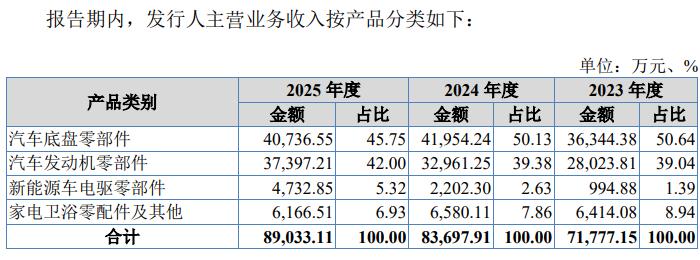
Figure / Futaihe Prospectus
From this perspective, Futaihe is essentially a company whose main business is still traditional fuel vehicle components.
From 2023 to 2025 (hereinafter referred to as the "reporting period"), the company's operating revenue reached 732 million yuan, 856 million yuan and 907 million yuan respectively, growing for three consecutive years, but the growth rate has dropped from over 22% to less than 6%.
The ceiling of the traditional main business is gradually emerging, and the urgency of transformation is rising accordingly.
Against this background, the new energy vehicle electric drive component business is highly expected. From 2023 to 2025, the revenue of this business increased from 9.9488 million yuan to 47.3285 million yuan, and its revenue proportion also rose rapidly from 1.39% to 5.32%.
However, in the company's total revenue of 900 million yuan, this revenue accounts for less than 6%, and it is difficult to become a new performance pillar in a short period of time.
More notably, in the field of new energy vehicles, the company is adopting the strategy of "trading price for volume", sacrificing profits in exchange for market share.
The prospectus shows that the average selling price of new energy vehicle electric drive components has been declining all the way, standing at 122.32 yuan per unit in 2023, dropping to 114.29 yuan per unit in 2024, and further falling to 104.31 yuan per unit in 2025, with a cumulative decline of nearly 15%. At the same time, product sales volume soared from 81,300 units to 453,700 units, with a cumulative increase of 458%.
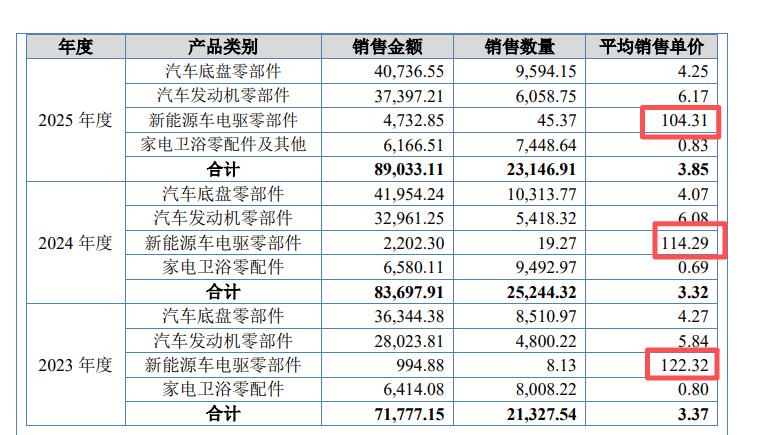
Figure / Futaihe Prospectus
In the process of rising sales volume and falling price, the gross profit margin of new energy vehicle electric drive components plummeted from 18.45% in 2023 to 4.97% in 2024, and directly fell to -8.50% in 2025, entering the loss range.
In response, the company explained that the year-by-year decline in gross profit margin is mainly due to the intensified competition in the domestic new energy vehicle market and the drop in selling prices of main products that account for a relatively high proportion of sales.
Venture Front noticed that when the company had not disclosed its 2025 financial data, the regulator paid special attention to the development of the company's new energy vehicle business.
In the first round of inquiry, the company was required to explain the growth potential of its new energy vehicle electric drive component business; in the second round of inquiry, the company was required to explain the proportion of automotive chassis components and engine components applied to new energy vehicles.
Futaihe's reply left some leeway. The company stated that since customers did not disclose to it the specific scenarios where products are applied to fuel vehicles or new energy vehicles, it cannot accurately grasp the specific distribution ratio of related products in vehicles of different power types.
According to the data confirmable by the company, from 2022 to 2024, the proportion of revenue from products applied to new energy vehicles in the revenue of automotive component business was 15.93%, 21.44% and 25.35% respectively, accounting for less than 30%.
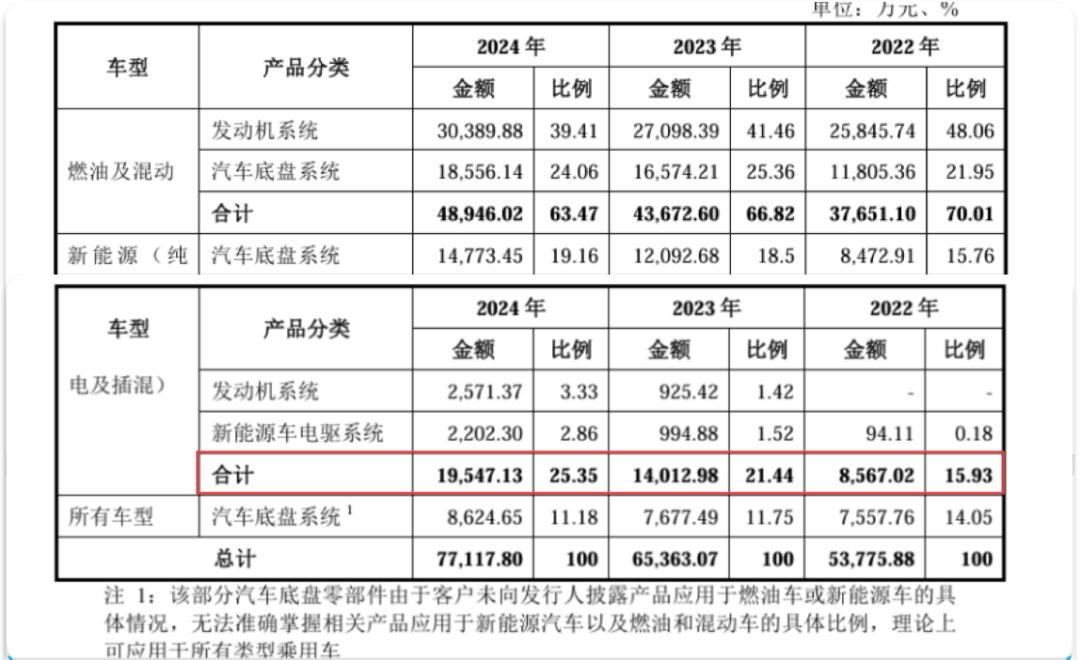
Figure / Futaihe's Reply Letter
Profit comes from joint venture, CFO changed 3 times in 2 years
While the revenue growth rate is slowing down, Futaihe's profit has been growing rapidly.
During the reporting period, Futaihe's net profit was 53.8797 million yuan, 76.4875 million yuan and 87.1081 million yuan respectively, with year-on-year growth rates of 8.74%, 41.96% and 13.89% respectively, maintaining double-digit growth for two consecutive years.
Then, what causes the slowdown of the company's main business revenue while the net profit is surging?
The answer is investment income.
During the reporting period, Futaihe's investment income was 7.8706 million yuan, 12.1568 million yuan and 30.6450 million yuan respectively, accounting for 14.61%, 15.89% and 35.18% of the net profit in the same period.
That is to say, in 2025, for every 100 yuan the company earns, more than 35 yuan comes from investment income rather than product sales.
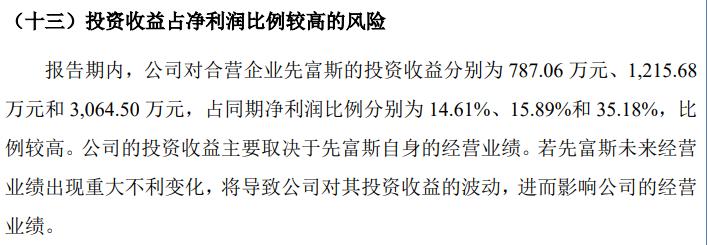
Figure / Futaihe Prospectus
It is understood that these investment incomes mainly come from the joint venture Xianfusi Technology Co., Ltd. (hereinafter referred to as "Xianfusi"). Unlike subsidiaries, joint ventures are not consolidated into the statement, and investors only share their operating results according to the shareholding ratio, which is recorded in the income statement in the form of "investment income".
Simply put, when Xianfusi makes profits, Futaihe's statement will have an extra "share of profit". And this "profit hero" has an unusual relationship with Futaihe.
In 2012, Futaihe's subsidiary Dongfang Junchi and Senior jointly invested to establish Xianfusi, with the former holding 51% of the shares and the latter holding 49%. Zhu Jiangping, one of the actual controllers of Futaihe, also serves as the general manager of Xianfusi.
During the reporting period, transactions between the two sides were frequent. The prospectus shows that the company leased office plants to Xianfusi, with the rent from 2023 to 2025 being 600,000 yuan, 655,300 yuan and 661,900 yuan respectively; Xianfusi also obtained 2 invention patents in 2022, and transferred them to Dongfang Junchi, Futaihe's subsidiary, in 2023.
However, Venture Front noticed that after deducting investment income, the core business profit of Futaihe in 2025 was about 56.4631 million yuan, which decreased rather than increased compared with about 64.3307 million yuan in 2024 (after excluding investment income), and the core business has actually recorded negative growth.
In addition, according to the company's forecast, in the first half of 2026, the company's net profit is expected to decrease by 28.27%-31.69% year-on-year.
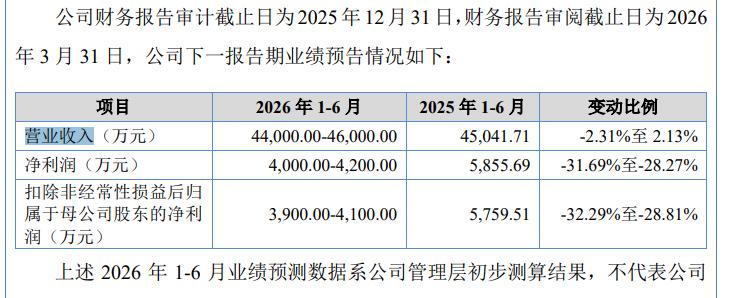
Figure / Futaihe Prospectus (Registration Draft)
In addition to the profit structure, the company's shortcomings in internal control governance have also attracted much attention.
Since 2022, Futaihe's chief financial officer has experienced 3 changes, all for "personal reasons". In May 2022, Wang Feiran resigned, and Qin Yuanyuan took over; only 4 months later, Qin Yuanyuan resigned quickly in September of the same year, and Yang Zian took over.
It is worth mentioning that Yang Zian once served as the company's chief financial officer before, and this time he returned to the post; in December 2024, Yang Zian resigned again, and the position of chief financial officer was finally taken over by Yang Jie, who was promoted from within the company.
Looking at the longer timeline, since the company was listed on the New Third Board in 2015, it has changed 6 chief financial officers in succession, with the longest tenure being about three years and the shortest only four months.
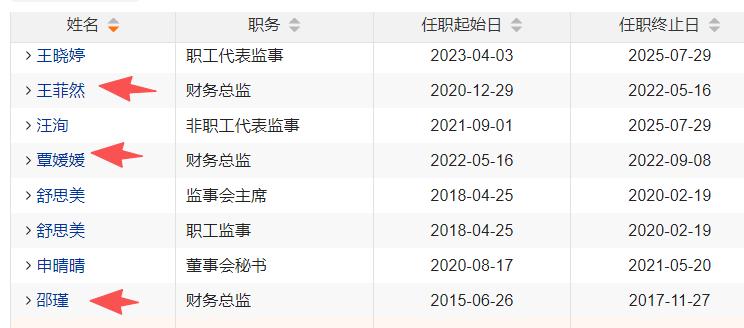
Figure / Eastmoney
The chief financial officer shoulders important responsibilities, is the "first gate" of the company's financial information disclosure, and is a sensitive position that the regulator focuses on in IPO reviews. Three changes in more than two years will inevitably make the public question the continuity of financial information and the stability of internal control.
What is more thought-provoking is the time node. In June 2021, the company launched the counseling filing and officially embarked on the IPO path; in May 2022, the company was transferred to the innovation layer of the New Third Board, which is an important precondition for applying for the Beijing Stock Exchange. And just in May 2022, Wang Feiran resigned as chief financial officer.
In the following three years, the change of chief financial officer almost ran through the whole process of the company's listing preparation. The last change took place in December 2024, only one month before the company's listing application was accepted in January 2025. Changing generals on the eve of the battle will hardly fail to arouse public concerns.
During the frequent change of chief financial officers, the company has been punished for many times. In July 2022, Zhu Jiangping, the actual controller, failed to disclose the share holding on behalf of Zhu Hanping, and was issued a warning letter; in September 2023, 14 directors, supervisors, senior managers/shareholders were criticized for share holding on behalf of others, and the violation was recorded in the integrity file; in June 2024, Zhu Hanping violated the stock lock-up regulation and was given an oral warning; in July 2024, the shareholder Zhongqi Hui violated the information disclosure regulation for share holding on behalf of others, and the company was given an oral warning.
All kinds of phenomena will inevitably make the public question Futaihe's governance level and management system.
Four brothers set up the factory, the situation of three people "running the business" was inquired
Futaihe is a typical family enterprise. The actual controllers of the company, Zhu Jiangping, Zhu Hong and WU Jiongzhong, are three brothers and are persons acting in concert.
As of the signing date of the prospectus, Zhu Jiangping holds 21.62% of the company's shares directly and indirectly, Zhu Hong holds 10.30% of the equity, and WU Jiongzhong holds 7.82% of the equity. The three of them hold a total of 39.73% of the company's shares directly and indirectly, with 40.91% of the disposable voting rights.
However, the fourth brother of the Zhu family is excluded from the list of actual controllers.
The prospectus shows that Zhu Hanping holds 1.26% of the company's shares, has long served as deputy general manager, is directly responsible for the daily operation and management of the Shenzhen entity, and provides joint and several guarantees for the company. Looking back at his resume, he served as deputy general manager from the establishment of the company in 2005 to 2009; he served as a director from 2019 to 2021; and he has served as deputy general manager again since July 2015.
With shareholding, management position, operation management and guarantee provision, Zhu Hanping is almost deeply involved in every link of core operation. However, he is neither recognized as a joint actual controller nor even included in the scope of persons acting in concert.
Such an arrangement has aroused direct doubts from the regulator: is there a situation of splitting actual controllers to evade relevant regulatory requirements such as horizontal competition and related transactions?
In the reply letter, the company also explained an old equity account that lasted for more than ten years. The brothers seem to have experienced a falling out and then made up.
In December 2009, Zhu Hanping suddenly withdrew his shareholding for personal reasons