Hardware including AI chips and servers are competing for air cargo space. The air freight demand from Asia to North America has surged by 14.7%, marking five consecutive months of growth. Korean Air stated that the strong demand will last until the second half of 2026.
A new global air cargo cycle led by AI is kicking off.
Core hardware worth hundreds of thousands of dollars such as AI servers and chips are flooding into air transport regardless of cost, replacing e-commerce as the new engine driving the growth of the air transport market.
Data from the International Air Transport Association (IATA) shows that in 2025, AI-related goods only accounted for 7% of cargo volume, but contributed 53.5% of the total air cargo value. As one of the major international routes, the Asia-North America route saw a 14.7% increase in cargo demand in June this year, marking the fifth consecutive month of growth.
"We believe AI is gradually becoming a structural driver of air cargo demand, especially in the field of high-value, time-sensitive tech products," Vincent Wong, Asia Air Freight Director of C.H. Robinson, a Fortune 500 company, said in an interview with a reporter from National Business Daily (hereinafter referred to as the NBD reporter).
Air cargo may also become a brand new window to observe the prosperity of the AI industry. Niall van de Wouw, Chief Air Freight Officer of air cargo analytics firm Xeneta, said bluntly, "AI demand is driving the growth of global (air freight) data, and no one knows how long this will last. But there is no sign yet that the driving effect of AI on air freight will level off."

Image source: NBD Media Asset Library
The Asia-North America route sees the fastest growth: AI chips, server architecture and data center infrastructure become the main engines
The growth engine of the global air freight market is shifting.
The performance of Korean Air Lines is a clear signal. Its cargo revenue in the second quarter of 2026 soared 46% to 1.54 trillion won (about 1.07 billion U.S. dollars). Company executive Jaedong Eum explicitly stated that AI chips, server racks and data center infrastructure have replaced e-commerce cargo as its main growth engine.
According to IATA data, global air cargo demand rose 8.5% year on year in June this year, among which the Asia-North America route grew by 14.7%, the fastest growth among major international routes, and has recorded growth for five consecutive months. Based on the full-year cargo data of 2025, this route accounts for about 23.5% of the global air cargo market share.
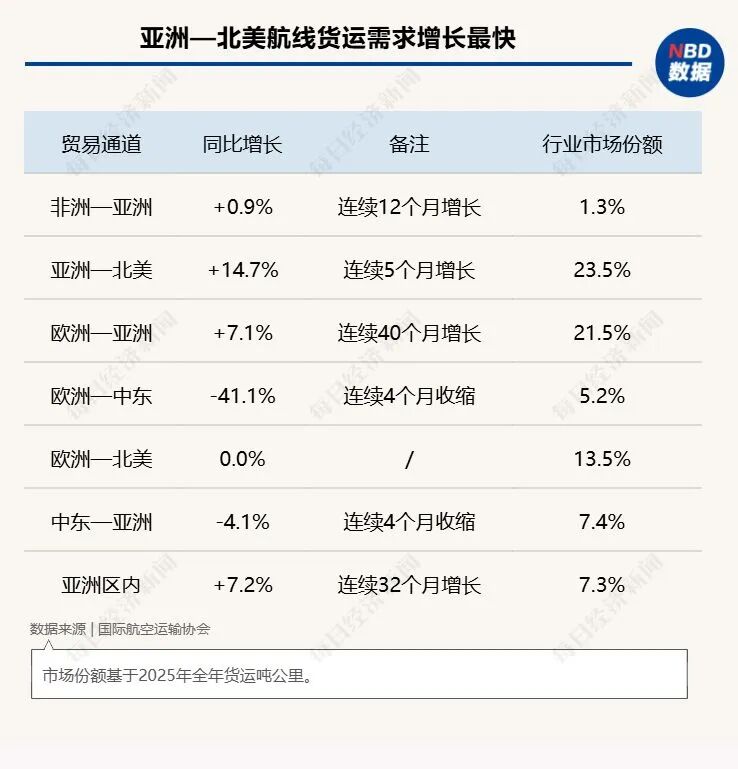
Strong demand has directly pushed up prices. Data from shipping analytics platform Xeneta shows that on the routes from Northeast Asia and Southeast Asia to North America with the strongest demand, spot freight rates at the end of July rose by 33% compared with the level at the end of February. In contrast, the spot freight rate on the Europe-North America route at the end of July fell by 27% compared with the level at the end of February.
IATA estimated in a 2026 report that in 2025, AI-related goods only accounted for 7% of cargo volume, but contributed as high as 53.5% of the total air cargo value.
80% of Asia's air export growth comes from tech products, and strong demand will last until the second half of 2026
Image source: National Business Daily, Zhu Yu
Critical hubs on Asia's semiconductor supply chain are rapidly emerging as new market hotspots.
"This is not driven by a single country or market alone, but by a highly interconnected regional industrial ecosystem. Demand related to the new generation of AI server platforms is creating more concentrated pressure in some major Asian origins such as Chinese Taipei," Vincent Wong said.
Wong further explained to the NBD reporter, "Chinese Taipei is a key hub for advanced semiconductor and AI server production. Other Asian markets are also widely involved in semiconductor manufacturing, components, equipment and electronic product assembly. For example, South Korea plays a key role in the advanced memory products required for AI systems."
The surging concentrated demand has left insufficient capacity in some hubs. International freight forwarder Dimerco pointed out in its July market report: "In addition to Chinese Taipei, countries and regions including South Korea, Malaysia, Thailand and Singapore remain among the tightest air freight markets, especially on routes to and from the United States and Europe."
Lin Ching Kiat, Executive Vice President for Air Hub and Cargo Development of Changi Airport Group in Singapore, said that driven by strong global semiconductor demand, Changi Airport's cargo throughput in the first half of the year increased by 8.7% year on year.
To adapt to this new flow of goods, airlines are actively restructuring their route networks. Japan Airlines stated that about 80% of the growth in Asian air exports excluding China in the past year came from tech products, and semiconductors and AI-related hardware are reshaping the regional cargo landscape. The company decided to expand freighter services connecting semiconductor hubs including Taipei, Bangkok and Hanoi with Tokyo Narita Airport.
Korean Air said, "As major tech companies launch next-generation AI processors and continue to fulfill their long-term infrastructure commitments, we expect strong cargo demand to last until the second half of 2026."
Air freight costs several times more than sea freight, why do AI hardware still choose to "take a flight"?

Image source: NBD Media Asset Library
The extreme reliance of AI-related equipment on air freight is the result of the combined effect of three core factors: value, project progress and technology iteration.
According to IATA's report, these goods are usually small in size, extremely high in value and time-sensitive, making air freight an indispensable transportation method. Some key AI components have extremely high dependence on air freight: for example, 56% of servers are transported by air, 68% of data storage units, and almost 100% of memory chips are transported by air.
"AI hardware tends to be transported by air, mainly because such goods are extremely high in value," Vincent Wong analyzed to the NBD reporter. "The equipment carried by a single AI server rack can be worth hundreds of thousands of dollars. If transported by sea, the transportation time of several weeks will not only occupy a large amount of capital, but also bring additional risks." For such high-value goods, the speed, reliability and security provided by air freight can effectively reduce the capital occupation cost in transit and the risk of physical damage.
Project progress is another key factor. "For hyperscale cloud service providers and large tech companies, delays (in data center launch) may bring significant operational and financial impacts," Vincent Wong emphasized. "Air freight can reduce the transportation time of several weeks by sea to several days, which is particularly critical when equipment must be in place before a specific deployment date."
The last factor is the pressure of technology iteration. The technology iteration cycle of AI chips and hardware is very short, and enterprises need to quickly deliver the latest products to the market through air freight to maintain competitive advantages. Jaedong Eum from Korean Air pointed out that the demand for AI hardware is very "substantial", with orders extending to the next two to three years, which reflects the entire industry's long-term planning and sense of urgency for future technology deployment.
"Depending on the specific route, goods and market conditions, air freight costs may be several times that of sea freight, but enterprises do not only consider the freight rate when making transportation decisions," Vincent Wong pointed out. Customers will comprehensively consider the total cost caused by delays, inventory holding costs, and the value created by whether the equipment can be put into operation on time. When factors such as high cargo value, high time sensitivity, short technology cycle and high delay cost overlap, air freight is often a more reasonable, even the only choice from the perspective of overall economic benefits.
Air freighters may become the "barometer" of the AI industry's prosperity
As AI evolves from a periodic trend to a structural force driving the global air cargo market, this traditional logistics industry may also become a "barometer" to understand the prosperity of the AI industry.
"Air cargo is very close to the actual flow of tech products. If the transportation of AI and tech-related goods in major Asian markets continues to decline, while the demand for high-end air cargo capacity weakens and freight rates fall, this may mean that the AI-driven demand cycle is starting to slow down," Vincent Wong told the NBD reporter.
However, he also said, "We will observe whether these signals change at the same time, instead of making judgments based on only one indicator."
According to what Vincent Wong shared, "Upstream in the supply chain, we will pay attention to semiconductor orders, wafer demand and chip packaging delivery cycles in the Asian market. If the tight capacity begins to ease and the delivery cycle is significantly shortened, this may be one of the early signals that the previous production boom is beginning to cool down."
He also added that the inventory level at major hubs is also a key indicator. "If components stay in the warehouse for longer, or the inventory accumulation speed begins to exceed the shipment speed, this may be another early warning signal."
This article is from the WeChat official account "National Business Daily", written by NBD Reporter, authorized for release by 36Kr.