A massive transfer of nearly 500 billion yuan in assets is underway, and the Nanjing version of "Temasek" is poised to emerge.
On the evening of August 19, four listed companies including Nanjing High-Tech, Nanjing Business Travel, Nanjing Utilities and Nanjing Securities simultaneously issued announcements pointing to the same event —
The Nanjing Municipal State-owned Assets Supervision and Administration Commission injected 100% equity of Nanjing Urban Construction Group, Nanjing Transportation Group and Nanjing Southeast Group, as well as 66.67% equity of Nanjing Innovation Investment Group, all into Nanjing State-owned Assets Investment Management Holding Group (hereinafter referred to as "Nanjing State-owned Assets Group").
After the completion of this equity injection, the asset scale of Nanjing State-owned Assets Group will exceed 480 billion yuan in one fell swoop, making it the largest shareholding platform in Nanjing's state-owned assets system.
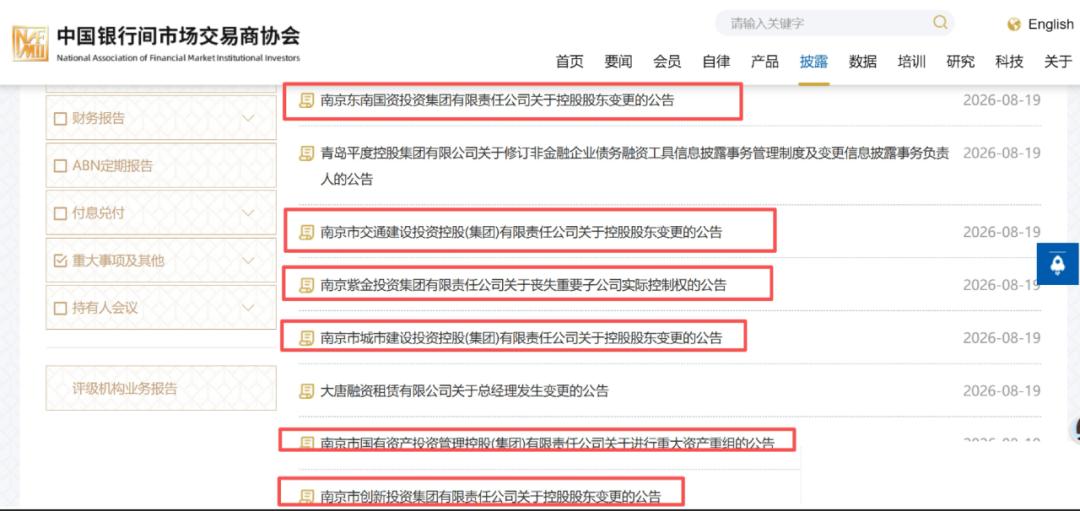
Major Restructuring of Nearly 500 Billion Yuan in Assets
Calculated based on the audited net assets at the end of 2025, the scale of these injected assets is about 486.3 billion yuan. This large-scale asset consolidation of nearly 500 billion yuan, a major move of Nanjing's state-owned enterprise reform, has caused a huge shock across the country.
The announcements of the four listed companies mentioned above are all consistent in wording: only their controlling shareholder has changed, while the actual controller remains the Nanjing Municipal State-owned Assets Supervision and Administration Commission, and no secondary market share reduction is involved.
However, this equity transfer has also caused minor changes in some shareholding ratios.
For Nanjing High-Tech, the indirect shareholding of Nanjing Municipal State-owned Assets Supervision and Administration Commission rose from 31.98% to 34.14%;
For Nanjing Securities, the indirect control ratio of the State-owned Assets Group increased from 28.83% to 39.11%;
54.19% of the equity of Nanjing Utilities is indirectly controlled by the State-owned Assets Group;
The indirect controlling shareholder of Nanjing Business Travel has been transferred from the Cultural Tourism Group to the State-owned Assets Group.
Nanjing's "Temasek" Model of State-owned Assets Emerges
This integration essentially unifies the equity of multiple industrial groups originally scattered under the Nanjing Municipal State-owned Assets Supervision and Administration Commission into a single entity, which is Nanjing State-owned Assets Group.
After the integration is completed, this 24-year-old established platform will directly hold 100% equity of six municipal groups including Urban Construction, Transportation, Housing Security, Southeast, New Rural Development and Zijin.

At the same time, it holds controlling stake in the municipal innovation investment group, and through equity penetration, holds the rights and interests of listed companies such as Bank of Nanjing, Nanjing Securities, Zijin Rural Commercial Bank, Nanjing Utilities and Nanjing Business Travel.
One platform takes charge of Nanjing's most core state-owned assets territory. Doesn't this structure look like a local version of "Temasek"?
This is not an exclusive move by Nanjing, and it is very likely a deployment that has been promoted starting from the provincial level.
You may recall that in 2025, Jiangsu Province has established a provincial state-owned capital investment and operation group on the basis of the original Guojin Capital Operation Group.
Not only in Jiangsu, many regions outside the province have also carried out similar consolidation and restructuring. For example, Taiyuan established Chang'an Full Asset Management Company with an initial capital injection of 5 billion yuan, focusing on revitalizing existing assets. Xi'an is also accelerating the establishment of a municipal asset management platform.
The state-owned assets reform of provincial capital cities across the country is entering the same rhythm, which will help the state-owned assets transform from "managing enterprises" to "managing capital", shifting from decentralized management to platform-based operation, so that each business segment under its banner has greater autonomy and more flexible operation.
Another huge benefit of this approach is that it is conducive to entering the capital market, especially listing and financing, and increasing the securitization ratio.
What Does This Mean for Listed Companies?
As mentioned above, once this flagship platform with an asset scale of nearly 800 billion yuan is put into operation, the space for capital operation will be opened up.
Subsequent moves by Nanjing State-owned Assets Group, whether it is fund investment, equity management, or promoting the gathering of its assets in strategic emerging industries such as new-generation information technology and high-end equipment manufacturing, may find landing points through these five listed companies.
A noteworthy signal here is that Nanjing Business Travel just contributed 25 million yuan in June this year to participate in the establishment of a 5 billion yuan cultural tourism M&A fund.
The fund completed the record filing at the end of July, and the upper-level architecture adjustment came on August 19. The fast pace shows that this arrangement is not a last-minute decision, but a layout that has been planned long ago.
Of course, we must also see the other side of the coin.
The registered capital of Nanjing State-owned Assets Group is only 5.44 billion yuan. To manage an asset plate of nearly 800 billion yuan, extremely high requirements are placed on management capabilities and market-oriented mechanisms.
Integration is only the first step. Whether the transformation of "managing capital" can be truly realized to activate the dormant assets still needs to be tested by time.
This article is from the WeChat official account "Deepwater Finance Society", author: Xiao Se, published with authorization from 36Kr.