This year's fresh graduates are trapped in countless "online assessments"
From the transition to junior high school, high school entrance examination, college entrance examination, to postgraduate entrance exam... After countless tests, fresh graduates are finally ready to knock on the door of their ideal career, only to find that endless assessments are still waiting for them ahead.
Relevant data shows that more than 60% of large and medium-sized enterprises have included online written tests in their campus recruitment processes. In addition, with the widespread popularization of AI, most of these assessments do not require HR to grade papers in person, but are directly screened by AI, and even interviews can be conducted by AI.
Educational background and internship experience are no longer the tickets to the interview. Whether you can pass the administrative aptitude test, personality test, and AI video interview determines whether you are qualified to be noticed.
To cope with these assessments, many job seekers on social platforms self-mock that they suffer from "assessment anxiety". It is widely believed that most online tests have nothing to do with the actual work of the position, and are just tools for enterprises to screen people in batches. But no one can avoid them.
The daily job hunting of countless young people has eventually become an endless loop of mass resume submission, question brushing, accompanying others to be eliminated, being eliminated, and submitting resumes again.
In this issue of Micro Story, we will walk into the lives of job seekers trapped by assessments.
The following are their true stories:
Trapped in Endless Tests
Since submitting her graduation thesis in April, 25-year-old Yang Liu spends several hours every day brushing up on questions, attending lectures, and reviewing answering routines. Sometimes she even records videos facing the phone camera to check her performance.
Don't get me wrong, she is not taking the civil service exam or preparing for the postgraduate entrance exam. Every set of questions she practices is only for one thing: to cope with the large number of online assessments for the upcoming autumn campus recruitment.
Every July and August is the core window period for fresh graduates' autumn recruitment, and also the period with the most concentrated job hunting traffic throughout the year.
Data shows that in 2025 alone, 12.22 million college graduates entered the job market. Among them, more than 31% of fresh graduates submitted more than 20 resumes in the early stage of job hunting, and 42% of previous graduates said they would be invited by enterprises to take assessments after submitting resumes.
Faced with the massive influx of job resumes, simple screening based on educational background and initial resume screening can no longer adapt to the recruitment pace of enterprises. Nowadays, not only state-owned enterprises, central enterprises and leading Internet giants, but almost all large-scale enterprises have set online application (resume submission), written test or assessment as a mandatory link before the interview, and even some companies have started to use AI interviews.
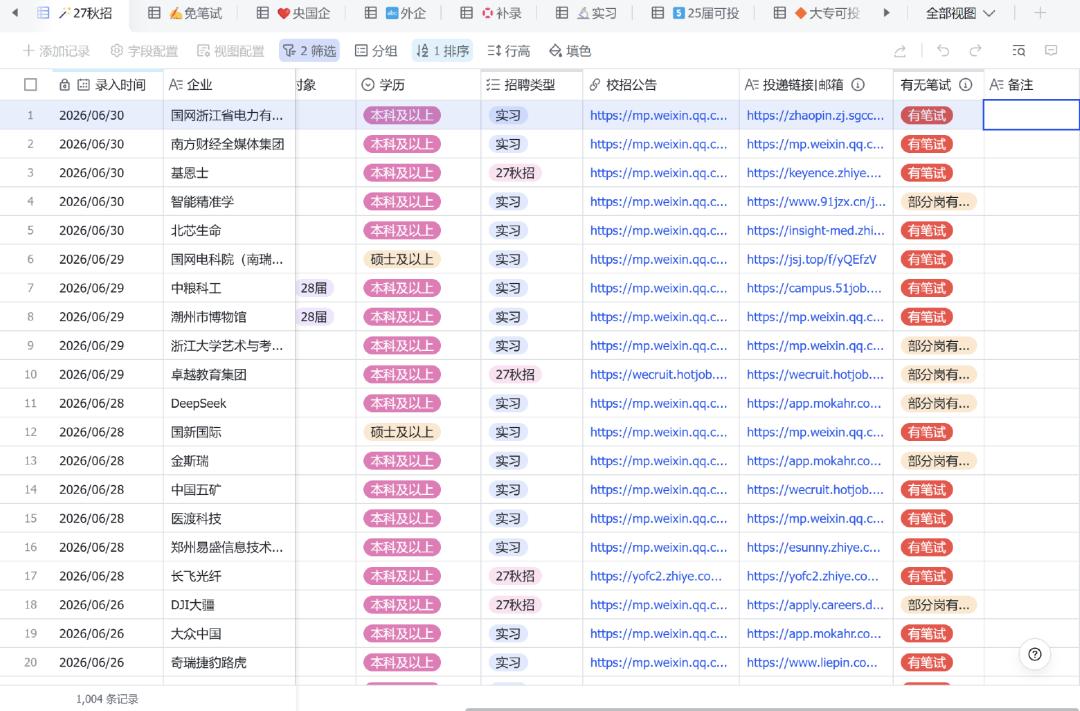
Figure | Among the relevant autumn recruitment information online, some companies that clearly have a written test link
"AI interview uses algorithms to observe the interviewee's body movements and emotional changes, analyze the applicant's language logic, and finally the AI decides whether the interviewee can enter the next link." Yang Liu said that some AI interviews are very strict: uncoordinated body movements or wandering eyes may be judged as "cheating".
In addition to AI interviews, the difficulty of written tests is also higher than before. Some links require time-limited answers, and even suddenly ask you for details of certain projects in the enterprise.
In order to improve the accuracy and efficiency of answering questions, Yang Liu has to make multiple preparations — although Yang Liu graduated from a 211 university, her educational background does not give her an advantage in the job market. "Without a hard core professional barrier, I can only rely on mass resume submission, take more assessments, and try more opportunities to exchange quantity for probability."
Yang Liu's senior school sister also used a similar strategy. She submitted more than 100 resumes, took more than 20 written tests, and finally found a job. "There are more graduates this year, and the situation may be more severe," Yang Liu said.
At present, corporate written tests are mainly divided into three categories: position-specific professional ability tests, general administrative aptitude tests aligned with civil service exams, and personality tests used to screen personal traits.
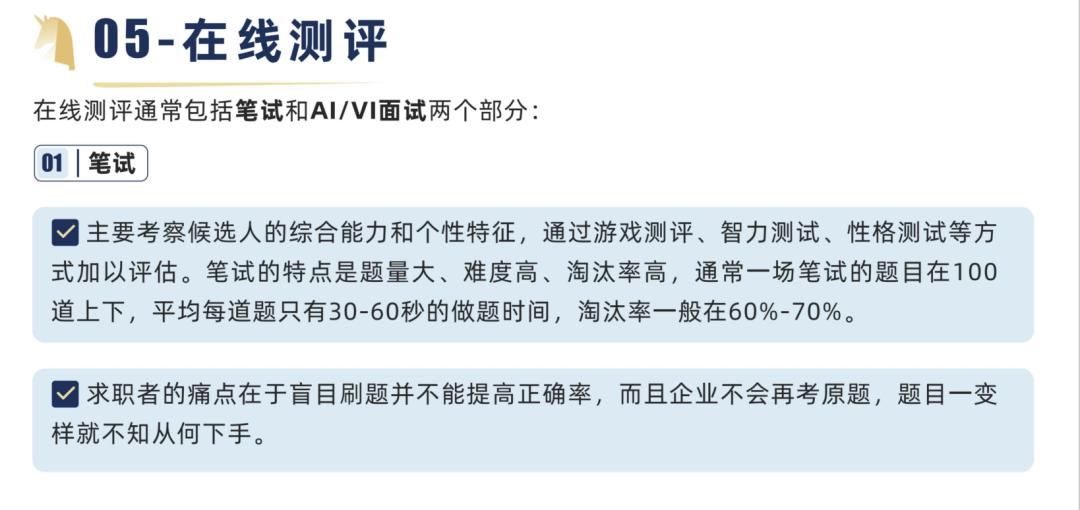
Figure | Introduction to online assessments from a job hunting institution
The three types of questions are randomly combined with different difficulty levels, and you can only rely on advance preparation to get through them.
The senior school sister summed up a set of preparation formulas: professional questions are closest to business and the most difficult, so you can only disassemble industry cases to accumulate problem-solving ideas; there is no shortcut for administrative aptitude test questions, only massive question brushing can make you skilled; personality tests cannot be answered casually, you must simulate repeatedly to meet the core expectations of the workplace for employees' stress resistance, ambition and stability.
To a certain extent, this is also the job hunting path for all fresh graduates at present: in order not to miss any opportunity, the vast majority of graduates will choose to submit resumes in batches, and the price of massive submission is to be swept forward by countless online assessments.
Xu Wang, who just got a summer internship offer, has a deep feeling about this, "Now even to get a summer internship, you have to participate in multiple assessments."
In the past two years, the number of market internship positions has shrunk by more than 15%, while the number of job applications has skyrocketed, and the competition pattern of more people than fewer positions has become increasingly fierce.
In order to seize the opportunity, Xu Wang devoted himself to assessment preparation since February this year. By June, he had submitted more than 120 positions in total and triggered 32 written test invitations.
After Xu Wang screened out some positions, he took 21 tests and finally got 7 internship offers.
In contrast, Li Xin, a Chinese student studying in the UK, was not so lucky. In the same period, she submitted 15 internship resumes, 12 of which triggered written assessments, and only once was lucky enough to enter the interview link.
"There are many obscure professional terms in the written test, and many comprehensive assessments that require long hours of thinking." The most exhausting experience for Li Xin was that she was required to rely on the AI tool designated by the enterprise to answer questions continuously for three hours, and independently complete an industry research report with complete logic, detailed data and comprehensive dimensions.
In the past, these work contents could only be completed independently by practitioners with 3-5 years of work experience, but now they have become written test questions for newbies.
I thought that after leaving the campus, I could get rid of more than ten years of exam-oriented involution, but I didn't expect that the first step to enter the workplace was to fall into a more intensive, more demanding and more inescapable prison of examinations.
"Our generation seems to be born to be exam-taking tools," Li Xin often mocks herself.
"You can also see it as a compliance test"
Compared with school exams, pre-employment tests are more like an endless "compliance test" with no correct answers that constantly consumes candidates.
In a written test, Li Xin spent more than 2 hours answering professional questions about data maintenance and merchant operation optimization in the KA post of an Internet company, but the system would not show her score and accuracy rate, and she could only wait for 2 days to see if anyone would notify her of the result.
After entering the interview, Li Xin unexpectedly found that the interviewer did not ask any business-related content throughout the whole process, and all the questions only focused on her personal experience: "Your undergraduate internship experience is not vertical enough, why? Did you not know what you wanted to do at that time? Then how can I be sure that you are passionate about this position?"
At the end of the interview, the HR even said directly: "Except for the fact that you are a local, I can't see any traits that match the position from your experience."
Eventually Li Xin "failed" the interview, and the reason given by the other party was "mismatch".
So Li Xin was a little confused: "Since the resume screening link can find that I don't match this position, why set up so many links to keep me until the interview link and then tell me I'm not suitable?"
But from the perspective of enterprises and HR, setting up these complex checkpoints to make things difficult for candidates is a helpless move under the imbalance of market supply and demand.
Chen Chen, who has worked as an HR in an Internet giant for many years, explained that recruiting fresh graduates is riskier than social recruitment. Most people's resumes are relatively simple, and it is impossible to see their logical ability, learning ability and stress resistance when actually facing work problems, so we can only screen them through complex question design.
At the same time, the number of fresh graduates rising year by year has also reduced the fault tolerance rate of enterprise recruitment to almost zero. There are about 12.7 million college graduates in 2026, and the number of graduates from high-quality 985 and 211 universities alone reaches the order of one million. In sharp contrast, the total number of summer internship positions in all leading Internet enterprises in China is only 25,000 a year.

Figure | Scene of 2026 Heilongjiang Talent Week
"This means that even if only one third of the students in 985 and 211 universities are interested in applying for Internet summer internships, at least 300,000 people will compete. According to the average number of 10 positions applied by one person, there will be 3 million resumes to process."
Chen Chen said that without these assessment links, enterprises have no way to carry out batch screening.
In addition, with the rise of labor costs and the widespread popularization of AI, many enterprises themselves have entered an era of improving human efficiency, increasing revenue and reducing expenditure. Even old employees are at risk of being optimized and eliminated, so they will only be more cautious in recruiting new employees.
"Now we also recruit fresh graduates, but the graduates we recruit have at least 2-3 internships of about 3 months, which is roughly equivalent to the level of new employees who have worked for 1-2 years in the past," Chen Chen said.
This also means that pure newbies are not welcome in the industry.
"Once we recruit new employees who can't get started quickly and adapt to the position, our recruitment department will be complained by the business department and face warnings and performance deduction penalties." Chen Chen explained that in order to avoid recruitment risks and improve human efficiency, enterprises can only continuously raise the recruitment threshold, upgrade the difficulty of written tests, and select the best from the best through high-intensity assessments.
Therefore, Chen Chen does not deny the statement of "compliance test". "If you can't even pass these pre-job tests before job hunting, it will be very difficult for you to gain a foothold in the future workplace. The written test itself is a low-cost way to select potential employees with more stable emotions and stronger compliance."
In addition, for enterprises, compared with recruiting people through headhunters, the cost of written test is relatively low.
"Even if 200 people take the written test for one position at the same time, the cost is less than half of that of using a headhunter. For the company, the written test is almost a zero-cost, zero-risk and high-yield new employee screening solution."
When there are more and more new graduates, fewer and fewer positions, and less and less patience to train new employees, assessment involution has become an unsolvable industry norm.
They Try Their Best to Fight for "Landing a Job"
As pre-employment assessments gradually become more involuted, gray demands also emerge as the times require. A commercial gray industrial chain attached to job hunting assessments and specially serving fresh graduates' exam taking has begun to penetrate the entire graduation season job market.
In major job hunting communities and social platforms, some people specially sort out the "list of positions without written tests". Such sort posts are always traffic codes, and will be frantically collected, forwarded and saved by fresh graduates once released.
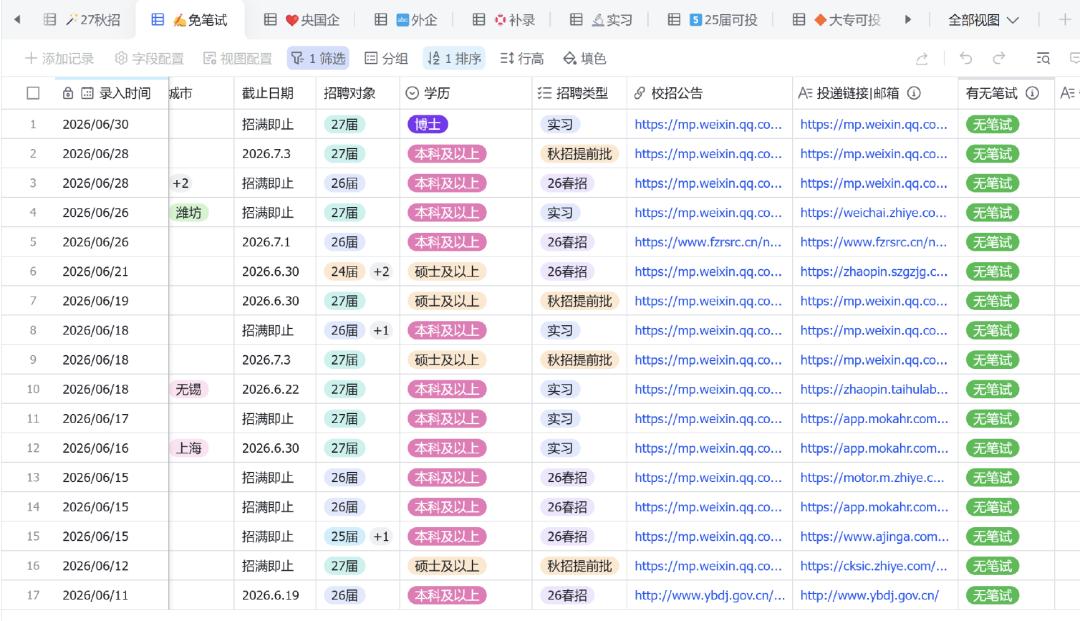
Figure | The number of companies that clearly have no written test in recruitment is extremely rare
"Some people sell relevant positions at a clear price," Chen Chen once saw someone openly claiming in Moments that they can arrange state-owned enterprise jobs for 150,000 yuan, "but as the supervision becomes stricter now, most of such things are scams, or they are only outsourcing jobs."
The vast majority of job seekers cannot avoid the written test, and there is corresponding business: from question bank real questions, to AI proxy answering, to written test guarantee pass, and full-process job hunting escort, which are eating away at the anxiety of fresh graduates layer by layer.
Li Xin tried to buy a question bank.
When the summer internship positions were open, she learned from friends that most of the enterprise assessments rely on mainstream third-party platforms such as Beisen, Zhiding, Niukao and Sai Code — these platforms all have fixed question banks, and the system randomly selects questions to form test papers. Even if the question types are changeable, the core test points and answering routines can be traced.
"Take the Beisen question bank as an example, I saw someone online saying that if you don't get 50 points, your resume may be automatically blocked and you can't enter the interview selection link." After learning this "hidden rule", Li Xin felt very anxious, and finally bought a copy of the so-called "most complete Beisen assessment question bank on the whole network" on the social platform at a low price of 4.9 yuan.
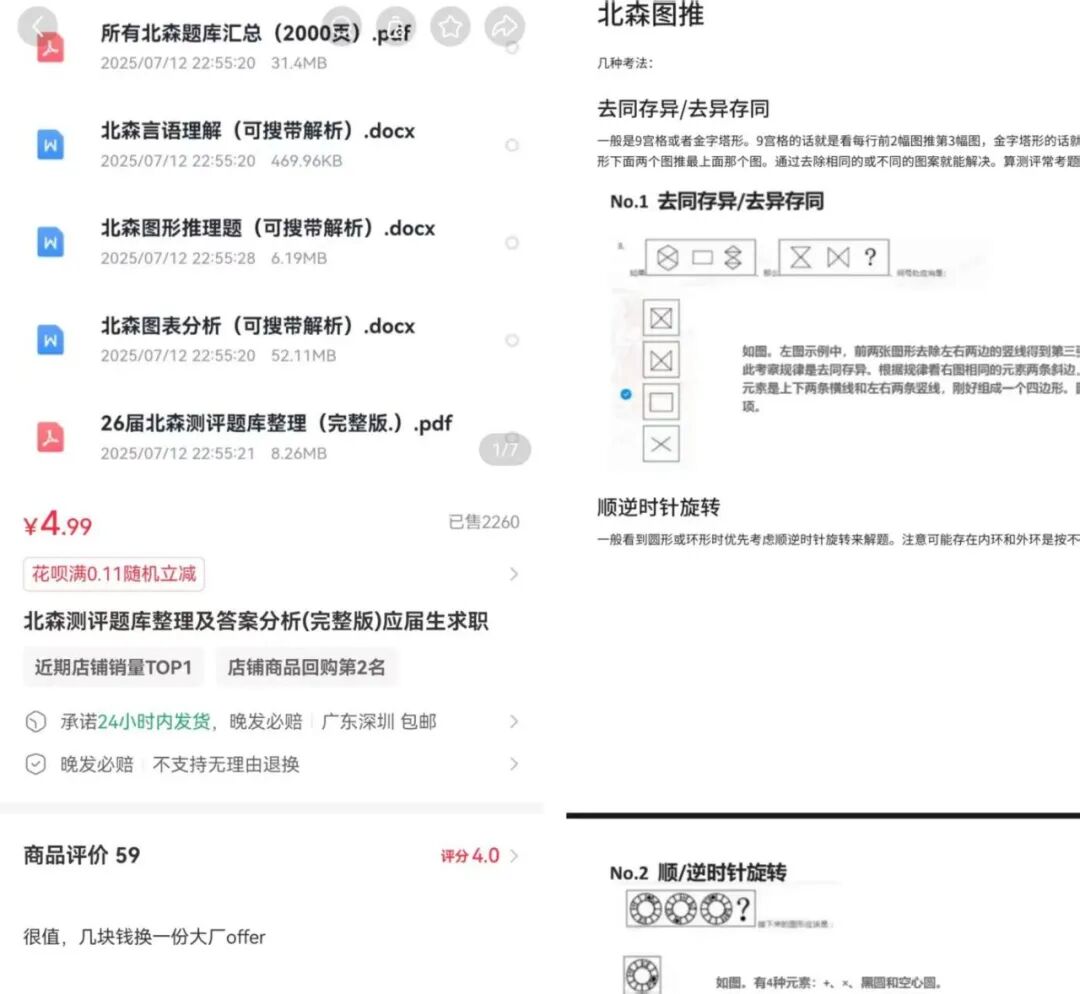
Figure | Beisen question bank sold online
The content of the question bank is all-inclusive, covering real questions over the years, answering skills, standard answers for personality tests, and quick problem-solving ideas for administrative aptitude tests. The order page shows that this document has been sold more than 2000 copies, which means that at least 2000 anxious fresh graduates like her have clicked to pay.
Under massive resume submission, question brushing is ultimately a stupid method with extremely high physical consumption. The window periods for autumn recruitment and spring recruitment are highly concentrated. A student often submits hundreds of resumes and takes dozens of assessments in a row. Administrative aptitude test questions, situational questions and personality tests come one after another, and no one has the energy to brush all the questions.
Many people began to take risks, using AI to search for answers and cheat to improve the pass rate.
