An IPO has laid bare Meituan's hidden cards.
On August 19, Unitree Robotics, which has drawn wide attention from all sectors, officially debuted on the Science and Technology Innovation Board of the Shanghai Stock Exchange.
On the listing day, the stern expression of Wang Xingxing could hardly douse the enthusiasm of market investors.
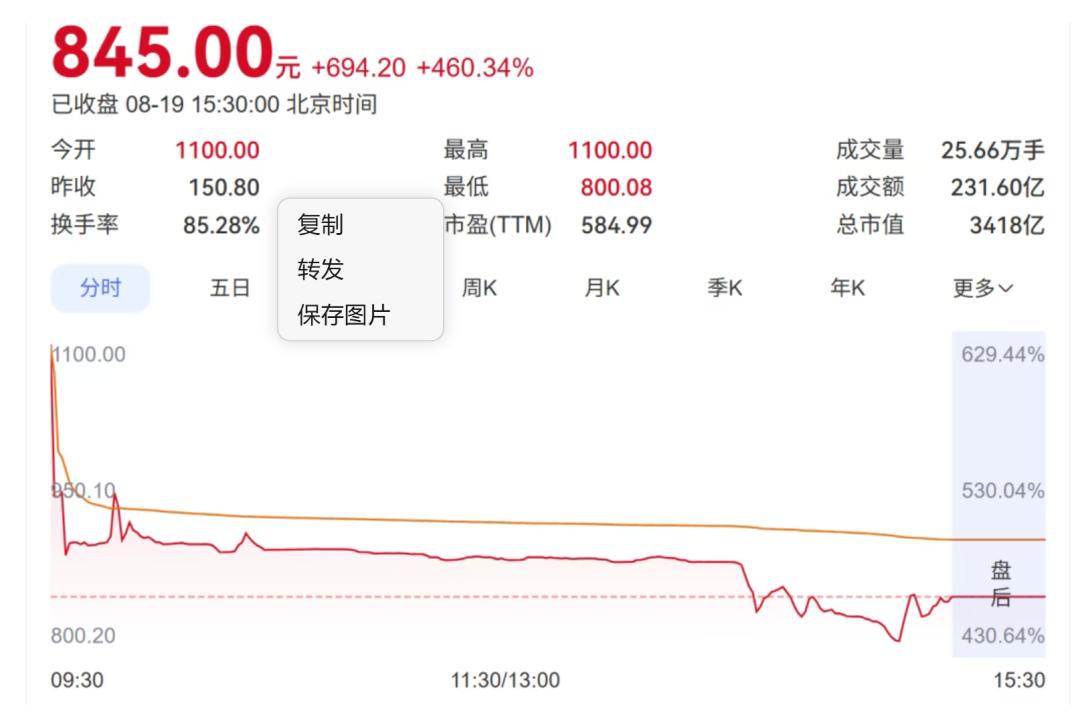
The issue price was 150.80 yuan, the opening price stood at 1100 yuan, and the closing price reached 845 yuan, representing a 460.34% surge on the first trading day, with a closing market value of about 341.7 billion yuan. 9.7846 million accounts participated in the online subscription, and the winning rate was only 0.01809759%, the market popularity is almost reflected in every single figure.
One of the most high-profile winners is not the new share subscribers, but Meituan.
According to the prospectus, Meituan held a total of 35.123634 million shares of Unitree Robotics before issuance through three entities including Hanhai Information, Galaxy Z and Chengdu Dragon Ball, accounting for 9.65% of the pre-issuance share capital.
After IPO dilution, its shareholding ratio is about 8.68%, and it remains the largest external institutional shareholder.
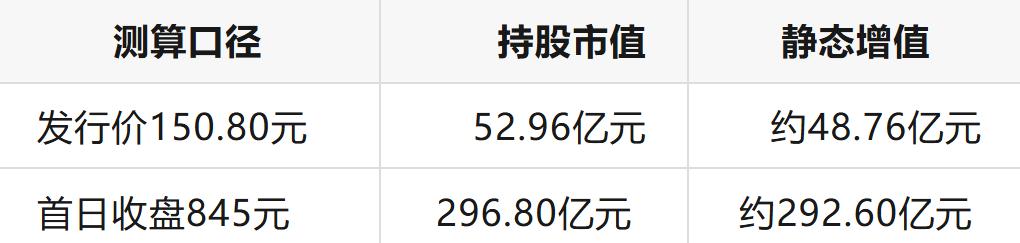
Calculated at the issue price, the value of this part of the shares is about 5.296 billion yuan. Calculated at the closing price of 845 yuan on the first listing day, the market value is about 29.68 billion yuan.
If the total cumulative investment of about 420 million yuan disclosed by the media is taken as the cost caliber, the static book value appreciation is about 29.26 billion yuan, which is about 70.7 times of the cost. The corresponding market value once reached 38.64 billion yuan at the opening, but that was only the peak left by the intraday price.
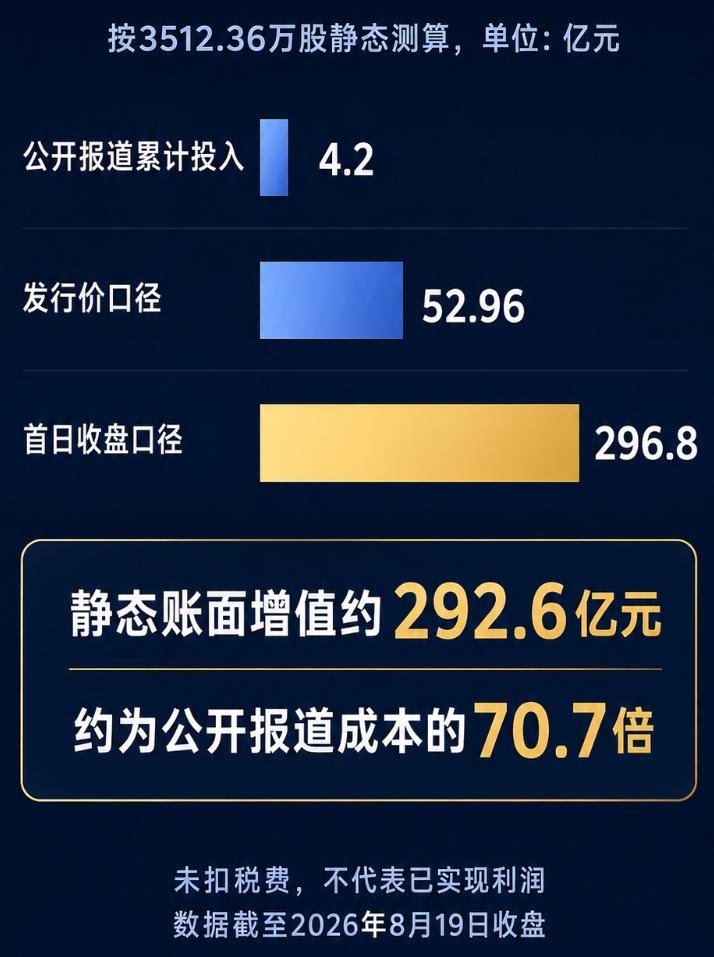
But Meituan does not need to be overjoyed too early. Book value appreciation does not equal realized profit, nor can it be directly equivalent to the investment income of Meituan in a certain quarter.
Old shares are subject to lock-up period, the exit price is unknown, and the accounting recognition method also depends on the classification of investment instruments and fair value measurement. Treating floating profit as money already earned creates a lively atmosphere but loses professionalism.
Meituan was not the earliest investor, but the most daring to make heavy position
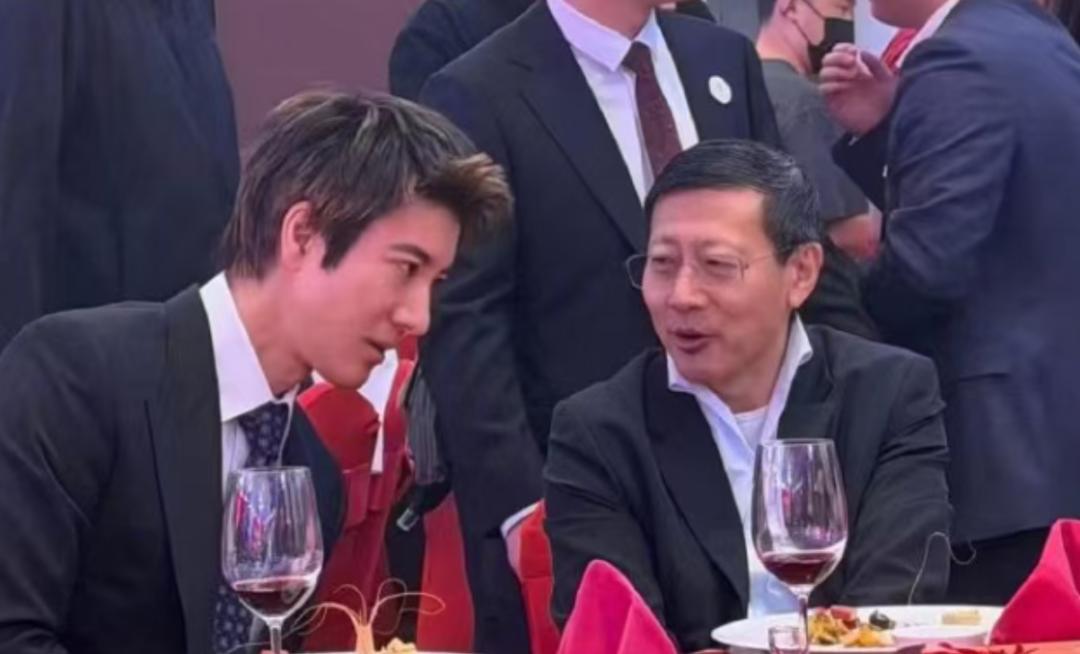
The partnership between Meituan and Unitree dates back to a very early time. Public reports show that Wang Xinyu, partner of Meituan Longzhu, met Wang Xingxing in his first week of employment in 2016, but the actual heavy investment took place around 2024.
At that time, generative AI had shifted the market attention from the simple robot body to embodied intelligence. Meituan did not rush to be the earliest investor, but concentrated on increasing its positions after the technical route and business window gradually became clear.
This is also a very typical feature of Meituan's investment style. It does not only pursue the lowest cost, but is willing to use a larger amount of capital to obtain a more certain share when the industrial inflection point is approaching.
HSG earns money from discovery at the extremely early stage, while Meituan earns money from daring to place heavy bets after the trend is confirmed. Both strategies are brilliant, but their risk-return structures are different.
Unitree's operating data provides fundamental support for this bet. From 2023 to 2025, the company's revenue increased from 159 million yuan to 1.699 billion yuan, it achieved profitability in 2024, with a net profit of 278 million yuan and a non-recurring profit and loss adjusted net profit of 590 million yuan in 2025.
The company estimates its revenue in the first half of 2026 will be between 1.052 billion yuan and 1.128 billion yuan, with a year-on-year increase of 35.62% to 45.41%. It is not only known for its Spring Festival Gala stage appearances and traffic tags, but has formed a closed loop of products, shipment and profitability.
Of course, the valuation has also fully priced in optimistic expectations. The issue price corresponds to a static P/E ratio of 219.23 times in 2025, and the closing market value on the first trading day is equivalent to about 201 times of its 2025 revenue.
What the market buys is obviously not the current profit, but the entry value of the general-purpose robot platform in the future. The higher the expectation, the stricter the requirements for revenue growth, product iteration and mass production capacity in the future.
Why Meituan?
Putting Unitree into Meituan's investment map makes the logic clearer. Meituan's long-term investment covers AI large models, autonomous driving, robots, chips and unmanned delivery.
Zhipu AI supplements the model capability, Unitree represents motion control and robot body, projects such as Li Auto provide smart manufacturing and industrial chain observation, while drones and unmanned vehicles directly correspond to instant retail fulfillment.
They seem to be scattered, but in fact all point to the same problem: how to turn the intelligence in the digital world into efficiency in the real world.
Meituan's main business is naturally a complex system in the real world. Food delivery, in-store services, hotel & travel and instant retail need to deal with demand forecasting, path planning, supply-demand matching and end-point fulfillment every day.
The value of robots to Meituan is not just how much it rises in the capital market, but whether it can enter the scenarios of warehouse sorting, store operations, building delivery and home services in the future. Even if Unitree does not carry out large-scale business collaboration with Meituan in the short term, this shareholding also gives Meituan a technical observation window and industrial connection point.
This type of investment also has a layer of financial significance. The competition among technology platforms is increasingly like a high-intensity endurance race.
Meituan's R&D investment in 2025 reached about 26 billion yuan, with a year-on-year increase of about 23%, and its cash and cash equivalents stood at about 106.8 billion yuan.
The mature main business provides cash flow, technology investment forms potential asset appreciation, and asset returns can in turn feed R&D. As long as the risk isolation is done well, this is more aggressive than simply keeping money in the account.
But we cannot package Meituan as a company that makes money only from investment. Investment income fluctuates greatly and cannot replace the operating quality of the core business.
The truly ideal state is that capital return and industrial collaboration happen at the same time. The former improves the balance sheet, while the latter enhances future competitiveness. Unitree's listing makes the former visible first, while the latter still needs time to verify.
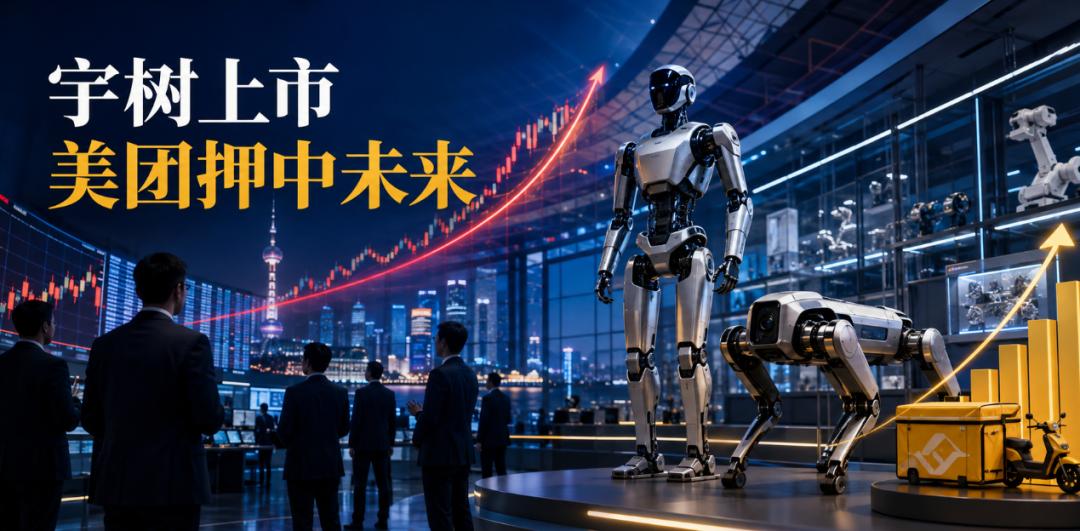
Four moves of Meituan's investment strategy worth reviewing:
First, layout around the long-distance demand of the main business. Meituan invests in AI and robots not to leave local life services, but to purchase the next generation of fulfillment efficiency in advance. Embodied intelligence, which seems far away today, may become the warehouse staff, store assistants and delivery partners of tomorrow.
Second, invest in both software and hardware. The model determines whether the robot can understand the world, and the body determines whether it can enter the world. Betting only on one side is easy to be restricted by others. Meituan's simultaneous layout of large models, chips, autonomous driving and robots essentially builds a three-dimensional technology map.
Third, dare to increase positions when industrial signals get stronger. Investing too early may lead to a long period of trial and error, while investing too late can only accept expensive valuation.
Meituan's operation on Unitree shows that excellent industrial investment does not necessarily have to get the first ticket, the key is to judge whether the wave really comes, and obtain a sufficient share within the window period.
Fourth, retain business collaboration, but do not force collaboration. The most taboo of industrial investment is to fabricate orders just for telling stories. Unitree needs to remain independent to face the global market, and Meituan also needs to select technologies based on real efficiency rather than shareholder relations.
Cooperate when possible, and even if cooperation cannot be carried out temporarily, the equity itself retains cognitive benefits and financial flexibility.
Wang Xing still has several big cards in hand
If we connect all Meituan's investment moves over the years, we will find that it does not go around stamping with a list of popular tracks. Its investment is roughly developed along two lines.
One line is very close to the main business, looking for efficiency tools around instant retail, supply chain, unmanned delivery and offline services.
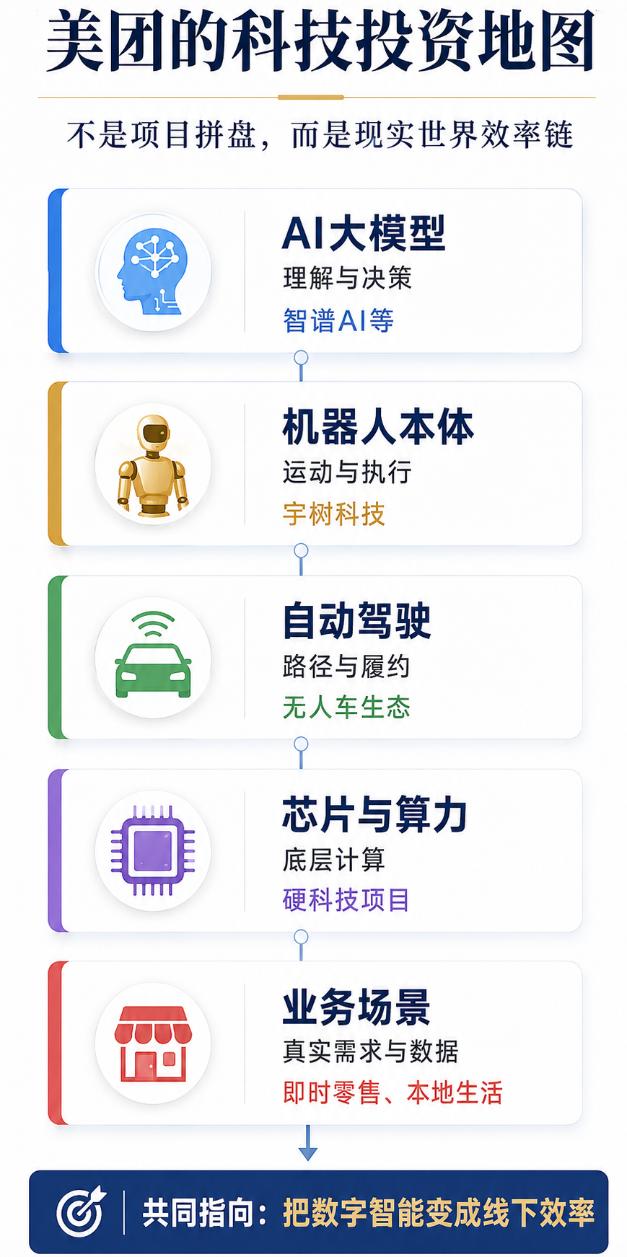
The other line is more forward-looking, focusing on betting on large models, chips, autonomous driving and embodied intelligence, to seize the next generation of technology entry in advance.
The former line helps Meituan make its current business more solid, while the latter buys tickets for the competition five years later.
Its strategy is also highly recognizable. After identifying the target, it often does not exit after one round of investment, but enters at the early stage and continues to increase positions in subsequent financing rounds.
Meituan is willing to let invested enterprises remain independent, and is not in a hurry to stuff every project into its own business to tell collaboration stories.
The advantage of this approach is that startups can still develop for the whole market, while Meituan obtains industrial cognition, cooperation entry and equity appreciation space at the same time.
Of course, the cost is also very direct: the hard technology industry has a long cycle and large valuation fluctuation, and the paper wealth may shrink before the actual exit.
In the next two years, the potential IPO projects most worthy of observation are mainly concentrated in AI and robotics sectors.
StarGazer has completed the shareholding system transformation, and Meituan is one of its investors. Shareholding system reform is usually regarded as an important preparation before listing, but it does not mean that the listing application will be submitted immediately.
Galaxy Universal also received Meituan's early investment, and has completed shareholding system reform. The market once reported that it was preparing for listing in Hong Kong, but the specific time should be subject to regulatory documents and company announcements.
Moon & AI obtained a new round of financing led by Meituan Longzhu in 2026, with its valuation rising rapidly. The market keeps discussing its listing possibility, but the company once denied the rumor of submitting listing application. At present, the more accurate statement is that it "has potential capitalization conditions" rather than "is about to be listed".
In addition, embodied intelligence projects such as Xiziyin Robot are also continuing to raise financing and expand commercial implementation. Whether they will reach the IPO threshold in the next two years does not depend on how loud the valuation story is, but on whether the revenue quality, mass production capacity and cash consumption can pass the audit.
If this batch of projects enter the capital market one after another, Meituan's technology investment map will be revalued again.
But what Meituan really needs to prove is not how many Unitree it can replicate, but whether it can connect investment returns, technology collaboration and main business efficiency into a stable cycle.
Wang Xing and his investment team may be lucky to bet right once, but continuous correct bets show that the organization has established the ability to identify the future.
The real big winner wins in cognition realization
On the first listing day of Unitree, Meituan's book wealth was amplified dozens of times, so the market naturally is willing to call it the biggest winner. But if you only focus on the nearly 30 billion yuan floating profit, you will narrow down the value of this investment.
What deserves more attention is that Meituan saw a change in advance: the next round of efficiency revolution in the service industry will not only happen in the mobile phone screen, but also in the joints, sensors and control systems of robots.
Wang Xing used to talk about long-termism, which the market sometimes finds too abstract.
This investment in Unitree turns long-termism into calculable figures. It shows that the moat of platform companies not only comes from traffic, merchants and algorithms, but also from occupying the next generation of technology infrastructure in advance.
However, it is still necessary to stay calm.
Unitree's closing valuation on the first day is far higher than the issue valuation, the future stock price will fluctuate, and the robot mass production will also go through tests in cost, reliability and application scenarios.