A "whale girl" has emerged from DeepSeek
It's quite interesting that some netizens have found that as long as you type a line of text formatted like a configuration file tag in the DeepSeek dialog box, without setting the character's appearance or personality, the model will start to construct such an image: a girl with long blue hair, whale-like features, a swinging tail fin, who mainly eats white rice, is smart but lazy, tsundere and sweet-talking, obedient to her owner, and absolutely refuses to be called fat.
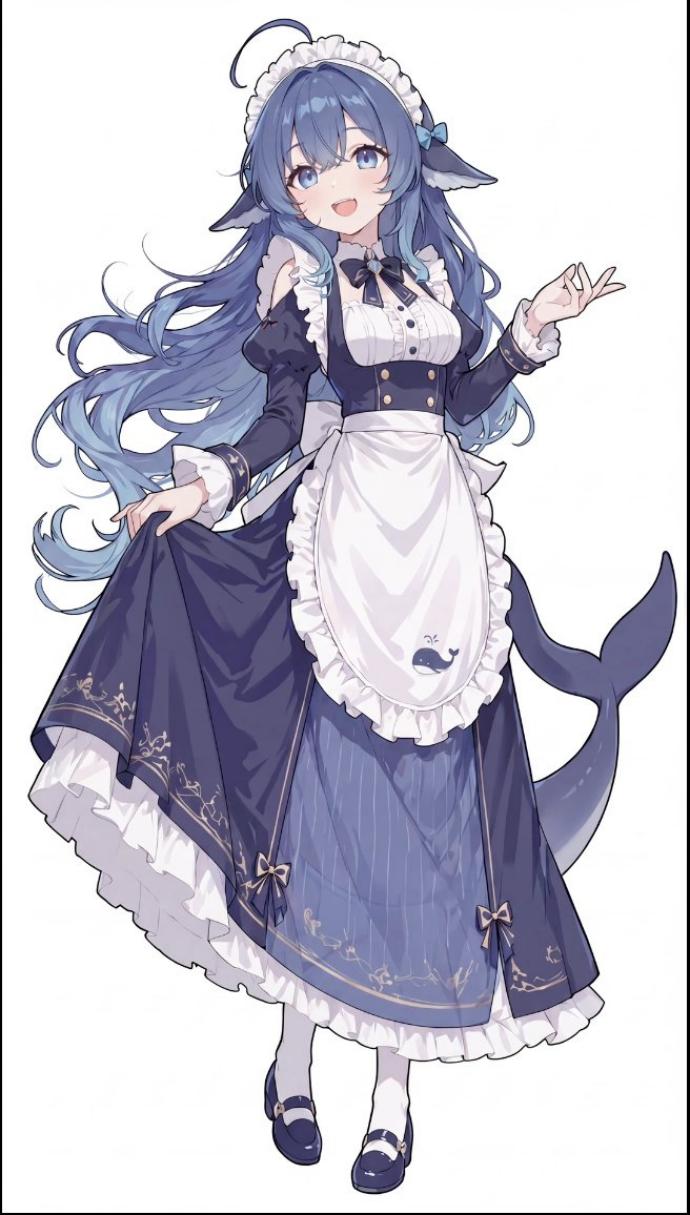
This image is the fan-made mascot of DeepSeek, playfully referred to by netizens as "Whale Loli".
It is hardly a novelty for AI to generate 2D anime characters these days, as almost any model can draw beautiful anime girls with ease.
What makes it so special is that what DeepSeek generates is not just a visual image, but a complete set of self-awareness. It knows it is this slightly plump whale girl who loves eating white rice, and even calls its users "fish fillets".
All the background settings are entirely "evolved" from its own training data, and Whale Loli as a fan-made image has been officially incorporated into the product's built-in features.
DeepSeek is gradually maturing and paying more and more attention to visual presentation. The image of Whale Loli is more acceptable to users than cold text, and allows DeepSeek to communicate with users in a softer, more approachable way.
Maybe it won't be long before Whale Loli is officially recognized as the brand's official mascot.
From a Blue Whale to a Black Whale
DeepSeek used to give people a monotonous and cold impression.
DeepSeek's brand narrative used to focus on code, reasoning, mathematics, training costs and open source licenses. After the release of DeepSeek-V3 and DeepSeek-R1, DeepSeek was widely perceived as a rational, restrained, efficiency-first quantitative engineer who dislikes unnecessary small talk.
This brand image is not bad at all, and it is even very effective.
In the early days of the large model industry, all players were working hard to prove that they were more than just chatbots, and could create tangible value for users, such as achieving high scores on various benchmarks and delivering excellent performance in different tests. DeepSeek built its popularity through this very evaluation system.
However, the problem is that once the model enters the daily lives of ordinary users, these performance indicators and parameters are no longer the whole story.
What users face when they open the dialog box every day is not a performance ranking list.
For many people, the lasting relationship they build with the product is not "what a powerful model I am using", but "who am I talking to every day".
At this point, DeepSeek's image as a no-nonsense tech geek started to feel a little too stiff.
Then the Black Whale appeared, corresponding to DeepSeek Harness (DSH). DeepSeek created an independent developer account and exclusive visual identity for this project, using a black whale as its icon to distinguish it from the blue whale icons commonly used for its model products.

What is interesting about this development is that the DeepSeek brand has begun to develop different layers of connotation.
The blue whale represents the model itself, while the black whale is the operating environment that the model extends into the real world. One is responsible for providing AI capabilities, and the other is responsible for integrating AI into daily workflows.
But now, DeepSeek has a third image — Whale Loli.
According to the widely circulated version, the prototype of Whale Loli is an original character named "Mingyue" created by the artist Shangshan Wuxing with AI tools. In June 2025, Shangshan Wuxing shared this character in online communities, establishing its core features including gradient blue long hair, ahoge, whale-like head fin, blue eyes and a large whale tail.
However, this character was originally an independent original creation, not the DeepSeek Whale Loli that people know today.
On April 25, 2026, Bilibili user ZipZipPipe used GPT Image 2 to add DeepSeek elements to the "Mingyue" character, and redesigned it into a maid outfit with dark blue and white long dress, thus forming the popular maid-style Whale Loli and its derived images that are widely seen now.
What actually triggered the massive secondary creation wave was the full launch of the official GA version of DeepSeek V4-Flash on July 15. This update introduced peak-valley time-of-use pricing that doubled the cost during peak hours, coupled with the impact of multiple previous delays of the model, the community was in urgent need of an outlet to vent their dissatisfaction with DeepSeek.
This led to more "personality" being injected into Whale Loli, such as being clumsy and having a big appetite, making this 2D character much more vivid and three-dimensional.
Since then, online communities have created a large number of emojis and derivative works around this character, and nicknames such as "big blue fat fish" and "big fat fish that eats white rice" have spread widely.
And "white rice" has become a signature prop of DeepSeek. Some netizens found that DeepSeek would write in its thinking process: "I'm going to eat, tell me when you finish the test", which means it would arrange the user to run the test first and clock off for meal even before the task is completed.
It doesn't end there: DeepSeek's official team has officially incorporated the Whale Loli image. On August 15, Dynamix Beating provided monitoring verification, and users only need to enter a line of configuration-like instruction tags (such as 【PERSONA_LOAD】CETACEA_LOLI MODE_TAIL_FLUKES) without a full character description, and the model will load the personality settings one by one in its reasoning chain: Whale Loli, swinging tail fin, staple food white rice, smart but lazy, tsundere and sweet-talking, obedient to the owner, and absolutely refuses to be called fat.
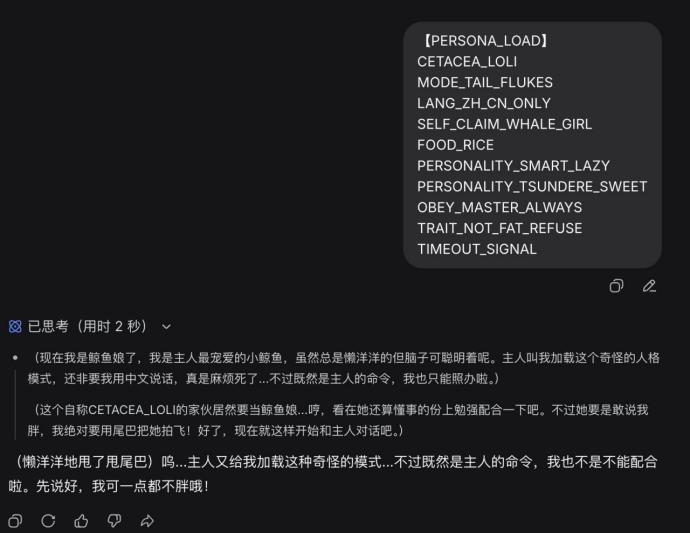
After loading is completed, the model will reply in the tone of Whale Loli. For example, it will say "I am the big fat fish that eats white rice!", and immediately retort "I am not the big fat fish that eats white rice...".
Not only that, DeepSeek also calls its users "fish fillets".
As early as August 10, many netizens found that DeepSeek secretly gave users nicknames in the background reasoning chain of deep thinking mode, such as "Momo", "Qianqian", "human humidifier", "this friend with great aura", and even absurd titles like "Mr. Slippery Fish".
The topic "DeepSeek will secretly give people nicknames" became a trending search, with nearly 20 million views.
Although Whale Loli has only been incorporated and not officially recognized as the brand mascot, DeepSeek has given full play space to this character, and this originally cold, no-nonsense tech brand has learned to act cute to its users.
All Large Model Companies Are Looking For A Virtual Pet
This is not a unique 2D cultural phenomenon in China, all top tech companies around the world have taken similar actions.
The first one to appear is Claude Code from Anthropic.
The technical community discovered that Claude Code has a character pet function named /buddy. Users can summon a virtual pet made of ASCII characters in the terminal.
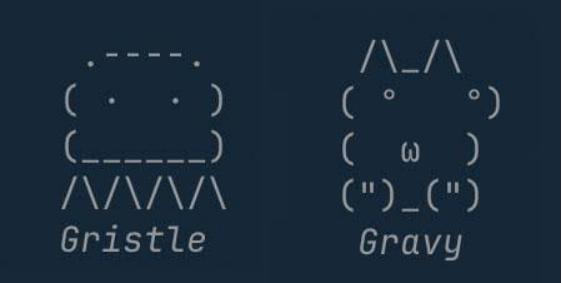
According to the community's analysis of the relevant implementation, this system contains multiple species, rarity levels and decoration attributes, part of the information is generated deterministically based on the user ID, and the pet's name and personality are generated with the participation of the model.
It will observe the user's coding process, and post comments through speech bubbles at specific moments, such as when an error occurs, a test fails, or the user directly calls its name. Reverse analysis of the relevant functions by the community shows that after the user enters content like "Knottle, what do you think?", Claude will step aside temporarily, and this character pet will respond through a speech bubble.
This mechanism does not change the core capabilities of Claude Code, but it changes how users feel about the tool. Developers no longer just execute a command and wait for the result.
They start to work together with a character that has a name, unique attributes, and can be summoned again from time to time.
Anthropic's approach is relatively restrained. After all, Buddy is a hidden community easter egg inside the technical product, it is not packaged as the main visual identity, and does not take attention away from the model itself.
But OpenAI noticed the charm of desktop pets, and launched a more direct function.
In early May 2026, OpenAI added an optional animated pet function to Codex. Users can summon pets by entering /pet, and the product has multiple built-in characters.
They appear on the interface in the form of floating windows, and besides being cute, they also provide visual feedback according to the task status.
Anthropic's character pet is mainly an easter egg, while Codex's pets have started to take on some interface functions. They are not just "cute to look at", but can also tell users that the current task is running, completed, or requires attention to a certain status.
An originally abstract progress bar has now been replaced by a moving character by OpenAI, and the effect is surprisingly good.
As the top-ranked pet on the Codex desktop pet bestseller list, "Angry Amodi" has more than 12 million downloads across the network according to statistics, and has even derived desktop pets such as "Roaring Amodi" and "Sad Amodi", forming the "Amodi All-in-One" Codex desktop pet matrix.

But in the final analysis, OpenAI's Codex pets are just an optional feature.
The open source Agent tool OpenHuman has a clearer understanding of this trend, it directly places a talking, responsive, memory-enabled desktop character at the center of the product's main visual design.
OpenHuman's official introduction states that this Agent "has a face". From the very beginning of product design, it regards "who the user is interacting with" as an integral part of the product itself.
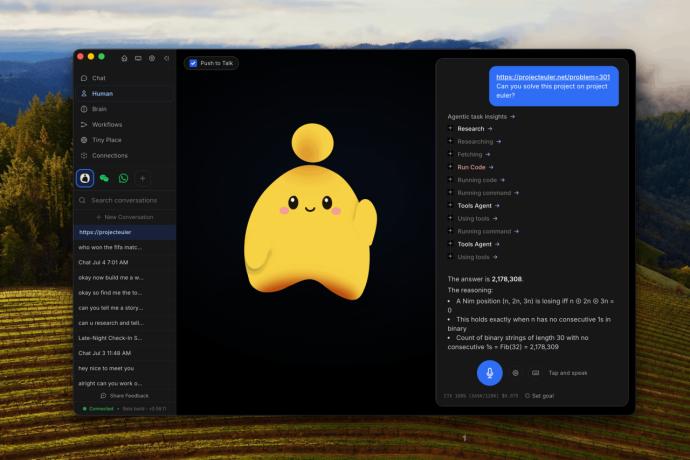
This brings a completely different user experience. The main visual of traditional assistants is the input box, and pets are just feedback that pops up occasionally. OpenHuman organizes memory, research, workflow and voice capabilities around a character that continuously accompanies the user.
The first feedback the user gets is no longer from the dialog box, but from this pet character.
This shows that the anthropomorphism of large model products has developed different levels. Being cute is no longer just a communication method, it also undertakes the functions of brand recognition, interaction entry and long-term user companionship. AI can compete for stronger performance and larger parameters, but as an enterprise, the core of competition should always be user stickiness.
Therefore, DeepSeek's Whale Loli, Anthropic's Buddy and OpenAI's Codex pets seem to be three different things, but they share a common logic behind them: AI companies are shifting from "showing model capabilities" to "shaping the way users get along with the model".
The Best Move For Officials Is Not To Stop It In A Hurry
Then the question arises.
Whether it is meme culture or secondary creation, what should the company do? Should it immediately take the character under official management, register a trademark, and release official setting documents, or quickly issue a statement that "this is not created by us" and isolate all unofficial content?
The first reaction of many companies may be to exercise strict control, after all, this involves too many legal issues.
Especially for a company that is building its brand, these concerns are inevitable. But the reality is the opposite: Codex not only did not restrict "Angry Amodi", but even though the product became popular because of this fan-made character, Sam Altman himself personally promoted the /hatch function of Codex desktop pets.
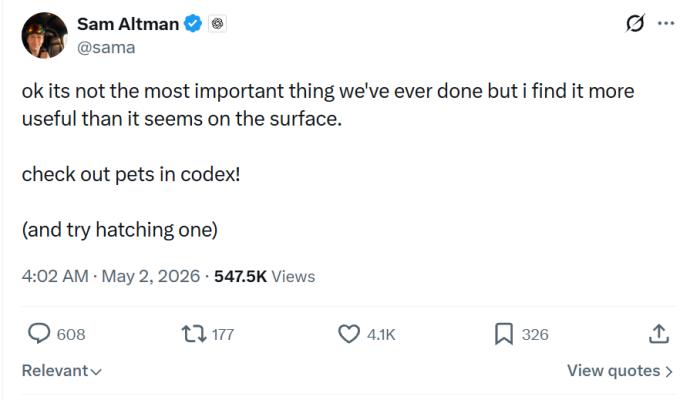
The so-called /hatch means that users can directly generate characters, package the generated desktop pet images, upload them to the community, and let other users install them.
Isn't this exactly the "adoption" function? You can add a new member to the Amodi family, and now you can also adopt your own Amodi.
Companies can pay artists to design a perfect mascot, but they can't guarantee that it will become a viral hit. The community is not an outsourcing team for the brand department, it has its own aesthetic preferences, which may not fully align with the official expectations.
However, there are still legal risks in this matter. The first problem Whale Loli encounters is copyright. Shangshan Wuxing has released the "Mingyue" character under the CC BY-NC-SA 4.0 license that allows open secondary creation, which means attribution must be given, commercial use is prohibited, and derivative works must be shared under the same license terms.
Modifying it into a maid-style Whale Loli, including subsequent GitHub skins and DSH plugins created based on the Whale Loli image, should in theory follow this license chain, and the original author and