Having soared to the TOP 1 of the beverage ranking list, Hema's fully revamped coconut water is set to seize the "de-bloating" business that was previously dominated by black coffee.
By transforming coconut water into "high-potassium water", the product has topped both the new beverage list and the repurchase list of Hema's beverage category in less than half a month since its launch.
This "Matcha Coconut High-Potassium Water" from Hema has an extremely simple ingredient list, consisting only of coconut water and matcha powder, with a core positioning of natural electrolytes.
The official product detail page never mentions de-bloating, but on Xiaohongshu, consumers have already regarded it as a "de-bloating magic drink". Some say it works better than black coffee; others share that after drinking a bottle the morning after eating hot pot, their faces are indeed no longer swollen.
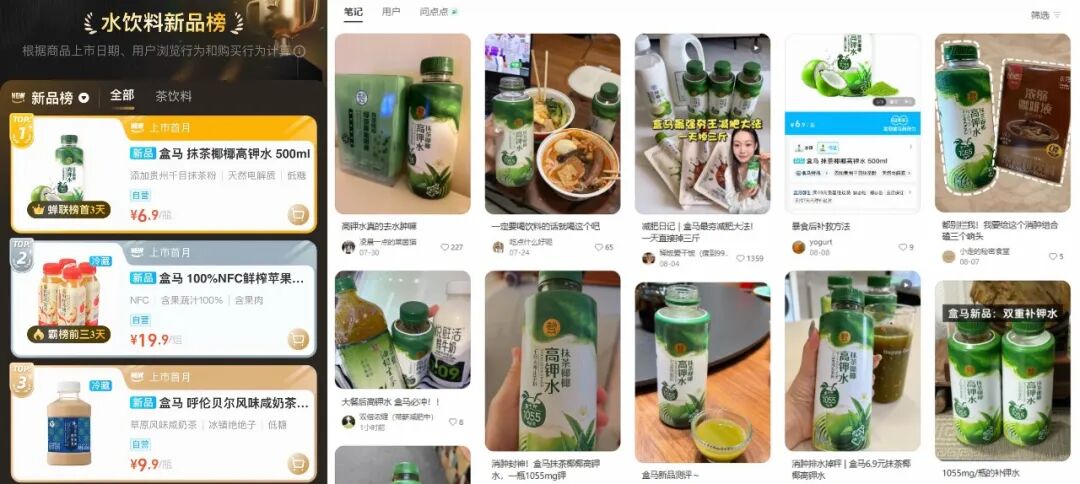
Image source: Hema APP, screenshot taken on August 18; Xiaohongshu
Foodaily has been continuously tracking the electrolyte water track recently. From our perspective, this practice of highlighting the natural electrolyte content of raw materials itself also represents a more natural innovation direction for electrolyte water. However, what is more noteworthy than the product itself are two signals behind its popularity:
First, "high potassium" is becoming a new entry point for the electrolyte water track. The narrative of traditional electrolyte water revolves around "sodium supplementation", but consumers have pushed a product positioned for "potassium supplementation" to the top of the sales chart. This proves that apart from sodium, other elements in electrolyte water are also worthy of attention.
Second, "de-bloating" is a more noteworthy business opportunity behind this new entry point. From black coffee to red bean and barley water, and then to high-potassium water, consumers have been using different categories to solve the "de-bloating" demand, but no single category has ever fully claimed this demand. This indicates that "de-bloating" is a potential market waiting to be tapped.
Why has the de-bloating demand in China not grown into an independent track yet? Looking at neighboring markets, South Korea has already built an independent category label of "de-bloating tea", while Japan has even listed "de-bloating" as an officially recognized functional claim.
Overseas markets have verified the commercial potential of de-bloating, so what is the huge growth potential hidden behind this demand in China?
A bottle of coconut water added with matcha, why is it regarded by users as an emergency de-bloating savior after heavy meals?
Before Hema entered this track, "high-potassium water" had already become a hit on Xiaohongshu once.
The so-called "high-potassium water" refers to a homemade de-bloating drink made with high-potassium ingredients such as bananas and coconut water, paired with metabolism-boosting raw materials like matcha and coffee. The underlying principle is simple: supplement potassium and excrete sodium to reduce edema quickly.
Ingredients can be freely matched, but the formula is basically fixed: bananas, coconut water, matcha, milk or soy milk, plus a serving of coffee. The version with five ingredients is called "five-times high-potassium water", the four-ingredient version is "four-times high-potassium water", and the three-ingredient version is "three-times high-potassium water". Some people even directly call it "regret water" or "heavy meal gut-cleansing water".
As of June 2026, the Xiaohongshu topic #FiveTimesHighPotassiumWater has accumulated about 2.105 million views; the total views of related topics on Douyin reach about 21.382 million times[1].
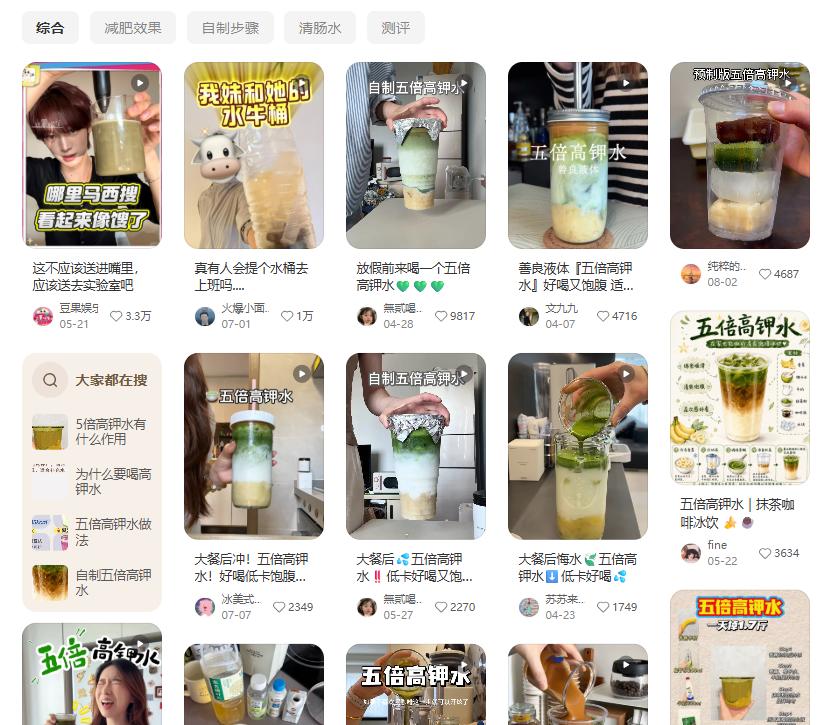
Image source: Xiaohongshu
Why did "high-potassium water" spread so fast on social media? The key reason is that it hits two real pain points in daily scenarios:
The first scenario is post-heavy-meal remedy. Many people have had this experience: after enjoying hot pot and barbecue the night before, they wake up the next morning with visibly swollen faces.
This kind of diet usually contains excessive sodium. To maintain osmotic pressure, the human body will automatically retain water. At this time, a drink positioned for "promoting water excretion" is very attractive, and the name "heavy meal regret water" comes exactly from this scenario.
The second scenario is daily edema caused by long-time sitting and staying up late. After sitting in the office for a whole day, you will find obvious indentations on your ankles from the socks when you take them off at night; after staying up late for work, your face is visibly puffy when you look in the mirror the next day. "Supplement potassium, excrete sodium, reduce edema" has become a simple and direct solution to this problem.
In addition, the "celebrity same style" effect brought by celebrities Zhang Ruonan, Tong Yao, and K-pop idols' body management routines further boosted the popularity of high-potassium water, making the high-potassium concept quickly break through the circle and enter the public view.
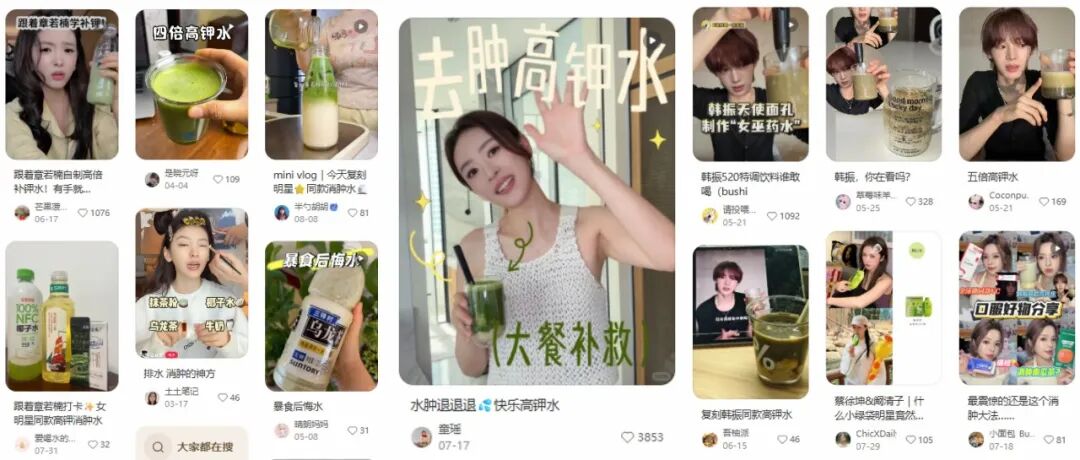
Image source: Xiaohongshu
With clear consumer demand and high social media popularity, what Hema needs to do is to capture the product prototype that can be standardized from these trends.
As we learned in our previous report on the "Budweiser Yogurt Bowl", Hema has a clear internal R&D path: turn the viral dietary therapy eating methods on social platforms into standardized pre-packaged products, launch small batches quickly to test market acceptance, and explore opportunities for incremental categories.
"Matcha Coconut High-Potassium Water" is exactly the new product born under this hit-making logic.
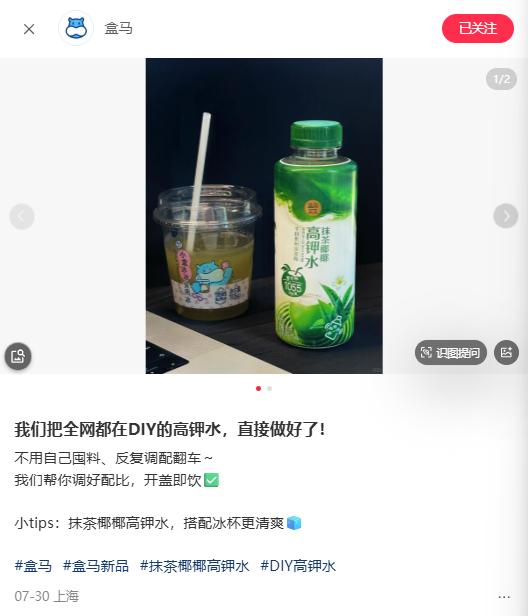
Image source: Xiaohongshu
However, Hema's high-potassium water only retains two raw materials: coconut water and thousand-mesh Guizhou matcha powder. Why did Hema choose these two from so many ingredients?
In the formulas that have been repeatedly verified by content creators, the three main ingredients that support the "high potassium" function are bananas, coconut water and matcha.
Among them, banana has the most intuitive public perception of "high potassium", but its biggest problem lies in industrial production: after being made into puree, its color is easy to oxidize and darken, its stability and shelf life are difficult to control, and the cost is also relatively high. For Hema, which aims for large-scale production, all these are negative factors.
Coconut water is a natural electrolyte carrier: every 100ml of natural coconut water contains about 200mg of potassium, and is rich in magnesium and calcium. More importantly, after years of market education, it has been deeply bound to labels such as "hydrating" and "natural", so the consumer cognition cost is almost zero.
Matcha powder is a "high-efficiency player": its potassium content is even higher than that of bananas, and a small amount of addition can raise the potassium content of the whole bottle. At the same time, it brings unique matcha flavor and color, and provides a milder refreshing effect than coffee.
Therefore, Hema did not copy the "five-times" formula from content creators, but retained the two core raw materials that are most convenient for industrial production and have a reasonable efficacy logic. Consumer feedback also verified this idea: many people on Xiaohongshu said that their faces are indeed no longer swollen the next day after drinking it.
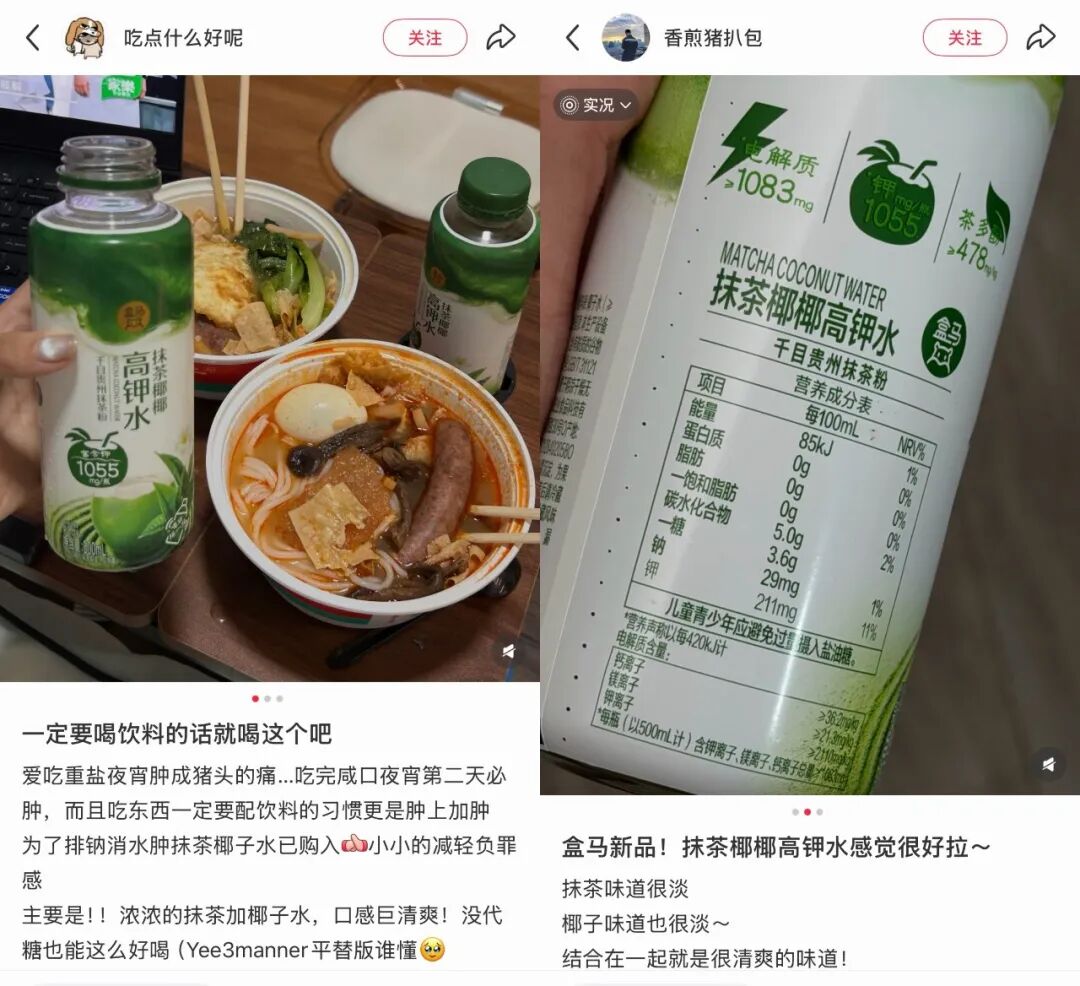
Image source: Xiaohongshu @WhatShouldIEatToday, Pan-Fried Pork Chop Bun
The booming de-bloating business in Japan and South Korea is still an underestimated market in China
De-bloating is not a new demand created by "high-potassium water", but a long-underestimated commercial opportunity.
More than 2,000 years ago, the classic medical work *Lingshu · Water Swelling* recorded: "At the beginning of edema, the eye sockets are slightly swollen, just like the state of people just waking up from sleep" — the situation of morning edema is no different for ancient people and modern people[2].
In the Song Dynasty, the *Zheng Lei Ben Cao* recorded an ingredient called adzuki bean, noting that "long-term consumption makes people lose weight". But ancient people used it mainly not for weight loss, but for "promoting diuresis and expelling pus"[3].
Across thousands of years, the de-bloating demand has never disappeared. Up to now, the topics about "reducing edema" on Xiaohongshu have accumulated 220 million views and more than 600,000 discussions.
However, in China, "de-bloating" has never grown into an independent track. Various products are trying to meet this demand, but almost no brand takes it as the core proposition for business operation.
Take black coffee as an example, it is a widely recognized "de-bloating magic drink". Caffeine itself is a natural diuretic, which can inhibit the reabsorption of water and sodium ions by the kidneys after entering the human body, so that the water that would otherwise be recycled by the body will be directly excreted as urine.
But de-bloating is only one of its many labels. Black coffee also has multiple labels such as refreshing, fat burning, and accelerating metabolism, and de-bloating alone cannot define this category.
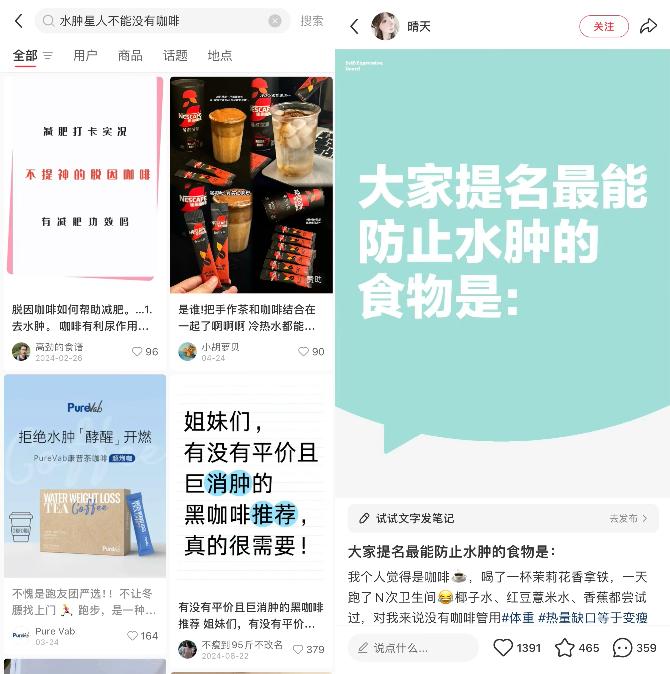
Image source: Xiaohongshu
The same is true for red bean barley water. In recent years, the Chinese health water track has produced 1-billion-yuan level hit products such as Genki Forest's Hao Zizai red bean barley water.
Although according to social media discussions, many users do take it as a "de-bloating water" voluntarily, the brand does not take "de-bloating" as the core product proposition, and mostly operates around concepts such as "water substitute" and "light health preservation".
This also indirectly shows that "de-bloating" is still a track with real consumption behaviors but no official naming.
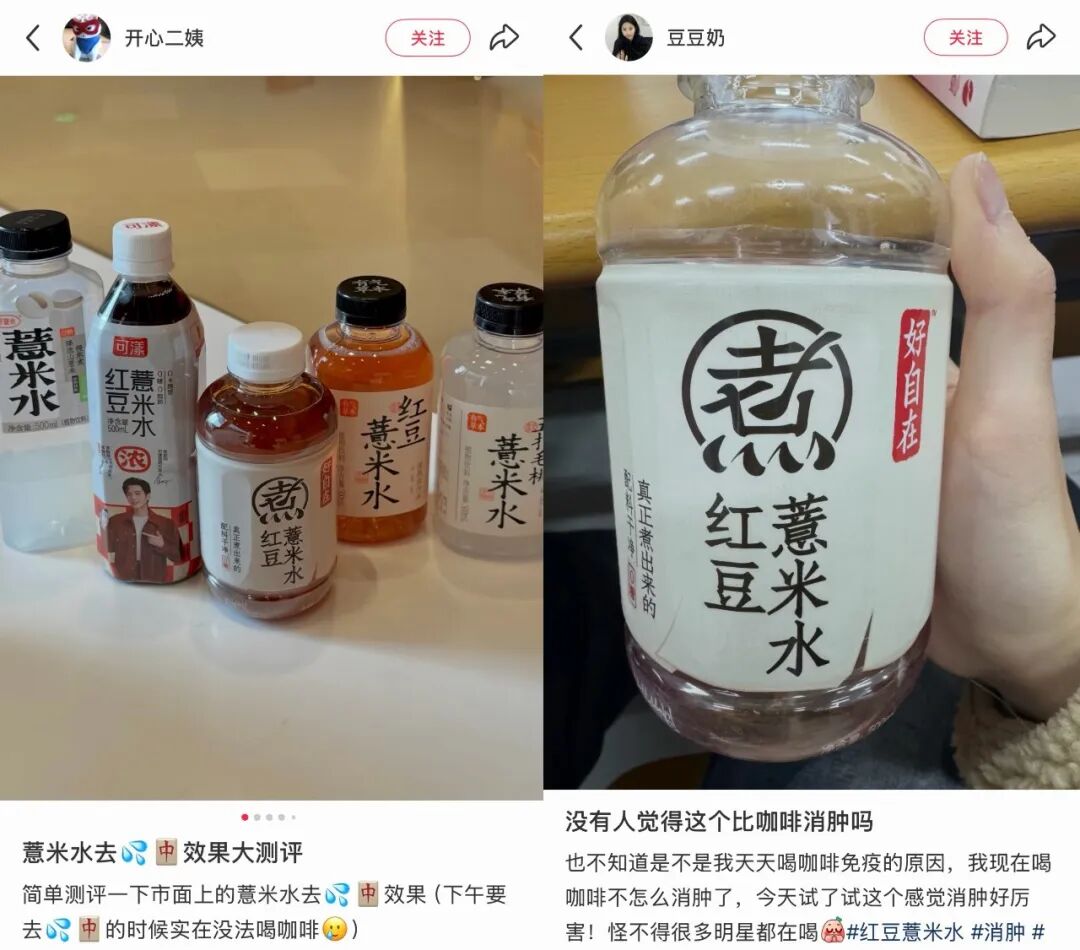
Image source: Xiaohongshu @Happy Second Aunt, Soybean Milk
While in South Korea, "de-bloating tea" has formed relatively clear consumer cognition.
Under the broader oral beauty track, "de-bloating tea" is a fast-growing sub-category. According to the offline store sales data released by Olive Young, South Korea's largest beauty chain, in October 2025, "de-bloating tea" has steadily ranked among the top in the "health management" category[4].
However, due to regulatory restrictions, ordinary food in South Korea cannot directly claim the de-bloating function, so brands usually do not talk about the efficacy directly, but convey product value through "de-bloating raw materials" that consumers are already familiar with.
Pumpkin tea is a typical representative of this. In South Korea, there has been a folk rumor that postpartum pregnant women must drink old pumpkin juice to promote water excretion and reduce edema. Although this rumor was later proved to be untrue, the association between pumpkin tea and de-bloating has taken root in consumers' minds.
Old pumpkin itself is rich in potassium, β-carotene and dietary fiber. These ingredients help promote blood circulation and metabolism, and do have certain de-bloating effects. For this reason, pumpkin tea has always ranked among the top sales in the health tea area of Olive Young, and is also recognized as the "de-bloating magic drink for Korean women" by domestic daigou.
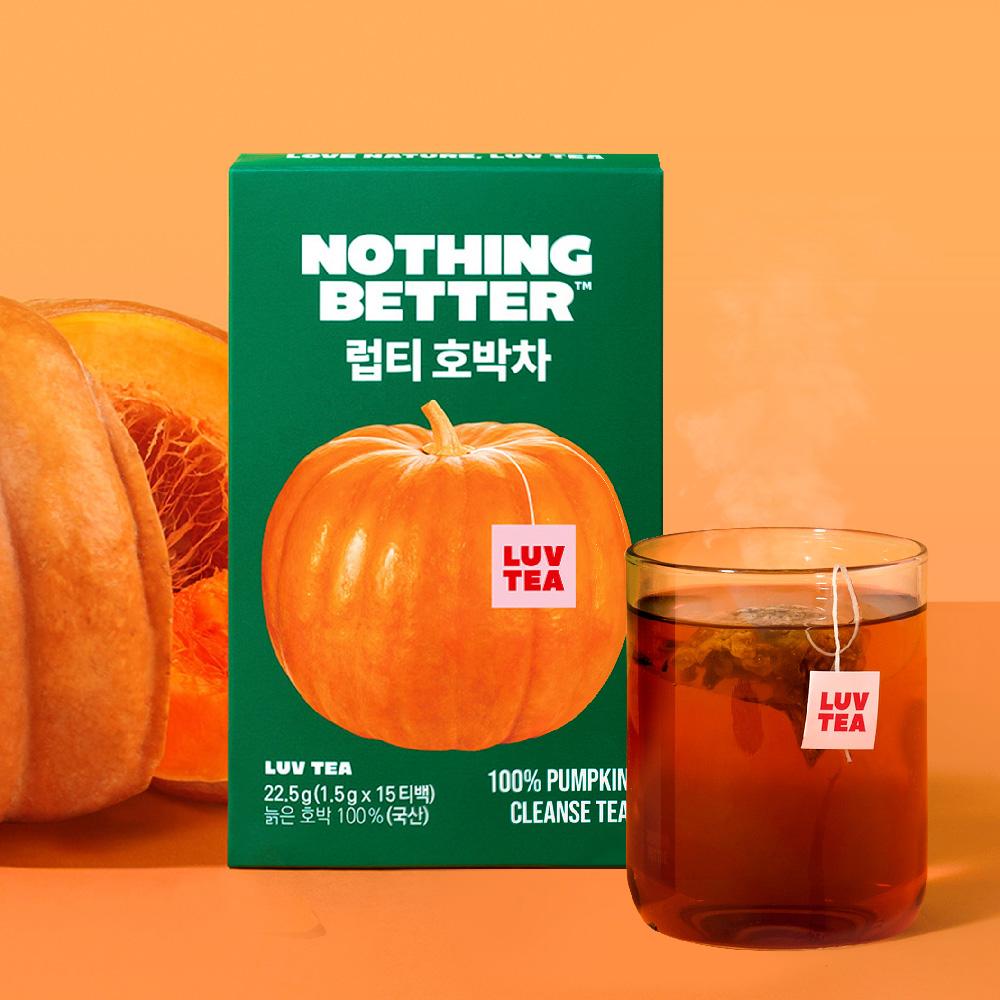
Image source: Yami
Another product that has to be mentioned is Corn Silk Tea from South Korea's Guangdong Pharmaceutical, which has almost built "de-bloating" into a category mindshare.
In traditional Chinese medicine, corn silk has long been used as a medicine and food homologous herb that "promotes diuresis, exudes dampness and reduces edema". Modern studies have also found that it contains flavonoids, polysaccharides, organic acids and other components, which have diuretic, auxiliary blood pressure lowering and water-salt balance regulating effects[5].
Since its launch in 2006, this product has been marketed around scenarios such as "diuretic de-bloating" and "V-line small face" for a long time. It has ranked first in the South Korean ready-to-drink tea market for 18 consecutive years, with cumulative sales of 1.6 billion bottles, which is equivalent to an average of 31 bottles per South Korean. This figure fully demonstrates its huge commercial potential[6].
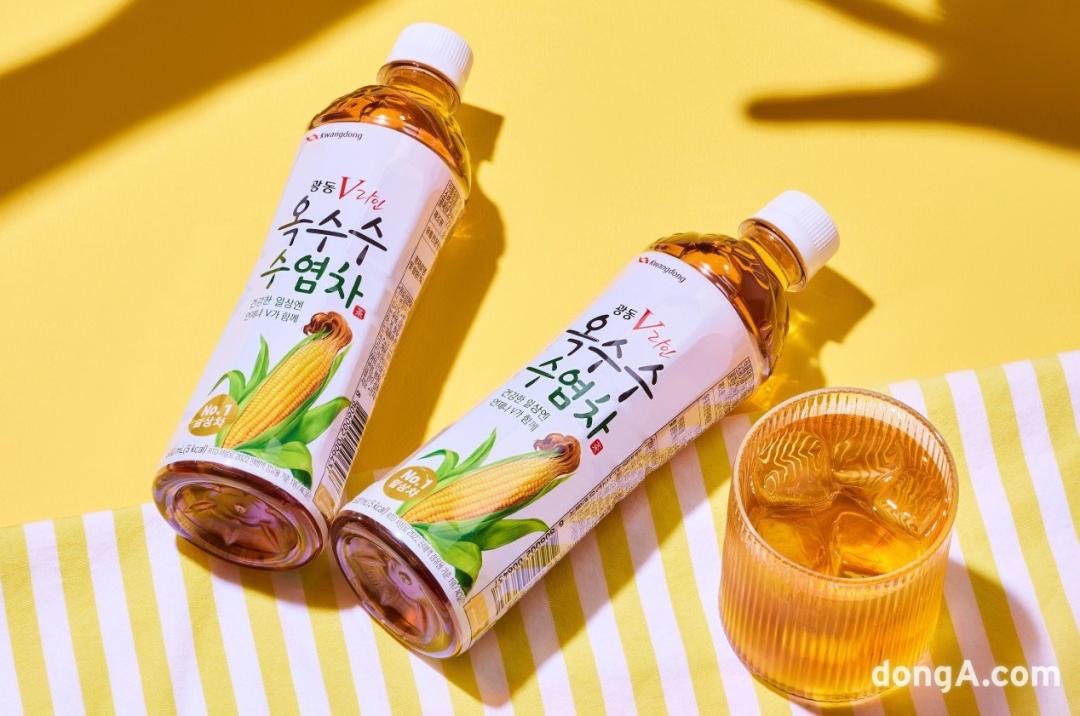
Image source: donga