Insights into Steady Investment of 1000 Chinese Families: Stay calm and unperturbed, and everything will go smoothly.
In 2026, a saying goes viral across social media: "Stay laid-back, and everything will fall into place smoothly."
Since "laid-back person" was selected as one of the top 10 internet buzzwords of 2024, this phrase has now become a widely used meme among young people. This trend that advocates for a sense of boundaries, low energy consumption and relaxed state is sweeping across the Chinese internet.
The "laid-back" here does not mean completely lying flat and doing nothing, but refers to emotional stability, not clinging to trivial disputes, not getting caught up in overthinking, and focusing all your energy on the most critical parts once you set a clear goal.
"Smooth" does not mean there are no setbacks at all either. Instead, it means you stay calm when facing periodic fluctuations, build a sense of order in your mind, so as to avoid external disruptions messing up your own planning rhythm.
This mindset is now spreading from daily life philosophy to the personal finance circle.
In recent years, deposit interest rates have kept declining, and the A-share market also experienced a round of sharp rise and fall in the technology sector from June to July. More and more people have started to rethink: what kind of wealth management method can really make people feel free of anxiety?
China Asset Management launched a questionnaire survey targeting Chinese families in June 2026, and finally collected 1793 valid responses. It also jointly released the Insights Report on Robust Investment of 1000 Chinese Families (hereinafter referred to as "the Report") together with CICC.
Apart from the data from the Report, we also participated in interviews with multiple family investors from different backgrounds, trying to understand their real wealth management choices and behavioral logic in daily life.
Based on this report and supplementary interviews, DT Business Review has discovered a counterintuitive rule: those who have gained good experience in robust investment all select products in a laid-back manner and hold their positions in a laid-back manner. We define this state as "relaxed wealth management".
Select products in a laid-back manner: keep your return expectation and evaluation cycle relaxed
The first step of relaxed wealth management is to lower your emotional intensity when selecting products. The essence of "laid-back" is not to be swayed by short-term market sentiment, not to get anxious when others make profits, and not to panic amid short-term fluctuations.
Combined with the interviews, we summarize the "laid-back" attitude in product selection into the following two points:
Keep your return expectation laid-back, do not be greedy
Ms. Xu is a housewife with two children. Her husband runs a business, and she is in charge of the family's long-term capital that will not be used in the next 2 to 5 years. She has a very clear goal for robust assets: "I only expect it to perform slightly better than bank deposits", hoping for an annualized return between 3% and 5%, and she considers 5% to 8% to be "overly optimistic expectation".
Mr. Wan, who works as a game planner in Hangzhou, has rich investment experience covering multiple fields including Hong Kong stocks, A-share funds and bank wealth management products. He has experienced the transition from pursuing high returns to prioritizing robustness. At present, he hopes for "less volatility" in his investment, and can also bear a certain degree of short-term floating losses.
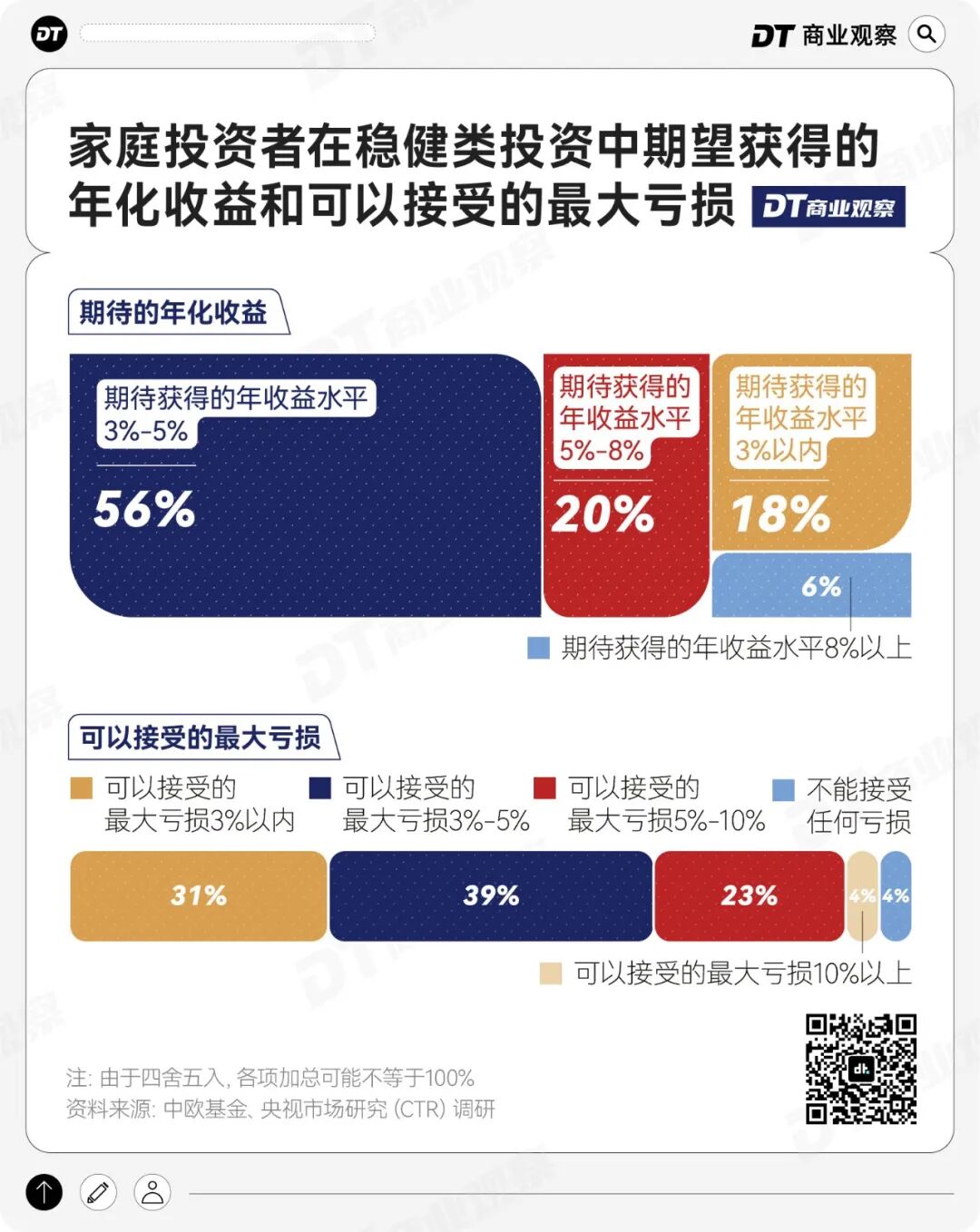
This kind of rational expectation is not a choice of the minority.
Data from the Report shows that 56% of investors expect an annualized return between 3% and 5%, and 74% of investors have a return expectation below 5%. Meanwhile, only 4% of investors say they cannot accept any losses at all, and more investors have been able to tolerate moderate periodic floating losses.
Return expectations are now matching risk tolerance capabilities. "Exchanging controllable volatility for long-term robust returns" is gradually replacing the old consensus of "cannot lose even a penny".
Only when your expectation is rational, your investment behavior will not go astray. If you do not covet excessive high returns, you will not be easily frightened by the high volatility of high-yield products, nor will you frequently trade just because the return fails to meet your expectation in the short term.
Behind this lies a clear division of "mental accounting" — you split your money into different "accounts" for management, and each account undertakes different functions. The money in the robust account acts as the "ballast stone", pursuing long-term and sustainable returns, not seeking short-term windfalls but steady and consistent growth. The money in the speculative account is used to pursue flexibility, seeking higher returns while taking greater volatility.
When you clearly divide your accounts and know what kind of money should be placed in what kind of products, you can keep a stable mindset.
Keep your evaluation cycle laid-back, do not rush
When selecting products, another thing you need to take easy on is the evaluation cycle. Do not chase short-term rankings, do not be led around by the performance within one year, and extend the evaluation timeframe calmly to three to five years.
The Report shows that the top 5 factors that investors pay most attention to when selecting robust products are: strategy transparency (53%), company brand (50%), historical maximum drawdown (43%), experience and reputation of the fund manager or investment team (40%), and long-term performance (33%).
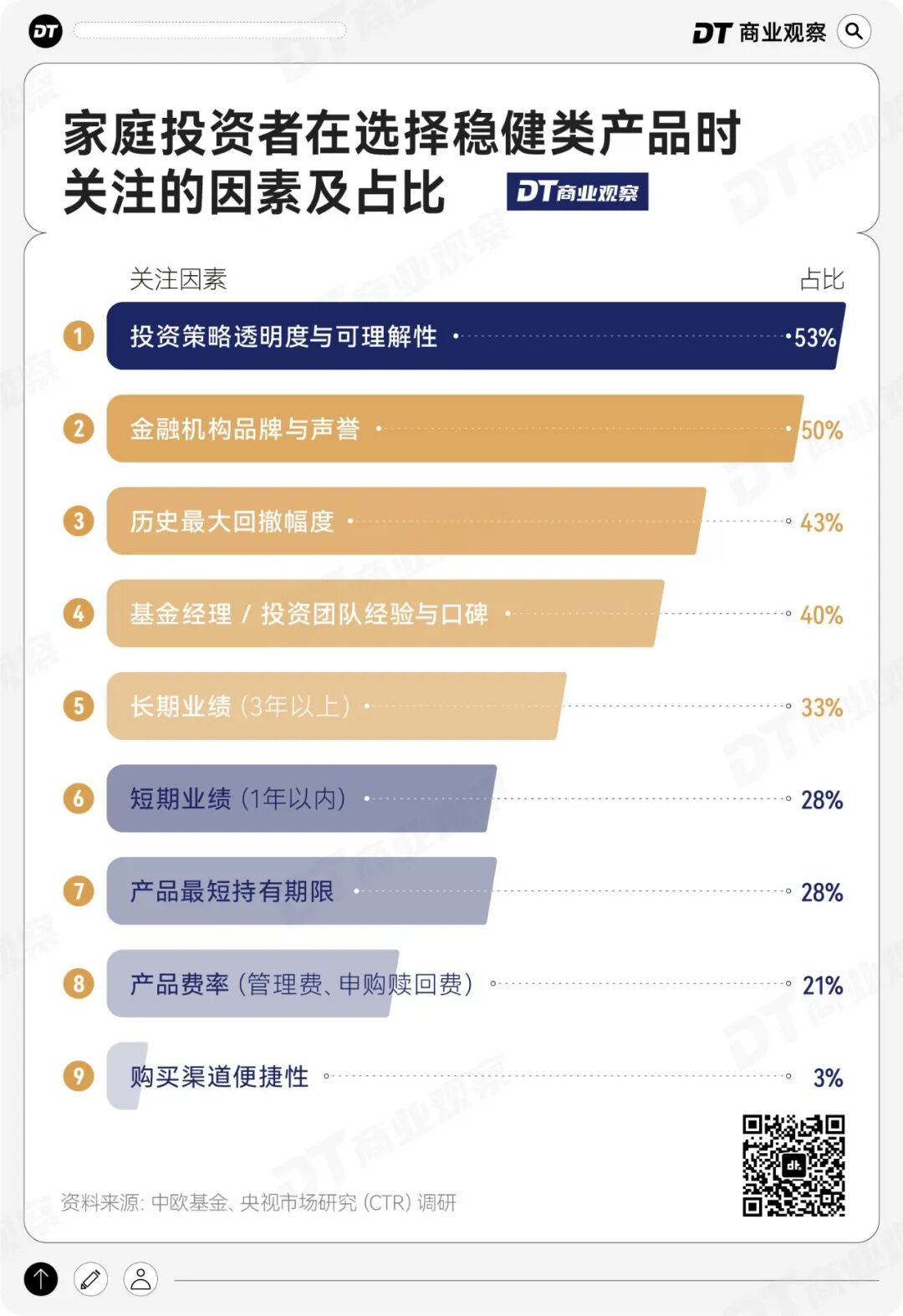
Those hard indicators that really need time to verify, such as company brand, historical maximum drawdown, fund manager experience and long-term performance, all rank at the top of investors' attention list.
This indicates that people are consciously looking at the long term when selecting products. Whether an institution can stand the test of time is its core strength. Whether a fund manager has gone through a complete bull and bear market cycle determines their judgment in responding to extreme market conditions. The maximum drawdown can only be verified after experiencing market troughs, and long-term performance itself refers to performance data over three years or longer.
The strategy transparency that accounts for the highest proportion is the premise of long-term holding. Only when you understand the investment strategy can you hold the position stably amid fluctuations. In contrast, factors that do not require time to verify, such as short-term performance, fee rates and channel convenience, attract relatively less attention.
More investors no longer focus on "who has the best recent performance", but on "who has been performing steadily all the time".
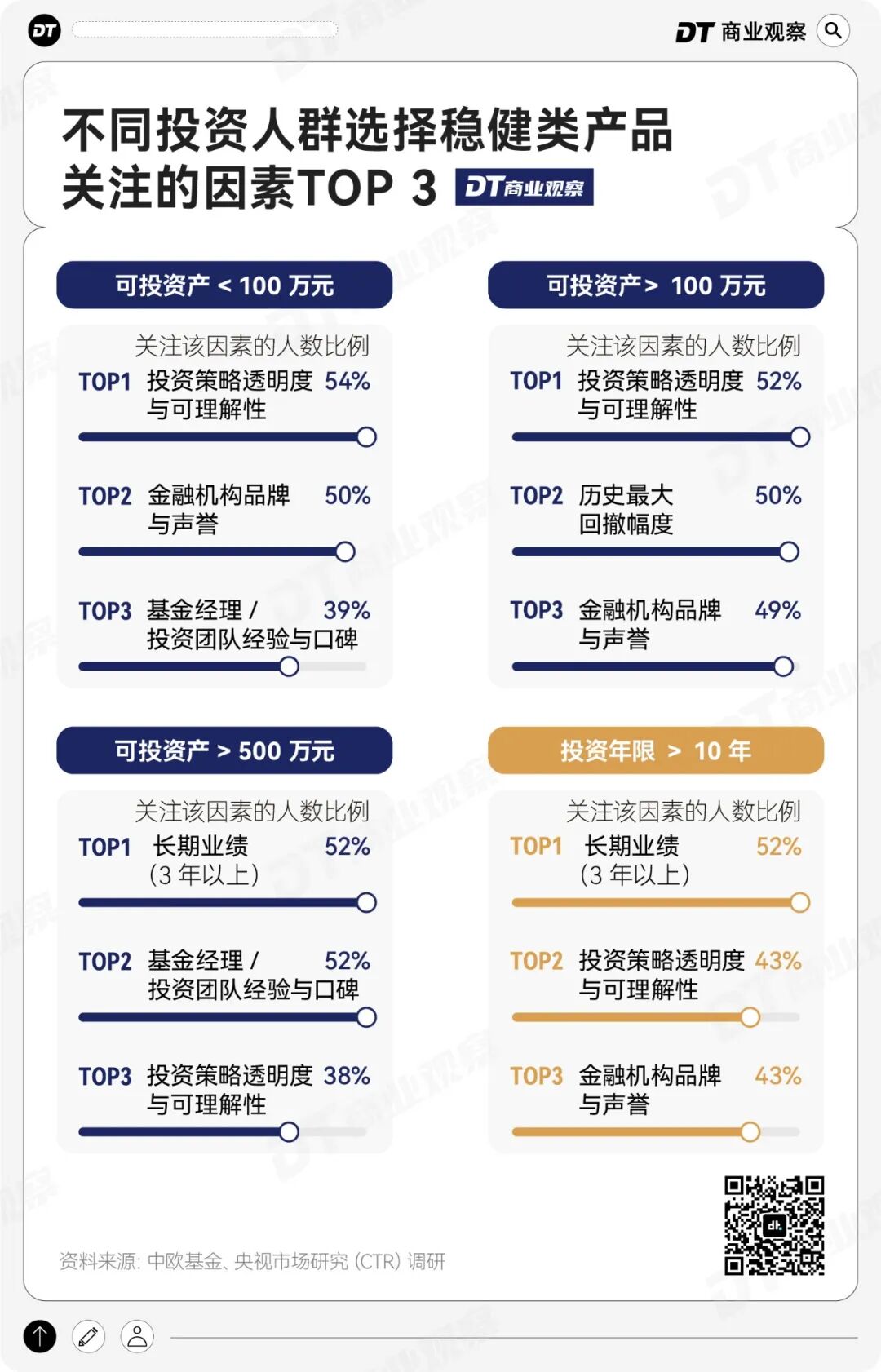
In terms of performance evaluation, the number of investors who focus on long-term performance of more than 3 years is significantly larger than those who focus on short-term performance within 1 year. For families with high asset scale and long investment years, long-term performance is the top priority factor in their product selection.
The experience of Mr. Wan is very representative. He used to jump back and forth between hot tracks including pharmaceutical, baijiu, sci-tech innovation and new energy, and finally summed up the biggest lesson: "Do not chase hot spots, because you can never predict when they will fizzle out."
Nowadays, he almost only refers to one indicator when screening funds: "Open the K-line chart, check if the trend over three to five years is smooth and upward with small drawdowns. Funds with such long-term steady performance are the 'good funds' in my mind."
When he was interviewed in June, the technology sector was surging, but he said he would "definitely not touch it". After entering July, the A-share technology sector saw a significant correction. Because he strictly abided by the trading rule of "not chasing hot spots", Mr. Wan avoided this round of sharp drop.
Mr. Liu, from Zhangzhou, Fujian, is an individual investor with more than 30 years of investment experience. His point of view is more straightforward: "Short-term performance cannot effectively evaluate the competence of a fund manager. Three years is the passing line."
Without greedy expectations, and with a sufficiently long evaluation cycle, you will not rush when selecting products, and will not panic when holding positions.
Hold positions in a laid-back manner, stay calm and do not make frequent unnecessary adjustments
After you select reliable long-term robust products, the next step is to hold them.
The second step of relaxed wealth management is to stay calm when holding positions, that is, do not panic amid short-term fluctuations, do not rush to adjust positions just because other tracks are more profitable, and take your time to let time deliver value.
The Report shows that 78% of respondents are willing to hold robust products for more than 6 months, among which 42% plan to hold for 6 months to 1 year, 25% plan to hold for 1 to 3 years, and 11% plan to hold for more than 3 years.
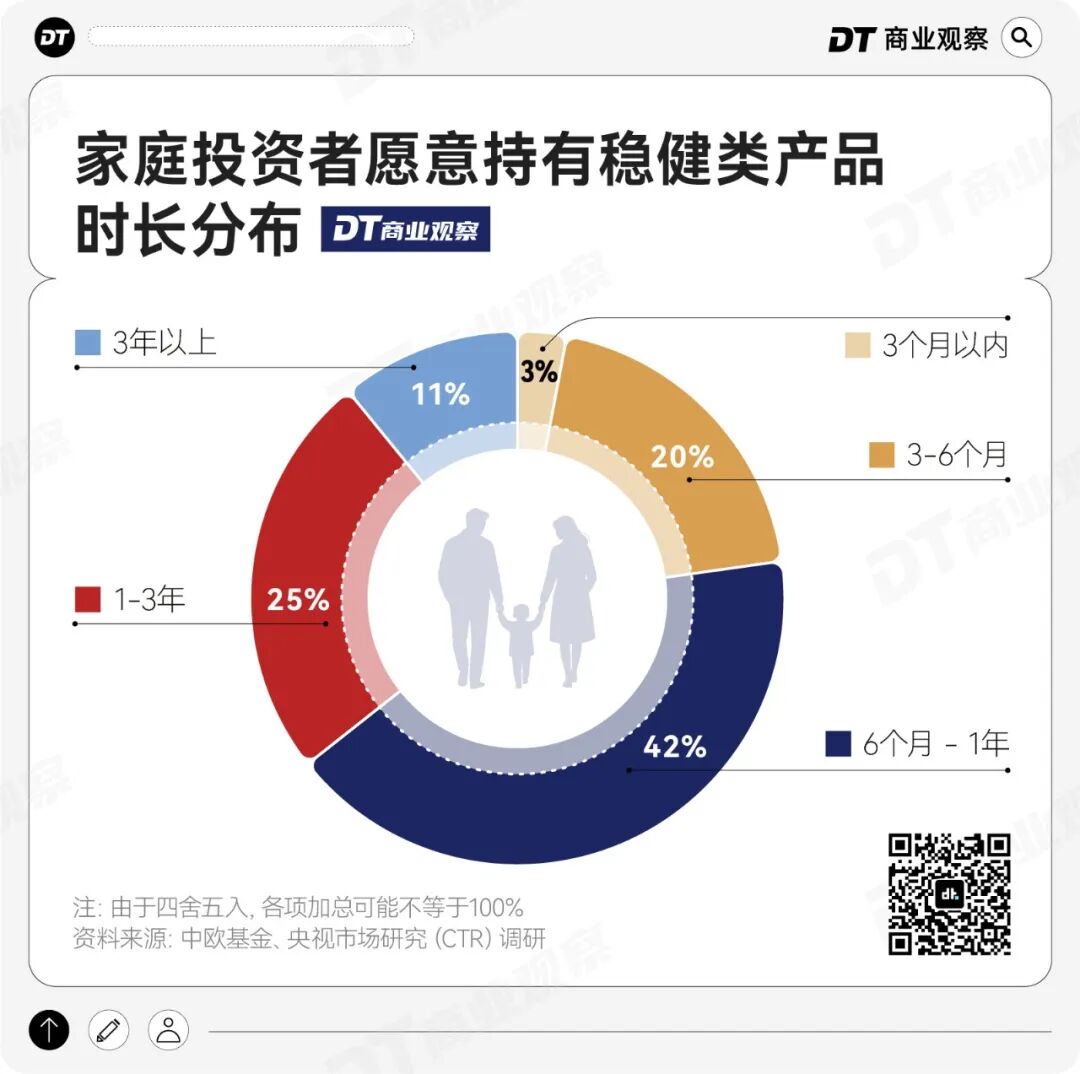
Among all groups, the longer one's investment experience is, the more inclined he is to hold positions for the long term.
Among the surveyed families with more than 10 years of investment experience, 71% are willing to hold positions for more than 1 year, and 37% are willing to hold for more than 3 years. While among families with less than 1 year of investment experience, only 12% are willing to hold positions for more than 1 year.
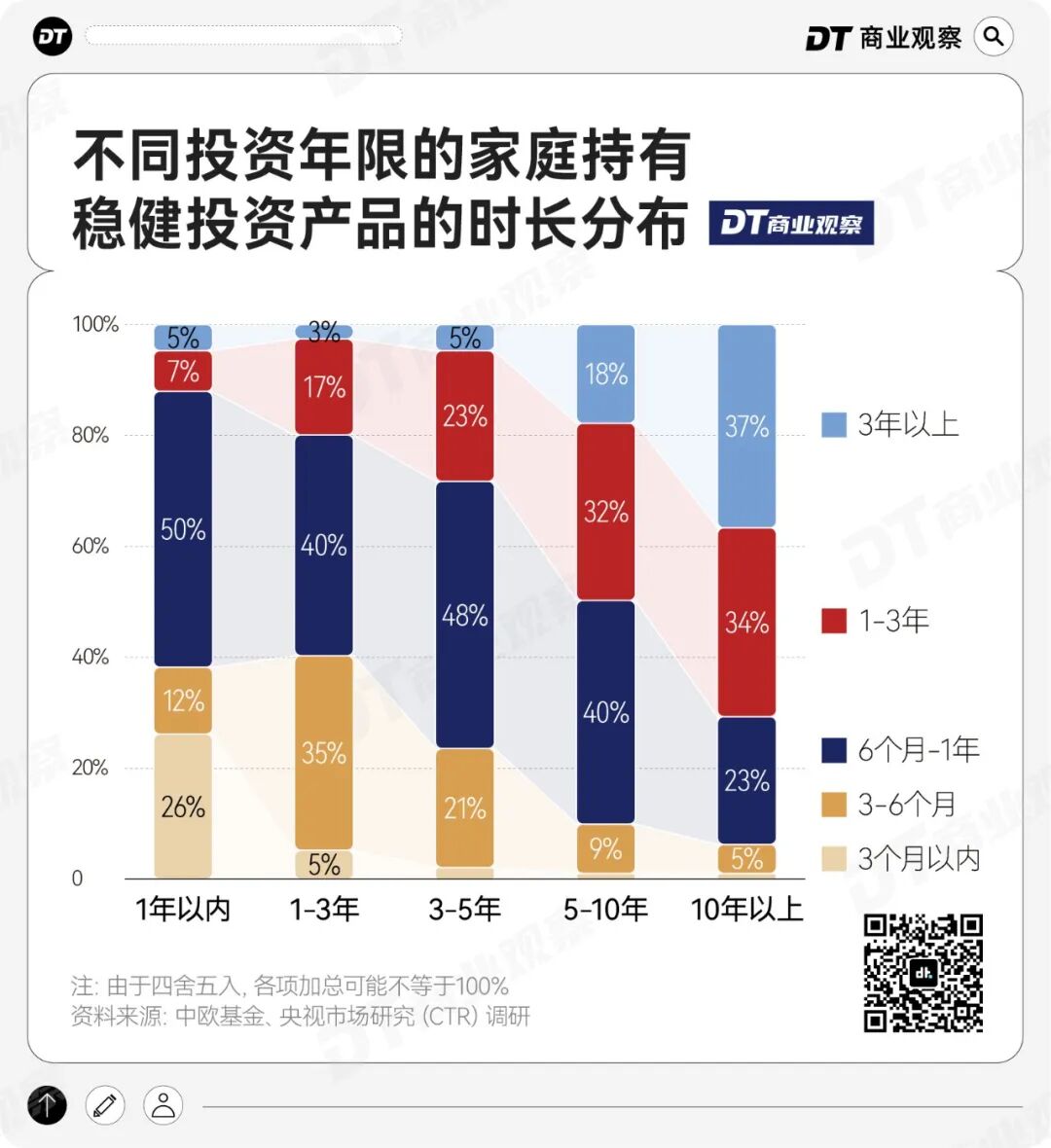
People who have gone through market cycles know better the value of the "laid-back" mindset.
Mr. Wan from Hangzhou has deep experience in this regard. In his early investment days, he switched between 20 to 30 funds, checked the market frequently and traded very often. After years of such hectic operations, he found the returns were far from satisfactory.
Later, he gradually reduced the number of positions he held. At present, robust assets account for as high as 80% of his total assets, and he adopts a "barbell strategy" in allocation: 80% is placed in bank wealth management products and pure bond funds as the base position to preserve value, and 20% is allocated to dividend funds and Hong Kong stocks to pursue excess returns and steady cash flow.
Now his attitude towards the robust base position assets is: "I only review the portfolio roughly every six months, and I will not make any adjustments as long as the loss does not exceed my preset expectation."
This kind of "laid-back" attitude remains consistent even when facing periodic losses. The Report shows that 50% of respondents choose to wait and see first, 40% choose to continue holding, adding up to 90% of people choose not to make any move, and only 6% choose to redeem immediately or switch to other products.
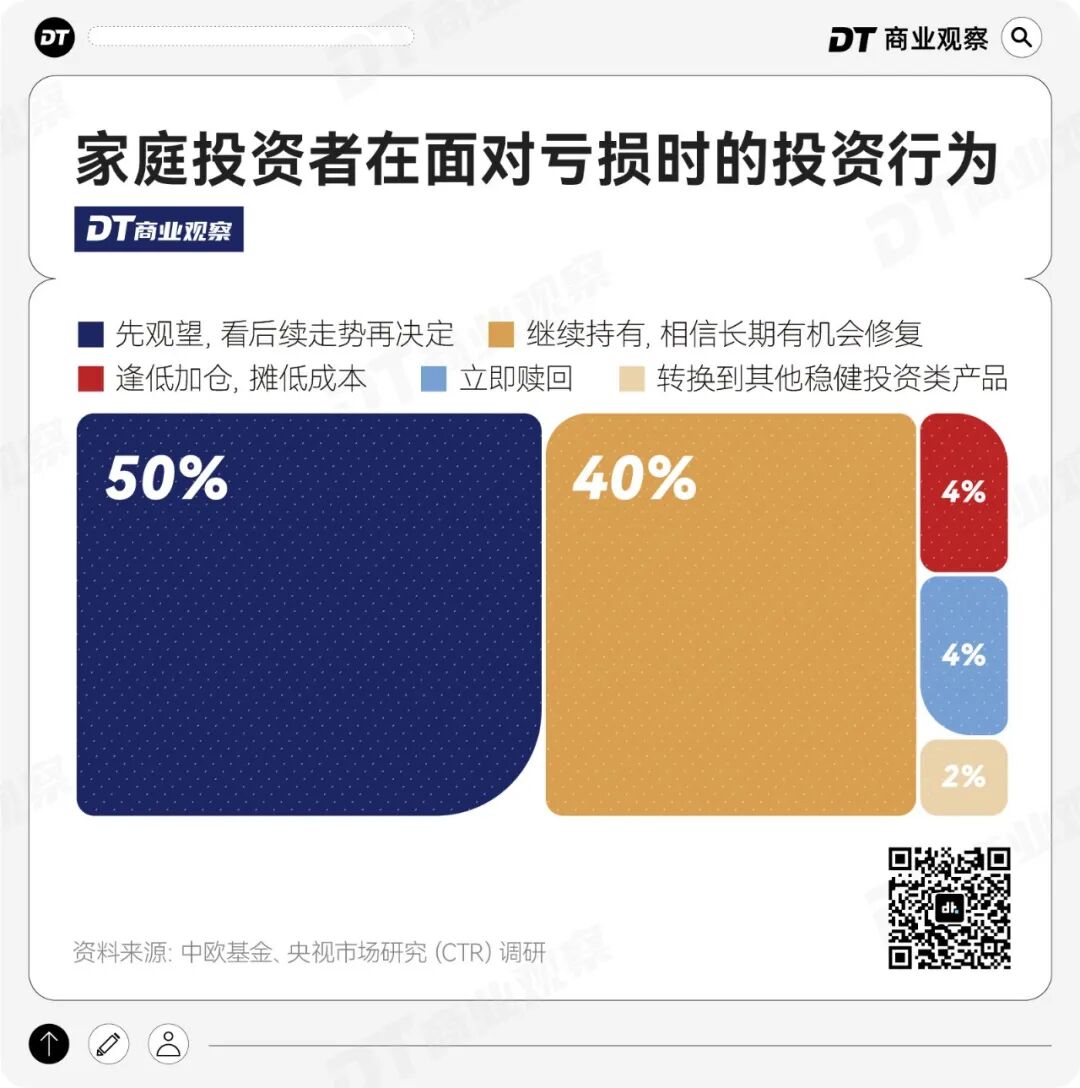
Why do most people choose not to make any move? The Report gives three core reasons.
First, trust in professionalism.
54% of respondents are willing to continue holding even after losses, and the primary reason is their trust in the fund manager and the management team. They believe that large institutions can endorse the products, so there is no need to check the net value every day. Mr. Wan also mentioned that he will learn about the background of the fund manager before purchasing products, and his trust is built on long-term steady operations and performance that has gone through bull and bear cycles.
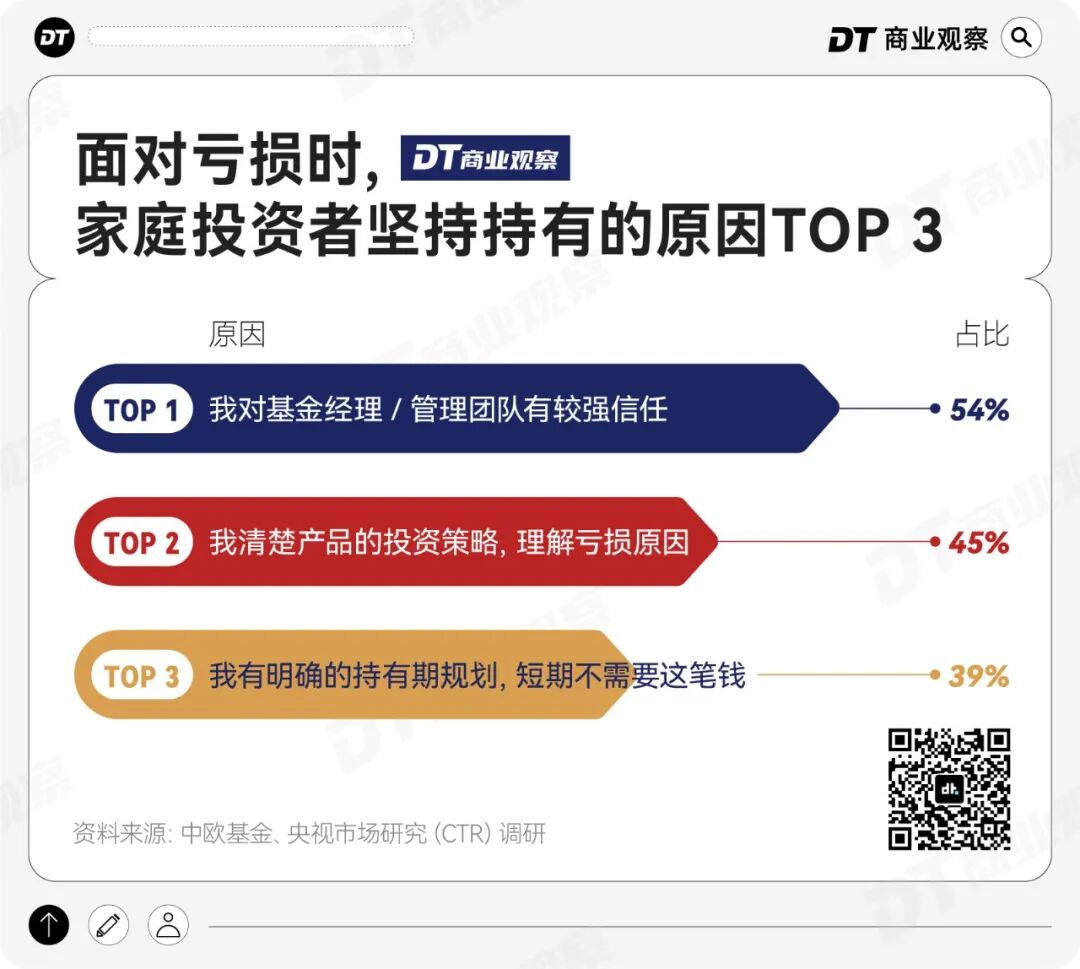
Second, full understanding of the products.
45% of respondents said they insist on holding positions because they understand the product strategy and underlying asset characteristics, and consider periodic fluctuations as a normal market phenomenon. Only when you fully understand the product can you hold it firmly. This also explains why strategy transparency becomes the top priority in product selection: products you fully understand will not make you panic amid fluctuations.
Mr. Wang, who works for a foreign enterprise in Suzhou, has put a lot of effort in this aspect. He usually obtains market information through various media platforms and financial analysis platforms, and also uses AI tools to sort out and summarize information from broker research reports. Although he clearly states that he will not directly adopt the investment suggestions from AI, he has taken it as an efficiency-improving tool to help him understand the market better.
Third, no rush for short-term returns.
39% of respondents choose not to redeem, because the money is planned for long-term use, and they do not need to withdraw it in the short term.
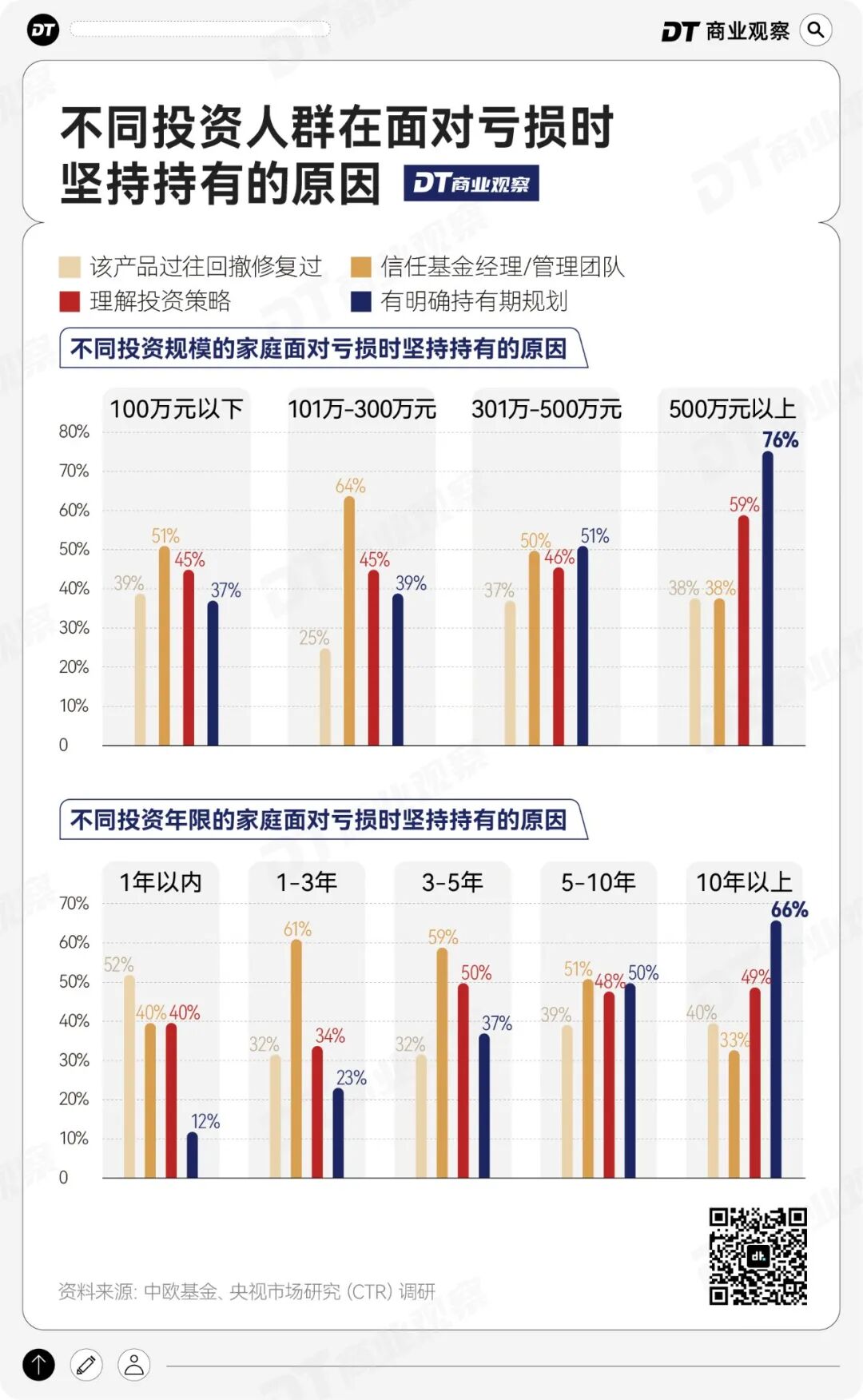
Specifically, the larger the capital size and the more market cycles one has experienced, the higher the proportion of people who hold the "no rush" attitude.
The Report shows that among families with assets above 5 million yuan, having a "clear holding period plan" is the primary reason for insisting on holding positions, accounting for 76%; among families with more than 10 years of investment experience, this proportion is as high as 66%.
In the interview with Ms. Xu, she mentioned that "I don't know where to put my spare money". The family has stable rental income from properties and profits from the business, and there are no large expenditure plans in the short term. Therefore, when investing in robust products, she believes that long-term holding can help recover losses, and chooses to "be friends with time".
Holding positions in a laid