The Rise of the Industrial Chain Leader: Unitree "Accelerates the Maturity" of Humanoid Robots
Back when Unitree was still little known, Wang Xingxing was not a high-profile figure in the industry.
Several years ago, at a domestic industry conference, the organizer invited several experts to deliver speeches on the technology sector. When it was Wang Xingxing's turn to speak, his presentation was highly technical and ran quite long. A leader interrupted him, saying he had talked too much.
At that time, Unitree was not yet a well-known brand. Shortly afterwards, the organizer tried to arrange another meeting with Wang Xingxing, but could no longer get in touch with him. The anecdote of "the man who interrupted Wang Xingxing" became a story that circulated internally for a long time.
A source close to Wang Xingxing told a reporter from Jiemian News another detail: even when the company already had more than sufficient cash on its books, Wang Xingxing would still ask who would cover the hotel expenses when he attended external meetings. Having experienced capital shortages in the early days, he has always maintained strict control over cash flow management.
As Unitree gained increasing fame, Wang Xingxing's sensitivity to cost has barely changed. This is also where the company has made its fastest progress over the past decade: manufacturing, cost reduction, and getting robots sold globally.
On August 19, Unitree Technology was listed on the Sci-Tech Innovation Board (STAR Market) of the Shanghai Stock Exchange, becoming the first A-share humanoid robot stock. Its opening price reached 1100 yuan per share, surging by 629.44%, a sharp increase of 949.20 yuan compared with the issue price of 150.80 yuan per share, bringing its market capitalization to 444.9 billion yuan. The diluted P/E ratio after this issuance reached 219.23 times, far higher than the industry average of 38.56 times.
According to the prospectus, Unitree's humanoid robot shipments exceeded 5,500 units in 2025, and the revenue from its humanoid robot business surpassed that of the quadruped robot business for the first time, becoming its largest source of revenue.
Unitree is the first complete machine manufacturer in this round of the humanoid robot industry that has achieved both scale and profitability. Its orders are reshaping the upstream industrial chain, and its pricing is also defining the price range of the entire industry. In China's relevant industrial chain, Unitree has become the de facto core leader enterprise.
A mass-producible humanoid robot with gross profit that can be sold globally is the most direct product of decades of accumulation in China's manufacturing industry. However, as the core leader enterprise, there are still components that Unitree cannot buy or produce for the time being.
The upstream industrial chain transformed by orders
During Unitree's subscription period, the A-share robot sector strengthened, with component companies including Leader Harmonious Drive, Zhongda Leader, and Estun leading the gains.
The market performance of the secondary market points to a fact: what is driven in this round is not a single company, but a group of Chinese component enterprises, which are adjusting their product lines along with the robot orders.
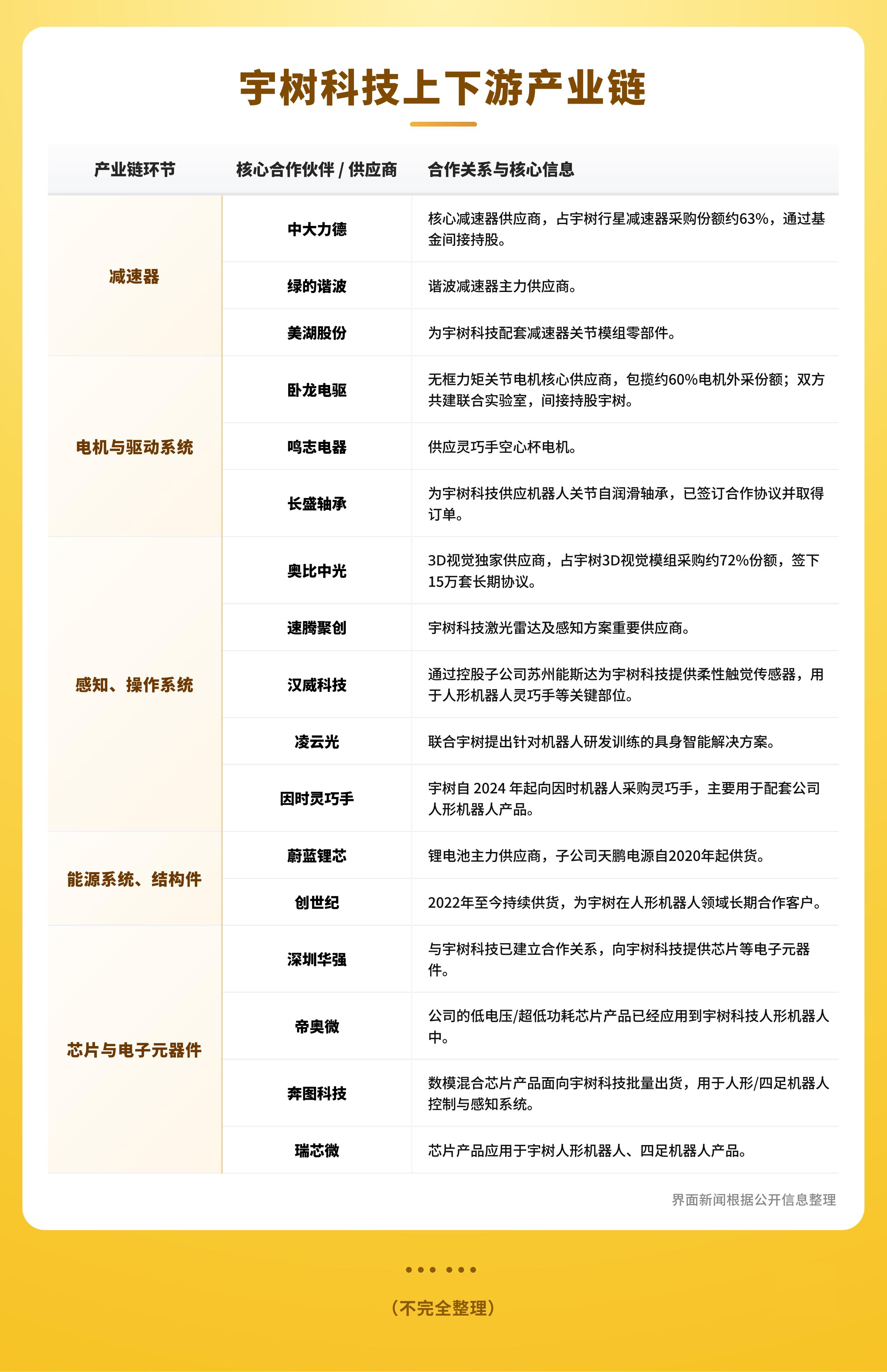
Map of Unitree's upstream and downstream industrial chains. Charted by Li Shuyao, reporter of Jiemian News
One direct change is that components have started to transform from custom-made parts to standard parts.
Zhuoyu Technology focuses on robot drive components. The relevant person in charge of the company said in an interview with Jiemian News that in the first stage of the industry, almost all products were custom-made with separate negotiations for each order. As the number of custom orders continued to grow, its products have been consolidated into three series of standard products: planetary modules, harmonic modules, and linear modules, which cover more than 95% of robots on the market. According to the person in charge, the company has cooperated with half of China's robot enterprises, and has built an automated production line with an annual capacity of 200,000 joint modules and 500,000 motors.
At the same time, the product pedigree is also subdivided along with the structure of robots. For example, the smallest motor of Zhuoyu Technology currently measures only 14 millimeters in outer diameter, roughly the size of a human finger, and is specially designed for the knuckles of dexterous hands. A single finger usually uses four such micro modules.
The transition from separate negotiations for each order to the release of a standard part catalogue is a sign that the industry has moved from the "hand-assembled" stage to the industrialized stage.
Huang Jinping, founding partner and chairman of Rongyi Investment, one of Unitree's investors, believes that there are no bottlenecks in the robot supply chain, and all related products can be fully developed. There is still room for further price reduction, because the current production volume is still too small, and the cost will definitely drop once the volume increases.
Another path is the horizontal expansion of established component enterprises. Audiowell has been engaged in the R&D and production of sensors and actuators for 27 years. Zhang Shuguang, chairman of the company, told Jiemian News that in recent years, the company has expanded from industrial scenarios to the market he calls low-level embodied intelligence, covering sweeping robots, swimming pool robots, and lawn mowers. It sold more than 10 million sensors last year, achieving a sales revenue of 110 million yuan, and it only took three years to grow from scratch.
He attributes the company's advantages to two points: first, the whole chain from materials to algorithms is vertically integrated, so the company can customize products for different application scenarios; second, Chinese enterprises are generally willing to accept customized orders, while overseas manufacturers only provide standard products.
However, being able to produce a product and being able to operate it stably for a long time are two different things. Zhang Shuguang cited the example of the humanoid robot half marathon held this year. In the competition the previous year, two people followed each robot, one carrying a bucket to pour water, and the other holding a remote control. The robot would break down immediately without water cooling. This year, no one pours water for the robots anymore, and the solution adopted is to make the joints larger and install fans inside. "But this solution is not conducive to the long-term development of the industry," he said.
His judgment is that robot joints need to move repeatedly, which requires high sealing performance. For traditional fans with bearings, the bearing oil will volatilize quickly at high temperatures and then fail. The next-generation solution the company is developing is to install a water tank inside the robot body, and use a micro pump to send water to the holes on the surface for vaporization and heat dissipation. Without a proper heat dissipation system, robots can only perform short-term demonstrations, and cannot be deployed in production lines that require continuous operation.
Joint design and heat dissipation are only two of the most prominent problems to be solved in the industry at present. China's manufacturing industry has basically passed the test of "whether the product can be developed". The current bottleneck lies in whether the product can operate stably for a long time after being produced, and some high-end components still rely on imports.
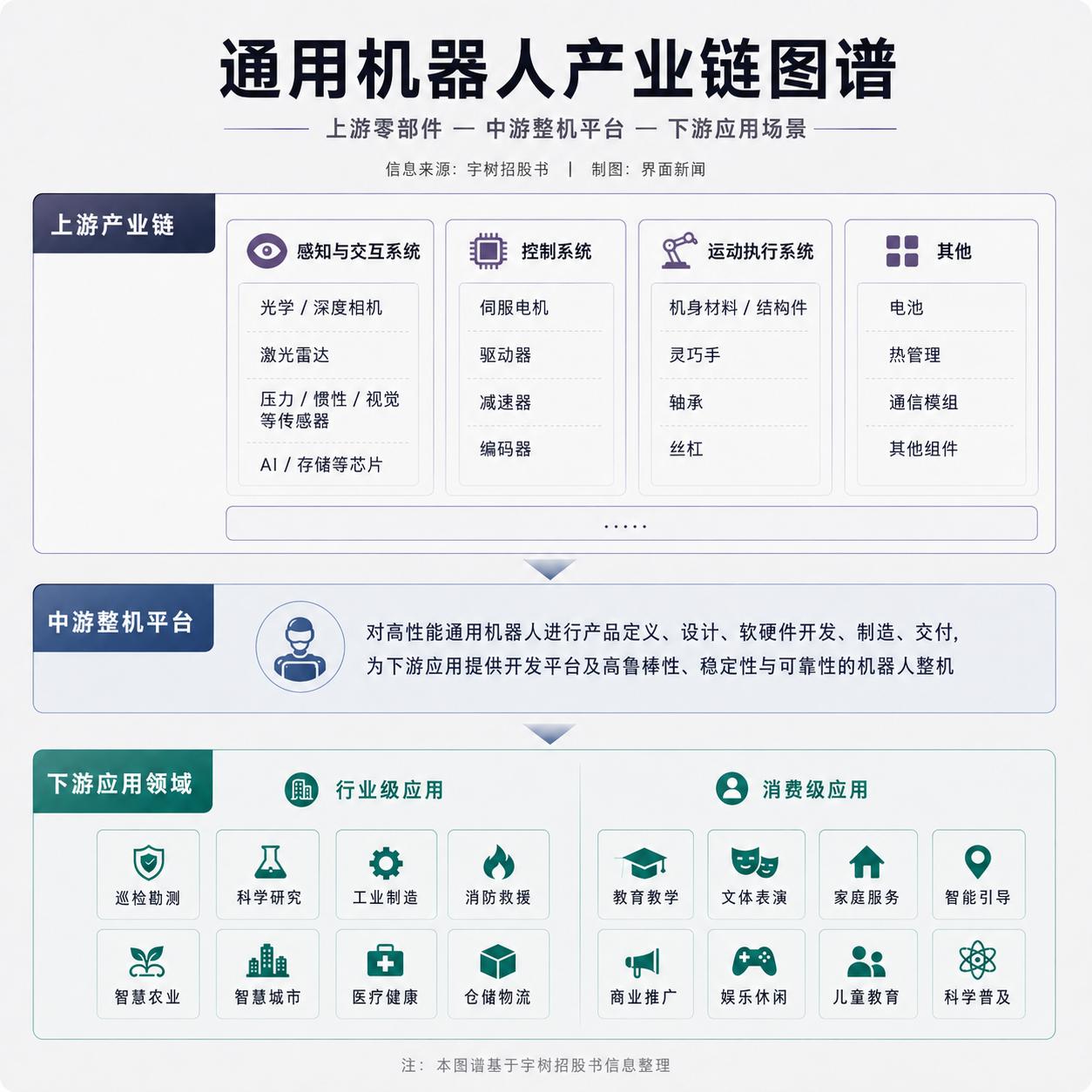
Map of the general-purpose robot industrial chain. Charted by Xu Meihui, reporter of Jiemian News
Yu Yiran, Managing Director of CIC Insights, said in an interview with Jiemian News that although leading enterprises such as Unitree have realized self-development and self-production of some core components, the localization process of the industrial chain still shows obvious structural differentiation: technological breakthroughs have been achieved in the hardware links of robot bodies, but there is still a certain gap in high-precision sensors, precision actuators, advanced embodied models and motion control algorithms.
Specific to components, Yu Yiran gave the following judgments:
In terms of sensors, six-dimensional force sensors still lag behind overseas manufacturers such as ATI in high-precision, high-dynamic and miniaturized products. Tactile sensors are still in the verification stage, and there is still a gap before large-scale mass production;
In terms of speed reducers, harmonic speed reducers have achieved domestic breakthroughs in conventional scenarios, but there is still a large gap between domestic high-end products and Japan's Harmonic Drive. High-end planetary roller screws also rely heavily on overseas manufacturers such as Switzerland's GSA;
In terms of motors, basic servo motors have a high popularization rate, but high-torque density frameless torque motors have not yet achieved complete localization, and domestic products are lower than overseas products in multiple performance indicators;
In terms of AI chips, the industry is highly dependent on overseas computing power platforms such as NVIDIA. There is a large gap in computing power between domestic chips and NVIDIA's products, and the high cost of computing power also leads to the low maturity of the "brain" and "cerebellum" of domestic humanoid robots. Yu Yiran said that this part is closely related to China's semiconductor industry, and cannot be achieved overnight.
Although there are shortcomings, this industrial chain is fully capable of supporting a core leader enterprise. It is Unitree itself that converts this supply capacity into price advantages.
The growth of the "core leader enterprise"
Ten years ago, when Wang Xingxing first founded Unitree in Hangzhou, the company was so small that no supplier was willing to cooperate with it.
Huang Jinping decided to invest in Unitree in the second half of 2021, and has participated in three rounds of investment since then. His review shows that the high self-development rate of Unitree in the early days, which was widely praised later, was half forced out by the harsh situation: the company was too small, and no one was willing to make custom parts for it, so the team had to split the development work into separate parts and overcome technical difficulties part by part.
"But on the other hand, they do have the corresponding capabilities," Huang Jinping told Jiemian News. When all core components are developed and produced by the company itself, its cost control ability becomes something that other enterprises cannot catch up with. Today, Unitree can even sell its lidar products to external clients.
Zheng Juncong, founding managing partner of Summitview Capital, took action even earlier. After the video of Boston Dynamics' robot dog Spot spread on the Internet in 2018, he judged that similar companies would definitely emerge in China, and asked his team to search for such enterprises across the whole network. Unitree thus came into their sight. In October 2020, Summitview Capital completed the Pre-A+ round of investment as the only institutional investor, and then made two additional investments.
However, at that time, Unitree only developed three types of robot dogs, with sales of dozens of units, most of which were sold to scientific research institutions. The unclear application scenario still discouraged many investors: what practical applications can quadruped robot dogs have besides scientific research? Some people even questioned in the internal investment committee meeting that "without clear application scenarios, the business cannot be scaled up".
A specific detail related to product weight made Zheng Juncong make up his mind.
Unitree's robot dog weighs 12 kilograms, half the weight of the benchmark product of Boston Dynamics. Why did the team make it 50% lighter? Wang Xingxing explained on the spot: a lighter body brings better controllability, significantly lower energy consumption, and lower costs. More importantly, he could clearly explain how to customize the core components and find cooperative resources to achieve this goal.
"These details are all very important, which show that he really understands the technology and knows how to implement it, rather than just making empty promises," Zheng Juncong said.
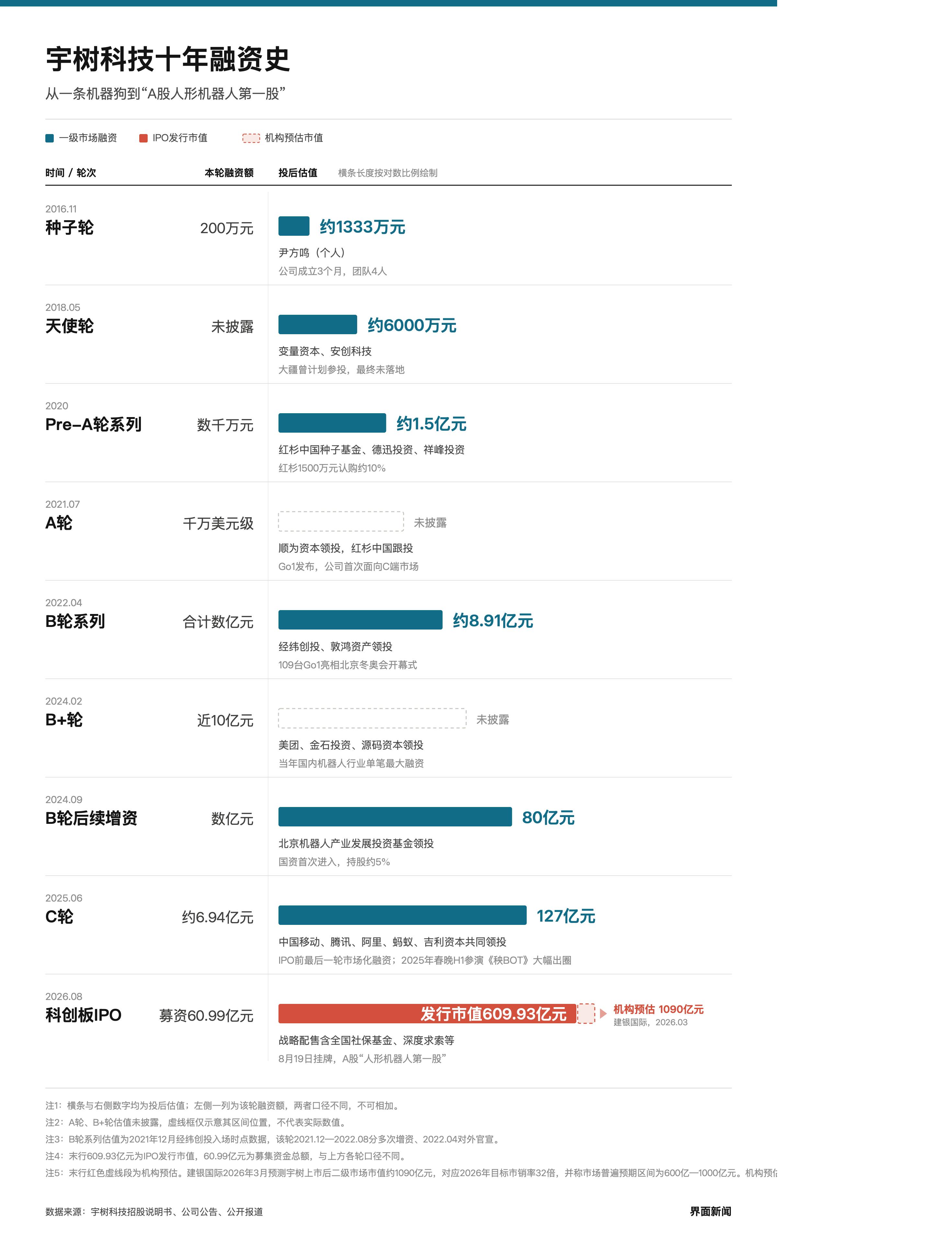
History of Unitree's financing. Charted by Xu Meihui, reporter of Jiemian News
This ability to control costs is finally reflected in product prices.
The average selling price of Unitree's humanoid robot was 593,400 yuan per unit in 2023, dropped to 260,400 yuan in 2024, and fell to 166,400 yuan in 2025, a decrease of more than 400,000 yuan in two years. The cost reduction process is still ongoing.
However, contrary to common expectations, as prices went down, Unitree's gross profit margin did not drop, but instead rose.
From 2023 to 2025, its gross profit margin of main business rose from 44.22% to 60.13%, and has been higher than the average level of peer companies since 2024.
Reducing prices while increasing gross profit margin is not common in the hardware industry.
Normally, when a complete machine manufacturer cuts prices, it usually reduces its own profit margin or transfers the pressure to the upstream chain. As the selling price goes down, the gross profit margin will also decline. What Unitree reduces is its own manufacturing cost, and the part of the profit given up in the price is compensated by the cost side.
The reason given in Unitree's prospectus is the full-stack self-development mode of robot complete machines and core components: the company independently develops motor drives, joint modules, complete machine structures, and motion control systems, so the hardware cost is kept at a very low level. At the same time, after the production and sales scale expands, process improvement, procurement bargaining power and cost structure optimization all play a role in further reducing costs.
All these results show that Unitree achieved operating revenue of 1.699 billion yuan in 2025, with net profit of 591 million yuan after deducting non-recurring gains and losses, and the net profit margin after deduction reached 34.77%. Among the four comparable peer companies listed in the prospectus, UBTECH, Dobot, and Leju Intelligence all suffered losses in the same period, while Yun Shenchu achieved a net profit of 15.12 million yuan after deduction.
In other words, in this track, Unitree is currently the only company that has achieved both large scale and profitability.
The missing "brain"
From motors and speed reducers to lidar, all the parts of Unitree's robots are either produced by itself or can be purchased from the mature industrial chain. There is only one exception.
In Unitree's prospectus, there is a rather unusual self-evaluation.
From 2023 to 2025, Unitree's R&D expenses were 49.9518 million yuan, 70.017 million yuan and 145 million yuan respectively. Although the R&D expenses grew rapidly, the scale of expenses and the proportion in operating revenue are slightly conservative compared with some enterprises in the industry.
The prospectus states that the early R&D investment focused on the body structure and motion control, that is, the robot body and "cerebellum". The company did not gradually strengthen the investment in embodied large models, the so-called "brain", until 2024. Under the circumstance that the global technical route and data scenarios are not yet clear, the company has not carried out large-scale real data collection and factory deployment training during the reporting period.
It is quite unusual for a company that has already ranked first in global shipments of robot bodies to admit in its IPO document that its investment in the "brain" part is insufficient.
The data also support this point. In 2025, Unitree's R&D investment accounted for 8.53% of its operating revenue, while the proportion was 31.39% back in 2023. For comparison, UBTECH's R&D expenses in the mid-term of 2025 accounted for 35.1% of its operating revenue.
In the allocation of IPO fundraising funds, among the 4.202 billion yuan that Unitree plans to raise, 2.022 billion yuan will be used for the intelligent robot model R&D project, which is close to half of the total fundraising, higher than the 1.11 billion yuan for the intelligent robot body R&D project and 624 million yuan for the intelligent robot manufacturing base construction project.