Is the Claude Code myth shattered? A large number of users are canceling their subscriptions
The growth myth of Claude Code has shattered!
"Anthropic is doomed, a huge number of users are frantically canceling their subscriptions right now."
A post from a developer on X sparked heated discussions across the community.

Latest data shows that Claude Code's earlier explosive growth period has officially come to an end.
Nowadays, new user growth has dropped to single digits, while existing users are defecting in droves.
Many loyal users of CC have switched to Codex, the old rival product from OpenAI.
ARR growth plummets to 5.2%, the runaway surge grinds to a halt
Today, well-known data tracking platform TickerTrends released its latest report, showing that ——
Claude Code's growth engine has clearly "stalled".
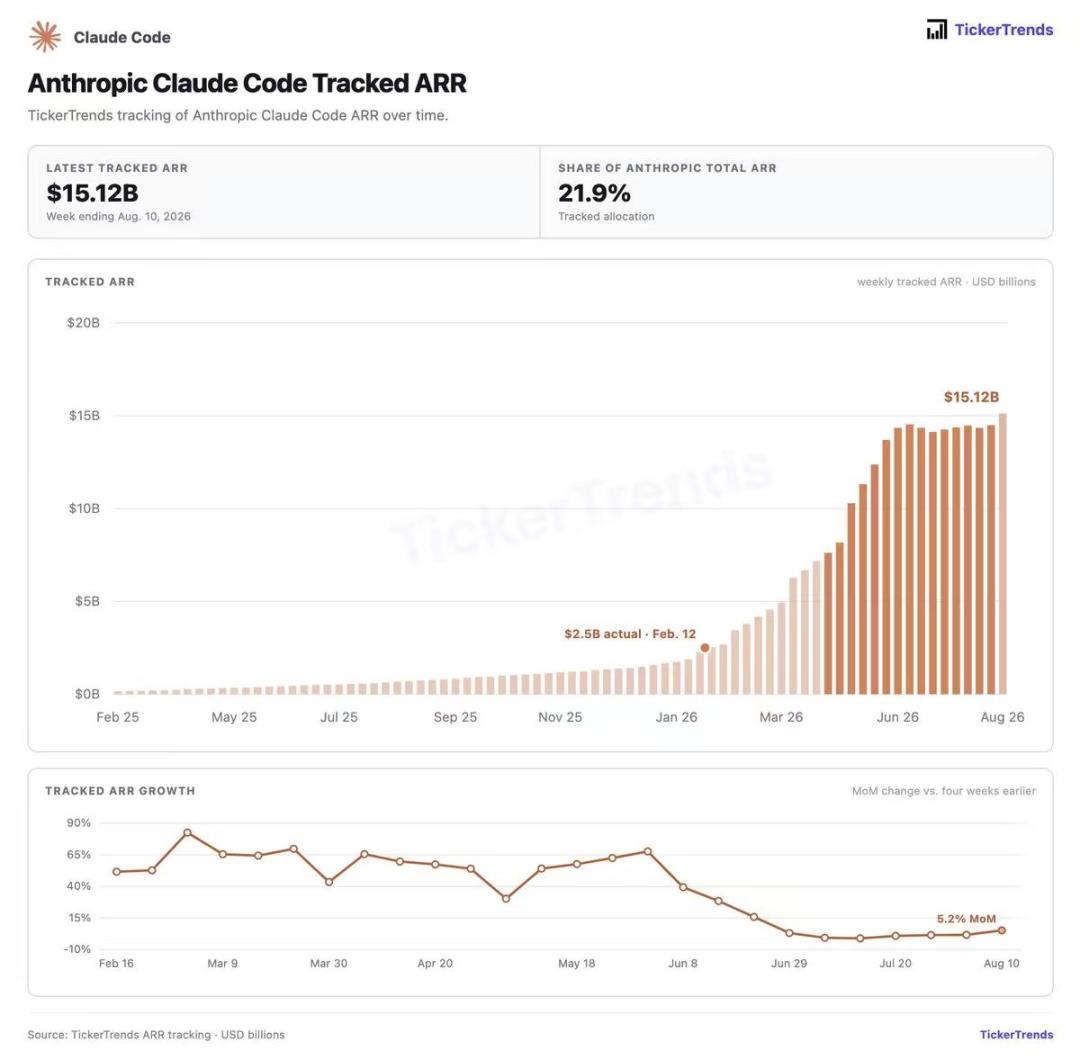
Once, Claude Code had a breathtaking growth curve.
Claude Code's ARR was approximately 2.5 billion US dollars on February 12, 2026; it surged to 6.3 billion by the end of March, exceeded 10.3 billion by the end of April, and the figure had surpassed 14 billion US dollars by June.
In just a few months, its ARR nearly sextupled!
This is not only a miracle in the history of AI, but also a myth in the entire history of the software industry. Investors were thrilled, and the entire tech circle was in an uproar.
But the myth of Claude Code came to an end in this August of 2026.
As of August 10, Claude Code's tracked ARR stands at 15.12 billion US dollars.
At first glance, the 15 billion scale is still huge (accounting for 21.9% of Anthropic's total tracked ARR), but if we look at the month-on-month growth rate, this figure has plummeted off a cliff to 5.2%!
What does 5.2% mean? For a trending AI unicorn, this number indicates that it has prematurely entered the low-growth phase of "traditional software".
Data does not lie, especially for SaaS and AI subscription products, ARR is the lifeline.
As tech commentator Orange AI pointed out:
The growth myth of Claude Code has collapsed.
It has entered the harsh single-digit growth mode, the penetration rate among programmers has almost peaked, users who were going to leave for Codex have all left, and the poorly designed Cowork feature has failed to capture a large share of the work productivity market.

Why can't it grow anymore?
First, the penetration rate among the programmer group has almost reached its ceiling.
Globally, the number of core developers who are willing to pay for advanced AI programming tools is ultimately limited. All potential users who are willing to buy have already purchased the product, so where does the incremental growth come from?
Second, Cowork, the product that Anthropic had high hopes for to reshape the workflow of the vast number of white-collar workers, suffered a crushing defeat.
Users generally report that Cowork is extremely clunky to use, and completely failed to capture the huge work productivity market as expected.
Product capabilities failed to keep up with its ambition, the attempt to expand beyond the developer niche failed, so it can only compete fiercely in the existing stock market.

Invisible watermarks spark public outrage, massive "unsubscription wave" breaks out
The slowing growth is only an internal trouble, and the more fatal external crisis is the "unsubscription wave" that is spreading across social networks.
The direct trigger of this unsubscription crisis is a new feature launched globally in early August 2026 — "Invisible Text Watermark".

It is reported that Anthropic took this move to comply with the increasingly strict regulations of the European Union. However, this move enraged users.
This watermark will be silently embedded in all text and code generated or processed by Claude, which completely infuriated programmers and content creators.
For many premium users who pay about 100 US dollars per month for Claude Pro/Max, AI is only an auxiliary tool.
They may paste their core code into Claude to help find bugs, or upload tens of thousands of words of confidential documents to Claude for minor polishing.
Now, as long as the content is processed by Claude, these original works condensed with human effort will be permanently marked with the "AI-generated" label.
In exclusive interviews with foreign media, multiple users who angrily canceled their subscriptions expressed their fury: "This will contaminate our works!"
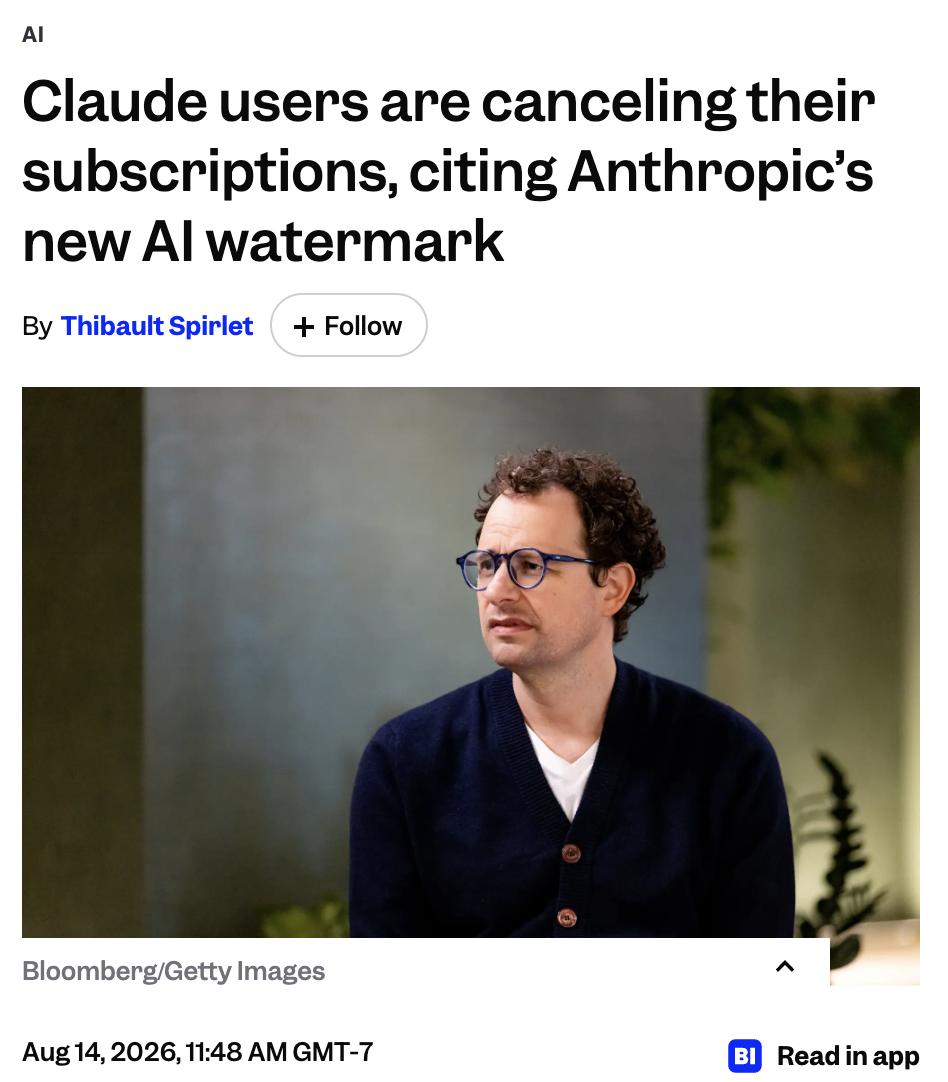
Once the code is secretly embedded with watermarks, independent developers will face huge trouble — after delivering the finished work to their clients, they may get sued and pay liquidated damages the next second.
Programmers working in large enterprises are even more panicked. If the company's core code repository is "contaminated" by AI watermarks, they will lose their jobs once the compliance audit finds the problem.
Moreover, the watermark is only the trigger of all the discontent.
The official's subsequent series of operations stacked up all the negative points, completely wearing out users' patience.
For example, the ridiculously stingy usage quota.
Different from OpenAI whose Tibor quota resets every day, Anthropic was forced to barely raise its weekly quota by 50% (and this adjustment is only valid until the end of August) after being widely criticized.
But for heavy users who rely on the tool to work every day, this increment is far from enough! Who can understand the frustration of being suddenly rate-limited halfway through writing code?
In addition, the model experience is highly unstable.
The much-hyped god-tier model Fable 5, which was launched in June, has been running into constant problems ever since its release.
When writing complex business code in practice, its performance is just like opening a blind box: sometimes it works amazingly well, sometimes it outputs completely useless garbage, so users can never trust it fully.
Since the product is overpriced and keeps squeezing users' value, it is only natural that users will choose to abandon it at any time.
OpenAI Codex's fierce counterattack
While Claude Code is mired in trouble and losing a large number of users, its arch-rival OpenAI Codex is seizing the market share rapidly.
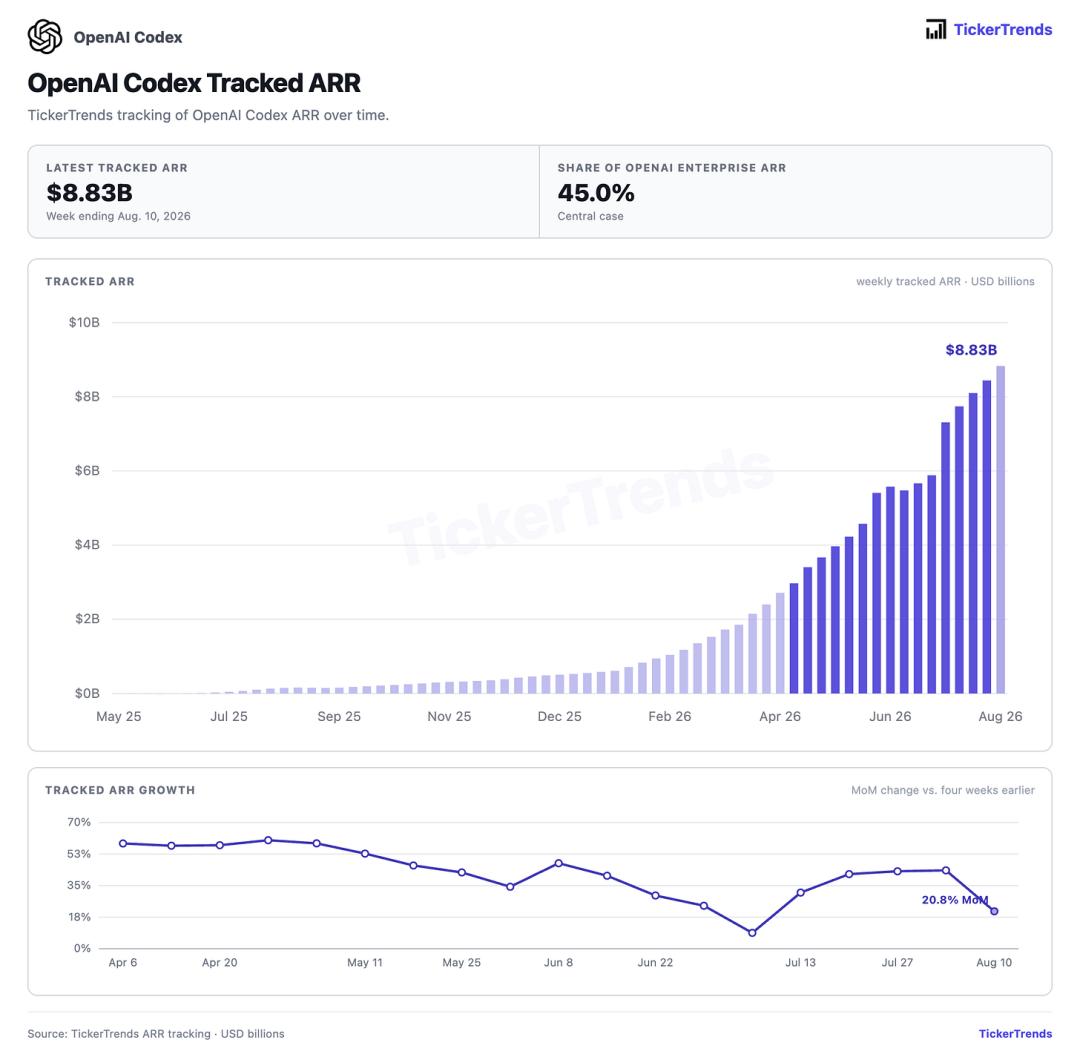
The comparative data from TickerTrends shows a total contrast between the two products.
In the four weeks ending August 10, OpenAI Codex's month-on-month growth rate reached an astonishing 20.8%, which is as much as four times that of Claude Code (5.2%)!
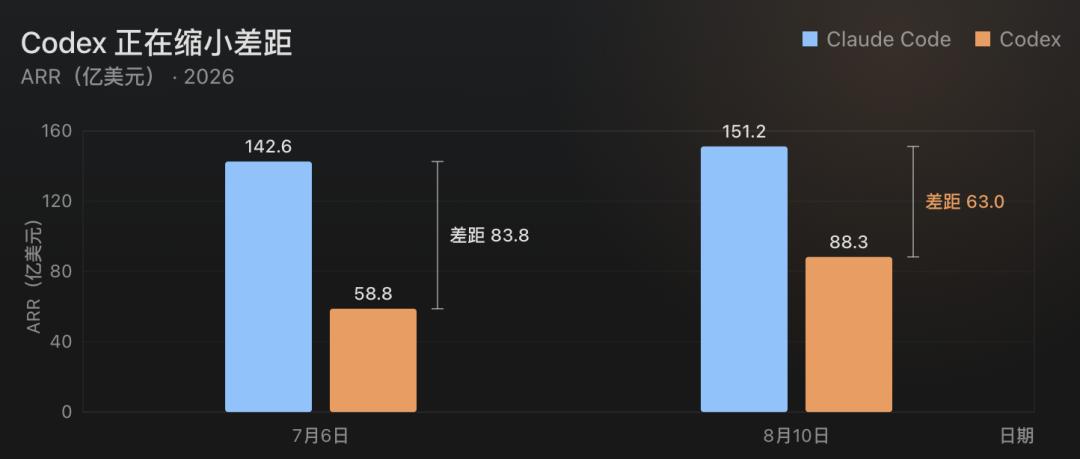
Why is Codex growing so fast? The answer is simple: it has received a large number of "refugee users" coming from Claude.
On platform X, a large number of developers stated that due to the watermark and usage quota restrictions, they have canceled their Claude subscriptions and fully switched to Codex.

Codex has looser restrictions, more seamless IDE integration, no disgusting invisible watermarks, and the strong endorsement of OpenAI's enterprise sales network (Codex currently accounts for about 45% of OpenAI's enterprise ARR).
As the comment puts it: "Users who were going to leave for Codex have all left". This is users voting with their feet.
Even Cursor, which was just acquired by SpaceX, launched a subsidy war: users can get a 200-dollar top-tier subscription for free as long as they provide a screenshot of their Claude unsubscription confirmation.
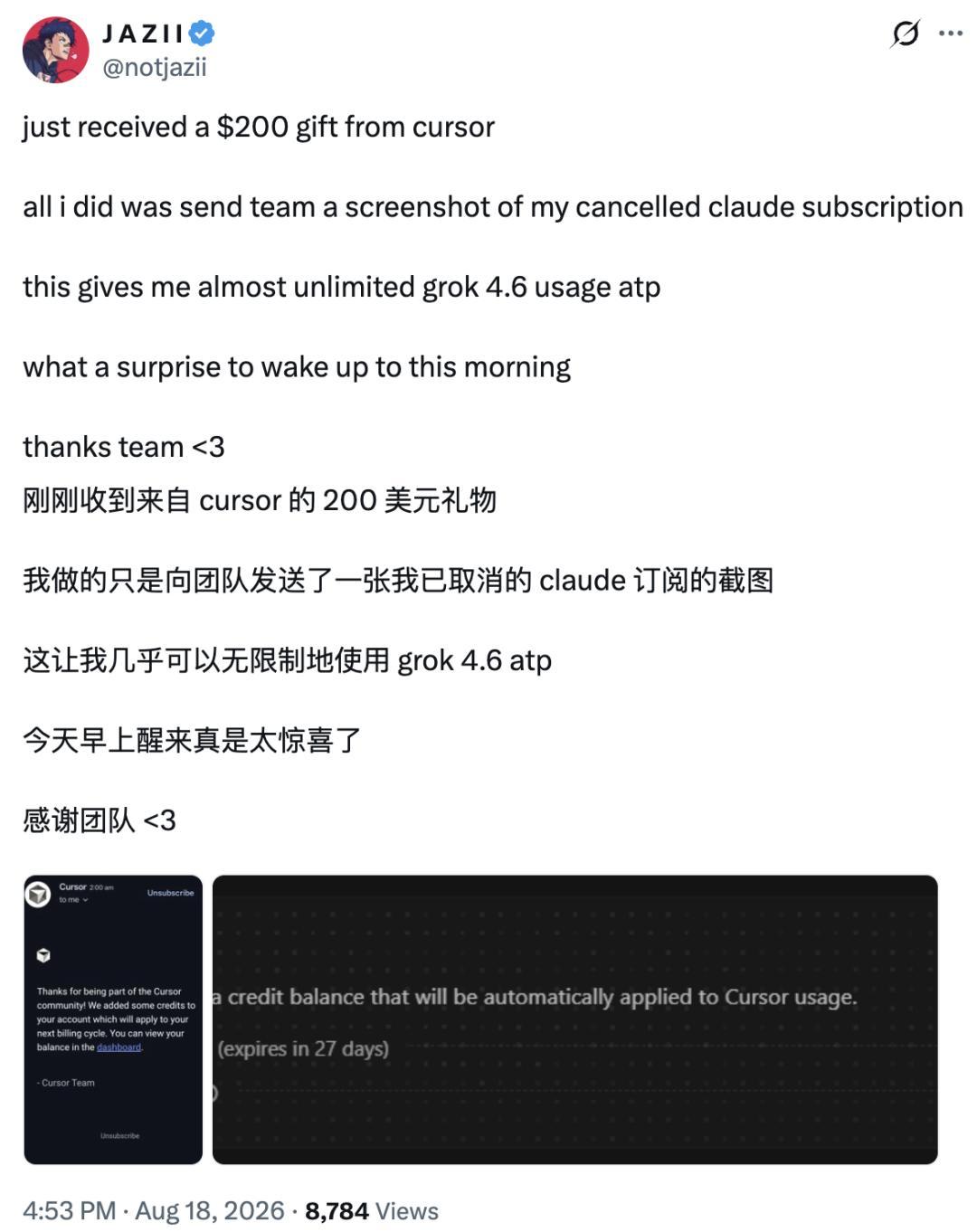

The moat that Claude Code built in its early days with its ultra-long context window and amazing zero-shot coding capabilities is being gradually eroded by OpenAI and Cursor with better product experience and more complete ecosystem.
The market enters a cooling-off period, shattering the illusion of "AI self-evolution"
Looking back at June and May this year, Anthropic was extremely high-spirited at that time.
The Fable 5 model had just been released, and team members were promoting a new narrative everywhere: "AI already has the ability to develop software on its own." "The role of human programmers will be redefined."
At the peak of the ARR surge, the entire Silicon Valley was immersed in the fanaticism of "AGI is coming soon, we are creating a god".
This narrative is extremely attractive, and it is extremely easy to make people inside the industry get carried away.
However, only two months later, reality has slapped this high-profile narrative hard.
When the tide recedes, enterprises are faced with the harsh commercial reality —
Enterprise budgets are limited, computing power is limited, and the demands of ordinary employees are very simple: they just want tools that work well, do not have unexpected flaws, and have sufficient usage quotas.
What users really care about is: "Can you stop adding watermarks to my code? Can you relax the hourly message limit? Can you design your Cowork feature to be a usable product for normal people?"
This is the common dilemma faced by all current AI super unicorns.
CC is absolutely top-tier in underlying technology, but in terms of product operation, commercialization strategies (such as forcing the watermark feature on users), and user psychology insight (such as pricing and quota setting), it acts like an arrogant novice, so it is natural that its public reputation backfires.
What pushes the discussion to a more in-depth level is the criticism from the capital and narrative perspective.
Some people point out bluntly: Anthropic's proposed IPO valuation of about 2 trillion US dollars is absurd, even higher than that of SpaceX.
But the reality is that it does not own any hardware, has no real unbreakable moat, and its prospects are not bright. Serious companies like SpaceX are developing rapidly, their intelligence level will soon surpass these models, and their revenue will also grow accordingly.
As for the IPO, more people will treat it as a tool to quickly sell their shares and achieve a decent exit.
Nowadays, the market has gone from the blind surge period to the cooling-off period.
The days when you can get huge profits just by relying on concept hype and early industry dividends are over.
Although Anthropic still has the ace of Fable 5.1 in hand, if they still insist on adding watermarks to user content, will users buy it?
Finally, a word for Anthropic: please be a responsible company and stay humble.
Do not get too carried away when you are growing fast, because your users who pay for your products can choose to leave you at any time.
References:
https://blog.tickertrends.io/p/claude-code-vs-openai-codex-arrhttps://techcrunch.com/2026/08/17/anthropics-annualized-revenue-surges-to-65b/https://x.com/oran_ge/status/2090040293383082085