A barbarian has broken into the MPV market
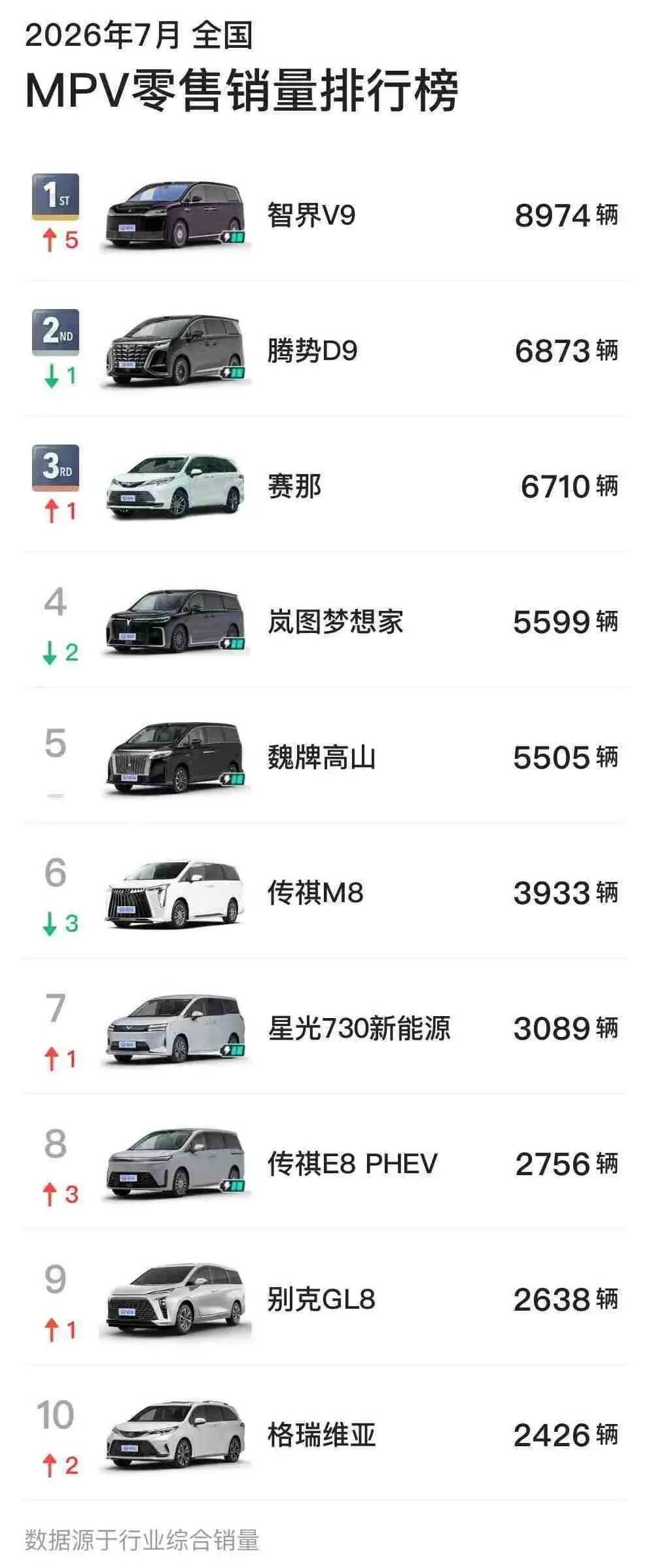
At the 2026 Chengdu Auto Show, the disruptive signals in the MPV track have been fully laid out. These signals, from the Huawei-backed brand's first MPV Zhijie V9 taking the top sales spot, to the launch of the premium MPV under the Zunjie brand, and the well-prepared arrival of Xiangjie V8, have destined that the competition in the MPV market will usher in a fierce battle in the next stage.
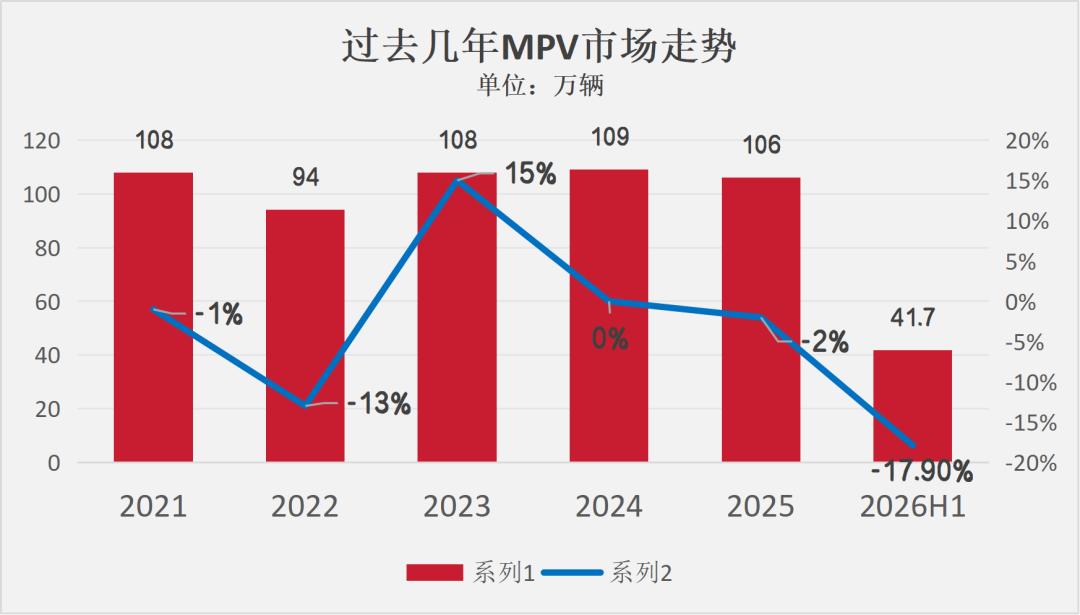
To be honest, MPV has never been a large-volume track in the passenger vehicle sector, with the annual market size stabilizing at around 1 million units, which is a typical niche segment with rigid demand.
However, in such a market with limited capacity, a large number of new vehicles are now being launched intensively, new products are expanding on a concentrated basis, and waves of players are entering the market one after another, leading to a visibly sharp rise in competition intensity. In particular, the full entry of Huawei's multi-brand lineup has completely broken the originally relatively stable pattern of the high-end MPV market, and is known as the "super barbarian" that has broken into the stock market.
Starting from this node, the logic of the MPV market has changed completely. It is no longer a simple incremental growth, but has entered an era of stock game featuring shrinking total volume, structural upgrading and soaring value.
MPV is no longer a van
When talking about the MPV market, many people will think of the term "van" in their minds, but this term is usually only used to describe micro vans of brands like Wuling and Changan.
In other words, the name "van" represents the utility vehicle attribute of the MPV market in the past that is famous for its large space, which can carry both passengers and goods, and belongs to the all-around model focusing on space. Of course, their prices are also relatively low, and they are basically positioned in the A-class MPV market with a price below 100,000 yuan.
However, looking back at the data of the past five years, the A-class MPV market is shrinking sharply. In 2021, the annual sales volume of the A-class MPV market was still 500,000 units, but by 2025, this figure dropped to 170,000 units. In the first half of this year, this figure fell again to only 40,000 units. At this pace, the total annual volume of A-class MPVs will drop below 100,000 units for the first time.
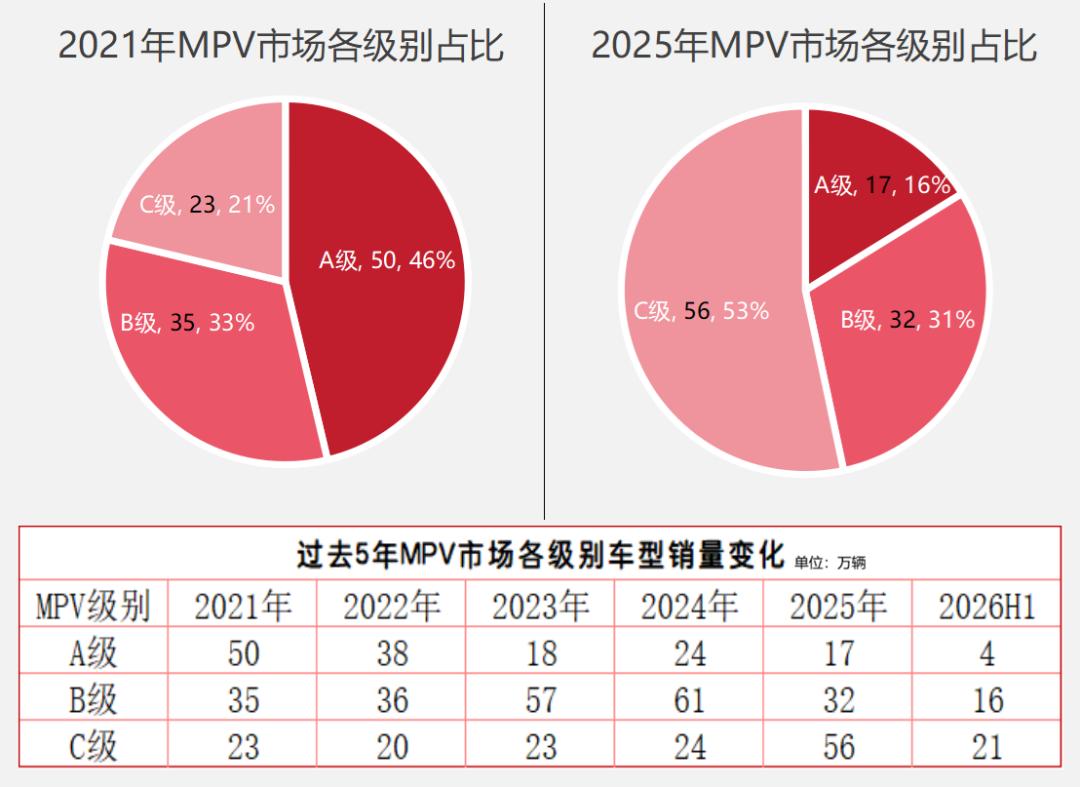
The rout of low-end entry-level MPVs is very obvious. The traditional demand for A-class MPVs as utility vehicles is continuously replaced by SUVs with large space or seven-seat layout. The MPVs that used to sell well for their utility attributes are gradually withdrawing from the mainstream consumer vision. The consumption center of the whole track is gradually shifting to B-class and C-class MPVs, among which the C-class MPVs with higher positioning are gaining strong momentum.
Data from the China Passenger Car Association shows that the total volume of C-class MPVs was only 200,000 units in 2022, but by 2025, the sales volume of this segment exceeded 560,000 units, directly accounting for half of the entire market. This set of data is sufficient to confirm a conclusion: nowadays, the main battlefield of MPVs is completely concentrated in the mid-to-high-end range above 250,000 yuan. Comfortable family use and business reception have replaced goods transportation and daily commuting as the core value labels of MPVs.
From a longer-term perspective, the MPV industry has always had a very fixed underlying law. At the beginning, it was dominated by mid-to-low-end utility vehicle attributes. In the early years, the domestic high-end MPV market was almost monopolized by Buick GL8, which long occupied the high-end market for business and family use, with almost no real competitors.
It was not until the localized production of Toyota Sienna that the market gap of high-end MPVs was completely torn open. Later, with the debut of Denza D9, which quickly won the top sales spot of MPVs, the whole industry saw the huge opportunity brought by new energy and high-end replacement.
Since then, a large number of automakers have flocked into the high-end MPV track, with new vehicles emerging in an endless stream. Voyah Dreamer, Zeekr 009, WEY Gaoshan, XPeng X9, Li Auto MEGA, Yizhen L380, BYD Xia, Galaxy V900, Leapmotor D99 and many other new high-end MPVs have been launched one after another. Almost every year, multiple heavyweight new products enter the market with the slogan of subverting the industry.
However, the reality is that although new MPV models keep emerging and the track seems bustling, the vast majority of them are just fleeting. Many new models with extremely high popularity quickly fade away after a short period of attention, without leaving continuous exposure and stable sales in the market. After years of fierce competition, the number of models that can truly gain a firm foothold for a long time, be remembered by consumers and stay at the top of the sales list is still very small.
The pattern of "a flood of new entrants but very few survivors" makes this track seem hot, but in fact it has extremely high barriers. For products that can survive and maintain a stable market base, what they compete for is never short-term popularity, but long-term product strength, reputation accumulation and brand recognition. For this reason, the originally relatively solid high-end MPV pattern has become particularly sensitive in the past two years, and Huawei's large-scale entry is even more subversive.
Will Huawei's success on AITO SUVs be replicated?
In the large SUV market in the past few years, Huawei has told the outside world through the market performance of AITO that its development path has been successful. This time, replicating this path to the MPV track has become a natural trend.
Previously, AITO M7, M8 and M9 entered the high-end SUV market, and seized a large number of shares from traditional luxury brands and domestic high-end brands, reshaping the market order of high-end SUVs above 300,000 yuan. This strong capability in product definition, traffic acquisition and high-end user conversion has now been fully applied in the MPV field.
Moreover, Huawei's layout is not a single model for trial, but precise positioning across multiple brands and full price ranges.
The upcoming Xiangjie V8 is targeted at the mainstream high-end family market of 250,000 to 400,000 yuan, Zhijie V9 focuses on the core high-end business range of 400,000 to 550,000 yuan, and Zunjie V680 and V800 directly enter the ultra-luxury field of 600,000 to 1 million yuan. From affordable high-end models to top administrative luxury models, the entire price range is fully covered, leaving almost no blank space for competitors.
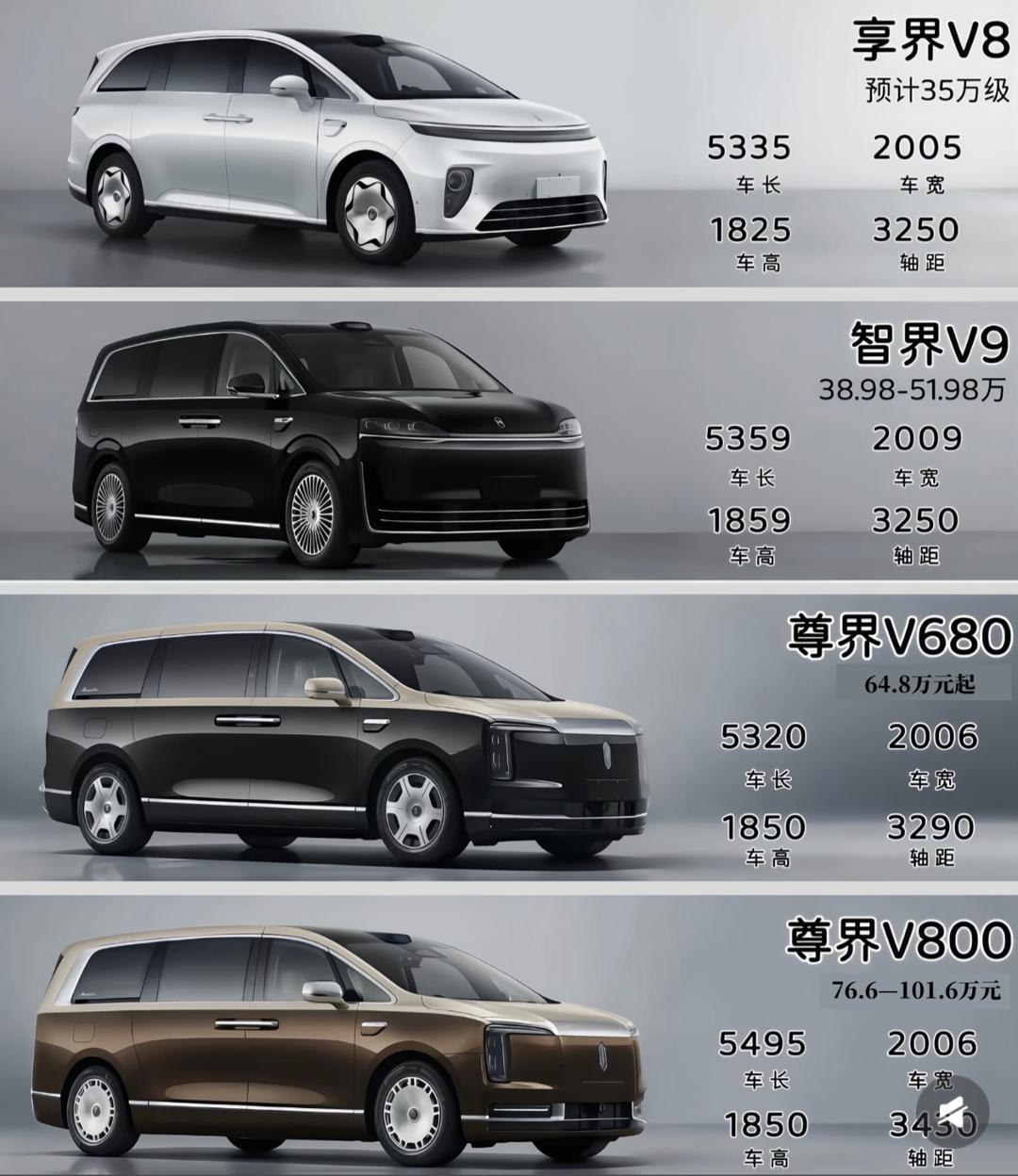
Can you get sales just by launching products? For other brands, people may have doubts. But for things that Huawei is determined to achieve, they are mostly worth expecting, and Zhijie V9 is a typical example of counterattack.
People familiar with the industry know clearly that the Zhijie brand was not in an optimistic situation at the beginning of this year, with the overall monthly sales once dropping to 2,000 to 3,000 units, almost on the verge of marginalization. However, relying only on the V9, the brand was directly pulled back from the trough to the mainstream track, with monthly sales exceeding 10,000 units and topping the MPV sales list. One single model revives a whole brand, and this extreme capability of creating hit products is a dimensionality reduction blow to the entire MPV market.
Looking at the more high-end Zunjie series, the previously launched Zunjie S800 has repeatedly surpassed Mercedes-Benz S-Class and Maybach in the million-level luxury sedan market, which has proved that Huawei's capability of building top luxury products can fully stand the test of the market. Now the Zunjie V series MPVs enter the market one after another, with booming orders in a short period after launch, and high recognition from high-end business and enterprise users, further squeezing the traditional market base of Toyota Alphard and Lexus LM.
After all, the involution in the high-end track has evolved from a simple competition in space and seats to an all-round competition in intelligent driving, ecosystem, luxury texture and brand momentum. All the original traditional high-end MPV players have to face this high-intensity competition directly. It can even be clearly said that after Huawei's entry, the comfortable era of high-end MPVs above 300,000 yuan has completely ended.
Continuous renewal leads to survival, differentiated positioning leads to victory
After Huawei's strong entry, many people will ask a question: do traditional automakers and original MPV players still have a way out in the future?
From the market performance this year, we can find that the MPV track is no longer a one-size-fits-all red ocean. The only way out in the future is hierarchical competition, with high-end segments competing for product iteration, mid-end segments competing for differentiated cost performance, and entry-level segments competing for precise satisfaction of rigid family demand.
Taking the current situation of mainstream new energy brands as an example, the most typical case is BYD's system. The market performance of BYD Xia has sounded the alarm for all traditional automakers.
Relying on BYD's huge market base, Xia was supposed to be a hit mainstream family MPV, but its final market performance was mediocre and sales remained sluggish. The core problem is very simple: in the current situation where high-end new energy MPVs are gathering and product strength competition is extremely fierce, products with conventional iteration and no differentiated highlights can hardly attract consumers to make choices.
In contrast, Denza D9 saw its sales decline and popularity drop in the early stage as the track became more competitive, but after completing the new model update, making up for product shortcomings and optimizing configuration cost performance, its sales quickly rebounded and it re-stabilized its position in the top tier of high-end MPVs.
These two contrasting cases are sufficient to sum up the survival rules of high-end MPVs: you will fall behind if you do not iterate, and you can stabilize your market base if you iterate strongly. Under the pace of Huawei's continuous high-intensity product updates, traditional high-end players can only hold their position in the stock market by continuously launching new products, upgrading and maintaining product competitiveness.
So is there still a real new blue ocean in the MPV market? The answer is definitely yes, and it is hidden in the product planning and layout of some enterprises, such as the C-class high-end family market at the 150,000-yuan level, which can fully refer to the logic of the large six-seat SUV track.
Previously, high-end large six-seat SUVs were generally priced above 200,000 yuan, with a relatively high threshold. At that time, Huajing S was priced at the 150,000-yuan level, making the 5-meter-class large-space six-seat products fully affordable, so that ordinary families can also afford large-size high-end family models, and quickly became a hit in the segment, selling more than 7,000 units in July. Next, Wuling may fully replicate this successful logic to the MPV track.
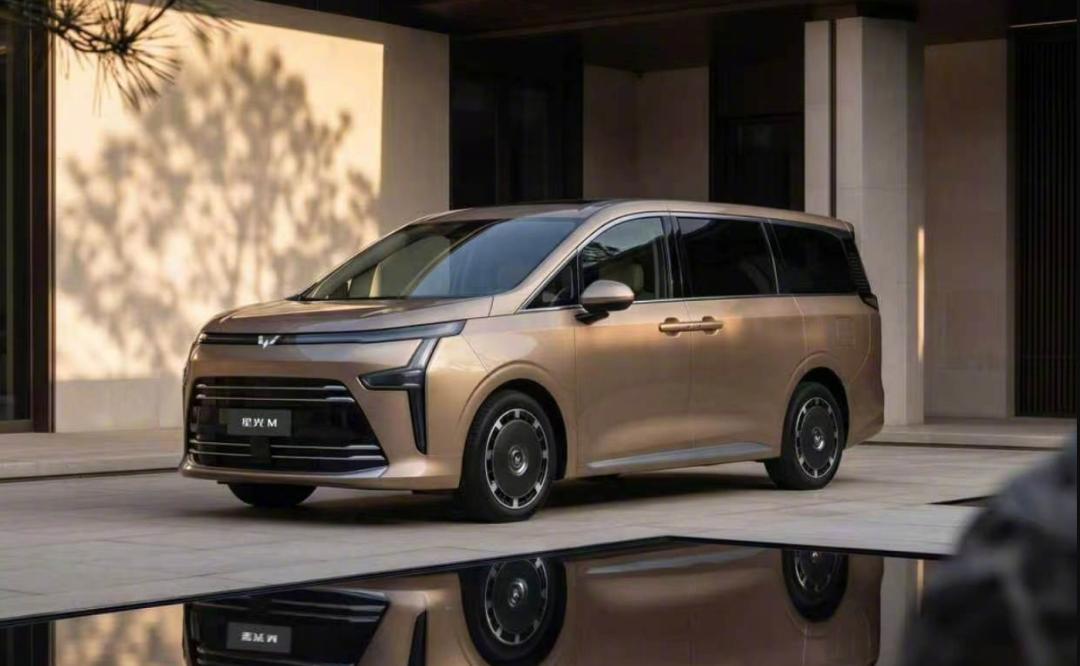
The Wuling Starlight M that was recently unveiled by the Ministry of Industry and Information Technology is a typical sample of differentiated breakthrough in the MPV market. The new vehicle is over 5.15 meters in length with a wheelbase of 3000mm, which is a proper C-class MPV size. It is equipped with a seven-seat layout, plug-in hybrid power and large space, with overall product strength comparable to traditional 300,000 to 400,000-yuan family MPVs, but the estimated starting price is only in the 150,000-yuan range, which is known as the "affordable version of GL8".
To be honest, this is also the best way out for ordinary brands in the future. Instead of blindly flocking to the bloody high-end battlefield above 200,000 to 300,000 yuan, they can rely on their own brand advantages to focus on affordable large-space, high-cost performance family MPVs, and fill the rigid demand gap of mainstream family users.
There is also an obvious trend in the current industry: even new power brands like Xiaomi have begun to learn from the space and comfort logic of MPVs to transform their SUV products. This fully proves that users' demand for family vehicles with large space and high comfort is long-term and continuously strong.
This major MPV disruption triggered by Huawei seems to be a barbaric entry, but in fact it is forcing the entire industry to complete the ultimate evolution from "barbaric growth" to "refined stratification". It remains to be seen whether Huawei can make the fire of the MPV market burn even more vigorously this time.
This article is from the WeChat official account "Auto Community" (ID: iAUTO2010), written by Du Yuxin, and published with authorization from 36Kr.