Please stop saying that multinational pharmaceutical and medical device giants cannot make money in China.
$2.5 billion. This is the product sales revenue of Novartis in China in the first half of 2026.
In the same period, Novartis' global net sales reached $27.5 billion, a year-on-year increase of 1%, and a 2% decrease at constant exchange rates. However, the Chinese market recorded a 13% year-on-year growth, a 7% increase at constant exchange rates, accounting for approximately 9% of Novartis' global sales.
If we only look at Novartis, the "recovery of multinational pharmaceutical and device enterprises' business in China" seems to be happening.
But when we turn to Merck's financial report, the picture reverses immediately.
In the first quarter of 2026, Merck's pharmaceutical sales in China reached $721 million, down 33% from $1.075 billion in the same period of the previous year; although the decline narrowed to 9% in the second quarter, the pressure still exists.
The drag mainly comes from the vaccine segment and mature products.
In the first quarter, GARDASIL and ROTATEQ saw a sharp decline due to reduced demand in China; although GARDASIL's global sales returned to positive growth in the second quarter driven by demand in Asia-Pacific and Europe, mature products such as JANUVIA continued to be impacted by generic drug competition throughout the first half of the year.
The growth inertia brought by the old ace products is weakening.
Roche also did not see a full rebound.
In the first half of 2026, its pharmaceutical sales in China were approximately 1.49 billion Swiss francs, down 9% at constant exchange rates. One important reason is the high base of influenza drug Xofluza in the first half of 2025.
However, Roche's internal product structure presents a different picture. Phesgo's strong growth in the International Region is "mainly led by China"; the high growth of Polivy, Gazyva and Alecensa in the international market is also mainly driven by Chinese demand.
Thus, an interesting phenomenon has emerged.
In the same Chinese market, Novartis achieved 13% growth, Merck's first quarter performance fell by 33%, Roche's pharmaceutical business decreased by 9%, and AstraZeneca, which has long been the "top multinational pharmaceutical enterprise in China", also saw its revenue in the Chinese market drop by 5% at constant exchange rates in the first half of the year.
Even within the same company, there are starkly contrasting performances.
Taking AstraZeneca as an example, on the surface, the overall market is under pressure because its former 10-billion-level ace hypoglycemic drug Farxiga and renal drug roxadustat both suffered a cliff-like decline in emerging markets including China due to the impact of volume-based procurement and generic drugs (roxadustat plummeted by 64% in the first half of the year).
But on the other side of the coin, its heavy innovative asthma drug Fasenra achieved a 75% counter-trend surge in emerging markets in the second quarter after being included in China's National Medical Insurance Catalogue in the first quarter of this year.
On one hand, old drugs have fallen to the bottom due to volume-based procurement, on the other hand, innovative drugs are expanding to reach new peaks. Even within the same company, there is a dilemma where innovative drugs are seeing rapid volume growth while mature products are under pressure.
Therefore, we can find that different from the previous overall growth situation, in the first half of 2026, it is difficult for multinational pharmaceutical and device enterprises in China to share a unified growth curve.
In the past few years, "volume-based procurement", "domestic substitution" and "multinational pharmaceutical enterprises retreating" have continuously reinforced a judgment - it is increasingly difficult for foreign enterprises to make money in China.
However, behind the latest financial reports of various enterprises, it is revealed that the easy money is indeed getting less and less, but growth has not disappeared. Instead, it is concentrating on a few tracks, a few products and innovations with truly differentiated values.
Since then, a new set of growth rules is taking shape.
Drug Shift: Growth Sinks from "Company" to "Product"
This value redistribution is first reflected in the pharmaceutical market closest to patients.
The most obvious change is that the granularity of judging growth is becoming finer, and the average growth rate at the company level can no longer represent the fate of specific products.
Novartis is a typical sample. In the first half of the year, Novartis' global sales decreased by 2% at constant exchange rates, while the Chinese market grew by 7%.
But more important than these 7 percentage points is: Where does the growth actually come from?
The first answer is innovative products.
In the first half of 2026, the global sales of lipid-lowering drug Leqvio reached $932 million, a year-on-year increase of 68% and a 64% increase at constant exchange rates; it reached $480 million in the second quarter alone, a year-on-year increase of 61%.
Novartis clearly mentioned in its financial report that Leqvio's growth in China comes from the continuous volume expansion after it was included in the National Medical Insurance Catalogue in January this year. After entering the medical insurance, the patient access threshold was lowered, demand was significantly released, and the product achieved continuous volume growth in the Chinese market.
This presents another side of "medical insurance price reduction". Price reduction is a concession that enterprises have to bear, but if the product has sufficiently clear differentiated value, greater patient coverage and lower access threshold may expand the market again through sales growth.
Even if Novartis China achieves overall growth, there is no simultaneous increase across the board internally. Leqvio continues to expand its volume, Rhapsido starts to contribute incremental revenue, but Cosentyx's sales in China have declined.
The differentiation of Entresto is more obvious. Affected by the US patent cliff and generic drug competition, its global sales in the first half of the year decreased by 46%, and the second quarter single-quarter sales decreased by 50%; but in markets outside the United States, it maintained growth by virtue of its globally approved "heart failure" indication and the "hypertension" indications approved in China and Japan.
This shows that the unit that determines the growth curve is sinking from "company" to "product", and even specifically to "indication".
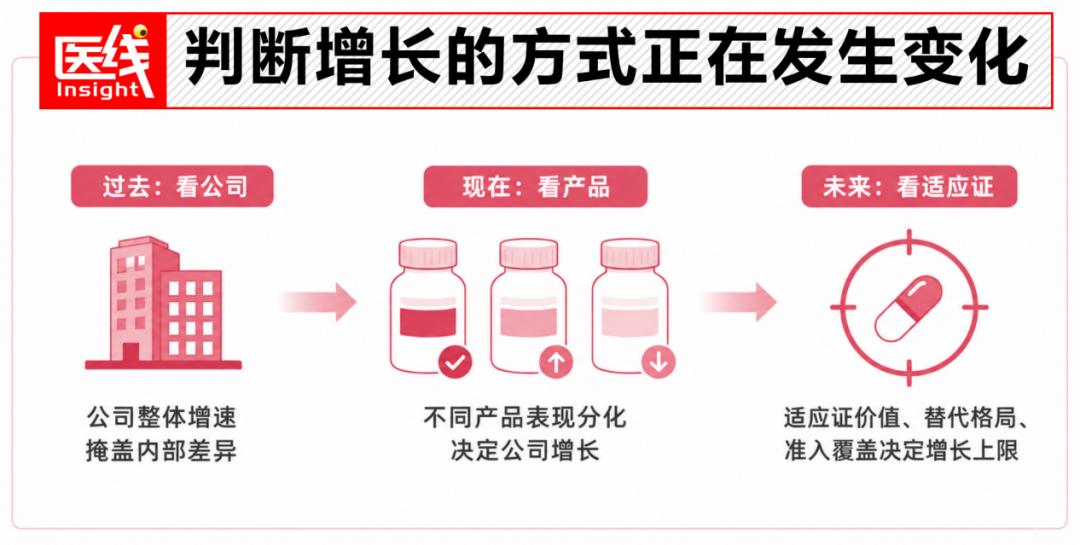
Schematic Diagram of Growth Mode Change
Clinical value, alternative solutions, medical insurance access, patient coverage and new demands begin to directly determine the commercial ceiling of a product.
Daiichi Sankyo's Enhertu embodies the "product value determines growth" logic more directly.
From April to June 2026, Daiichi Sankyo's ASCA business revenue reached 68.7 billion yen, a year-on-year increase of 21.0%.
This growth rate is based on the overall caliber of Asia, South America and Central America, and cannot be directly equated with "21% growth in China", but the company clearly disclosed that Enhertu's sales growth in the Chinese market is one of the factors driving the rise of ASCA.
The more critical point is the indication expansion. From December 2025 to March 2026, Enhertu was successively approved in China for chemotherapy-naive HR-positive HER2-low expression/ultra-low expression breast cancer, second-line treatment of HER2-positive gastric cancer and neoadjuvant therapy of HER2-positive early breast cancer; in June, the new acute myeloid leukemia drug Vanflyta was also approved in China.
Continuous indication expansion provides a path for innovative value to be continuously transformed into commercial scale.
In the past, labels like "international big factory", "original research" and "imported" themselves carried high commercial premium; now, the weight of these labels is decreasing, and payers, hospitals, doctors and patients are more and more directly measuring the therapeutic value and substitutability of the product itself.
Novo Nordisk takes this logic a step further.
That is, products with real incremental value not only compete for stock, but may also create new demand.
In the first quarter of 2026, Novo Nordisk's Region China sales decreased by nearly 11% year-on-year at constant exchange rates; by the second quarter, it had turned to a 13% growth, showing that the reversal in the second quarter was very obvious.
The most prominent growth comes from the obesity business. In the second quarter, the sales of the obesity business in Region China reached 335 million Danish kroner, a 104% year-on-year increase at constant exchange rates.
It is more noteworthy that this single-quarter high growth occurred after the core product Wegovy lowered its online listing price at the end of the fourth quarter of 2025.
The financial report shows that affected by the pain in the early stage of price reduction, the overall sales of Novo Nordisk China's obesity business in the first half of 2026 actually still decreased by 11% year-on-year at constant exchange rates.
But this does not mean that the price reduction strategy has failed. The 104% counter-trend rebound in the second quarter shows that the strongly released new sales volume finally covered the gap caused by price concessions in a single quarter, and re-formed scale increment.
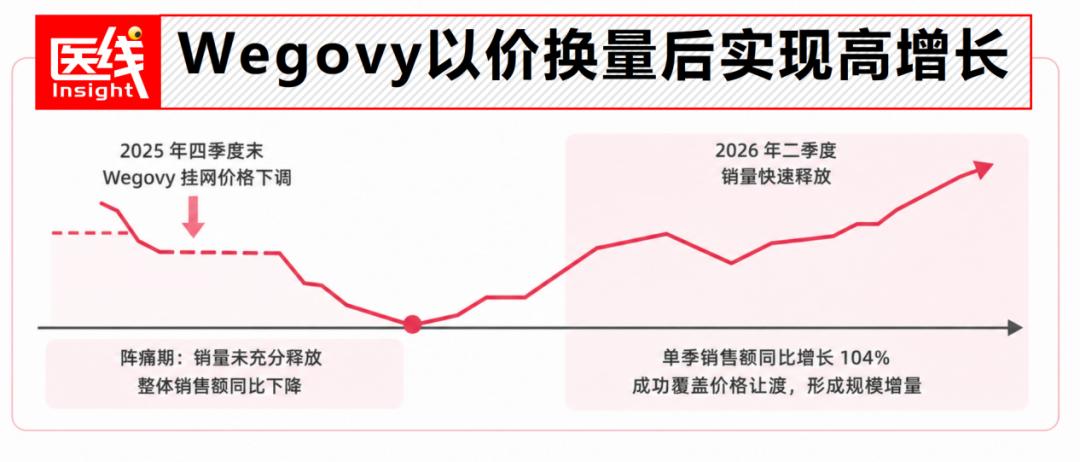
Schematic Diagram of Growth Achieved by Trading Price for Volume
New generation drugs such as obesity treatments are also converting a part of the population that did not receive adequate drug treatment in the past into new medication demands.
It is not difficult to find that the money in China's medical market has not disappeared, but it is flowing to new disease fields, new treatment methods, and products that are harder to be replaced.
However, drugs can still achieve scale expansion through medical insurance coverage expansion.
The more severe problem lies in the device sector: after the price is directly suppressed by volume-based procurement, can growth be restored?
Device Reshuffle: How to Restore Growth After Volume-based Procurement
Medical devices are a touchstone for testing this new set of rules.
Compared with drugs, device enterprises face the price revaluation brought by volume-based procurement more directly. It is not enough for products to have value. The key is whether enterprises can re-expand their business through new products, sales volume and product mix after price reduction.
Boston Scientific is a typical case.
In the first quarter of 2026, its international market business including China performed strongly; in the second quarter, this international region continued to maintain steady growth.
But Boston Scientific is not outside the scope of volume-based procurement.
The financial report shows that the stone management business in the urology pipeline was affected by China's volume-based procurement and the lack of key product portfolio, and the Chinese arterial business in the cardiovascular segment was also impacted by volume-based procurement.
Mature pipelines are under pressure, why can the overall Chinese business still maintain double-digit growth?
The answer lies in the product mix.
Driven by double-digit growth of coronary products such as AGENT (paclitaxel-coated balloon), the company's coronary intervention business achieved 9% and 15% growth respectively in the first and second quarters.
The international electrophysiology business continued to grow by more than 20% driven by innovative mapping systems and PFA (pulsed field ablation).
Two curves in opposite directions can exist at the same time. Mature pipelines bear the pressure of volume-based procurement, and innovative products expand rapidly.
Therefore, what ultimately determines the company's performance is whether the entire product portfolio can use new increments to cover the decline of old businesses.
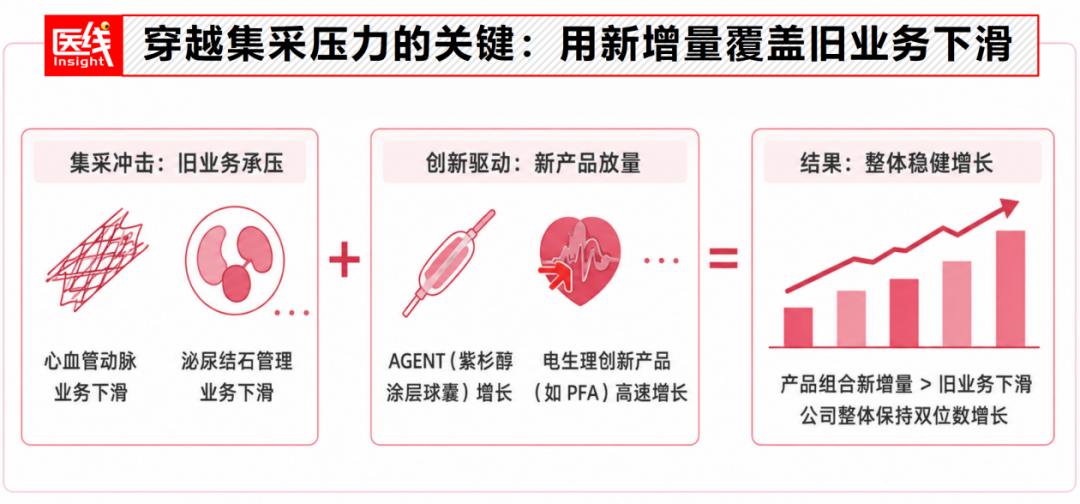
Schematic Diagram of Surviving Volume-based Procurement
Johnson & Johnson provides another sample of coping with pressure through product mix.
In the second quarter of 2026, Johnson & Johnson's MedTech global operational sales grew by 3.6%; among them, there are both steady performance of traditional mature products such as wound closure and Biosurgery in the Surgery business, and strong pull of high-barrier innovative pipelines such as electrophysiology products in the cardiovascular intervention field and newly acquired Shockwave, both of which have become sources of growth.
This set of data is mainly based on the global caliber and cannot directly represent China, but it reveals the common solution for device giants to go through cycles: while stabilizing the base of mature pipelines, supplement growth with innovative products with higher barriers.
In the field of in vitro diagnostics, price pressure is more directly manifested.
Roche's half-year report shows that its diagnostics business decreased by 5% in the Asia-Pacific region at constant exchange rates in the first half of the year, and the Chinese market decreased by 15%. The company clearly stated that this is mainly affected by China's volume-based procurement for immune diagnostic products.
It can be seen that the pressure of volume-based procurement does exist, but growth opportunities are not completely blocked.
The past model of maintaining advantages by relying on brands, technological generation gaps and hospital channels is fading, enterprises must re-find space through new products, product mix, surgical procedure expansion and sales growth after price revaluation.
Foreign enterprises are still at the table, but the rules that determine the seating order have changed.
Both the drug and device sectors point to the same conclusion: old advantages still have value, but it is increasingly difficult to exchange for growth alone.
But this is only the change in terminal sales and clinical application.
To judge whether growth is spreading to the industrial level, we need to look further upstream.
Upstream Recovery: R&D and Production are Resuming Spending
The growth of drugs and devices may be driven first by a few strong products; upstream orders are more like an industrial thermometer.
Increased purchases of equipment, consumables and services by pharmaceutical enterprises and laboratories mean that changes are beginning to transmit from the terminal to R&D and production links.
In the first half of 2026, Danaher and Thermo Fisher gave signals in this regard.
They are further away from patients, but closer to the industrial cycle, and their orders and revenue often reflect changes in R&D and production budgets earlier.
Let's look at Danaher first.
In the first quarter of 2026, the company's global core revenue increased by only 0.5% year-on-year, while the core revenue in China achieved a mid-single-digit growth; among them, Biotechnology and Life Sciences performed better than expected, offsetting the decline of Diagnostics caused by weak demand for respiratory disease tests of its subsidiary Cepheid in the first quarter.
In the second quarter, Danaher's global core revenue increased by 3%, reaching $6.3 billion, a year-on-year increase of 5.5%; the management once again stated that the Chinese market achieved mid-single-digit growth.
Growth for two consecutive quarters is more noteworthy than a single-quarter rebound.
More importantly, it is about orders. Danaher's management said that the life sciences business delivered "the strongest single-quarter performance in several years" in the second quarter, and the underlying order volume of the bioprocess business increased by more than ten percent.
Orders usually lead revenue. Double-digit order growth from biotech and life science enterprises means that customers