Having stayed in the US for 25 years and engaged in robotics research and development, he said, "I have perfectly missed all opportunities to make a fortune."
Companionship brings people closer to each other, instead of creating a substitute for people to hide in.
Zhang Fumin spent 25 years in the United States and has been engaged in robotics research and development for 25 years. When he entered the industry in 1998, the International Robotics Conference had fewer than 400 attendees. Not long ago, he went to Vienna to attend the same conference, and there seemed to be 10,000 people in the venue.
People who experienced the early quiet years of the industry have a different perspective on the current bustling boom. In his words, it is almost impossible for any enterprise to stand up and claim that "I am stronger than Unitree and Agibot" nowadays. Therefore, his choice is to explore new directions: not to develop humanoid robots, but to focus on companionship technology.
When we asked how many years it would take for the "GPT moment" of embodied intelligence to arrive, he estimated it would be 5 years. Elon Musk once predicted that fully autonomous driving would be fully realized in 2021, but it has not been achieved as of this year. He is not afraid of industry bubbles, as he believes bubbles are a good thing for a young industry. What he fears is another word: irrationality.
His solution is not to cool down the overheated tracks, but to inject momentum into the underdeveloped cold tracks.
He has been working on marine robots for more than 20 years, and other similar tracks include construction robots and agricultural robots. The path of integrating these industries with real scenarios is very long. Every step forward for marine robots is extremely difficult, and none of the sensors, communication systems, propulsion devices and batteries can achieve rapid iteration. While 6G technology is already under discussion on land, the communication technology in the ocean may still stay at the 1G level. Niche tracks are not crowded, but they are all waiting for people to explore and develop.
As for the gap between China and the United States in this field, he believes that we should face it calmly first. "In the 1990s, our ceiling was equivalent to their floor; now our overall level has improved greatly."
In 1998, Zhang Fumin went to the United States. After completing his postdoctoral research at the University of Maryland, he taught at the Georgia Institute of Technology for 15 years, was elected as a Fellow of both IEEE and ASME, and focused on marine robots and cyber-physical systems. He participated in the whole process from development to commercialization of China's underwater gliders. After returning to China, he served as the dean of the Zhengjiachun Robotics Institute at the Hong Kong University of Science and Technology for three years. Now he is the chief scientist of "In2mate Shadow Technology", specializing in companion robots.
In the novel *The Demi-Gods and Semi-Devils*, Wu Yazi carved a jade statue that looked exactly like the younger sister of Li Qiushui. Li Qiushui was right beside him, but he stared at the jade statue in a daze every day. Zhang Fumin said that if he had made this statue, he would definitely program it to remind Wu Yazi from time to time: "You should give Li Qiushui a call." Companionship brings people closer to each other, instead of creating a substitute for people to hide in.
Jin Yong used this story as a metaphor for "loneliness": even if the most beautiful girl in the world is by your side, you still cannot avoid loneliness. In Zhang Fumin's view, King Edward VIII of the UK gave up the throne for Mrs. Simpson because that woman understood him. Loneliness has nothing to do with social status, nor does it have anything to do with whether there is someone accompanying you around.
Can academic research, entrepreneurship, and even AI and companion products become the solution to loneliness? Zhang Fumin said that no single thing can completely eliminate human loneliness. Loneliness is even the driving force for human progress, and many great works of art are created by people in a state of loneliness. His products cannot promise to dispel loneliness either, they only promise to make people feel a little more comfortable when they are lonely.
He repeatedly emphasized that real AI should enhance people's sense of control over the world, rather than making people feel increasingly powerless.
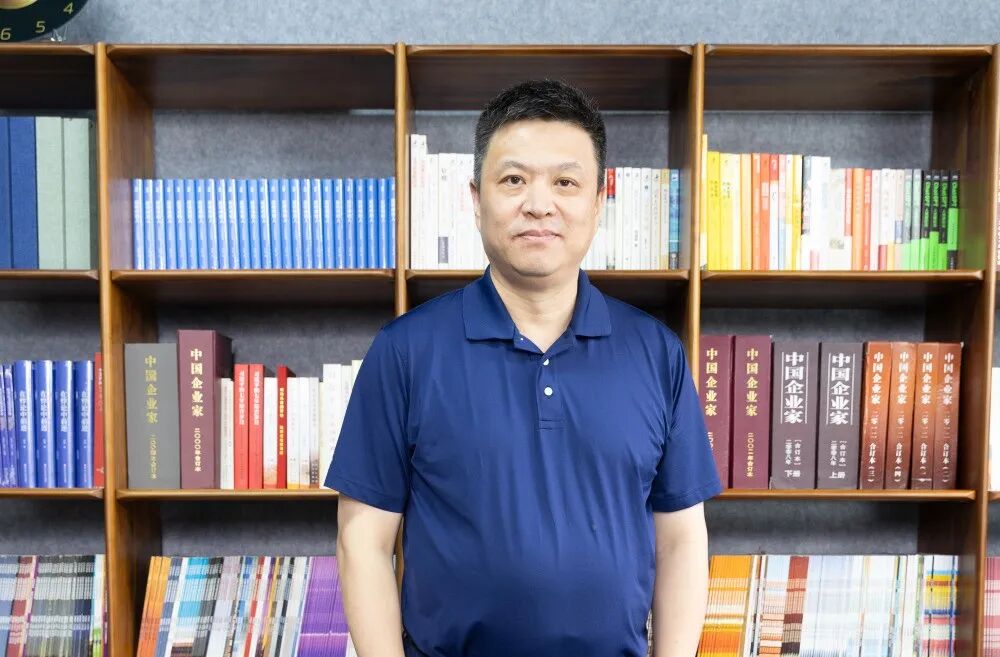
Photography: Deng Pan
After starting his business, Zhang Fumin had a strong feeling of "setting foot on the journey to fetch the Buddhist scriptures". The most important thing for Tang Sanzang and his disciples to fetch the scriptures is the growth they experience during the whole process. After they obtained the scriptures, their way of behaving and dealing with others changed completely. The same goes for life: you have to keep moving forward instead of standing still. "The Lingshan Mountain, the final destination of the pilgrimage, can never be reached, but what you gain on the way can make you a better person. This is also a form of spiritual practice." He believes in finding joy in hardship and enjoying the whole process.
The following is the full interview record of Zhang Fumin by *China Entrepreneur*:
Excitement, Euphoria and Anxiety
*China Entrepreneur*: WAIC has just concluded, and the embodied intelligence boom is surging. How can entrepreneurs find their own focus and stability?
Zhang Fumin: The exhibition represents a possibility for the future. Some robots can perform very cool movements, and can fetch water and fold clothes under the guidance of VLA (Vision-Language-Action model), which have entered many family scenarios. This is great, but for the industry implementation, in addition to possibilities, we also need to turn them into certainties.
What users buy is certainty. Can the robot succeed every time after 10 attempts? Even if it succeeds 9 times, many users will hesitate, and different industries have different tolerance for failure.
*China Entrepreneur*: Are investors more anxious now, or are entrepreneurs more anxious?
Zhang Fumin: It is not necessarily anxiety, it should be described as excitement. Both investors and entrepreneurs are very excited. The depth, breadth and complexity of this track are unmatched by several previous industry booms. We have experienced the boom of the Internet and autonomous driving, and going further back, I also experienced the boom of communication companies in my early years.
Now everyone is in a state of excitement. After excitement may come euphoria, and after euphoria comes anxiety. Now the valuation of some enterprises is already very high, but their business models are not yet very clear, which is easy to cause anxiety at this stage.
*China Entrepreneur*: So how many years do you think it will take for the industry to usher in its "GPT moment"?
Zhang Fumin: The embodied intelligence industry may take another 5 years to achieve a certainty rate of 80% to 90%. When it comes to truly critical industries, the industrial circle requires a 99.99% success rate, which means only one failure in ten thousand attempts, and that will take a much longer time. What investors care about is not to achieve 100% perfection. As long as they can make profits and promote the development of the industry, that is enough.
*China Entrepreneur*: Domestic embodied intelligence enterprises are setting off an upsurge of going public, but stakeholders will ask: how many real landing cases are there, and how many products only stay at the demo or PPT stage?
Zhang Fumin: For a young industry, having bubbles is a good thing, as long as it does not go to extremes. Bubbles represent optimism and show that people are optimistic about the prospects of this industry. Investment reflects the prediction of the future. Investors have professional analysis teams, and they will not make decisions purely on impulse or herd mentality. Top investors are very rational and will conduct a lot of in-depth analysis.
Bubbles are not scary at all. What we need to worry about is irrationality. Any irrational event in history has caused huge losses in the end. I do not want embodied intelligence to become such a track.
*China Entrepreneur*: Have the head players in the robotics track begun to take shape and the market pattern become relatively concentrated?
Zhang Fumin: It is gradually converging. If no disruptive technology emerges, the existing players are all developing in depth, and there is little room left for start-up teams in the humanoid robot track. Now if a new entrepreneurial team says it wants to build a robot company stronger than Unitree and Agibot, it is already very difficult to convince investors.
Source: AI Generated
*China Entrepreneur*: So you don't think you belong to this camp of humanoid robot startups?
Zhang Fumin: What we are doing should not be defined as humanoid robotics, and it is more appropriate to call it companionship technology. The carrier may be a full-size humanoid robot, but what we actually focus on is emotional companionship. When people talk about humanoid robots now, they can name no more than 20 leading enterprises in their minds. We will not compete with such leading enterprises, because our tracks are completely different.
*China Entrepreneur*: What do you think of the highly controversial humanoid bionic robot products developed by Ubtech? Are you doing the same thing as them?
Zhang Fumin: Ubtech is the first person to eat crabs in this field. It brought full-size humanoid robots under the spotlight, which aroused great public attention. This is a good thing, because people used to avoid discussing related topics before. When Ubtech launched this product, there must have been negative voices at the beginning. The main reasons are the immaturity of technology and the insufficient product power, and the whole industry is still in the initial stage. Ubtech's products already have a relatively high degree of completion, but there is still a gap from the ideal form expected by the public. This just shows that the industry has huge room for improvement. When new things first appear, it is normal to have critical voices. The key is to see what the final goal is, and whether you can prove to everyone in a relatively short time that you can achieve the goal. From the perspective of the whole embodied intelligence field, this is a brand new track. Our ideas are also different from Ubtech: it focuses on promoting humanoid robots, while we are dedicated to companionship technology.
General Purpose or Special Purpose: An Unresolved Debate
*China Entrepreneur*: Everyone talks about general-purpose robots when discussing embodied intelligence. Does a future of fully general-purpose robots really exist?
Zhang Fumin: This is a controversial topic in both academic circles and the industry. The pro side believes that after thousands of years of development of human society, only several forms have been retained: the form of human, dog, horse and cow. These forms have been tested by history, and general-purpose robots should imitate these forms. The con side believes that general-purpose means being able to do everything, but may not be able to do anything well. The robots that sell well and have real market demand now are all special-purpose robots.
At present, special-purpose robots account for the vast majority, and they are the ones that actually perform practical work. General-purpose robots are still in the possible stage, and have not reached the stage of certainty. As time goes by, will the improvement of general-purpose robot capabilities replace special-purpose robots? Especially in some scenarios that special-purpose robots cannot enter, such as family scenarios. No family will place more than a dozen robots at home. Is it feasible to put one general-purpose robot to complete more than a dozen tasks? We can only wait for time to give the answer.
*China Entrepreneur*: People generally believe that physical AI is the path to AGI.
Zhang Fumin: I think it is the other way around: AGI will definitely lead to physical AI. Moreover, I think physical AI still has limitations, and the final form should be physical human-centric AI. AI should not only be implemented in the physical world, but also be integrated with human nature. Only such AI is the ultimate form we expect. AGI is a means, a ladder to achieve the final goal. I majored in control in college and have been working in the robotics industry. Whether it is industrial robots or service robots, my work has never been separated from the physical world. Later, I expanded my research boundary to human beings, to human nature, psychology and social behavior. I have always been concerned about the physical world and people. AI should serve people and the physical world, instead of turning everything we do in the physical world and for people into AI.
*China Entrepreneur*: You have stayed in the United States for more than 20 years. Is the gap between China and the United States in the field of robotics or embodied intelligence narrowing?
Zhang Fumin: In the past, the United States ranked first and China ranked second. From our current perspective, the United States is still slightly ahead of China. But the gap is completely different from when I was in college. In the 1990s, China's ceiling was just enough to touch the floor of the United States. Now our ceiling has been raised a lot, and we even perform better than the United States in some fields. But there is still a certain gap, and both sides have their own strengths. In the field of AI, from the perspective of originality, this wave of AI boom was initiated by the United States. OpenAI released ChatGPT, and the humanoid robot track of embodied intelligence was first led by Elon Musk's Tesla. This is a fact that we must recognize. But we also have Kimi, DeepSeek and many other distinctive domestic products.

Source: AI Generated
*China Entrepreneur*: The capabilities of Kimi K3 seem to have made overseas companies very nervous recently.
Zhang Fumin: It is normal for them to feel nervous. At the level of algorithm, computing power and data, algorithm equalization is relatively easy. Once an algorithm is invented and open sourced or published in academic journals, both sides can master it. In terms of computing power, the United States is still slightly ahead. In terms of data and scenarios, China has richer resources. If there are only three large model companies left in the world in the end, I hope they are not all American companies, and it is also impossible for all of them to be Chinese companies. How China can occupy a place in this field is what we need to work hard for.
*China Entrepreneur*: What are the differences between domestic and US investment directions in AI?
Zhang Fumin: Both sides attach great importance to and promote this field, and the investment circles are very optimistic about its prospects. The United States focuses more on the software direction, while China is better at the industrial chain and hardware direction. Embodied intelligence is a field that leans towards hardware and industry, and requires a complete industrial chain, so the development speed in China is faster than that in the United States. In the fields that lean towards software, require large computing power and huge investment, the United States is temporarily ahead.
Between Fast and Slow: Communication in the Ocean Still Stays at 1G Level
*China Entrepreneur*: What is the biggest test for you when you switch from an academic researcher to an entrepreneur?
Zhang Fumin: The biggest test is the rhythm of doing things. When doing basic scientific research, everyone is patient enough to give you enough time. But entrepreneurship requires you to solve problems in the shortest possible time. Sometimes the solutions you come up with are not particularly complete or cutting-edge, but as long as they can solve the problem, they are acceptable. This is the biggest difference between basic research and entrepreneurship. For example, the company I am participating in now iterated the first version of the product in about 3 months. This is very difficult to achieve from the perspective of scientific research, but the company pursues efficiency, and needs to develop products that can solve problems with the lowest cost and the shortest time. This has greatly impacted my previous cognition. At the beginning