2026 WRC, All Facets of Embodied Intelligence
Robotics education should start from children!
On August 19, the opening day of WRC (World Robot Conference), a large number of groups of primary school students arrived at the exhibition site. Full of curiosity and raising all kinds of novel questions, they have become a unique and beautiful sight at the venue.
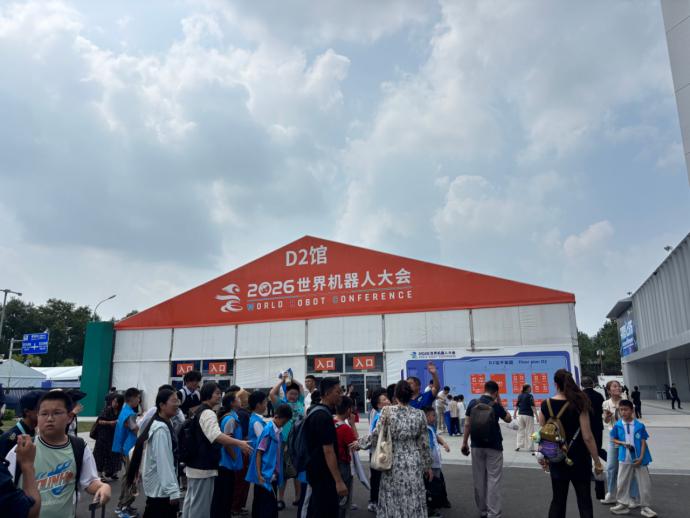
As the core event rooted in the robotics industry, WRC this year saw AI step down from the leading role for the first time, and become a capability layer embedded in the entire industrial chain.
Compared with WAIC held one month ago, both events are dominated by the boom of embodied intelligence, but the narrative focus has shifted significantly. If WAIC represents AI moving downward to find a physical carrier, WRC represents robots growing upward to gain intelligent "brains" and striving downward to achieve large-scale mass production.
This year, the financing scale of embodied intelligence is huge. According to data from IT Juzi, the total financing amount of China's embodied intelligence sector in the first half of 2026 reached 935 billion yuan, with the cumulative total hitting 1.217 trillion yuan so far, 67% higher than the full-year figure of last year. This conference has become a key occasion for enterprises to examine the mass production and pricing window, and also provides a roadshow platform. Capital no longer sprinkles funds randomly just for the concept of "humanoid robots". Shipment volume, production line working hours and repurchase rate have replaced cool dynamic demonstrations, and become the new hard currency in the industry.
As the conference set up the "Procurement Day" for the first time, almost all relevant manufacturers have spared no effort to strengthen their market orientation. Most pavilions have built real landing scenarios, such as logistics sorting, shelf restocking, cooking, etc. Even some robots for underwater cleaning scenarios have built several square meters of deep pools on site for demonstration.
Hall C is the most important arena of fame and fortune, gathering top embodied intelligence companies, which stand opposite to the exhibition area of central state-owned enterprises across the aisle.
Unitree Robotics
Unitree Robotics officially landed on the Sci-Tech Innovation Board today, with an opening price of 1100 yuan per share, surging nearly 630% higher than the issue price, and its market value once exceeded 400 billion yuan. The booth is crowded with people, which is absolutely the biggest traffic attractor of this conference.
At the exhibition site, even strangers passing by can overhear people talking about Unitree's IPO today for many times. More than one CEO of embodied intelligence company told Photon Planet that they are happy to see this situation happen, as it has positive significance for the subsequent financing of other companies in the industry, though people are also worried that Unitree's share price may plummet sharply later.
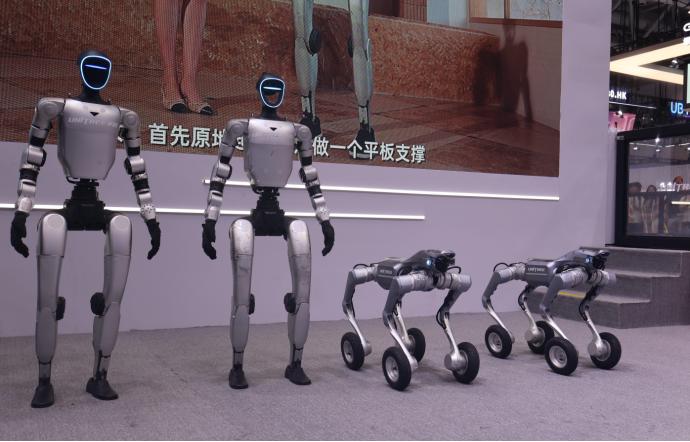
Two days ago, Unitree released its new "Superman" humanoid robot, which has made full preheating for its debut at this conference. This product can jump 2 meters in place, and its limit running speed reaches 12.66m/s, both of which exceed human records.
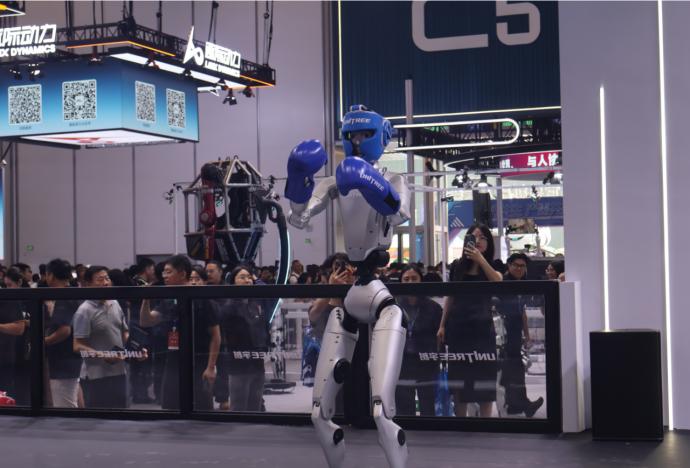
Just like what happened at WAIC, Unitree set up a boxing ring at the site and exhibited robot fighting. Seeing Unitree's huge popularity, some other manufacturers also want to attract attention, for example, a group of cyber dog-walkers walked to the front of Unitree's booth to attract audiences.
Agibot
Although Agibot did not attend the exhibition this time, it can be regarded as the uncrowned king. When we communicated with practitioners from many embodied intelligence companies at the site, many of them mentioned this company.
Agibot's early aura mainly came from "Huawei Genius Boy" Zhihui Jun, but now its reputation comes more from its amazing growth speed: its revenue exceeded 1 billion yuan last year, the cumulative number of offline products has exceeded 15,000 units, and it has officially launched the Hong Kong listing process at the end of July this year. This means that after Unitree's IPO, Agibot is likely to become the next target of the capital carnival.
Zibianliang
Most booths in Hall C focus on demonstrations in industrial and commercial links such as production line handling and storage sorting.
At Zibianliang's booth, in addition to industrial scenarios, its quantum series robots are also handling other types of tasks: tidying up desktop sundries, sorting garbage, stacking clothes, watering flowers, and other long-sequence tasks including independent flower arrangement. These actions have no preset scripts, and are output end-to-end by the WALL-B embodied intelligence foundation model.

The on-site staff told Photon Planet that since May, the robots equipped with this model have entered hundreds of real families in Shenzhen, Beijing, Shanghai and other places through the "Robots Enter Families" project in cooperation with 58.com, undertaking tasks such as sundries sorting, garbage removal, deep kitchen cleaning, and assisting in making beds.
This is also one of the most counter-consensus narratives of Zibianliang: when the industry is generally proving that "robots can work" in industrial scenarios, it places the verification field in the most unstructured family scenarios.
An interesting episode is that we happened to meet two staff members of Starbot Era at Zibianliang's booth, who were whispering that Zibianliang's package sorting capability has evolved rapidly recently, which put them under great pressure.
Galbot
The night before WRC, employees of Galbot were still arranging the sub-forum venue on the first floor of the conference center. Dozens of people were busy around the lighting and scenery, and some of them were modifying the PPT word by word while eating boxed meals. The theme of the sub-forum is "The Evolution Road of Embodied Intelligence Large Models", co-hosted with Caixin and 36Kr. This scene itself is very consistent with Galbot's style of no gimmicks, only down-to-earth work.
On the afternoon of the 19th, Galbot launched the industry's first humanoid robot "Gal · Starzai" with agent-level learning capability. This small humanoid robot has anthropomorphic movements, real-time action imitation capability and real-scene interaction capability. This means that embodied intelligence has been able to cross the preset trajectory, and move towards learning while observing and independent decision-making.
The capability of Starzai represents the leap of embodied intelligence from limb movement learning to cognitive decision-making. It can extract and imitate the dancer's limb rhythm in real time, complete interaction with the audience in the real environment, identify genders, and make impromptu responses according to scenarios, etc.
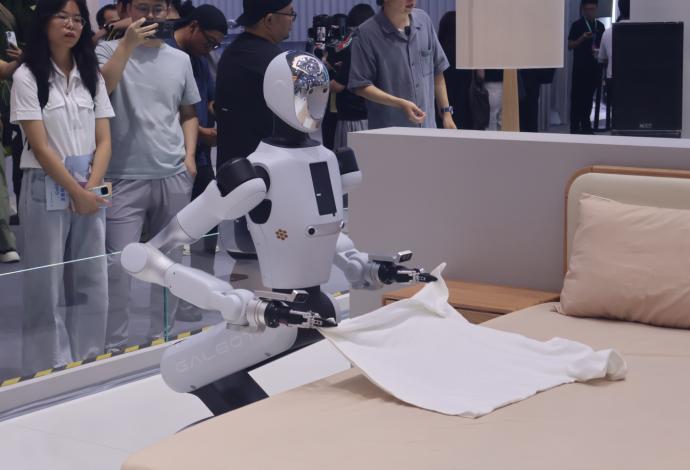
At WAIC, Galbot's focus was on the industrial field, from sorting to screw tightening. WRC obviously focuses more on the family environment, to demonstrate its generalization and general capabilities under the "one brain for multiple bodies" strategy. Two of the three scenarios are home scenarios, one is the robot folding clothes, the other is item storage, and the robot's performance is satisfactory. The third one is the retail scenario of commercial services.
Qianxun Intelligence
Qianxun Intelligence follows the integration route of "VLA + world model". The company believes that what really restricts the landing of embodied intelligence at present is not the end actuator, but the gap in the "brain" part.
One month has passed since WAIC, and Spirit v1.6 has been continuously iterated, further expanding the generalization boundary of long-distance complex tasks. At the WRC site this time, Qianxun Intelligence once again chose the long-distance task of "living room sorting" to take the initiative to have a public "competition" with its own performance 30 days ago.
After receiving the instruction, Moz1 will first perceive the environment, identify the position of objects, analyze the subtasks, then plan the process and path according to the on-site environment, and explicitly present its Task Plan on the visualization platform. In this process, Spirit first endows Moz1 with planning and reasoning capability through Chain of Thought (CoT), then strengthens the generalization with the pre-trained base model, then improves the accuracy of the model with imitation learning fine-tuning technology, and finally uses real task data for reinforcement learning training to enhance the robustness of the model.
Moz2 pays more attention to the friendly design and natural interaction experience in public spaces, further improves and upgrades the natural language interaction capability, and greets the audience, has multi-round conversations and takes group photos for interaction on site.
In terms of landing rhythm, Qianxun Intelligence adheres to the three-step strategy of "industry first, then commercial service, and family last". Moz1 has entered CATL's battery production line to perform precise plugging operations, while Moz2 focuses on commercial service scenarios such as supermarkets, hotels and tourism, featuring natural voice interaction and multi-modal response.
UBTECH
At WAIC, UBTECH focused on real-scene factory deployment and full-stack localization; at WRC, UBTECH further pushed this direction to a deeper level.
It is about to launch the industry's first full-stack localized 3+N mass deployment solution, covering three fields of scientific research, commercial services and industry.
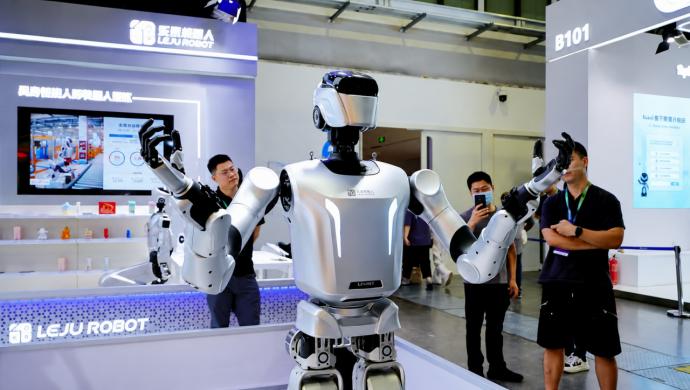
In the commercial service scenario, UBTECH demonstrates the landing capability of the full-size high-dynamic humanoid robot "Kuavo". This model can independently explain the operation status of robots at other stations in the booth, support multi-language and multi-dialect voice interaction, synchronously output anthropomorphic gestures, and respond to multi-modal action and movement instructions.
In the industrial scenario, it reproduces the factory production line, and focuses on displaying real operations such as carton depalletizing, material box handling, and small parts feeding. More fundamentally, UBTECH has launched the Taskor deployment solution with no-code, modular drag-and-drop graphical arrangement for industrial scenarios.
In terms of scientific research scenarios, UBTECH exhibits a complete humanoid robot solution from entry-level to secondary development for scientific research.
Starbot Era
As a manufacturer with full-stack self-research covering data, brain, dexterous hand and complete humanoid machine, Starbot Era mainly exhibited two robots corresponding to two sets of capabilities at this WRC.
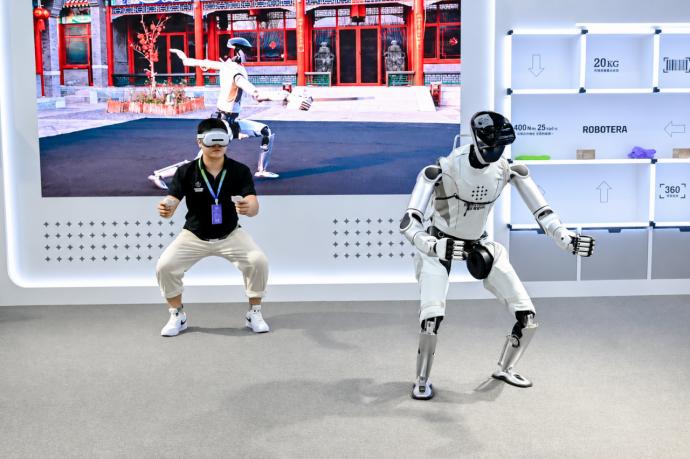
The full-size bipedal humanoid robot L7 demonstrates full-body teleoperation on site: the operator's arm swing, turning and bending movements are accurately reproduced on the 171cm-high machine with 55 degrees of freedom. This demonstration points to "body symbiosis" — how human real-time decisions can be transferred into robot motion data.
The M7 next to it follows a different idea: it retains the upper body and five-finger dexterous hand, and replaces the part below the waist with a column structure, which is directly oriented to fixed station operations. According to the staff, its application solution has been operating normally in more than ten logistics centers of SF Express and China Post across the country, undertaking links such as sorting and code scanning. To restore its operation capability on site, Starbot Era even brought a complete set of logistics sorting scenarios. At WRC 2026 with the theme of "Integration of Production and Demand", this is both pragmatic and impressive.
Qianfan Robotics
While other manufacturers are deploying family scenarios and industrial scenarios, Qianfan Robotics located on the other side of Hall C has chosen a completely different eye-catching path — letting its full-size humanoid robot T800 perform close-quarters robot fighting in an octagonal cage.
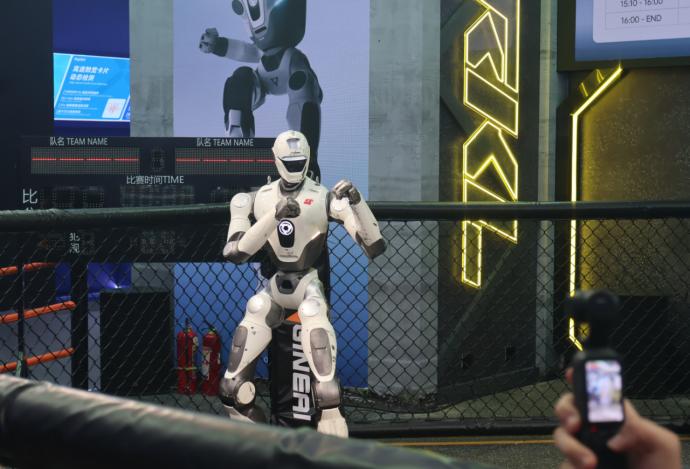
This is not a performance, but a test of the complete system of "physical body + cerebellar motion control + brain cognition". With high burst torque and omnidirectional perception system, this 1.73-meter-tall robot can withstand impacts, reset quickly and make tactical decisions, and its comprehensive physical performance has reached the level of an adult male.
Another lightweight model PM01 demonstrates its flexibility. Standing 1.38 meters tall with 24 degrees of freedom, it is the world's first humanoid robot to complete a front somersault. At this conference, it performs autonomous patrol in the crowd, and realizes local obstacle avoidance relying on the end-to-end neural network.
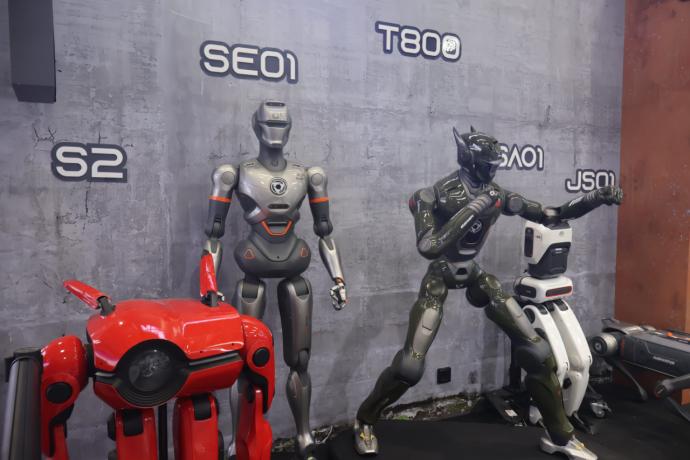
From fighting, terrain traversal to dexterous operation, Qianfan, which has been established for only three years, is taking the label of "the most capable fighter" to spill over the technologies verified by extreme sports to commercial and industrial scenarios, and will extend to family