40 Trillion, Major Upheaval in the Public Fund Industry
There is a very interesting contrast in the 2026 fund market.
On one hand, the scale of public offering funds continues to hit new records; on the other hand, popular tracks are switching drastically. Products that were still at the top of the ranking list in the first half of the year may experience obvious drawdowns as early as July.
The real problem that investors need to solve is no longer "whether there are good funds", but how to find the type of products that suit them and are worth holding for a long time from a huge number of offerings.
Public offering funds remain one of the most mature and transparent tools for ordinary people to participate in the capital market. However, the richer the tools are, the more the selection process tests investors' judgment methods.

The industry is close to 40 trillion yuan, and the competition logic is changing.
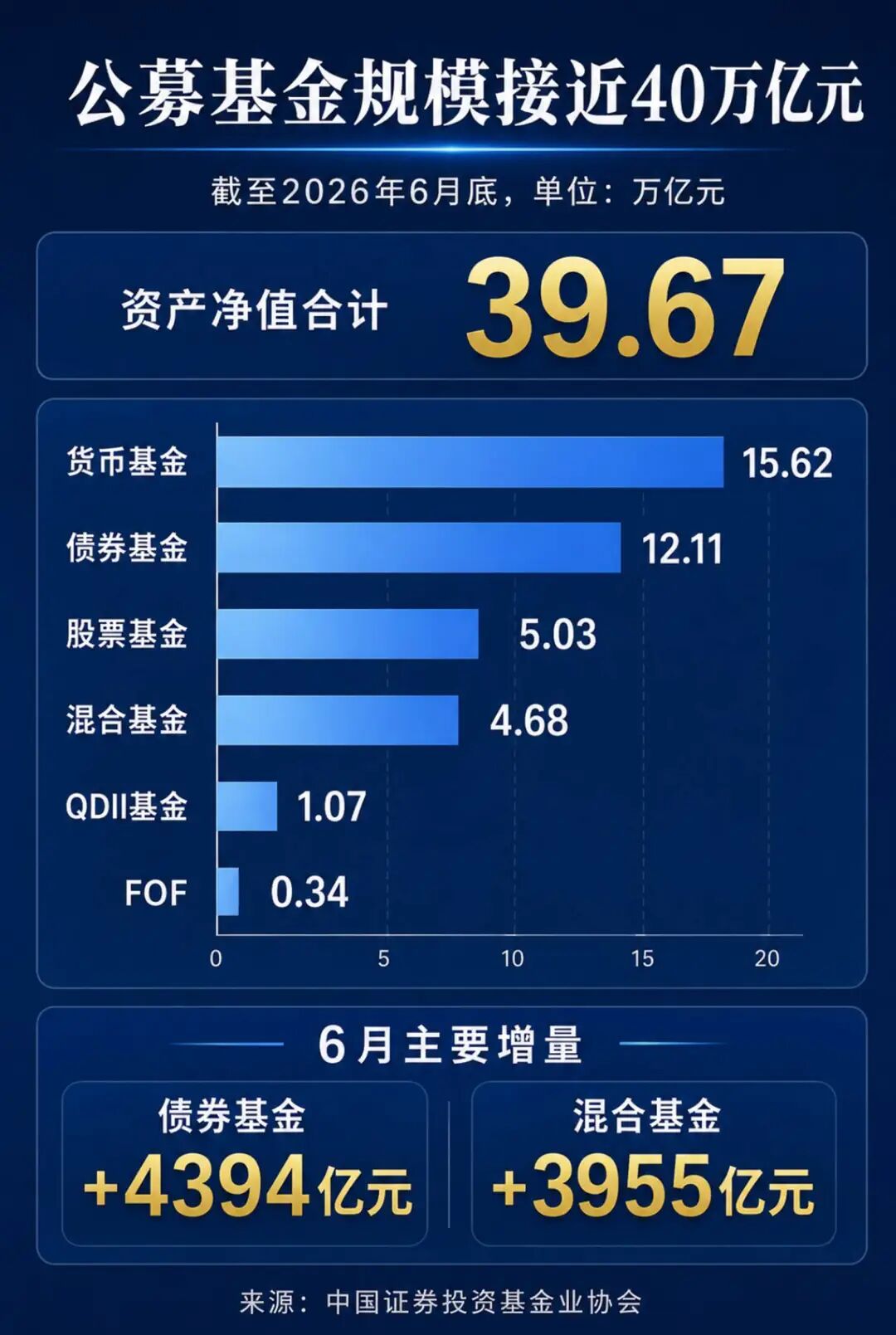
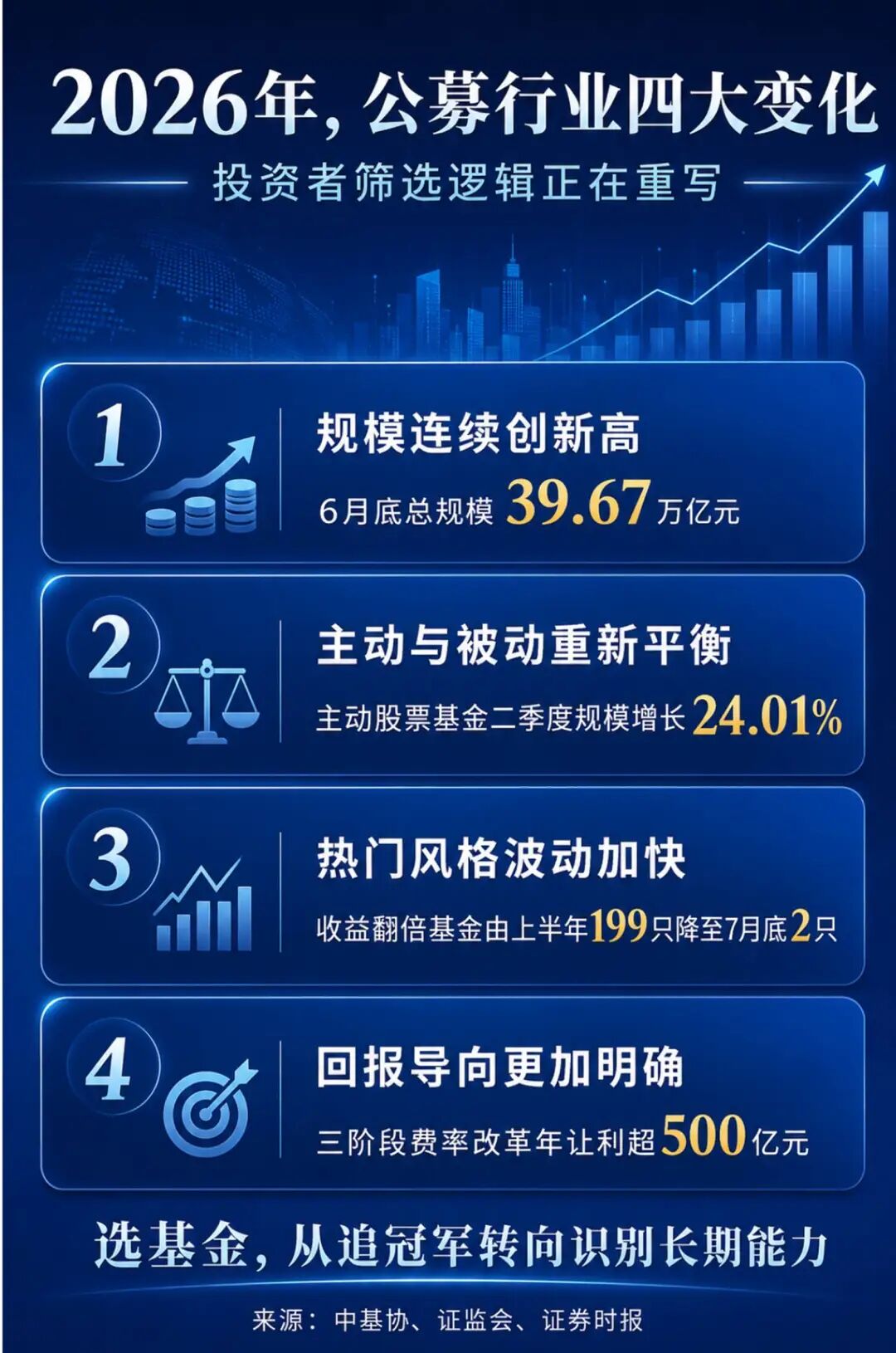
Data from the Asset Management Association of China shows that by the end of June 2026, there are 165 domestic public offering fund management institutions, with a net asset value under management of 39.67 trillion yuan, hitting a record high for three consecutive months, which reflects the market's recognition of public offering funds and future growth expectations.
The scale of equity funds, hybrid funds and bond funds is about 5.03 trillion yuan, 4.68 trillion yuan and 12.11 trillion yuan respectively, while money market funds still take the largest share with 15.62 trillion yuan.
Scale growth is only the surface, and what is really worth observing is the change in capital preferences.
In June, the scale of bond funds increased by about 439.4 billion yuan month on month, and hybrid funds increased by about 395.5 billion yuan, with these two types of products contributing the main increment. At the same time, the share of equity funds and hybrid funds decreased to some extent, indicating that the rise of net value occurred simultaneously with investors' profit taking.
First of all, capital is willing to pursue equity elasticity and does not give up defense, and the market has shifted from one-sided betting to more complex offensive and defensive allocation.
The second change is active management is being re-examined. In the second quarter, the scale of actively managed equity funds increased from 562.784 billion yuan at the end of the first quarter to 697.935 billion yuan, with an increase of 24.01%.
This does not mean that passive investment has lost its value. Instead, when industry differentiation deepens and the performance of different indices is uneven, part of the capital is willing to pay for the capabilities of stock selection, drawdown control and dynamic allocation again.
The third change is the shelf life of performance ranking is getting shorter and shorter. According to Wind data, the number of funds that doubled their returns in the first half of 2026 once reached 199, and only 2 remained by the end of July.
Extreme figures are the easiest to catch the eye, but they are also the easiest to mask fluctuations. If investors chase in only after the champion product appears, what they buy is often not the sustainable capability, but the style that has been fully exposed.
The fourth change is the industry attaches more importance to holder returns. Since January 1, 2026, the new regulations on fund sales fees have been officially implemented, which reduces subscription fees and sales service fees, and no longer charges sales service fees for fund shares held for more than one year, except for money market funds.
The three-stage fee reform is expected to give up a total of more than 50 billion yuan to investors every year.

At the same time, as of July 10, 141 new-mode floating management fee funds have been established, with an issuance scale of more than 170 billion yuan. The interest connection between fund managers and holders is becoming more direct.
Recently, China Europe Fund held its 20th anniversary brand launch event and investment strategy conference, with the theme of "Seeing the Super Factory", demonstrating the upgrading of its professional, industrialized and digital intelligent investment research system. The significance of this node does not only belong to one single institution.
Liu Jianping, General Manager of China Europe Fund, once said a very impressive sentence: "Asset management is essentially a career of 'planting time'. Plant the depth of research, the thickness of the system, the temperature of trust, and then wait for time to give the answer."
What are the main sources of profit for funds in the market
There are many names of funds, but the underlying logic is not that mysterious. They can be roughly divided into five categories.
Broad-based index and index enhancement funds mainly obtain returns from the overall market growth and rule-based stock selection. Their advantages are transparency and low fees, while the disadvantage is that they usually drawdown when the market falls. They are suitable to be used as the bottom position of the portfolio, not as a tool that guarantees steady profits.
Industry-themed and growth-style funds focus on high-prosperity sectors such as technology, medicine and high-end manufacturing, with high elasticity and high net value volatility. They are more like the offensive position in the portfolio. When the judgment is wrong, the drawdown speed is often faster than investors' psychological expectation.
Value and dividend-style funds emphasize cash flow, valuation and dividend, which are usually more resilient in the volatile market, but may seem slow when the market is concentrated on chasing growth. Their value is not only reflected in the rate of return, but also in reducing the volatility of the portfolio.
Fixed income and "fixed income plus" funds take bond returns as the base, and then use a small amount of stocks, convertible bonds and other assets to pursue excess returns. Special attention should be paid to the fact that "fixed income plus" funds are not principal guaranteed products, and credit risk, interest rate risk and equity position will all affect the net value.
Multi-asset, quantitative and global allocation funds create returns by relying on asset diversification, model discipline or cross-market opportunities. They put forward higher requirements for the team's system, data quality and risk control, and also require investors to understand the strategic boundaries of the products.
A truly effective screening process needs to go through five stages.

The first stage, select the risk budget first, then select the fund. How much drawdown you can bear is more important than how much profit you want to make. Money that will be used within three years should not take high volatility equity risks; long-term capital does not have to be all placed in low-return assets. Once the asset term is mismatched, even the best fund may be forced to be sold at the worst time.
The second stage, focus on the source of performance, do not blindly believe in a single ranking. Observe the performance for at least 3 to 5 years, break down the stages of rising, falling and fluctuating, and see whether it makes money through industry concentration, style exposure or stable stock selection. Instead of asking "how much profit did it make in the past year", it is better to ask "where does the return come from, and whether it can be replicated in the next round of market".
The third stage, look at the recovery ability after drawdown. The maximum drawdown is only the lowest point, and the recovery cycle is closer to the real holding experience. For two products with the same 20% drawdown, the one that recovers in half a year and the one that has not recovered in three years are completely different. It is also necessary to check whether the performance is significantly worse than similar products when the market falls, and whether the fund manager frequently drifts the style in order to control risks.
This is just like the players on the football field: excellent players can counterattack immediately after losing the ball, and rely on their strong ball control ability to keep the ball under their control.
The fourth stage, pay attention to the person, and pay more attention to the mechanism. The tenure of the fund manager, the management scale, the number of products managed at the same time, and the stability of the team all need to be verified. Too fast expansion of the scale may dilute the strategy, and frequent replacement of fund managers will make the historical performance lose reference significance. The value of excellent institutions lies in the mutual verification of research, risk control, trading and talent echelon.
The fifth stage, focus on fees and holding discipline. For active funds, you need to judge whether the excess return can cover the higher cost, while for index funds, you should focus on comparing tracking error, liquidity and comprehensive fees.
Setting rebalancing rules after buying is more effective than checking the net value every day. The more fund products you hold in the portfolio does not mean the safer it is. Holding ten products with similar styles is essentially a concentrated bet.

The final judgment
The commendable part of the public offering fund industry is not only that the scale is close to 40 trillion yuan, but also that it is undergoing more rigorous tests. The reduction of fees, the improvement of information disclosure, the expansion of floating management fee funds, and the upgrading of investment research systems are all promoting the industry to shift from selling products to managing the holding experience of investors.
However, the progress of the industry cannot make choices for investors.
A fund is not a profit lottery ticket, but an asset management contract.
A high-quality fund does not always rank first, but obtains returns with explainable methods and bears risks in an acceptable way within a clear strategic boundary.
What is truly scarce in the future is not the champion fund of a certain year, but the funds with long-term stable performance, clear style, controllable drawdown and reliable team. If investors stick to these four points, they can turn the professional capability of public offering funds into their own long-term returns.
Disclaimer: This article is for industry observation and professional sharing only, and does not constitute any investment advice. Funds are risky, and investment needs to be cautious.
Risk Warning: Funds are risky, and investment needs to be cautious. This article is only an analysis of public information, and does not constitute any investment advice. The market views of fund managers may change with the market environment. Investors should combine their own risk tolerance, and carefully read the fund contract, prospectus and product information summary.