Dexterous Robotic Hands Are Taking WRC 2026 by Storm: From Peripheral Accessories to the Industry's Center Stage, the Tough Battle Has Only Just Begun
In previous WRC editions, the focus has always been on whether robots can walk stably, jump higher, and achieve more bionic gaits. This year, WRC seems to have seen a shift: dexterous hands, once regarded as "accessory parts" of robots, have taken the center stage.
On August 19, the 2026 World Robot Conference (abbreviation: WRC2026) themed "Human-Robot Symbiosis, Integration of Industry and Demand" kicked off in Beijing.
This year's exhibition has more than 300 participating enterprises, 36% more than last year, with over 2000 exhibits and more than 150 debut new products. At the same time, over 10,000 contestants from more than 20 countries will also participate in the finals of the robot competition. The reporting team of Lei Technology (ID: leitech) rushed to the scene to witness this grand industry event.
Interestingly, a large number of dexterous hand suppliers such as Octopus Dynamics, Lingshin Dexterous Hand, and BrainCo have all obtained large exhibition booths, no longer attached to the booths of full humanoid robot machines.
Dexterous hands get independent booths, three major solutions demonstrate their strengths
In the past two years, the dexterous hand track has been a thorough parameter competition: 20 degrees of freedom, 24 degrees of freedom, 30+ degrees of freedom have been constantly refreshing records, manufacturers compete for more joints and more fancy movements, and demonstrations such as flipping coins, playing the piano, and unscrewing bottle caps emerge in an endless stream on site.
This year, almost all participating enterprises no longer take high degrees of freedom as their core selling point, the industry has got rid of the misunderstanding of "being bionic for the sake of bionics". The consensus of all parties has become extremely unified: no matter how high the degree of freedom is, without stability, practicality and implementation capability, it is only a showroom gimmick.
At the technical level, enterprises have realized that there is no universal optimal solution for dexterous hands. The three technical routes of linkages, tendons, and full direct drive have taken shape, and the solution that adapts to the working scenario is the best one.
Lingshin Dexterous Hand, the enterprise with the highest valuation in the dexterous hand field, is a rare enterprise in the industry that has realized mass production of all transmission solutions including direct drive, linkage and tendon. Its exhibited direct drive Linker Hand O30 specially designed for reinforcement learning is oriented to industrial scenarios, and can even assemble dexterous hands with a dexterous hand, indicating that the product already has the conditions for automated mass production.
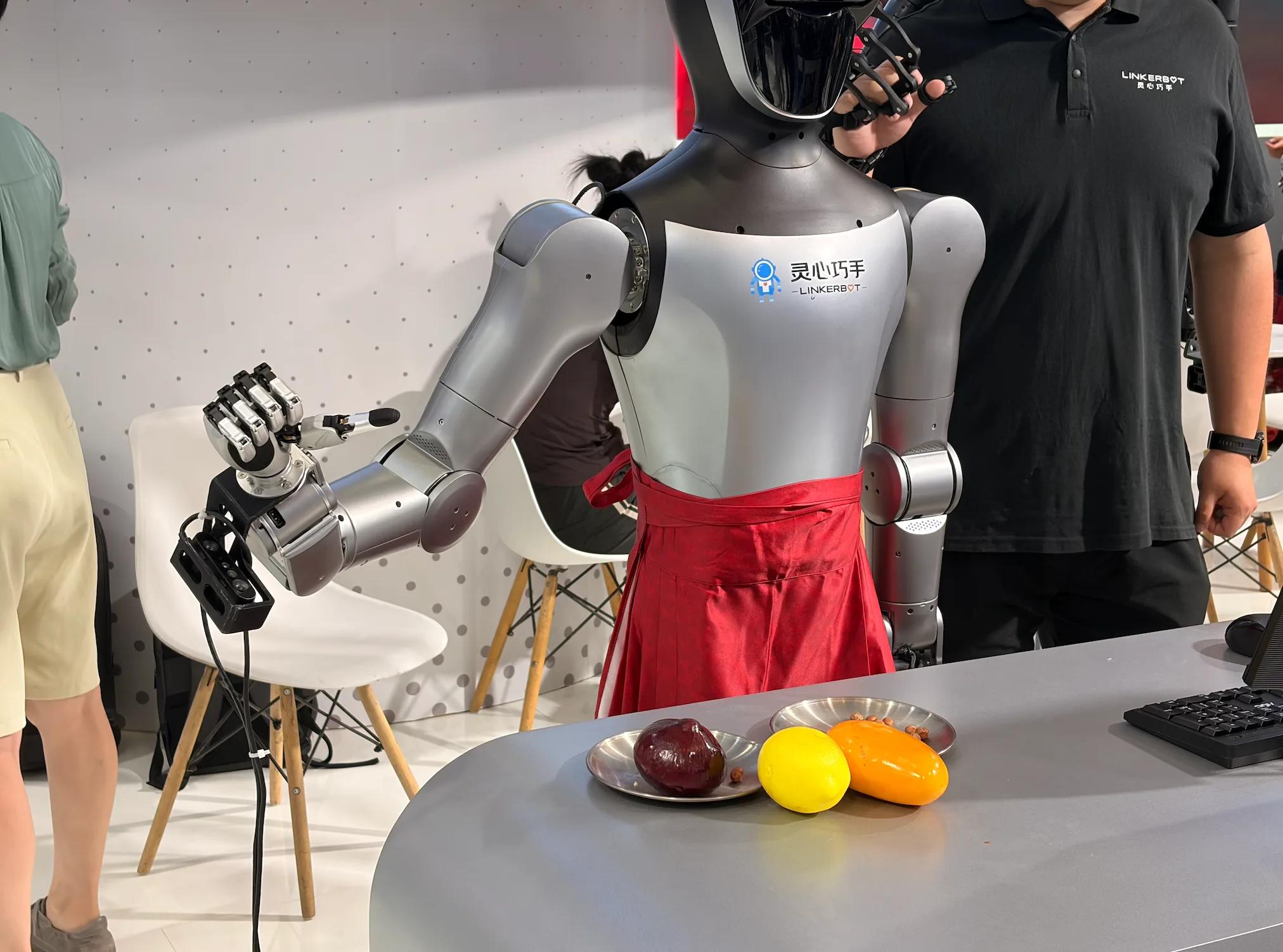
(Source: Shot by Lei Technology)
The OctoH-Hand bionic dexterous hand released by Octopus Dynamics adopts the hybrid drive scheme of tendon rope + forearm motor direct drive, has 23 active degrees of freedom, is equipped with more than 1900 tactile sensing units, focuses on digital twin closed loop, and is matched with exoskeleton data collection gloves, which can directly map human hand movement and tactile data to the dexterous hand, solving the problem of data source for embodied intelligence training.
Inspire Robots, which is known as the "Four New Little Dragons of Chinese Dexterous Hands" together with Lingshin Dexterous Hand, BrainCo and Critical Point, adopts the linkage drive scheme for its RH56F2 dexterous hand. BrainCo's Revo3 dexterous hand has opened up the brain-computer interaction track, targeting medical rehabilitation and human-computer interaction scenarios with extremely fast response and precise force control.
More and more manufacturers are beginning to adopt hybrid drive architectures: load-bearing joints use linkages to ensure stability, and fine finger joints use tendons or direct drive to ensure flexibility, taking into account performance, weight and reliability. Scenario-defined hardware and implementation priority over parameters have become the new industry standard.
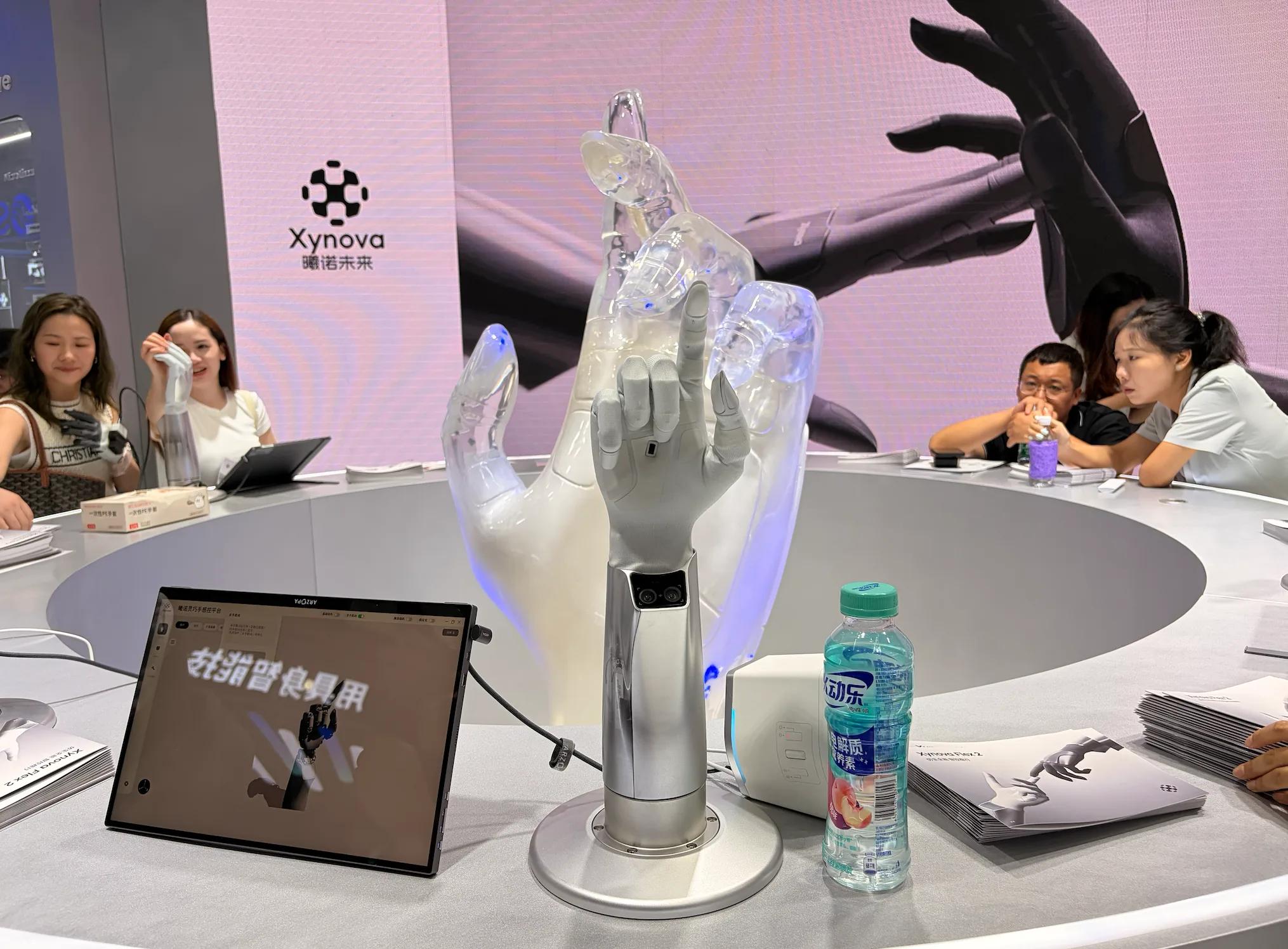
(Source: Shot by Lei Technology)
In addition, high-density electronic skin and micro force sensors that used to only exist in laboratories have made their large-scale debut this year. Vision can only judge what an object is and where it is, while touch can perceive whether the object is soft or hard, slippery or rough, and how much force is applied, which is the premise for robots to complete fine operations such as grasping, anti-slip and anti-damage. Nowadays, high-density tactile perception has changed from an optional configuration to a standard feature of mid-to-high end dexterous hands.
More critical than hardware upgrading is the formation of data closed-loop capability. The biggest shortboard of current humanoid robots is not hardware performance, but the gap in operation data in the real physical world. At this exhibition, leading manufacturers have generally launched supporting data collection gloves and simulation twin tool chains, which capture human hand movements and tactile feedback through exoskeleton data collection gloves, and then map the data to the dexterous hand to complete reproduction and iteration, which can quickly make up for the training shortboard of embodied intelligent large models.
Dexterous hands are about to explode, but the tough battle has just begun
According to incomplete statistics from information service provider IT Juzi, the financing amount of China's dexterous hand track in 2025 was 168.77 billion yuan, and in the first half of 2026, this figure exceeded 250 billion yuan.
Even Lei Jun, CEO of Xiaomi Group, announced on Weibo in March this year that Xiaomi's dexterous hand has made major breakthroughs. Agibot, a well-known player in the humanoid robot field, has also spun off a new company called Critical Point focusing on dexterous hand R&D, which shows that dexterous hands have become the new favorite of the investment market.
It is not difficult to understand this situation. Whether it is a humanoid robot or a wheel-legged robot, the purpose of R&D and production is to implement in many scenarios such as industry, household, and medical treatment, and a pair of dexterous hands is the key for robots to perform complex tasks.
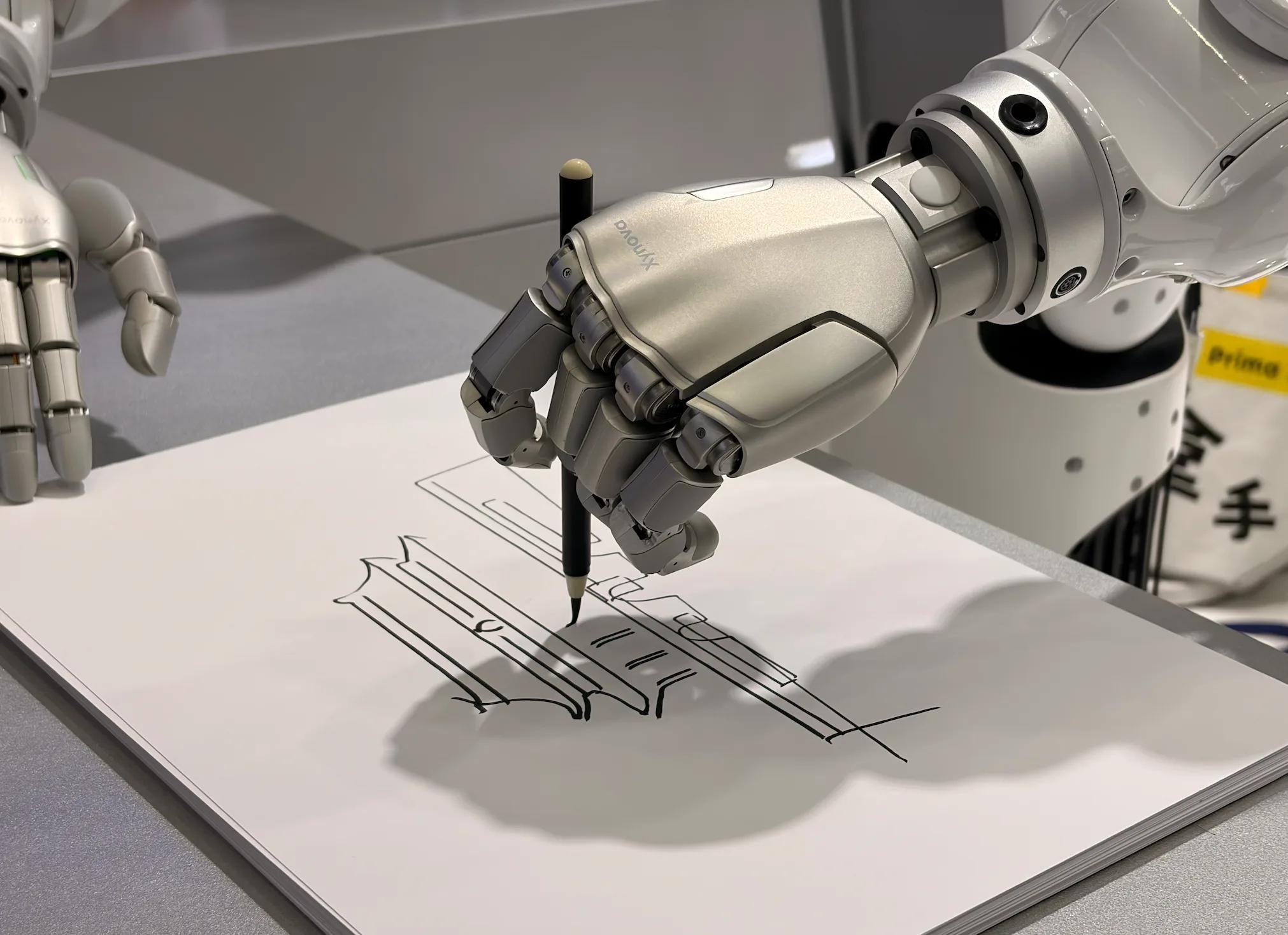
(Source: Shot by Lei Technology)
However, while the dexterous hand track has entered the explosive stage, the tough battle has just started.
Octopus Dynamics' OctoH-Hand claims to achieve a Mean Time Between Failures (MTBF) of 1000 hours, and Xiaomi's dexterous hand has completed 150,000 durability tests, but this is far from enough. The real working scenario of dexterous hands is quite different from that in the laboratory. Previously, there was a precedent that a dexterous hand of an enterprise failed after grasping a 5kg object for 50 times, and the service life of core hardware still needs to be broken through.
2026 is known in the industry as the "first year of embodied intelligent tactile". Tactile function has almost become the standard for dexterous hand products, but high-pixel electronic skin is still expensive. Each five-finger dexterous hand is covered with thousands of tactile contacts, which leads to the increase of the cost of the whole set of sensors, acquisition chips, wiring and signal processing. At present, most high-density tactile products are more oriented to small-batch scientific research use. To be widely installed on mass-produced humanoid robots, the supply chain needs to further reduce costs.
Moreover, if humanoid robots want to achieve commercialization, the cost of the whole machine must be reduced to the range acceptable to the market. As a high-value component, dexterous hands need to not only ensure degrees of freedom, force control and tactile perception, but also continuously reduce costs. It is difficult to achieve the optimal balance of performance, weight and cost at the same time, which requires manufacturers to make a lot of trade-offs.
Some enterprises have taken the initiative to make subtraction, instead of blindly stacking degrees of freedom, they cut redundant joints according to the needs of real scenarios, and use fewer active degrees of freedom to obtain lower prices.
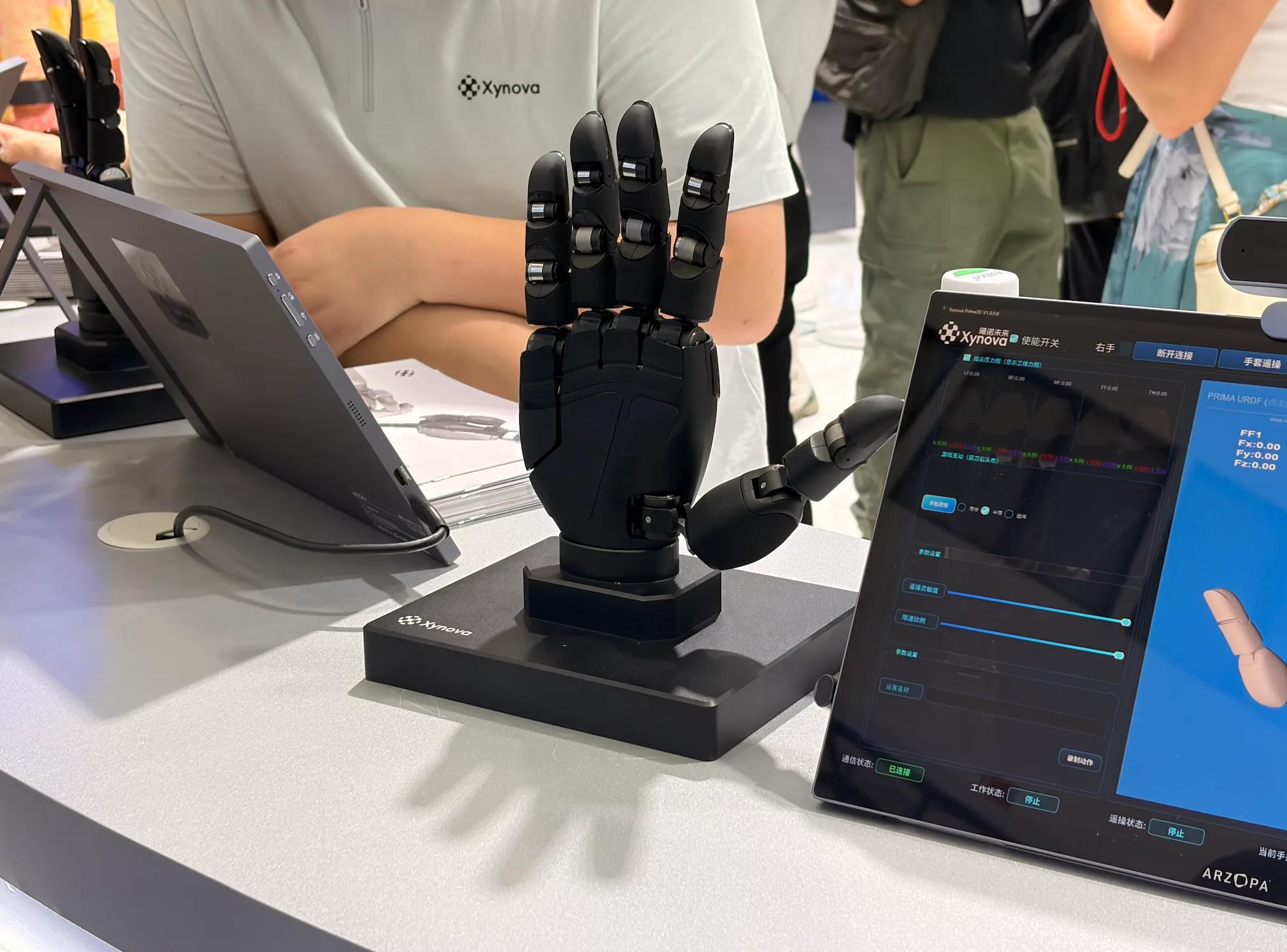
(Source: Shot by Lei Technology)
In addition, the hardware iteration speed of dexterous hands is very fast, but for robots to truly learn the ever-changing human hand operations, a huge amount of real physical interaction data is still needed. Tightening screws of different specifications, grasping various objects that are soft, hard, brittle and slippery, the combination of objects in the real world is endless. Relying solely on simulation cannot cover all scenarios, thousands of dexterous hands need to run in the real environment, continuously collect interaction data, and complete model iteration, and this process requires time accumulation.
In terms of competition pattern, two forces have formed a confrontation in the track: one type is independent suppliers, such as Lingshin Dexterous Hand and Octopus Dynamics, which are the main force participating in this WRC, supplying to humanoid machine enterprises across the whole industry, pursuing standardization, scale and complete tool chain; the other type is the self-developed route of humanoid machine factories, some leading machine manufacturers choose to develop dexterous hands independently to achieve deep software and hardware coupling and pursue the optimal performance of the whole machine system, and Critical Point is the representative of this type.
In the next few years, the dexterous hand industry may face a reshuffle. Enterprises that can only make prototypes and lack mass production and delivery capabilities will most likely be gradually eliminated by the market. Mass production, consistency, after-sales service and complete software ecosystem will become the survival threshold.
Only by landing in real scenarios can real value be created
Looking at this WRC, the dexterous hand track is obviously transforming. Different from previous years that focused on the competition of robot walking ability, the industry focus this year has fully shifted to the end-point operation ability. Dexterous hands have got rid of the positioning of accessory parts and stood at the center of the industry, marking that domestic humanoid robots have moved from morphological bionics to a new stage of practical implementation.
Leading enterprises represented by Lingshin Dexterous Hand, Octopus Dynamics, Inspire Robots and BrainCo rely on their respective technical advantages to adapt to differentiated scenarios. At the same time, the large-scale implementation of tactile perception and the formation of data closed-loop system enable them to have the fine operation capability in real scenarios.
In the past, the industry evaluated dexterous hands by looking at the number of degrees of freedom on the parameter sheet. In the future, to judge a product, we need to see whether it can stably complete tasks in real scenarios. A dexterous hand is not only a hand of a robot, but also the most important interface for the robot to interact with the physical real world, which determines whether the humanoid robot is just a performance prop in the exhibition hall or a labor tool that can truly create value.
Of course, there is still a long way to go for dexterous hands and humanoid robots to achieve large-scale popularization, and there are still a large number of technical peaks to be overcome in materials, sensors, control algorithms, and embodied data. However, from the exhibits of various manufacturers at WRC2026, it can be clearly seen that domestic dexterous hands have crossed the technical verification stage from 0 to 1, and have officially entered the industrialization tackling era from 1 to 10.