Hesai: Unit prices continue to plummet, how long will the painful transition period last?
Overall, Hesai delivered a performance that basically met expectations, but this quarter's earnings report still highlights the core problem Hesai is currently facing — the "price decline range" of LiDAR remains excessively large. Specifically:
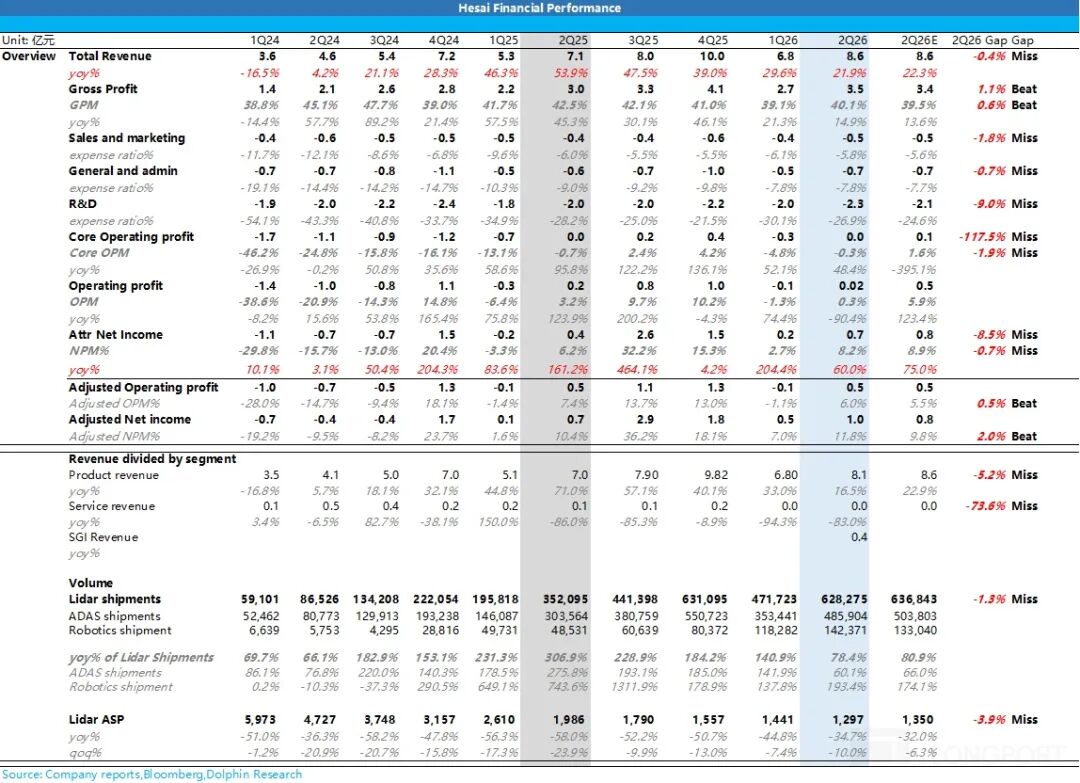
① Total revenue basically met expectations, but core LiDAR revenue fell short of expectations: Total revenue in the second quarter was 860 million yuan, a year-on-year increase of 22%, which was at the lower end of Hesai's 2Q26 revenue guidance of 850 million to 900 million yuan. The new SGI business (currently mainly including Kosmo and actuator modules) contributed 40 million yuan this quarter. After excluding this part, the revenue of the core LiDAR business was about 810 million yuan, with the year-on-year growth rate slowing down to about 16.5%, which was also lower than market expectations.
② Both LiDAR shipment volume and unit price were lower than expected:
In terms of shipment volume: 628,000 units were shipped in 2Q26, lower than the company's guidance of 650,000 units and also lower than the market expectation of 637,000 units. This was mainly due to the slower-than-expected sales growth of ADAS passenger car LiDAR: 486,000 units of ADAS LiDAR were shipped in 2Q26, lower than the market expectation of 504,000 units, which was probably mainly related to the pressure on the sales growth of new energy vehicles under the new energy purchase tax cutback, as well as the slower-than-expected sales growth of Hesai's major clients Xiaomi and Li Auto.
Shipments of robotic LiDAR reached 142,000 units this quarter, higher than the expected 133,000 units, mainly driven by the shipments of JT128 suitable for humanoid and quadruped robots (which has carried out cooperation with more than 50 embodied intelligence companies), and the shipments of JT16 lawn mower LiDAR exceeded expectations.
In terms of shipment unit price: The average comprehensive price of LiDAR in 2Q26 was only 1,297 yuan, continuing to decline by 35% year on year, and also lower than the market expectation of 1,350 yuan, which was mainly due to:
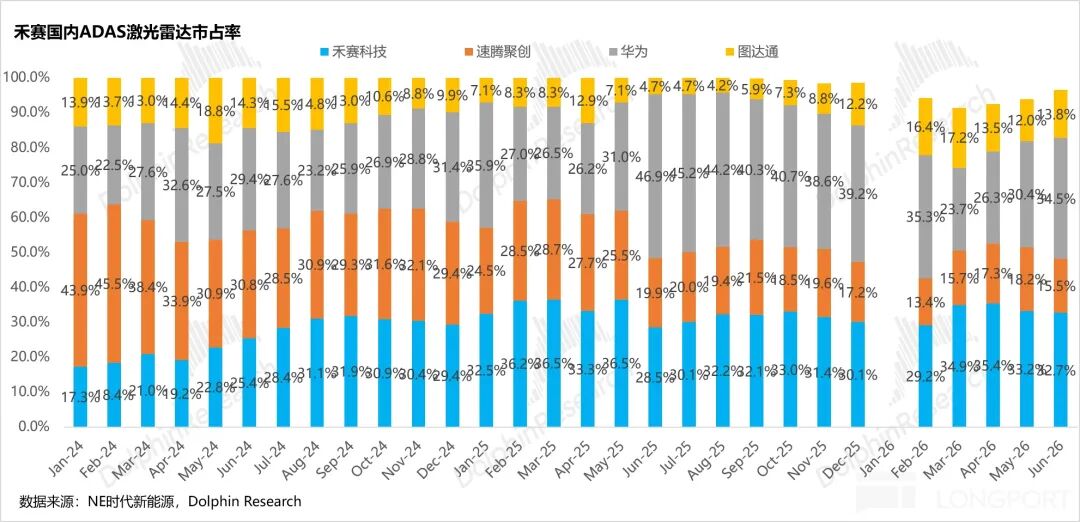
a. Intensified industry competition: As the gap in product strength between competitors (such as RoboSense's EMX series) and Hesai narrows, Hesai, as the industry leader, voluntarily gives up the 10-20% pricing premium it used to enjoy over peers, adopting the strategy of trading price for volume to maintain market share;
b. The exclusive version of ATX for high-volume clients such as BYD and Geely has a unit price of only about 800 yuan. As its shipment proportion rises, the average price of the ATX product line is further dragged down;
c. The ASP guidance of FTX blind-spot LiDAR is only about 100 US dollars. As the shipment proportion of blind-spot LiDAR increases, it also exerts a structural drag on the overall average price.
③ The overall gross margin held the 40% threshold: The gross margin in 2Q26 was 40.1%, slightly higher than the market expectation of 39.5%, up 1 percentage point month on month. Against the background of the rapid decline in LiDAR unit price, it still maintained the important 40% gross margin threshold.
This is partly benefited from the release of scale effect brought by the month-on-month growth of shipment volume this quarter, and partly benefited from the localization and high integration of main control chips, as well as the technical cost reduction brought by self-developed SPAD integration technology.
④ Operating profit was lower than expected, mainly dragged down by the growth of three expenses: The operating profit in 2Q26 was only 2 million yuan, lower than the market expectation of 50 million yuan, which was mainly due to the year-on-year growth of R&D expenses: R&D expenses in this quarter were 230 million yuan, up 16% year on year, mainly due to the increased R&D investment in the new SGI business (the previous management expected to make a forward-looking investment of about 200 million yuan in 2026).
Core Views of Dolphin Research:
Overall, Hesai delivered a performance that basically met expectations this quarter: Revenue slightly exceeded expectations driven by the contribution of the new SGI (Spatial General Intelligence) business; The gross margin maintained the important 40% threshold driven by scale effect and technical cost reduction; Operating profit was lower than expected due to increased R&D investment in the new SGI business.
However, this earnings report once again highlights the core contradiction Hesai is currently facing — the excessively large decline of ASP: The unit price of LiDAR this quarter dropped to below 1,300 yuan, with a year-on-year decline of 35%. In addition to the natural drop in unit price brought by technical cost reduction, the more core driving factor is the intensified industry competition. The company firmly adopts the strategy of "trading price for volume, maintaining market share and expanding scale", and voluntarily compresses its premium to cope with the technical catch-up of competing products such as RoboSense EMX (which has accelerated shipments since Q4 last year).
This means 2026 is still destined to be Hesai's "year of trading price for volume" with in-depth game playing. In particular, the high-priced product ETX (L3 core LiDAR) will not enter mass production until the end of the year, and the overall competitive environment will still focus on low-priced L2 passenger car LiDAR (ATX/FTX); Downstream new energy vehicle clients are facing slower sales growth after the new energy purchase tax cutback, and the erosion of gross margin caused by rising prices of upstream bulk commodities (aluminum, iron, batteries, storage), which further increases their price sensitivity to upstream components.
At present, especially for 2026, this is the unavoidable pain point for the company to go through the price war cycle and seize the position in the next-generation general sensor ecosystem:
① The annual shipment volume will continue to maintain high growth, but the unit price will shrink more than expected due to increased competitive pressure:
a. Shipment volume continues to grow rapidly: The company has raised its 2026 shipment guidance from the previous 2-3 million units to 3-3.5 million units, maintaining a high year-on-year growth of 85%-116%, and this quarter it keeps this target unchanged. To match the surging demand, the company plans to double its annual production capacity from 2 million units in 2025 to more than 4 million units in 2026. Among them, the ADAS business is nearly doubled, and the robot business is more than doubled:
ADAS business: It is expected to ship 2.5-3 million units (about 200,000-300,000 are FTX blind-spot LiDAR, and the rest are thousand-yuan-level ATX series), with a year-on-year increase of 81%-117%. The core driving factors include:
① ATX penetrates into the sinking market of L2+: At present, LiDAR has been included in the optional configuration of some car models in the 80,000-100,000 yuan price range;
② L3 high-level autonomous driving drives the on-board LiDAR carrying volume to multiply, but the actual volume release may not happen until the end of 2026 or even 2027. It is expected that after the L3 regulations are officially implemented in 2027, the on-board scheme will be upgraded from 1 main LiDAR at L2 level to "1 main LiDAR (ATX/ETX) + multiple blind-spot LiDAR (FTX)", and the on-board value will jump from about 200 US dollars to 500-1000 US dollars, while clients will have higher price tolerance. At present, ETX has obtained the mass production project designation from Great Wall Motors, with SOP expected at the end of 2026, and its detection distance is more than twice that of ATX;
③ The blind-spot product FTX accelerates shipments: Li L8 and Li L9 are each equipped with 4 Hesai LiDAR which has entered mass production, and the newly launched Li L6 (priced at about 250,000 yuan) provides a 4-LiDAR optional configuration, marking that high-level configurations have entered the mainstream price range.
From the split of ADAS clients in 2026, Dolphin Research estimates that the core sales volume in 2026 will mainly come from large orders of Xiaomi (estimated annual sales of 460,000-500,000 units in 2026, which has introduced RoboSense as the second supplier), Leapmotor (basically exclusive supply of about 600,000 units), Li Auto (exclusive supply of about 400,000 units), BYD (occupying half of the market with about 300,000-350,000 units), Geely (about 500,000 units) and Great Wall Motors (about 200,000 units).
Robot business: Hesai guides shipments of more than 500,000 units, with a year-on-year growth of 109%. Structurally, it is still dominated by the JT series with a unit price of about 1,000 yuan (about 450,000 units), which is mainly supplied to lawn mower robots of brands such as Dreame and Mova. In addition, Hesai has cooperated with more than 50 embodied intelligence companies, and recent orders come from Unitree, Robbyant, Galbot, Galaxea, Dexmal, etc. The JT128 LiDAR dedicated to humanoid robots is expected to drive shipments to exceed expectations. In some high-performance warehousing and logistics scenarios, a single device can be equipped with as many as 15 JT128 units, and the ASP of JT128 is higher than that of the JT16 used in lawn mowers.
Dolphin Research estimates that Hesai's total LiDAR sales in 2026 will reach 3.3 million units, of which:
2.62 million units are ADAS LiDAR, with a year-on-year growth of 90%, which is at the lower end of the guidance. This is mainly due to the slowdown of downstream new energy vehicle sales growth and the impact that major client Xiaomi has introduced RoboSense as the second supplier;
677,000 units are robotic LiDAR, with a year-on-year growth of 183%, significantly exceeding the guidance of 500,000 units, which is mainly benefited from the possible over-expected shipments of JT128.
b. But the unit price continues to shrink: As the gap in product strength between competitors (such as RoboSense's EMX series) and Hesai narrows, and large-scale shipments started in Q4 2025 (RoboSense's early MEMS route has now shifted to the rotating mirror route, and the technical generation gap with Hesai has basically disappeared), the industry price competition has intensified significantly. As the industry leader, Hesai voluntarily sacrifices the 10-20% pricing premium it used to enjoy over peers, adopting the strategy of trading price for volume to maintain market share.
The specific manifestations are as follows:
a. Although the unit price of the regular version of ATX in 2026 is expected to remain at 150 US dollars, the unit price of the exclusive version for high-volume clients such as BYD and Geely is only about 800 yuan. As its shipment proportion rises, the average price of the ATX product line will be further dragged down;
b. The ASP guidance of FTX blind-spot LiDAR is only about 100 US dollars;
c. The high-value product ETX will not enter mass production until the end of 2026.
Therefore, the comprehensive ASP of Hesai's LiDAR in 2026 will continue to deflate. According to the previous company guidance (revenue of 4.2-4.6 billion yuan, shipments of 3-3.5 million units), the corresponding comprehensive ASP is about 1,300-1,380 yuan, but the unit price of LiDAR in the second quarter has dropped to 1297 yuan, and the price deflation range exceeds Dolphin Research's expectation.
Therefore, Dolphin Research estimates that Hesai's overall ASP in 2026 will continue to decline by 31% year on year to 1268 yuan, especially when the unit price in the second quarter continues to be lower than expected.
c. The new SGI business accelerates revenue contribution:
The new SGI business is mainly divided into two categories:
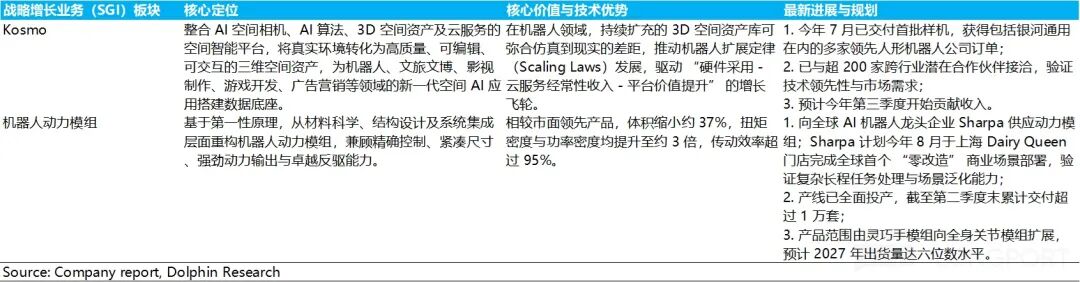
① Kosmo (Spatial Intelligence Platform): It is a system integrated by AI spatial camera, AI algorithm, 3D spatial assets and cloud services, used to capture, reconstruct and understand the physical world. In terms of commercial progress, after the prototype was sent out in July, it received orders from many leading humanoid robot companies including Galbot within 7 days; Since the preview in April, more than 200 potential partners have contacted, and the scenarios have extended to cultural tourism, film and television, games, advertising and other fields.
② Actuator module: It starts with the dexterous hand, which is the most difficult part of humanoid robot, verifies the architecture in the most difficult scenario first, and then expands to other parts of the whole body. The SOP of the whole body module is expected to be in the second half of 2026, expanding to the shoulder and wrist joints.
In terms of shipment volume: As of the end of Q2, the cumulative shipment of modules has exceeded 10,000 units, and it will soon climb to about 10,000 units per month, with shipments expected to reach six figures in 2027.
In terms of clients: It supplies to AI robot company Sharpa (sharing the same founder with Hesai, which is an independent company outside Hesai's system), and Sharpa has been adopted by NVIDIA's GROOT platform.
Therefore, with the accelerated expansion of the new business, Hesai has raised the SGI revenue guidance: The 2026 revenue is raised from 100 million yuan to 200-300 million yuan (the single-quarter contribution in 3Q26 is close to the 100 million yuan level), and the 2027 revenue remains unchanged at the previously raised 700 million yuan (about 100 million US dollars).
Dolphin Research estimates that Hesai's total revenue in 2026 will reach 4.48 billion yuan, a year-on-year increase of 48%. Among them, LiDAR revenue is 4.18 billion yuan, with a year-on-year growth of only 40%, which is mainly dragged down by the excessively large price deflation; The new SGI business contributes 250 million yuan; Other revenue is about 50 million yuan. The overall revenue expectation is at the middle axis of the company's 4.2-4.6 billion yuan guidance.
c. Despite the continuous decline of ASP, Hesai previously still