High-flying AI stocks plummet across the board.
On Tuesday, although the long-dated US Treasuries halted their sell-off and staged a rebound after entering the New York trading session, the panic lingering over Wall Street traders clearly failed to dissipate completely...
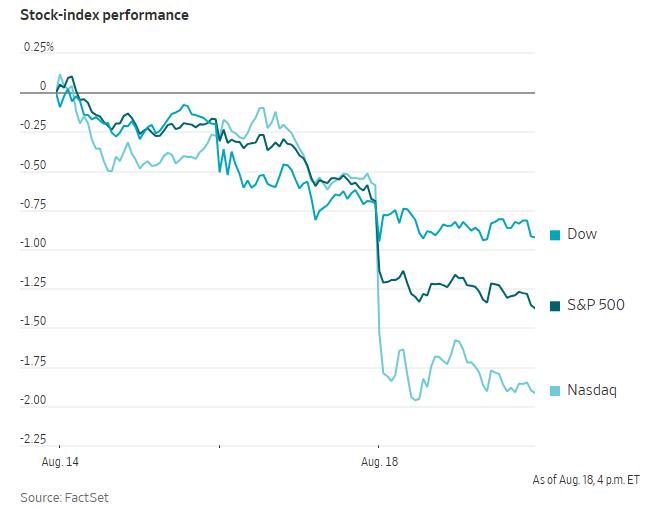
The three major US stock indexes closed lower collectively overnight, with the semiconductor sector leading the losses among tech stocks. Many analysts pointed out that as the 30-year US Treasury yield soared to its highest level since 2007 at the start of this week, market concerns over rising corporate borrowing costs and persistently high inflation have heated up rapidly.
The Philadelphia Semiconductor Index tumbled 5% on Monday. Stocks that had previously rallied sharply driven by strong AI demand were hit by a wave of sell-offs, and rising borrowing costs eroded investors' willingness to pay the premium for high earnings growth of tech stocks.
By the close of trading on Tuesday, the S&P 500 Index fell 53.30 points, or 0.69%, to close at 7,691.76; the Nasdaq Composite Index dropped 355.20 points, or 1.33%, to close at 26,289.71. Both indices posted their largest single-day percentage drop since July 29. Among the 11 core sectors of the S&P 500, the information technology sector dragged the broader market down the most and also saw the largest decline, falling 1.9% on the single day.
The stocks that weighed most heavily on the S&P 500 were mainly from the chip industry: NVIDIA fell 2.3%; Micron Technology also plunged 7% after surging nearly 18% for five consecutive trading days previously.
Other heavily hit stocks included data storage companies SanDisk and Western Digital, which fell 9% and 7.4% respectively. The Roundhill Memory ETF plummeted 8.8% after five consecutive days of gains.
Tony Welch, Chief Investment Officer of SignatureFD, said: "Nothing kills the rally of momentum stocks more than rising interest rates, and you are seeing exactly that today." He added that rising yields show that the Federal Reserve's policy is too loose for the growth and inflation outlook.
Burns McKinney, Portfolio Manager at NFJ Investment Group, said: "The market slump is almost like a domino effect. The breakdown of US-Iran peace talks led to rising oil prices, which in turn triggered higher inflation expectations, and bond yields rose accordingly." He added, "Whenever bond yields rise, it tends to inflict disproportionately heavy damage on tech stocks."
While pulling capital out of high-growth sectors, investors flocked to more defensive sectors: for example, the healthcare sector rose 1.6%, and the consumer staples sector closed up 1.1%. Wall Street's fear index VIX rose 0.65 points to close at 15.84, marking its highest closing level since August 4. In addition, supported by the strengthening of international oil prices, the S&P 500 energy sector led all sectors with a 1.8% gain.
US Treasuries temporarily halted declines but market panic has not dissipated
An interesting point of the market on Tuesday was that as the panic of global long-dated bond sell-off began to spill over, the decline in US Treasury prices eased instead, and the yields of US Treasuries across all maturities generally fell back in the overnight New York session.
By the late New York trading session, the 2-year US Treasury yield fell 0.23 basis points to 4.165%, the 5-year US Treasury yield fell 0.53 basis points to 4.362%, the 10-year US Treasury yield fell 1.59 basis points to 4.702%, and the 30-year US Treasury yield fell 2.13 basis points to 5.283%.
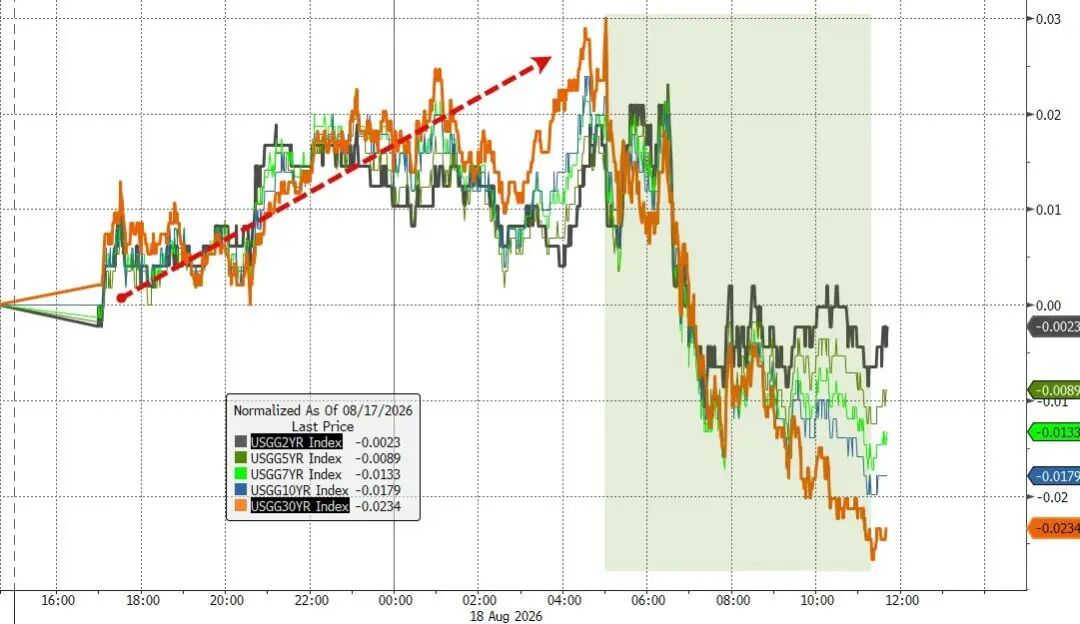
However, the panic in the bond market clearly has not completely dissipated. As the 30-year US Treasury yield rose to a 19-year high in this round, investors attributed this sharp decline to various factors — ranging from inflation anxiety triggered by geopolitical conflicts to the "siphon effect" on bond funds caused by concentrated bond issuance by tech giants. In addition, the high government budget deficit and the uncertainty about the policy path of the new Federal Reserve Chairman Wash have further exacerbated market anxiety.
Although all parties still have differences on the specific weight of the impact of a single factor, one point of consensus widely reached in the market is that these structural pressures are difficult to subside in the short term. Some analysts pointed out that if the 2008 financial crisis created an era of ultra-low interest rates, the current pattern may be announcing that the market is returning to the normal interest rate level before the crisis. Due to concerns that interest rates will continue to rise or even climb sharply, even if the Federal Reserve does not explicitly turn hawkish, the willingness of the buy side to take up long-dated government bonds has been greatly reduced.
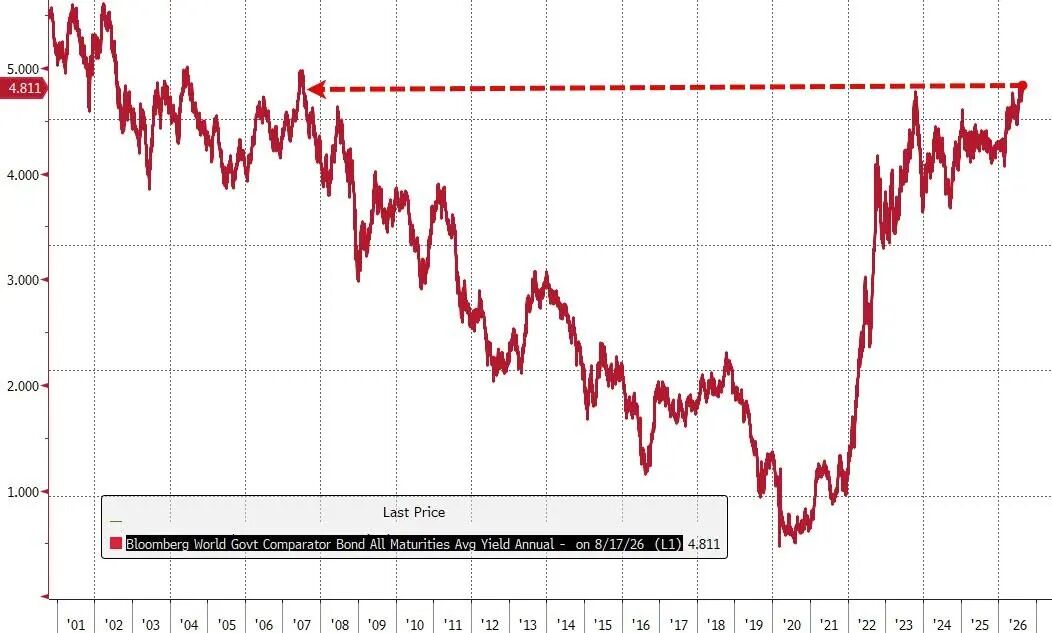
In fact, the drastic turmoil in US Treasuries is just a microcosm of the severe situation in the current bond market. At present, the average yield of the benchmark investment portfolio of investment-grade government bonds has soared to about 4.5%, the highest level since Bloomberg began to count this data in 2015. Among them, the competitive pressure from large-scale corporate bond issuance is one of the important triggers for the pressure on US Treasuries.
The record bond issuance volume has injected a huge amount of duration supply into the US fixed income market. Especially under the investment wave in the artificial intelligence field, tech companies obviously prefer to raise funds by issuing ultra-long-dated bonds.
While the supply volume hits a new high, the buy-side structure is also undergoing profound changes. In the past, long-term funds such as pension funds were the solid "anchor" of the US Treasury market, as they needed to allocate long-term assets to match the liability side. However, the marginal allocation willingness of foreign investors to US Treasuries is now widely questioned, and some foreign investors have shown a trend of diversified allocation and gradual de-dollarization of US Treasuries. At the same time, many pension institutions are gradually reducing defined-benefit pension plans, and regulatory rules also encourage funds to increase equity investment.
Anshul Pradhan, Head of US Rates Strategy at Barclays, analyzed that the allocation demand of the official sector is mainly driven by policy orientation, while private investors are more sensitive to risk return ratio. He pointed out that this profound evolution of the buy-side structure over the past decade is enough to explain the movement of about 90 basis points in the 30-year US Treasury term premium.
This also indicates that the transmission mechanism of drastic fluctuations in the bond market in the future with the US real economy and other related financial markets will become closer and more far-reaching.
The panic of US Treasury sell-off begins to spill over
Many industry insiders said that the sell-off triggered by the US Treasury crash may continue to push up borrowing costs, which will likely put heavy pressure on US households, corporate operations, financial markets and the US federal budget at the same time. For a long time, US Treasuries have often been regarded as the crucial "risk-free" benchmark asset in the global financial system, laying the pricing anchor for global mortgages, corporate loans, emerging market debts, private credit and stock valuation.
The 10-year US Treasury yield is a key weathervane for US mortgage rates, as its trend is usually highly consistent with that of mortgage-backed securities (MBS). Higher interest rates will directly reduce the loan amount that home buyers can get, and at the same time inhibit the willingness of homeowners who hold old mortgages with low interest rates to move and change houses, thus dragging down home sales, residential construction and related consumer spending.
As market interest rates and the financing costs of lending institutions rise, the interest rates on new auto loans and other fixed-rate consumer loans will also rise accordingly, although this transmission process is not completed instantly or precisely corresponding. Credit card rates are more closely anchored to the banks' prime rate, which usually fluctuates with the Federal Reserve's policy rate. Therefore, a simple surge in long-term yields may not immediately push up credit card rates, but the market's expectation that the Federal Reserve will maintain a tightening stance is enough to bring this effect.
The impact of bond yields on the stock market is more complex — in the past, rising interest rates would reduce the discounted present value that investors assign to the future profits of enterprises, which directly suppressed high-growth tech stocks; but if the background of rising yields is strong economic fundamentals and improved corporate earnings, its destructive power to the stock market may be limited to a certain extent.
At the moment, the background faced by the stock market is obviously more like the former. Corporate financing costs usually add a certain credit spread on the basis of US Treasury yields to compensate investors for the default and liquidity risks they take. Once US Treasury yields climb, corporate borrowing costs will also rise accordingly — the most painful ones are enterprises that need to issue new bonds, roll over old debts (refinance) or hold floating-rate loans.
Against the current background of AI boom, the increase in borrowing costs will obviously directly reduce the attractiveness of capital-intensive projects such as data centers, energy infrastructure and industrial capacity expansion, thus inhibiting enterprises' future investment enthusiasm and earnings growth. This point is particularly severe for the tech industry, which is currently funding huge investments in the AI field through a record volume of bond issuance.
In addition, the continuous surge in US Treasury yields will absorb capital into dollar assets, push the dollar to strengthen and tighten overseas financial environments. This will greatly increase the refinancing difficulty of low-rated enterprises, highly indebted governments and emerging market borrowers.
For financial institutions such as banks, insurance companies and pension funds, the sharp surge in yields will directly erode the market value of the existing long-term bonds they hold. Once they are forced to sell and realize the cash before maturity, these institutions will turn floating losses into real losses — even though these securities can still be redeemed at par if they are held all the way to maturity.
It is foreseeable that under the intertwined tests of US-Iran conflicts, inflation concerns and the huge bond issuance wave, this turmoil triggered by the bond market is destined to continue to affect the fragile nerves of the global financial market for a long time in the future.
This article is from the WeChat official account "Sci-Tech Innovation Board Daily", written by Xiaoxiang, and published by 36Kr with authorization.