US Treasury Yields Hit 5%, Spooking AI Investors
Author | Yeda Huang
Editor | Fan Zhang
Recently, the long-term US Treasury yield has risen significantly, driving the yield curve to show a typical steepening feature. In terms of data, from June 29 to August 17, the 10-year and 30-year US Treasury yields rose sharply by 34 and 45 basis points (bps) respectively, while the 2-year US Treasury yield only rose by 9 basis points in the same period, and the term spread expanded rapidly.
More notably, after this round of rapid surge of US Treasury yields: the 30-year US Treasury yield has broken through 5%, not only exceeding the high point of the post-pandemic rate hike cycle, but also hitting a new high since 2004; the 10-year US Treasury yield is not only close to the previous high, but also near the level during the 2007 subprime mortgage crisis.
As the anchor of global risk-free interest rates, the rapid rise of US Treasury yields has triggered a round of repricing of major asset prices including equities, foreign exchange and commodities. The drastic fluctuations in the AI industrial chain recently also include the impact of this transmission logic. Meanwhile, the pricing of the 10-year US Treasury yield itself is a mapping of the global macro economy, and the current interest rate level also evokes investors' painful memories of the 2007 subprime mortgage crisis.
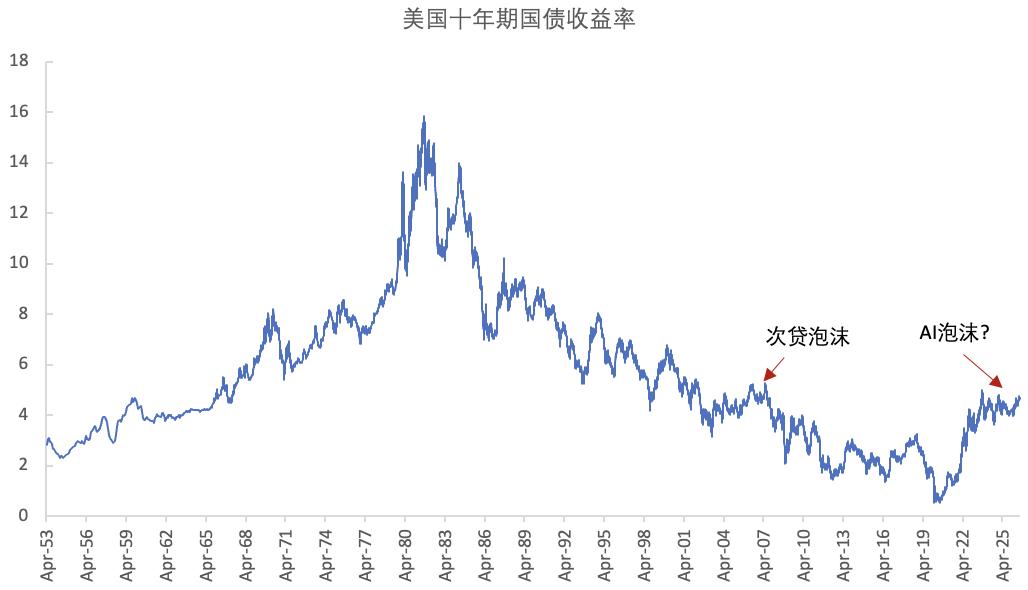
Figure: Trend of 10-year US Treasury yield; Source: Wind, 36Kr
So what are the core factors driving the rise of US Treasury yields? How does the rise of US Treasury yields affect the AI sector market?
01 Multiple factors drive the rise of long-term US Treasury yields
For investors who are not familiar with bonds, a basic common sense needs to be clarified first, that is, bond yields move in the opposite direction to asset prices; therefore, the sharp rise in US Treasury yields indicates that US Treasury prices have fallen sharply. From the fundamental perspective, this round of rise in US Treasury yields is mainly driven by the supply and demand pattern of the capital market; at the same time, factors such as rising inflation and tightening monetary policy expectations also play an important driving role.
First of all, the US government's fiscal expansion and the resulting massive issuance of national debt are the fundamental reasons for the rise of long-term US Treasury yields in this round. Over the past 20 years, the total size of US Treasury debt has continued to expand, reaching as high as 37.6 trillion US dollars by the end of 2025, 6.6 times of the 5.7 trillion US dollars in 2000; although after the peak of pandemic issuance in 2020, the annual growth rate of US Treasury supply has dropped to the median level in the past 20 years, under the high base, the actual expansion of US Treasury size is still very rapid.
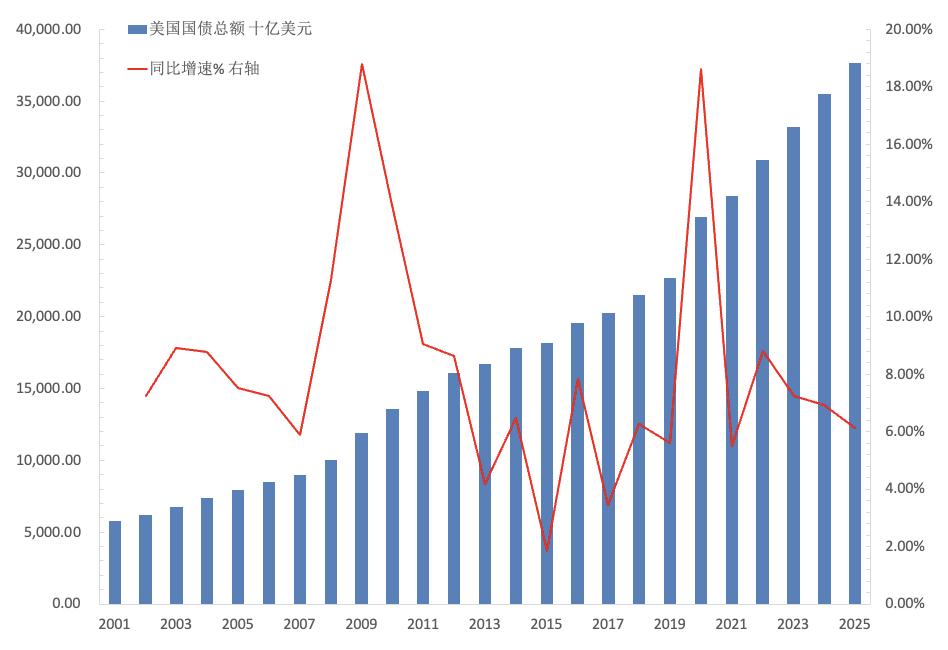
Figure: Total size and year-on-year growth rate of US Treasury debt; Source: Wind, 36Kr
At the same time, affected by factors such as tax cuts and high proportion of rigid expenditure in US finance, the supply expectation of US Treasury debt remains strong, which also pushes up US Treasury yields to a certain extent. From the perspective of asset pricing logic, the continuous growth of US Treasury supply has an obvious dilution effect on market funds, and the rising expectation of US Treasury supply further exacerbates the imbalance between supply and demand in the US Treasury market.
From the demand side, the main buyers of US Treasury debt are foreign official institutions and the Federal Reserve, and the significant change in the structure of US Treasury buyers in recent years has amplified the price fluctuation of US Treasury debt. For foreign official institutions, against the background of weakening US sovereign credit, part of the asset allocation demand has shifted from US Treasury debt to assets such as gold and non-US sovereign bonds; at the same time, after the continuous balance sheet reduction in the last round of rate hike cycle, the Federal Reserve has reduced its holdings of a large amount of US Treasury debt. If Walsh continues to shrink the balance sheet after taking office, it will further reduce its holdings of US Treasury debt.
With the holdings of the two traditional major buyers of US Treasury debt declining significantly, the demand for US Treasury debt has to shift substantially to financial institutions in the capital market, such as banks, pension funds, hedge funds, insurance companies, etc. Given that different types of institutions have different preferences and tolerance for factors such as investment returns, risk control indicators, exchange costs and speculation space, when commercial entities become important holders of US Treasury debt, the investment strategies in the US Treasury market tend to be diversified, and the increased volatility of US Treasury yields is expected.
It is worth noting that the wave of bond issuance triggered by the expansion of capital expenditure in the AI sector constitutes a marginal force driving the rise of US Treasury yields. Public data shows that the total amount of credit bonds issued by five tech giants including Amazon, Alphabet, Meta, Microsoft and Oracle in 2025 exceeded 120 billion US dollars; as of October 2025, the scale of AI-related bonds has reached as high as 1.2 trillion US dollars.
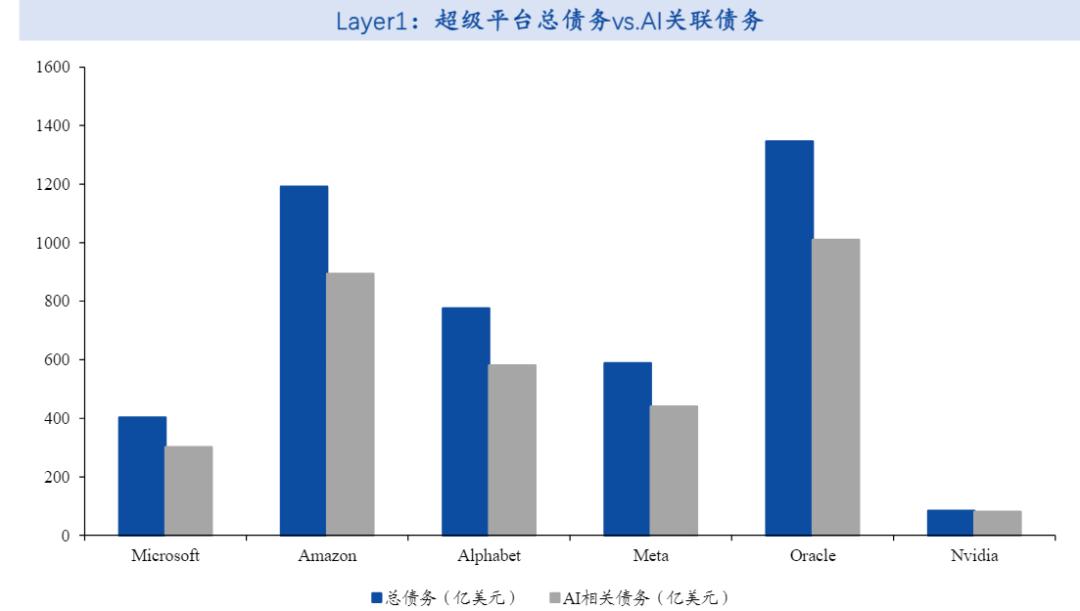
Figure: Scale of AI-related debt of major tech companies; Source: Huifu Securities, 36Kr
In the current US Treasury holder structure, financial institutions occupy an important position. Compared with traditional US Treasury buyers such as foreign official institutions and the Federal Reserve, institutional investors' allocation demand is more inclined to investment returns and speculation. Therefore, under the influence of the AI bond issuance wave, a large number of credit bonds with high quality credit and high returns pour into the bond market, forming a certain competitive relationship with US Treasury debt, thus creating a crowding-out effect on US Treasury debt within a limited range, and marginally driving the rise of US Treasury yields.
At the macro and policy level, the high long-term US Treasury yield essentially reflects rising inflation and monetary policy tightening expectations. The current US inflation still has a gap from the policy target, and the repeated rise of inflation since this year shows strong resilience, which pushes up the inflation risk premium included in long-term yields. The Federal Reserve's dual-target system of monetary policy focusing on inflation and employment, as well as Walsh's hawkish policy tendency, all indicate that the market is repricing the long-term inflation path and monetary tightening risks.
02 What impacts will the rising US Treasury yields bring to the AI sector?
In terms of the shape of the yield curve, the recent surge of long-term US Treasury yields has pushed the yield curve to steepen; for the short-term yield, based on Walsh's current hawkish policy orientation, the short-term yield still faces considerable upward pressure in the future. Once the rate hike expectation is fulfilled, the short-term yield will rise rapidly, driving the yield curve to flatten, that is, switching from the so-called "bear steepening" to "bear flattening".
In the rate hike cycle, both long-term and short-term US Treasury yields are high and the yield curve flattens, which will lead to a systematic rise in the center of the global risk-free pricing anchor. The resulting high interest rate environment and tight monetary policy will put pressure on the global stock market as a whole, especially the tech stocks represented by the AI sector, whose continuous R&D investment and capital expenditure are more sensitive to changes in the financing environment, so the impact will be more significant.
Looking back at history, on the eve of the subprime mortgage crisis from 2006 to 2007, the US Treasury yield curve was very flat for a quite long time. Although the high interest rate and flattened yield curve brought certain valuation pressure to the stock market, the real adjustment of the stock market occurred after the outbreak of the crisis. It can be seen that high interest rates are not the trigger for the stock market to turn bear, and its core impact is to continuously exert valuation pressure on the stock market: it not only reduces the cost-effectiveness of high-valuation assets, but also makes it easier to pierce crowded trades and exacerbate the fluctuation of asset prices.
Looking at this round of AI sector bull market, the hot spots are mainly concentrated in the hardware field. The strong performance of relevant enterprises and the overall positive expectation at present are the fundamental basis of this round of structural bull market. However, based on the above discussion, the valuation pressure brought by rising US Treasury yields on relevant targets is inevitable. Especially for the storage sector, under the background of considerable accumulated returns in the early stage and once extremely crowded transactions, the rising valuation pressure caused by interest rate factors is one of the important factors inducing the phased adjustment of the recent market and profit taking.
From the underlying logic of asset pricing, the test faced by the current AI sector is highly similar to the situation on the eve of the 2007 subprime mortgage crisis: the outbreak of the subprime mortgage crisis began with the fact that the yield of residents' rents could not support the high housing price bubble (holding cost) in the US; now, AI giants invest huge capital expenditure, which also relies on downstream commercial realization to close the loop of investment return.
At present, the growth slope of Anthropic's ARR (Annual Recurring Revenue) has slowed down significantly, which means that the contradiction that cash flow cannot cover high-leverage debt and high valuation has begun to appear, and the high interest rate will further exacerbate these two major contradictions. In the future, the market may reassess the intensity of capital expenditure based on the slowdown of ARR; and the stock investors, out of the psychological shadow brought by the subprime mortgage crisis, have already reflected the revaluation of AI-related enterprises in the current asset pricing.
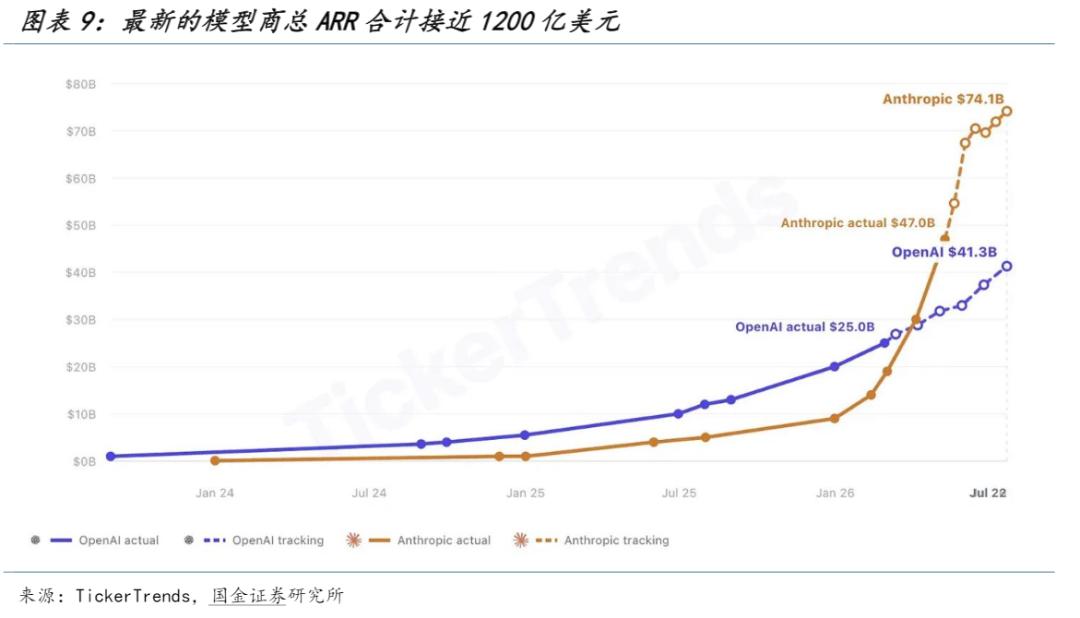
Figure: ARR of OpenAI and Anthropic; Source: Guojin Securities, 36Kr
In addition, the rising US Treasury yields will further change the financial behavior of major AI companies. To support huge capital expenditure, it is a wise move for major companies to issue bonds intensively before the time window when interest rates rise further and lock in interest costs. Affected by this, a huge amount of credit bonds pour into the bond market in a short period of time, squeezing the stock liquidity of the market and exacerbating the situation of persistently high long-term yields. As a result, the long-term financing threshold at the macro level is eventually raised, and the AI sector will also suffer from it.
*Disclaimer:
The content of this article only represents the views of the author.
The market is risky, and investment requires caution. Under no circumstances shall the information or opinions expressed in this article constitute investment advice to any person. Before deciding to invest, investors must consult professionals and make prudent decisions if necessary. We have no intention of providing underwriting services or any services that require specific qualifications or licenses to engage in for all trading parties.