Starting from September 20, the housing provident fund will shift its orientation from "supporting home purchase" to "supporting home maintenance": Who will be affected by this institutional scope expansion?
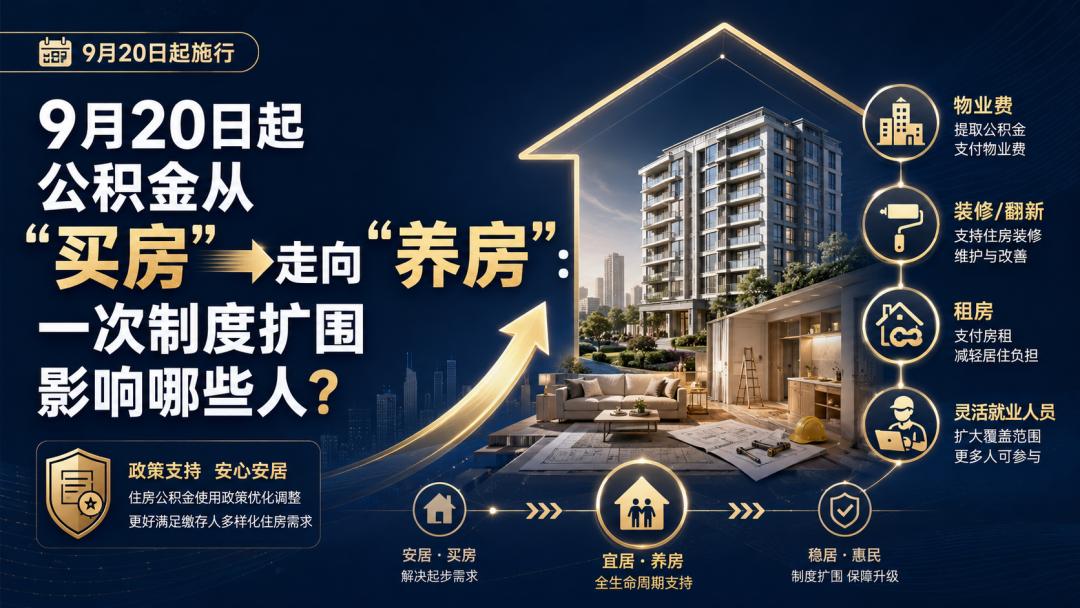
A rare institutional expansion of the Housing Provident Fund is underway.
The State Council recently announced the *Decision on Amending the Regulations on the Administration of Housing Provident Fund*, and the new regulations will come into effect on September 20, 2026. There are 20 amendments in total, and the change that draws the most attention from ordinary families is the further expansion of the provident fund withdrawal scope: in addition to house purchase, mortgage repayment and house rental, renovating self-occupied housing and paying property fees for self-occupied housing are also officially included in the eligible withdrawal scenarios.
Meanwhile, individual industrial and commercial households, part-time employees and other flexible employees are also explicitly included in the institutional scope that can voluntarily contribute to the Housing Provident Fund.
If the most distinct label of the Housing Provident Fund in the past was "buying a house", then an important signal released by this revision is:
The provident fund is gradually shifting from supporting the purchase of a house to covering the longer life cycle of a residential property.
Who will be most directly affected?
Category 1: People who already own a house and plan to renovate it
This is one of the most intuitive beneficiary groups of this reform.
The new regulations make it clear that employees can withdraw their Housing Provident Fund to renovate their self-occupied housing. It is worth noting that the officially released final provisions no longer have the expression of "the cost of renovating self-occupied housing shall not exceed a certain limit" in the previous draft for comments, and directly list it as a scenario where the Housing Provident Fund can be withdrawn.
The changes behind this are of great practical significance.
In the past, the largest expenditure on housing consumption often occurred when buying a house, so the provident fund system has long been designed around down payments, loans and mortgage repayment.
However, after the real estate industry entered the stock era, the expenditure structure of families on housing is also changing.
After a house has been lived in for ten or twenty years, it needs to be renovated again, kitchens and bathrooms reconstructed, water and electricity systems updated, and elderly families may also face aging-friendly renovation.
The amount of these expenditures may not reach the scale of buying a house, but it can easily cost tens of thousands of yuan or even more.
The Ministry of Justice explicitly mentioned when introducing the background of the law revision that urban development is shifting from large-scale incremental expansion to stock quality improvement, and residents' housing consumption is further extending from "house purchase and house rental" to "house renovation and house maintenance".
Therefore, including renovation in the withdrawal scope is essentially adapting to the changes in the housing market structure.
Category 2: House-owning families who pay property fees every year
Compared with renovation, property fees may affect a wider range of people.
Because renovation usually occurs once every few years or even more than a decade, property fee is a continuous expenditure.
The new regulations explicitly include paying property fees for self-occupied housing in the withdrawal scenarios of the Housing Provident Fund.
This means that the usage scenarios of the provident fund have gone deeper into the daily "house maintenance" expenditures for the first time.
For families with improved residences or multiple houses, the amount of property fees may not be small; for ordinary working-class families, even if it is only a few thousand yuan a year, it is a long-term and stable housing cost.
In the past, many contributors had balances in their provident fund accounts, but as long as they had no needs such as buying a house or repaying the mortgage, the actual available space was relatively limited.
Now that the withdrawal scenarios are expanded, the gap between the money in the account and the actual housing consumption is narrowing.
From the perspective of institutional design, this may be more universal than simply increasing the loan amount.
Because it does not only affect people who are planning to buy a house.
A large number of people who have already bought a house have also re-entered the usage scope of the provident fund system.
Category 3: Young people who rent houses and new citizens
There is another change in this revision that is easy to be overshadowed by renovation and property fees:
The threshold for withdrawing provident fund for house rental is further lowered.
The new regulations cancel the original restriction that "the rent exceeds the specified proportion of the family's wage income" before the Housing Provident Fund can be withdrawn, and the new withdrawal scenario is directly listed as "paying rent".
This change is especially important for young people in big cities and new citizens.
More and more young people will not buy a house immediately in the first stage after they move into the city.
They may need to go through a rental period of five years, ten years or even longer.
If the Housing Provident Fund only plays a major role when buying a house, the usage experience of these contributors is actually not strong.
After canceling the income proportion restriction, the provident fund provides more direct support to the rental group.
This also shows that the logic of the housing system is changing:
Housing security no longer only revolves around "whether there is property right", but further revolves around "whether there are stable living conditions".
House purchase and house rental are being included in the same housing consumption framework.
Category 4: Flexible employees such as food delivery riders, online car-hailing drivers, and individual business owners
If the expansion of withdrawal scope changes "how the money can be used", then the entry of flexible employees changes:
Who can access this system.
The new regulations add provisions that individual industrial and commercial households, part-time employees and other flexible employees can voluntarily contribute to the Housing Provident Fund, and enjoy corresponding policy support in accordance with regulations. The specific measures shall be formulated by the local people's governments at or above the city level with districts.
This is an obvious institutional expansion.
The traditional provident fund system is built on the "enterprise + employee" relationship.
The joint contribution by enterprises and employees is the most typical mode.
But the job market is changing.
There are more and more online car-hailing drivers, food delivery riders, freelancers, live streamers, individual industrial and commercial households and various platform employees.
They may have continuous income, but do not have a traditional fixed employer.
If the provident fund system is always bound to the traditional labor relationship, it is difficult to fully cover the housing financial needs of this group of people.
Now that voluntary contribution has further entered the national regulatory framework from pilots, it means that the flexible employee group is expected to obtain a more stable entrance for housing savings and policy support.
However, there is an important distinction here:
"Can voluntarily contribute" does not mean that the exact same contribution rules will be implemented across the country after September 20.
The regulations have made it clear that the specific measures shall be formulated by local governments.
Therefore, how much to contribute, how to contribute, how long of continuous contribution is required to apply for a loan, and how the loan amount is calculated still depend on the subsequent detailed rules of various regions.
Category 5: Migrant population who work across cities for a long time
There is another change in this reform that is less eye-catching but may have a huge impact:
The nationwide mutual recognition of provident fund is being further written into the system.
The new regulations make it clear that digital and intelligent construction shall be strengthened to realize mutual trust and mutual recognition of Housing Provident Fund contribution records across the country, and promote more convenient and efficient services such as transfer and continuation, and cross-city loans.
This is especially important for the floating employed population.
For example, a person worked in Wuhan for five years, then switched to a job in Shenzhen, and later settled in Hangzhou.
In the past, there were certain information and institutional frictions in account transfer, contribution certificates and cross-city loan qualification between different regions.
If the nationwide mutual trust and mutual recognition is further implemented, it theoretically means that the cost of "people move, the account follows" will continue to decrease.
This is more and more matching with today's employment patterns.
The era of working in one enterprise for a lifetime is over.
If the Housing Provident Fund continues to be managed in a highly localized way, it is prone to conflicts with cross-city employment.
Therefore, the nationwide mutual recognition seems to be only a service optimization, but in fact it is adapting to the new reality of population mobility.
People applying for loans will also get faster approval
There is also a clear change in the efficiency level.
In accordance with the new regulations, the period for the Housing Provident Fund Administration Center to make a decision on whether to approve a loan application is shortened from the original 15 days to 10 days; for applications for withdrawing the Housing Provident Fund, a decision shall be made within 3 days from the date of acceptance.
For house buyers, 5 days does not sound like a very long time.
But in real estate transactions, the speed of loan approval is directly related to contract performance, down payment arrangement and house delivery rhythm.
Therefore, this reform not only expands the usage scope, but also improves the efficiency of the provident fund as a housing financial tool.
Why expand the scope of "renovation and maintenance" right now?
If you look at all these changes together, you will find that they point to the same background:
China's housing market is gradually shifting from incremental construction to equal emphasis on increment and stock.
In the past stage of rapid real estate development, the core issue of housing consumption was "how to buy a house".
Therefore, down payment and mortgage loans were the largest financial needs.
But after a large number of families already own houses, the demands will naturally change.
Houses will get old.
Communities will get old.
Facilities need to be updated.
Decoration will become outdated.
As the elderly population increases, the demand for aging-friendly renovation will also rise.
Property management, house maintenance and community renewal have gradually changed from one-time expenditures to long-term expenditures.
As a result, the problem faced by housing policies has expanded from "helping residents obtain housing" to:
How to make the existing houses more livable.
This is the logic that deserves more attention behind the shift from "buying a house" to "maintaining a house".
What does this mean for the real estate market?
This reform will certainly release part of the housing consumption capacity.
But if we simply draw the conclusion that "the relaxation of provident fund will stimulate a sharp rise in housing prices", that is obviously over-interpretation.
The scenarios covered by this institutional adjustment are very scattered.
Some people use it for rental.
Some people use it for house renovation.
Some people use it to pay property fees.
Some people use it for house purchase and mortgage repayment.
For flexible employees, it is to expand the scope of institutional participation.
Not all the funds will flow to the new house market.
On the contrary, the more noteworthy feature of this reform is that funds begin to spread to stock housing consumption.
Therefore, from an industrial perspective, the potential impact may not only fall on real estate development enterprises.
Related services such as home decoration, home furnishings, building materials, property management, house maintenance, aging adaptation and housing rental may all get more direct housing consumption policy support as a result.
This is obviously different from the previous real estate chain that was mainly driven by new house sales.
Another question: How much can I withdraw after September 20?
This is the part that ordinary contributors need to pay the most attention to.
The regulations solve the institutional boundary at the national level:
Which scenarios are eligible for withdrawal.
But in the actual processing process, local provident fund centers usually need to introduce more detailed policies, such as withdrawal limit, frequency, supporting documents and specific procedures.
Especially for new scenarios such as renovation and property fees, there are obvious differences in housing structure, capital scale and provident fund operation situation among different cities.
Therefore, the implementation of the new regulations on September 20 does not mean that all cities across the country will implement exactly the same withdrawal limit and operation methods.
For ordinary people, the most practical approach is not to make a budget according to a fixed amount right now, but to pay attention to the implementation details to be announced by the local provident fund management department.
Final note
The most important change of this Housing Provident Fund reform may not be the addition of two or three new withdrawal items.
But the role of the provident fund is changing.
In the past, it was more like a housing financial tool built around house purchase.
Now, it begins to cover:
Rental, house purchase, mortgage repayment, renovation, property management and housing consumption of a longer cycle.
At the same time, the inclusion of flexible employees in the system and the continuous advancement of nationwide mutual recognition also mean that this long-established housing security system is adapting to new employment patterns and population mobility.
Starting from September 20, the provident fund will not suddenly become a sum of cash that can be used at will.
But the gap between it and the actual housing life of ordinary families is indeed narrowing.
After the housing market entered the stock era, the problems people face are no longer only:
"Can I afford a house?"
It also includes:
"After buying it, how to live in this house well for a long time?"
The shift of the provident fund from "buying a house" to "maintaining a house" truly responds to this change.
Information sources: public information from the State Council, the State Council Information Office, the Ministry of Justice, the Ministry of Housing and Urban-Rural Development, etc. This article is an analysis of public policies and housing consumption trends, and does not constitute house purchase, investment or financial advice.
This article is from the WeChat official account "BT Finance" (ID: btcjv1), written by BT Finance, authorized for release by 36Kr.