What Did The Shopping Malls Ditched By LV, GUCCI And Other Luxury Brands Do Wrong?
Luxury brands that have been struggling amid a downward performance curve have finally pulled through the slump once again.
The latest financial reports show that in the first half of the year, LVMH recorded an organic revenue growth of 2%, ending seven consecutive quarters of decline; Kering posted revenue of 7.22 billion euros, up 1% on a like-for-like basis, with its core brand Gucci narrowing its second-quarter decline to 2%; Hermès raked in 3.533 billion euros in revenue in the Asia-Pacific market (excluding Japan), marking a 2.4% year-on-year increase at constant exchange rates; Richemont recorded total revenue of 11.729 billion euros in the first half of the year, up 11% year on year.
Yet behind this promising set of figures lies a hidden narrative of restructuring of luxury brand store footprints across China. From the beginning of 2025 to July 2026, long-established high-end luxury malls including Shanghai One ITC, Shanghai Shangjia Center and Beijing Financial Street Shopping Center have successively seen top luxury brands withdraw their stores, and some malls in Kunming, Guiyang and Harbin have even faced the dilemma of multiple luxury brands leaving one after another.
The flow of top luxury brands between high-end malls is never a simple matter of expansion or contraction, but a strategic migration of closing old stores and opening new ones: withdrawing from secondary malls and cities with insufficient consumption power, and concentrating resources on standalone flagship stores in top-tier business districts, as well as MixC projects in second- and third-tier cities with proven consumption power.
Once upon a time, luxury brands expanded aggressively across the market, and any mall positioned as high-end could attract top brands to settle in; now, the era of extensive expansion has come to an end. Brands no longer pursue the sheer number of stores, and every outlet is required to be assessed for its output value. A number of malls have been voluntarily abandoned by luxury brands: some have lost out to the siphon effect of stronger competitors in the same city, while others are trapped by the insufficient pool of local high-net-worth consumers.
In this reshuffling process, what pitfalls of the times have those abandoned malls actually stepped into?
01.
Stagnant Performance, Constantly Swapped Stores
The performance of the three major luxury groups fluctuated and diverged in 2023.
Since that year, LVMH's total revenue has taken a downward turn; Kering faced a worse situation, with double-digit declines for two consecutive years; only Richemont has charted its own independent growth trajectory, posting total revenue of 22.42 billion euros for the 2026 fiscal year (ended March 31, 2026), up 11% year on year. The performance gap between luxury giants is not short-term, but structural.
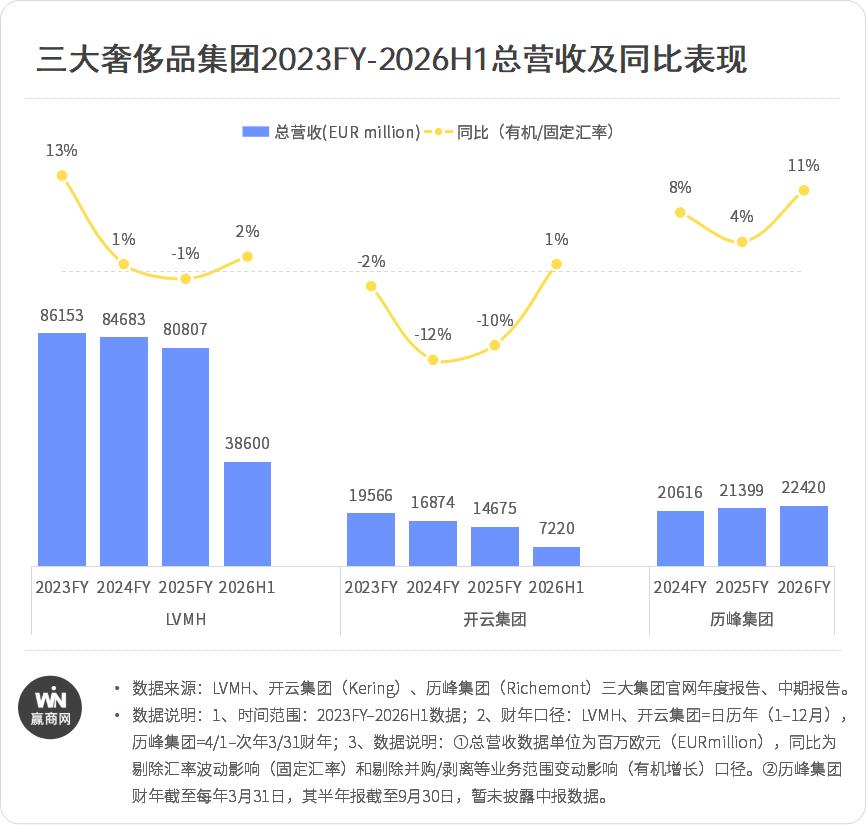
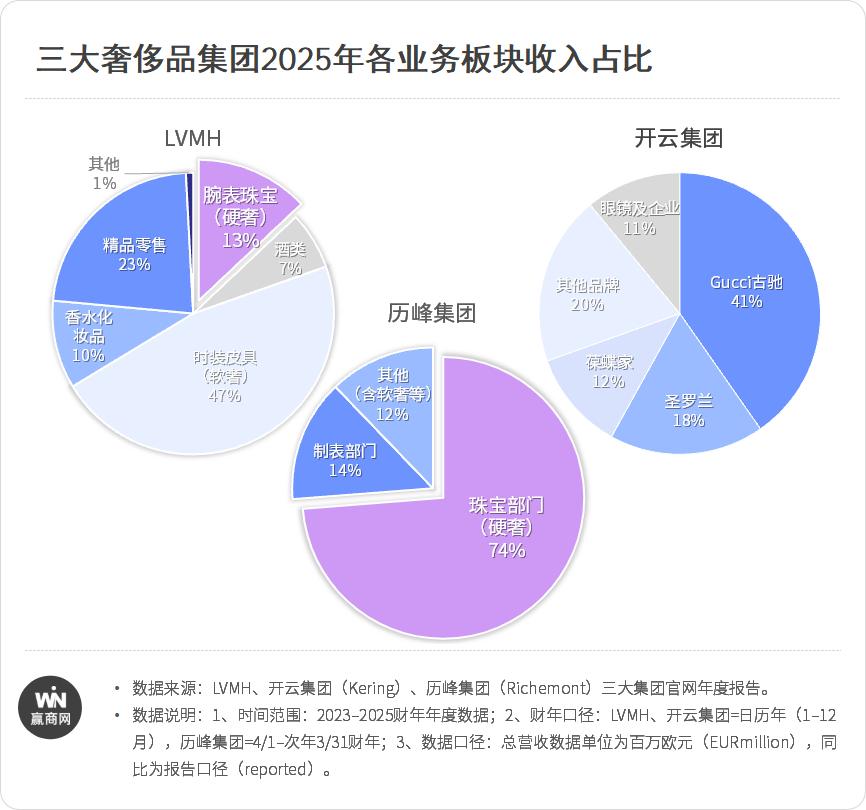
Business structure determines their position in the cycle: hard luxury rises while soft luxury falls. Looking at the revenue composition of the three major groups, leather goods and luggage account for nearly half of LVMH's revenue, fashion and leather goods take up an even higher proportion at Kering, while the jewelry division of Richemont contributes nearly 70% of its revenue, and the rising gold price has added a "value preservation" aura to its jewelry business. In comparison, LVMH and Kering, whose core businesses are leather goods and fashion, are under passive pressure in the cycle where the middle class is cutting back on spending.
When high performance growth disappears, every store has to re-prove that it deserves the rent it costs. Andrea Guerra, CEO of Prada Group, said bluntly on the 2026 first-half earnings call: The second and third stores in the same city have overlapping foot traffic, scattered output and high operating costs, and no longer have the value for continuous investment (I don't think that those second or third store are valuable anymore). The CEO of Kering even plans to close about 100 more stores in 2026, with China listed as a priority for adjustment.
The store closure signals from top luxury brands are stirring the sensitive nerves of China's high-end malls. Those projects that have seen brand withdrawals are hovering on the edge of negative chain reactions; those newly selected projects are going all out to prepare for vigorous development.
Retreat: Old High-End Luxury Malls, High-End Venues in Low-Tier Cities
From January 2025 to July 2026, on the store closure list of brands under the three major groups in Chinese mainland, the top ones are all long-operated high-end luxury malls with relatively old properties — 5 brands have withdrawn from Shanghai One ITC, 3 brands each have left Shanghai Shangjia Center and Réel Department Store, and 3 brands have moved out of Beijing Financial Street Shopping Center.
The retreat in low-tier cities is more thorough. At Kunming Golden Eagle Department Store, Guiyang Lixing Center and Harbin Seasons Place, brands have withdrawn from the entire city, with no willingness to stay behind at all.
New Entries: Top-Tier Landmark Locations, "MixC Commercial" Projects in Second- and Third-Tier Cities
The first category is flagship landmarks in top-tier core business districts. Beijing Sanlitun Taikoo Hui welcomed 6 new luxury stores within one year — the four-story standalone LV House, Dior House, standalone Tiffany store, Yves Saint Laurent Rive Droite, the largest Loro Piana store in North China, and Alaïa's first store in China; Shanghai HKRI Taikoo Hui introduced the LV "Louis" ship-shaped experience space, turning the entire mall into a dock for the ship.
The other direction is somewhat counterintuitive: second- and third-tier cities that have been verified by MixC's commercial operation system. Cities including Fuzhou, Changchun, Shenyang, Jinan and Wenzhou rarely appeared on the luxury brand store expansion list in previous years, but almost all their new stores opened since 2025 have been taken over by MixC projects.
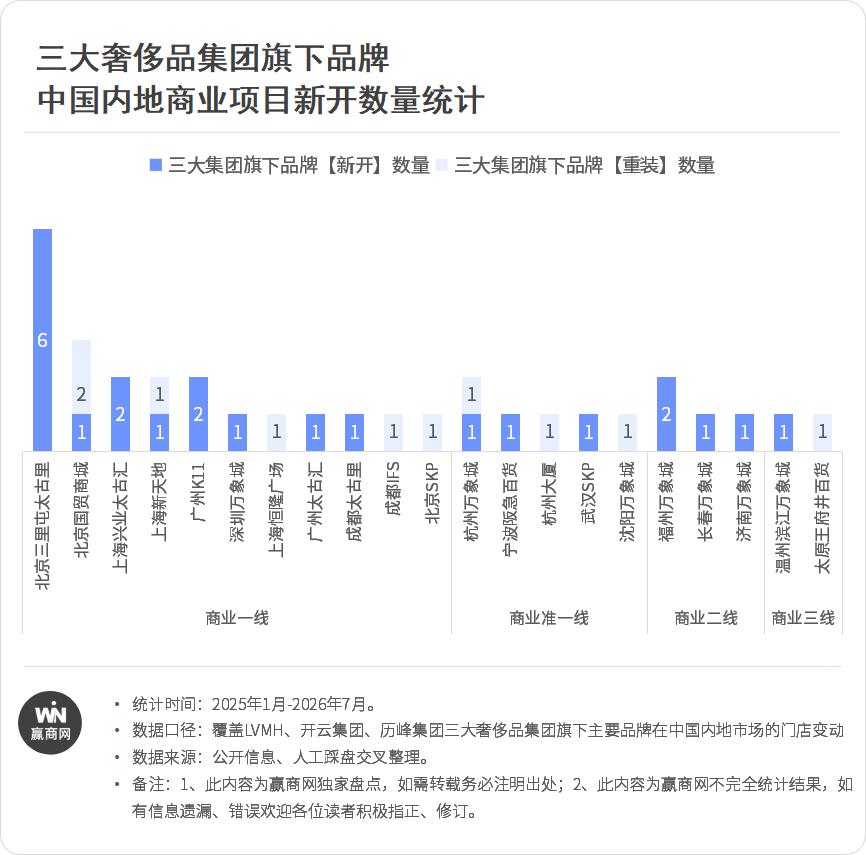
Stores are being closed in "secondary malls and low-tier cities", while new stores are opened in "top-tier business districts and MixC projects". On this map of luxury store migration, there is a clear logic: brands are voluntarily abandoning places that are no longer suitable for long-term development, and concentrating resources on building more solid strongholds in a small number of locations.
Judging from the path of brand store opening and closing, the brands flowing out of Shanghai One ITC have moved to HKRI Taikoo Hui; the brands that withdrew from the entire cities of Kunming and Guiyang have reappeared in MixC malls in Fuzhou and Changchun. This is not a retreat, but a full-scale rearrangement.
Migration is never an isolated event. Luxury brands have a strong cluster effect: LV and Dior are the anchor stores in a high-end luxury mall; once the anchors withdraw, the endorsement effect weakens, and the rest of the brands will have reasons to leave one after another. Conversely, the opening of one flagship store can attract peers from the entire street, which is exactly how the 6 new stores in Beijing Sanlitun Taikoo Hui settled one by one.
02.
Malls Abandoned by LV and Other Top Brands Have Two Root Causes of Failure
A close look at those malls that lost top luxury brands shows that there are only two reasons for their failure.
Taken Away by Neighboring Competitors
Cities of this type are fully capable of supporting luxury consumption, and the problem lies in "the mall next door is stronger", which is a pure competition of project operation capability.
The most recognized hard indicator for luxury brand site selection is sales performance: the higher the sales of a mall, the more it can secure double-layer flagship stores, limited-edition premieres and exclusive exhibitions, forming a spiral of "high sales → stronger brand portfolio → even higher sales", where the core projects get increasingly stronger while the peripheral ones are left further behind, making the siphon effect more and more obvious.
In Shanghai and Beijing, brands have not left the two cities, but transferred from lower-capability malls to core high-end luxury venues. Brands in Shanghai are concentrating towards HKRI Taikoo Hui, Plaza 66 and IFC Mall; brands in Beijing are gathering towards Sanlitun Taikoo Hui, China World Mall and SKP. Within the same city, brands are also re-aligning themselves.
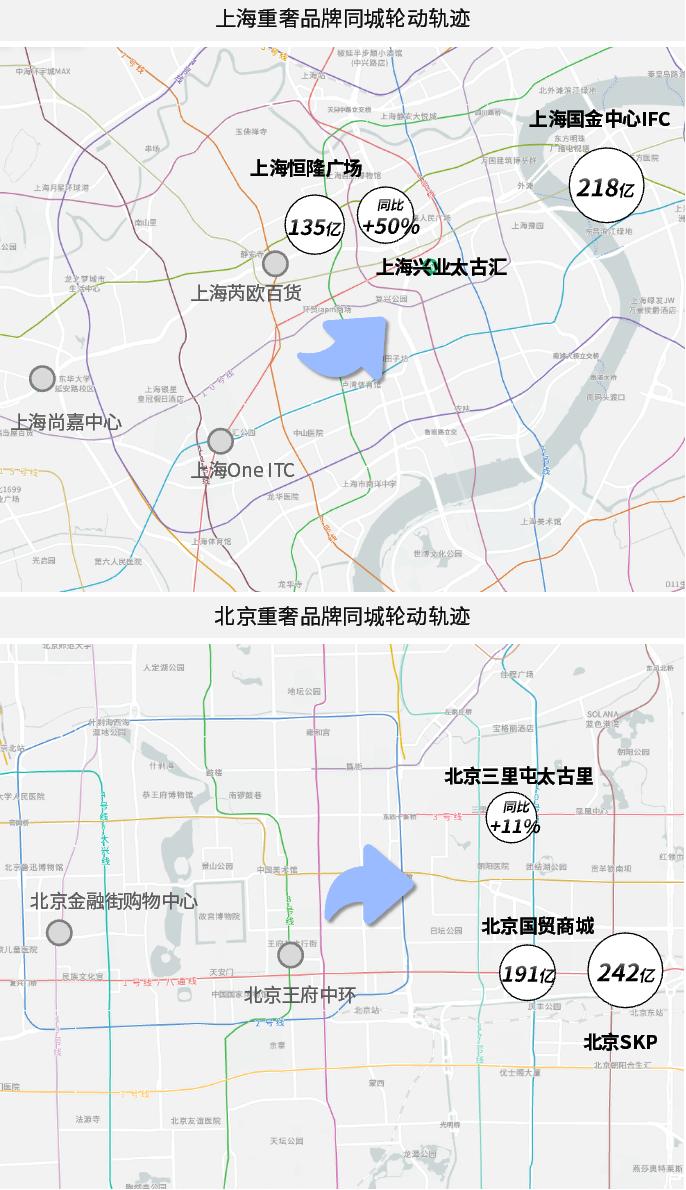
From the perspective of net city-level store change, Shanghai ranks first in "city-level store downsizing" with a net reduction of 16 stores. Although it has the largest number of store closures, it is still the city with the highest luxury density; Wenzhou and Fuzhou are seeing an increasing number of new store openings, appearing on the list of net inflow locations. The urban footprint of luxury brands is being precisely filtered according to the actual carrying capacity of each city.
Hang Lung Plaza Wuhan can be regarded as the most representative case in the current high-end luxury competition. Facing the weakening overall market environment and the continuous expansion of high-end luxury portfolios by surrounding competitors, the project took the initiative to shift its positioning from high-end luxury to trendy luxury, renovated its B1 floor into a food-themed block "Hengxiang Li", and successively introduced two characteristic sectors, the 24KR K-pop block and the Greenhouse department store block.
But the transformation comes with growing pains: its revenue dropped by 18% in the first half of 2026, and tenant sales fell by 13%. The trendy blocks still need to be nurtured, and it is difficult for their revenue to catch up with the luxury business in the short term, but the drainage effect of "Hengxiang Li" has already emerged, proving that differentiated adjustment is a feasible breakthrough path.
The City Cannot Support the High-End Luxury Business
Malls of this type do not have low operation capabilities, and some are even high-capability projects operated by top-tier developers, but they still failed to retain the brands. This is because the brands took the initiative to exit based on the strategic judgment that "this city is no longer worth investing in", and no matter how hard the mall tries, it cannot retain them.
The fundamental reason for the insufficient support is that the local consumption pool is too shallow. The main sales force of a high-end luxury store mainly depends on the consumption power of local high-net-worth groups. If we sort the 31 cities by per capita disposable income, Guiyang, Kunming and Harbin rank at the lower end. How many high-end luxury stores a city can support ultimately depends on how many people in the city can afford and continuously purchase luxury goods, and whether it can support the repurchase and precipitation of the entire high-end luxury portfolio.
High-end luxury commercial projects are far more dependent on non-local customers than ordinary shopping malls. The average proportion of non-local customers across national shopping malls is 26%, while that of high-end luxury projects is 39%, which means that "external support" is particularly important for high-end luxury projects. Whether a mall can survive depends not only on the base of local wealthy people, but also on whether it can attract high-net-worth people from a larger radius.
Among the four projects of Hang Lung Plaza Kunming, Golden Eagle Department Store Kunming, Seasons Place Harbin and Lixing Center Guiyang, the proportion of non-local customers from first-tier and new first-tier cities is less than 10% for all of them. The "external support" of these stores mostly comes from surrounding cities with lower operation capabilities, making it difficult to attract high-purchasing-power customers from higher-tier cities.
The local consumption pool is shallow, and the channel to attract external customers is also blocked. With two ceilings pressing down at the same time, it is only a matter of time before luxury brands withdraw from the entire city.
The way out for these malls may be the path that Hang Lung Plaza Wuhan is taking — transforming to focus on light luxury, high-end catering and experience-based formats, evolving from a high-end luxury mall to a high-quality lifestyle destination. Instead of waiting in place for someone who will never come back, it is better to switch to a new track and rebuild its own operation.
03.
Luxury Brands and High-End Commercial Properties
From Extensive Coverage to In-Depth Binding
The high-end luxury camp is also dividing into two completely different worlds.
Where the stores flow and where the money goes, all end up reflected in the financial reports of the malls. After this round of cycle, high-end luxury malls no longer seem to belong to the same industry. When we put the financial data of Swire Properties and Hang Lung Properties together, the divergence becomes increasingly intuitive.
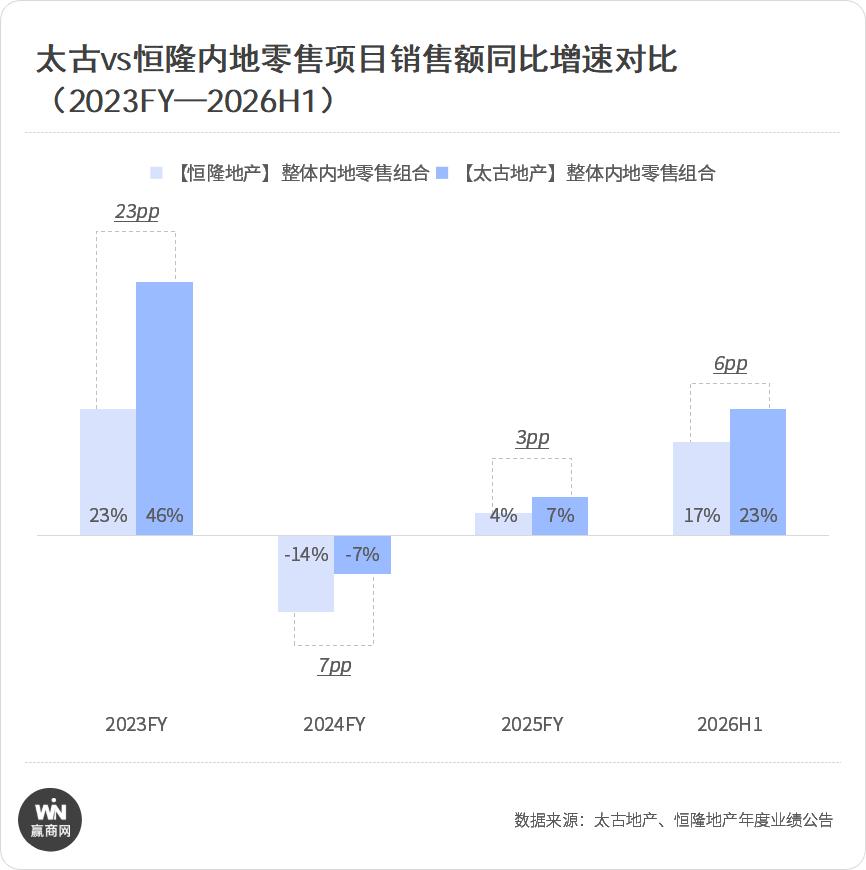
Swire Properties is the clearest winner in this round of divergence. In the first half of 2026, the retail sales of HKRI Taikoo Hui Shanghai surged by 82.2%, Sanlitun Taikoo Hui Beijing grew by 63.2%, while Taikoo Hui Guangzhou, Sino-Ocean Taikoo Li Chengdu and Taikoo Hui Qiantan recorded growth of 9%, 14% and 14% respectively.
The internal divergence of Hang Lung Properties has intensified. The tenant sales of Plaza 66 Shanghai and Grand Gateway 66 Shanghai both increased by 24% year on year in the first half of 2026, stabilizing their basic market, but the projects in Shenyang and Wuhan are still losing money. Under the same "high-end luxury" label, completely different performance curves have emerged.
Behind these figures lies the change of growth logic. The explosive growth of Swire Properties does not rely on "introducing more brands", but on "making existing brands sell more goods". The settlement of Hermès Global Flagship Store, LV House and Rolex Flagship Store means that brands have poured their best products, most exclusive services and most concentrated marketing budgets into these few stores. The purchasing power of consumers, which was previously scattered across three or four stores, is now concentrated into one flagship store. The mall's sales skyrocketed, while the total number of luxury brand stores decreased.
The contraction of brands is exactly the expansion of leading commercial properties. Leading projects attract flagship stores, and the soaring performance in turn attracts more luxury brand flagship stores to settle in. This is the chain effect of "closing small stores and opening large stores", and once this cycle starts, it is difficult to stop.
Obviously, the current relationship between luxury brands and high-end commercial properties is evolving from extensive coverage to in-depth binding.
Brands no longer count how many stores they have opened in China, but instead calculate whether each store is a landmark