Wind power installed capacity plummeted by 27%, what enabled it to achieve a 20% profit growth? By closely partnering with NVIDIA and Huawei, Sinoma Technology no longer wants to only engage in the wind turbine blade business.
Sinoma Science & Technology has achieved both revenue and profit growth, with its wind turbine blade business stabilizing its core base, lithium battery separator and special fiber businesses driving growth, and the company transforming into a new materials platform.
Foresee Energy notes that on August 17, Sinoma Science & Technology disclosed its 2026 semi-annual report. In the first half of the year, its operating revenue reached 16.257 billion yuan, a year-on-year increase of 21.95%; its net profit attributable to shareholders stood at 1.208 billion yuan, representing a 20.93% year-on-year rise.
This central state-owned enterprise, which was spun off from three national-level scientific research institutes, was listed on the Shenzhen Stock Exchange in 2006, stepped into the wind turbine blade industry in 2007, acquired Taishan Fiberglass in 2016, and deployed the lithium battery separator business in 2019. These three key decisions have formed the current pattern of three core businesses operating in parallel.
But the real question worth exploring is: in the first half of 2026, China's newly grid-connected wind power capacity reached 38.62GW, down 27% year on year. How can a blade company still achieve double growth of more than 20%?
The answer does not lie in the blade business itself.
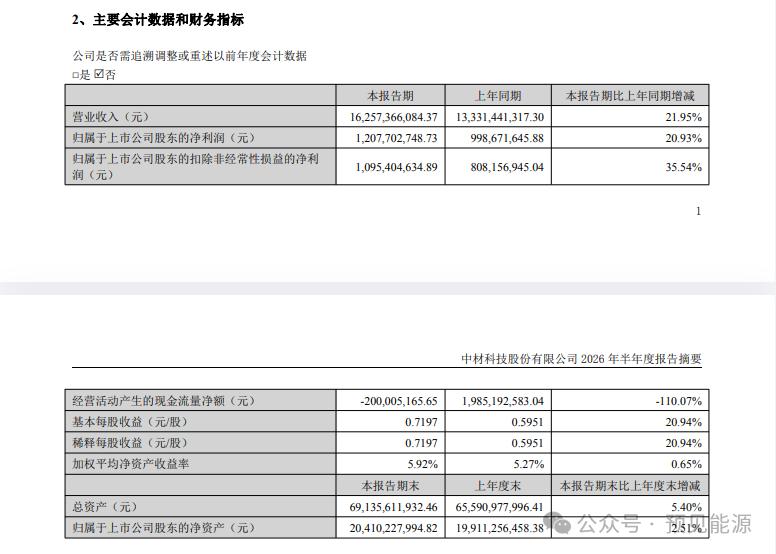
(Screenshot from Sinoma Science & Technology's official announcement)
The rules of the game for the wind power sector have changed
2026 marks the first year of the 15th Five-Year Plan period. The "15th Five-Year Plan for New Energy System Construction" issued in May clearly stipulates that wind power and solar power installed capacity will become the main body of China's total power installed capacity by 2030. The "15th Five-Year Plan for Renewable Energy Development" released in July further quantifies the target: the total installed capacity of wind power and photovoltaic will exceed 2.8 billion kilowatts by 2030.
The core orientation of the 15th Five-Year Plan has shifted to "reliable substitution". The plan puts forward for the first time that the average confidence output of wind power and photovoltaic across the country will be raised to 8%, and the new reliable peak-shaving capacity of renewable energy will exceed 300 million kilowatts. This means that the wind power sector must be equipped with energy storage systems and optimize unit performance.
The renewable energy consumption responsibility weight system jointly issued by four government departments came into effect on August 1, which for the first time establishes a dual-line assessment system combining provincial consumption weight and key enterprise consumption proportion. Green power consumption has changed from "voluntary" to "mandatory".
The policy signal is clear: the market size of wind power is still expanding, but the rules for sharing the benefits have changed. The Wind Energy Committee of China Renewable Energy Society predicts that the newly installed wind power capacity in 2026 will be about 120 million kilowatts, while CICC estimates that the figure will reach 130 to 140GW. The overall demand for wind turbine blades is still growing.
Profits in the industrial chain are being redistributed
In the past few years, the price war of wind turbines has pressed the gross profit margin of complete machine manufacturers to single digits, and upstream blade manufacturers have also faced difficult operating conditions. In 2024, China's domestic wind turbine blade production capacity was about 117GW, while the newly installed capacity in the same period was only 79.82GW, with the capacity utilization rate lower than 70%.
Three changes have taken place in 2026.
The price of complete wind turbines has begun to stabilize. In the fourth quarter of 2024, benefiting from the signing of the industry self-discipline agreement and the owners' revision of bidding rules, the weighted average winning bid price of mainstream 5-8MW units and large units above 8MW increased by 9% and 8% quarter on quarter respectively. State Power Investment Corporation has adopted a new scoring standard, which no longer takes the lowest price as the benchmark price for bid evaluation.
There is a structural shortage of large-sized blades. The proportion of units of 8MW and above has risen to more than 30%, and the production capacity of blades over 100 meters cannot be released rapidly in the short term due to factory space constraints. The scarcity of large blade production capacity of leading enterprises has become increasingly prominent.
Upstream raw material prices are rising, which in turn creates room for blade price increases. The fiberglass industry has entered a cycle of "rising volume and rising price", the CR3 of wind power yarn is about 90%, and enterprises such as China Jushi have raised product prices by 15-20%. Under the pattern of tight supply and demand, blade manufacturers have the opportunity to pass on the cost pressure to downstream links.
According to the calculation of Guojin Securities, if blade prices rise by 3%-5% and the price increase of wind power yarn remains within a controllable range, the gross profit margin can be increased by 1.5-3.5 percentage points.
This is the industry position of Sinoma Science & Technology's blade business: the market demand is expanding, the competitive landscape is optimizing, and the pricing power is recovering.
Blade business remains the core base, but its profit margin is thinning
Let's go back to Sinoma Science & Technology's semi-annual report.
The sales volume of wind turbine blades reached 15.5GW, up 2% year on year, and its global market share remained the first. The corresponding revenue hit 5.579 billion yuan, accounting for 34.32% of the total operating revenue. With a 2% sales volume growth rate and a 7.29% revenue growth rate, the unit price of blades is on the rise. The SI108 series products performed outstandingly, and the proportion of large-sized blades increased.
However, the gross profit margin dropped from 14.18% for the whole year of 2025 to 12.00%, down 4.38 percentage points year on year. The company explained that this was caused by the rising cost of raw materials.
Lu Xiaofeng, Deputy General Manager of Sinoma Wind Blade Co., Ltd., once publicly disclosed that taking 90-meter-class blades as an example, the weight of a single blade is about 30 tons, of which fiberglass accounts for nearly 12 tons. The company's cumulative sales of wind turbine blades have exceeded 200GW, orders from overseas customers have risen sharply, and all production lines are operating at full capacity.
The rising cost of raw materials is an established fact, but the decline in gross profit margin also indicates that cost transmission has not been fully completed. Some institutions predict that the gross profit margin of blades will recover from about 12-14% in 2025 to 16-18% in 2026. Whether this recovery can be realized depends on whether the tight supply and demand pattern of large blades can be sustained.
The real highlight of the blade business is not the 15.5GW sales figure, but its position in the industrial chain profit distribution is shifting from "being squeezed" to "being restored".
Special fiber and lithium separator, two different growth curves
If the blade business is the stable core base, then special fiber fabrics and lithium battery separators are the new growth variables.
In the first half of the year, the sales volume of special fiber fabrics reached 13.45 million meters, and the corresponding revenue was 530 million yuan, up 50% and 114% year on year respectively. Low-dielectric fiber fabric is a key basic material for high-frequency and high-speed PCBs in AI servers. Taishan Fiberglass has invested in R&D in this field for 8 years, and is currently the only enterprise in China that covers all categories of low-dielectric first-generation, second-generation, low-expansion and ultra-low-loss low-dielectric fiber fabrics.
Its customers include Taiyo Ink, Doosan Electronics, Panasonic, Nanya New Material, and ITEQ, and its products are finally applied to the products of NVIDIA, AMD, Amazon, Google and Huawei. The total planned production capacity exceeds 100 million meters, and the first phase of 35 million meters has been put into operation successively in the second half of 2026.
The blade business earns processing fees under the scale effect, while the special fiber business earns premium brought by technical barriers. This is not a cyclical recovery, but a qualitative leap from 0 to 1.
The change of the lithium battery separator business is more direct. In the first half of the year, the sales revenue reached 2.18 billion yuan, up 135% year on year; the external sales volume was 2.77 billion square meters, up 113% year on year. The net profit attributable to shareholders was 155 million yuan, while the figure for the whole year of 2025 was only 50 million yuan. The gross profit margin reached 17.8%, with a year-on-year improvement of 16.54 percentage points.
From the industry perspective, the shipment of energy storage batteries has nearly doubled, and the separator industry has seen both rising sales volume and rising prices. Sinoma Science & Technology completed the long-term agreement negotiation with leading battery manufacturers in March 2026, with a price increase of about 10%, and the price of high-end 5μm separator increased by nearly 30%.
Cash flow is a key signal
While revenue and profit both increased, the operating cash flow turned from positive to negative. It recorded a net inflow of 1.985 billion yuan in the first half of 2025, but a net outflow of 200 million yuan in the first half of 2026.
Accounts receivable increased from 7.577 billion yuan to 9.262 billion yuan, up 22.24% year on year; notes receivable surged by 45.5%. Short-term borrowings soared from 3.028 billion yuan to 6.008 billion yuan.
The "VIM model" of the wind turbine blade business means that customers settle payments based on actual usage, which naturally extends the payment collection cycle. In the first half of the year, the newly installed domestic wind power capacity fell by 27% year on year, and the capital chain of downstream developers was tight, which further prolonged the payment collection cycle.
At the same time, Sinoma Science & Technology is actively increasing its raw material procurement. Electronic fabrics have experienced five rounds of price increases in 2026, with a cumulative increase of nearly 100%. Locking raw material costs in advance is an active strategic choice. The expansion of special fiber fabric production capacity and the capacity ramp-up of lithium battery separators both require large capital investment.
The 9.262 billion yuan accounts receivable accounts for 13.40% of the total assets. With the continuous pressure on downstream links, the risk of bad debts cannot be ignored. However, the price increase cycle of electronic fabrics has just started, and the cost of locking raw materials in advance may be converted into profit elasticity in the second half of the year.
Sinoma Science & Technology is transforming from a blade manufacturer to a new materials platform. The blade business has stabilized its operating scale, the lithium battery separator business has achieved profit reversal, and the special fiber fabric business has secured a key position in the AI industrial chain.
The driving logics of the three businesses of Sinoma Science & Technology are different: the blade business relies on industry cycle recovery and market share concentration, the lithium separator business relies on energy storage boom and product upgrading, and the special fiber business relies on the structural gap of AI computing power demand.
The valuation logic of this company is being rewritten. The anchor of revaluation is not the 15.5GW blade sales volume, but the fact that the three core businesses have all found their own positions in their respective tracks. The cash flow pressure is the cost of transformation, and also the evidence that the transformation is underway.
Foresee Energy will continue to pay attention to the transformation path of Sinoma Science & Technology.