The AI chip unicorn that had all its core talents poached by Jensen Huang has raised 2.4 billion yuan in financing.
Groq plans to expand its computing power scale from 54 megawatts to over 200 megawatts next year.
August 18 report from AI Core, last night, US AI inference cloud unicorn Groq announced the completion of a $350 million (approximately RMB 2.37 billion) Series A funding round, with a post-money valuation of $3.5 billion (approximately RMB 23.7 billion). This round of funding is led by US tech investment institution Disruptive, Nvidia plans to participate in the investment, but the relevant investment is still pending completion of closing.
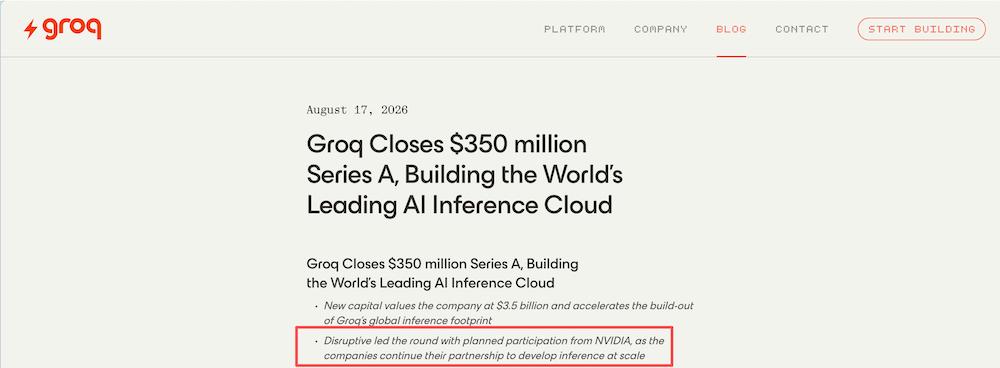
Groq officially announced the financing news (Source: Groq)
Groq said this round of financing will be used to expand its Nvidia chip-based computing cluster to provide computing power for customers to train and run AI models.
According to TechCrunch's report yesterday, Groq's current valuation has dropped by about 49% compared to the $6.9 billion (approximately RMB 46.7 billion) valuation in September 2025. However, a Groq spokesperson stated that the company does not consider this a "down round", but a revaluation of Groq after the completion of the Nvidia technology licensing transaction.
In December 2025, Nvidia reached a technology licensing deal with Groq worth approximately $20 billion (approximately RMB 135.4 billion), and brought in its founder and CEO Jonathan Ross, then-President Sunny Madra and multiple core talents, with the relevant transaction proceeds distributed to original investors.
After that, Groq shifted from mainly developing self-developed LPU chips to operating an AI inference cloud based on Nvidia systems. This financing is therefore called Series A, which is equivalent to the first round of financing in Groq's new stage after adjusting its team, business and capital structure.
In June this year, Groq had obtained $650 million (approximately RMB 4.4 billion) in bridge funding to support its business strategic transformation. Adding this round of financing, Groq has obtained a total of $1 billion (approximately RMB 6.77 billion) in financing within two months.
Before the Nvidia technology licensing transaction, Groq had raised a cumulative total of more than $1.75 billion (approximately RMB 11.9 billion) through seed rounds, Series A to D and additional financing, with investors including Social Capital, Tiger Global, D1 Capital, BlackRock, Cisco, Samsung, Neuberger Berman, Disruptive and Infinitum, etc. Including the two financings after the Nvidia technology licensing transaction, its total public equity financing over the years has exceeded $2.75 billion (approximately RMB 18.7 billion).
01. Founder and core team join Nvidia, Groq shifts to inference cloud
Groq was founded in 2016 by Jonathan Ross, a former Google engineer. Ross participated in the R&D of Google's TPU chips, and Groq later launched the Language Processing Unit LPU for AI inference, trying to form differentiated competition with Nvidia GPUs in the AI inference track with lower latency and higher throughput performance.
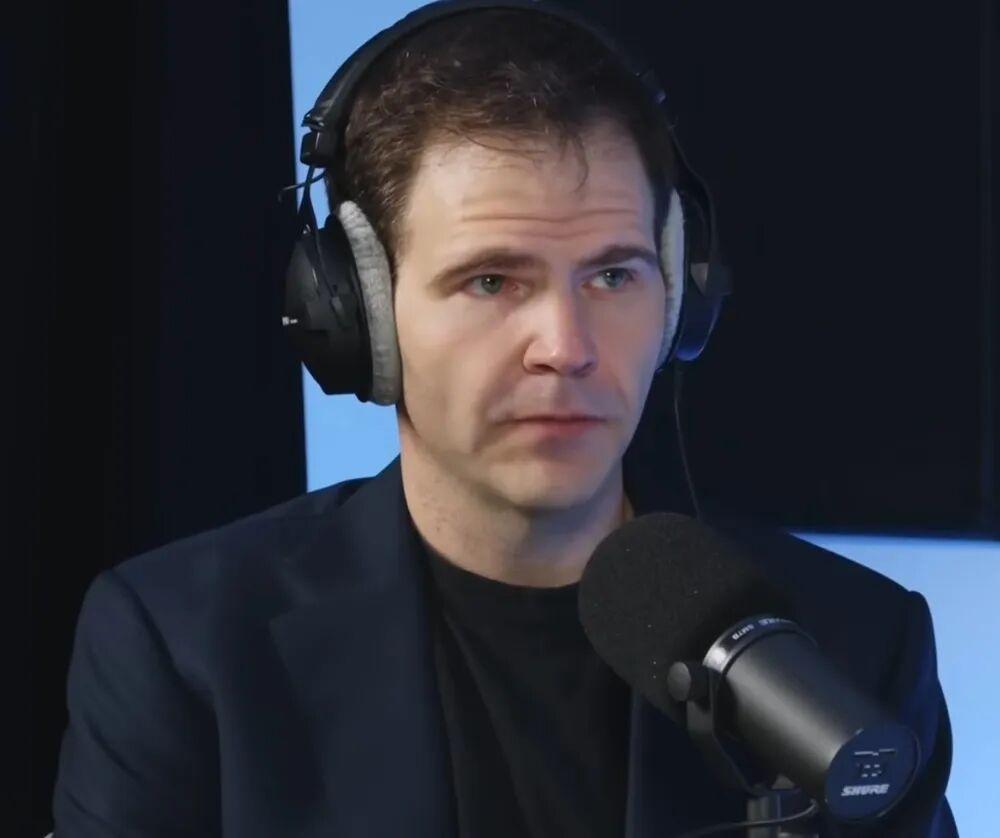
Jonathan Ross (Source: 20VC Podcast)
However, the relationship between Groq and Nvidia changed in 2025. Groq officially announced last December that it had reached a non-exclusive inference technology licensing agreement with Nvidia worth about $20 billion (approximately RMB 135.4 billion), Nvidia obtained the right to use Groq's related technologies, and Ross and many core employees joined Nvidia.
This transaction is not an acquisition, and Groq still operates as an independent company. After the transaction is completed, Groq began to shift its business focus to operating AI data centers to meet the inference computing power needs of enterprises and model manufacturers.
Groq's official disclosure shows that the company has now become a Nvidia cloud partner, which can design, deploy and operate accelerated computing clusters in accordance with Nvidia's reference architecture and operation standards. In the past, Groq relied on self-developed LPU to compete with Nvidia GPUs in the AI inference track, but now it provides training and inference computing power to the outside world through the Nvidia computing platform.
Nvidia currently only "plans to participate" in this round of financing, and the official announcement did not disclose its proposed investment amount; Nvidia has not responded to Bloomberg's request for comment.
02. Operating 13 data centers, computing power scale to increase to over 200 megawatts next year
Groq's official disclosure shows that the company is currently operating 13 data centers in North America, Europe, the Middle East and Asia-Pacific, serving more than 6 million developers, Fortune 500 companies and thousands of AI-native companies, and the platform processes trillions of Tokens every week.
At the GTC conference in March this year, Nvidia launched the Groq 3 LPU and Groq 3 LPX inference accelerator racks built based on Groq's technology, and incorporated them into the Vera Rubin platform. Nvidia said that Groq 3 LPU is mainly responsible for decoding tasks with high latency and bandwidth requirements. When paired with Rubin GPU, the inference throughput per megawatt when running trillion-parameter models can be increased by 35 times.
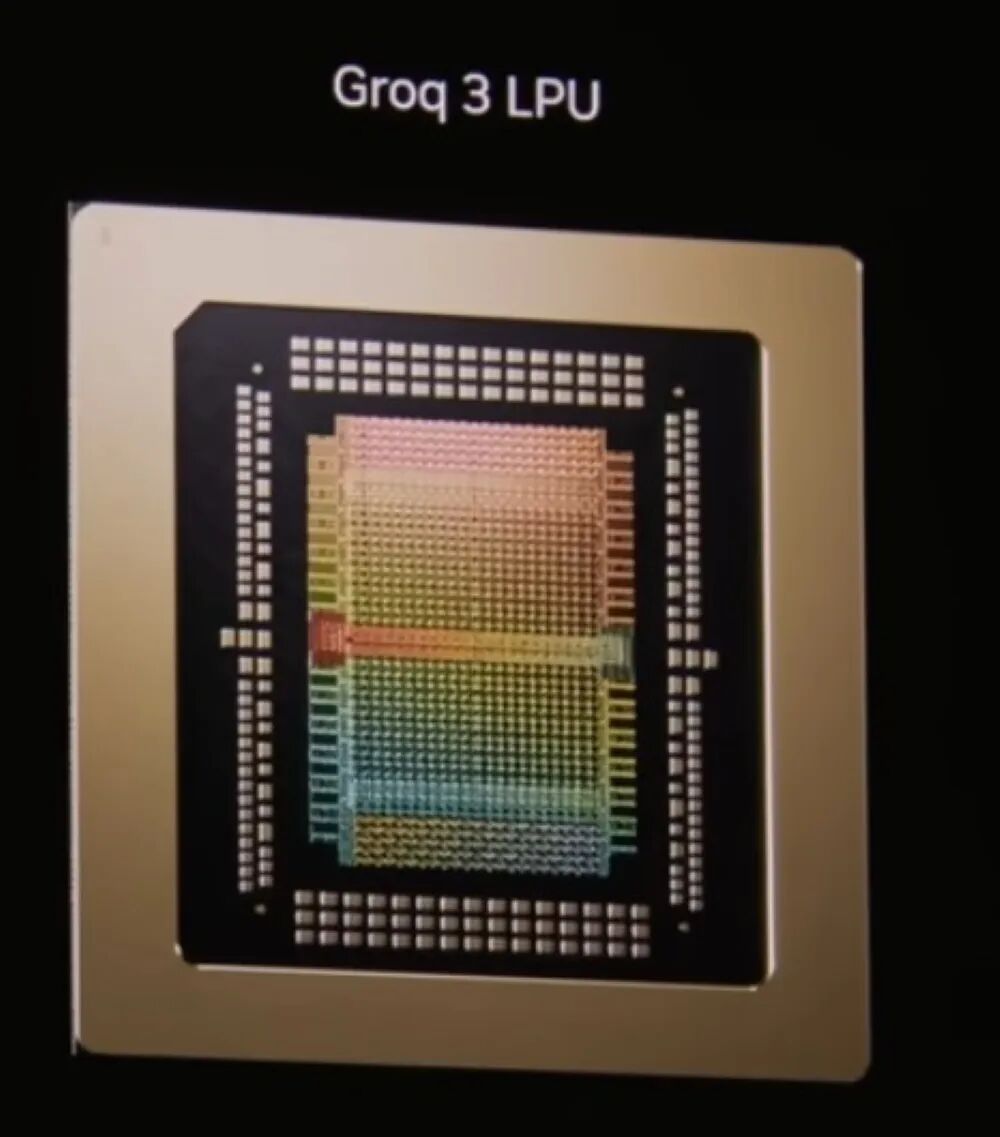
Groq 3 LPU diagram (Source: Nvidia press conference)
Groq plans to use the recent financing to continue expanding data centers and computing clusters, and increase the total computing power scale from the current 54 megawatts to more than 200 megawatts in 2027, with an increase of at least about 270%.
Alex Davis, Executive Chairman of Groq and CEO of Disruptive, said that Groq will focus on serving major model developers, and believes that AI inference will become one of the largest and most critical AI infrastructure links.
However, Groq did not disclose its current revenue, customer payment scale, data center utilization rate and profitability, nor did it specify the respective proportions of Nvidia GPUs and self-developed LPUs in the new computing power.
03. Conclusion: Groq shifts to inference cloud, business model faces re-verification
Groq previously mainly relied on self-developed LPUs to expand the AI inference market. After reaching a technology licensing agreement with Nvidia and some core employees joining Nvidia, the company began to expand its computing cluster based on Nvidia chips, and Nvidia also plans to participate in this round of financing. However, Groq is still operating LPU-related businesses, and the two sides are not currently in a simple competitive or cooperative relationship.
This change means that Groq not only needs to prove the performance advantages of LPU, but also needs to face the problems of computing power utilization, customer acquisition and cost control in data center operation. Its valuation has dropped by about 49% from the peak, and whether the new business can generate stable revenue will affect the market's judgment on Groq's value after transformation.
This article is from the WeChat Official Account "AI Core", Author: Qiezi, Editor: Cheng Qian, published by 36Kr with authorization.