Books generated by AI are not selling well, yet they have made human authors even poorer.
Over the past two to three years, many self-published authors on Amazon have gradually noticed that their books remain the same, the number of readers does not seem to have decreased, but their income has been getting lower and lower.
Image source @Momoyv6
Meanwhile, a romance author writing under the pen name Coral Hart told The New York Times that with the help of AI, she has published more than 200 novels under 21 pen names in the past year; in a video interview, she generated an entire book in 45 minutes in front of the reporter.
People tend to call the latter "slop" and assume that readers will not pay for it, so it cannot cause much impact. But if it is really insignificant, where does that cliff-like decline come from?
In 2026, researchers at Columbia University found that AI-written books do not need to outperform human-written ones — as long as there are enough of them, that is sufficient.
You don't need to write better than humans, you just need to write more than humans
The researchers selected 14419 genre fiction works self-published on Amazon, spanning from 2023 to 2026, and used the Pangram detector to evaluate the full text of each book. They divided these books into three tiers based on the proportion of AI-generated text: no AI content, low AI content, and "high AI content" where AI accounts for more than a quarter of the text.
Books with high AI content account for 20% of the entire catalog, but only contribute 12.1% of sales volume and 11.3% of revenue; while books with no detectable AI content account for more than 60% of the catalog, taking nearly three-quarters of the total revenue.
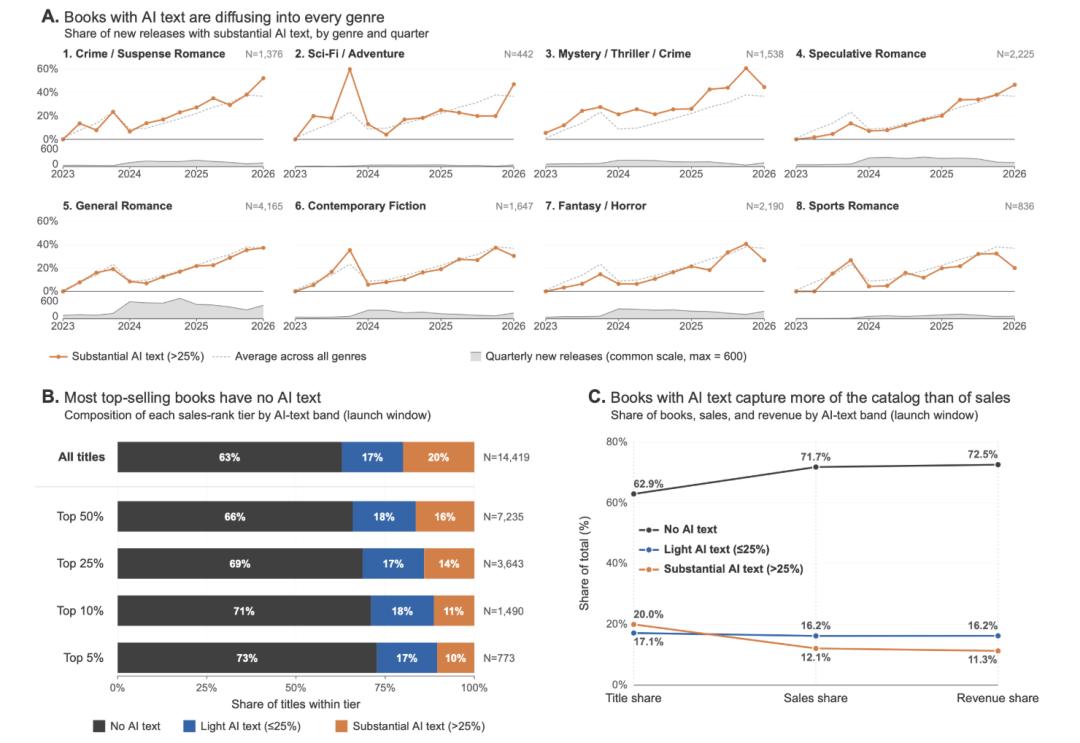
From the first quarter of 2023 to the first quarter of 2026, the total catalog has expanded by 38.3 times cumulatively, the number of books actually sold each quarter has increased by 19.2 times, while the quarterly revenue has only grown by 8.9 times.
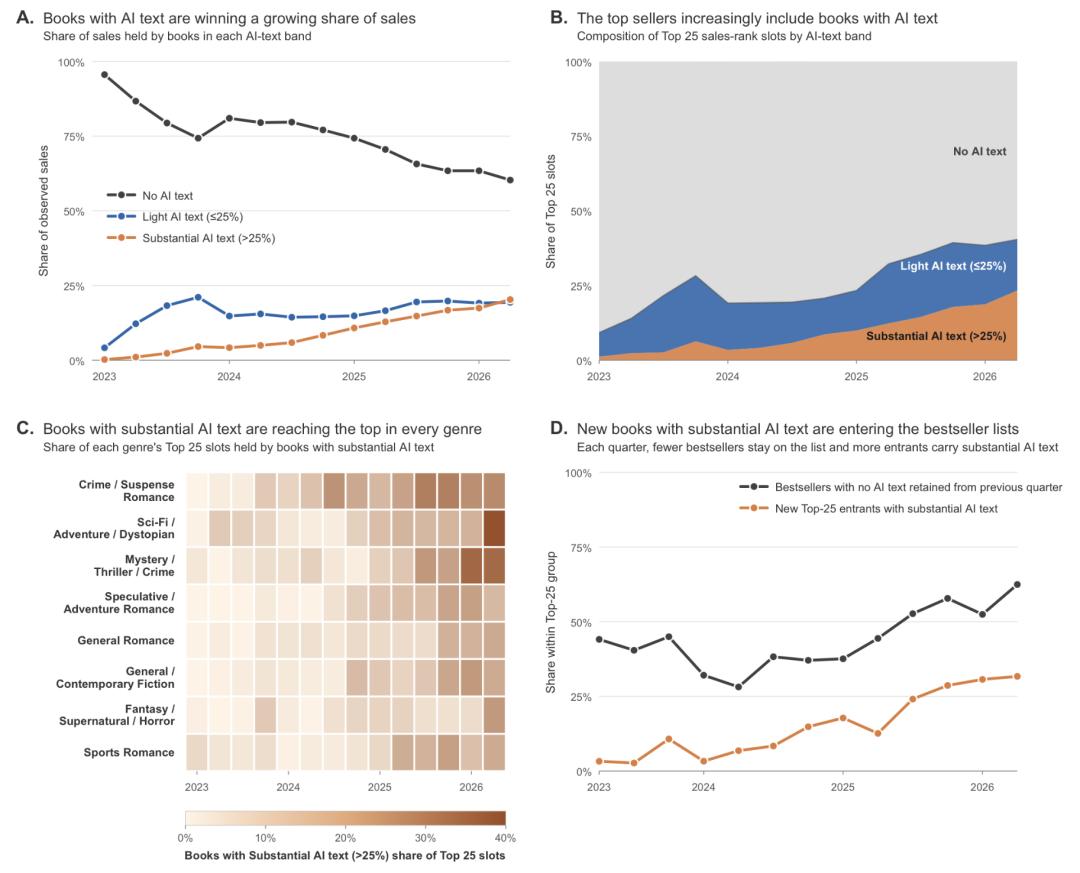
The output of books has exploded, but the overall size of the book market has not grown. In other words, the income each author can get is declining rapidly.
The researchers excluded all unsellable AI books and only compared books with no detectable AI content, and found that the revenue per book of these works is lower than that two years ago. This means the overall decline in average revenue cannot be simply dismissed as "inferior products padding the numbers".
The researchers named this phenomenon "dilution". They also added cautiously that this is an observed correlation, not a strict proof of causality.
AI books rely more on quantity to achieve sales. And this high output is highly concentrated in a small number of people: among the 385 author identities that "continued to publish a large number of books after their first AI book", 287 further increased their monthly output afterwards. The highest-earning pen name earned 1.7 million US dollars before deducting platform fees with only 8 books; the best-selling single book with high AI content sold 80431 copies, generating 643000 US dollars in revenue.
Coral Hart, mentioned earlier, is exactly the spokesperson for this logic. She has published 216 novels under 21 pen names in total. The first 96 books were written word by word in the traditional way, and then she handed over the writing work to AI.
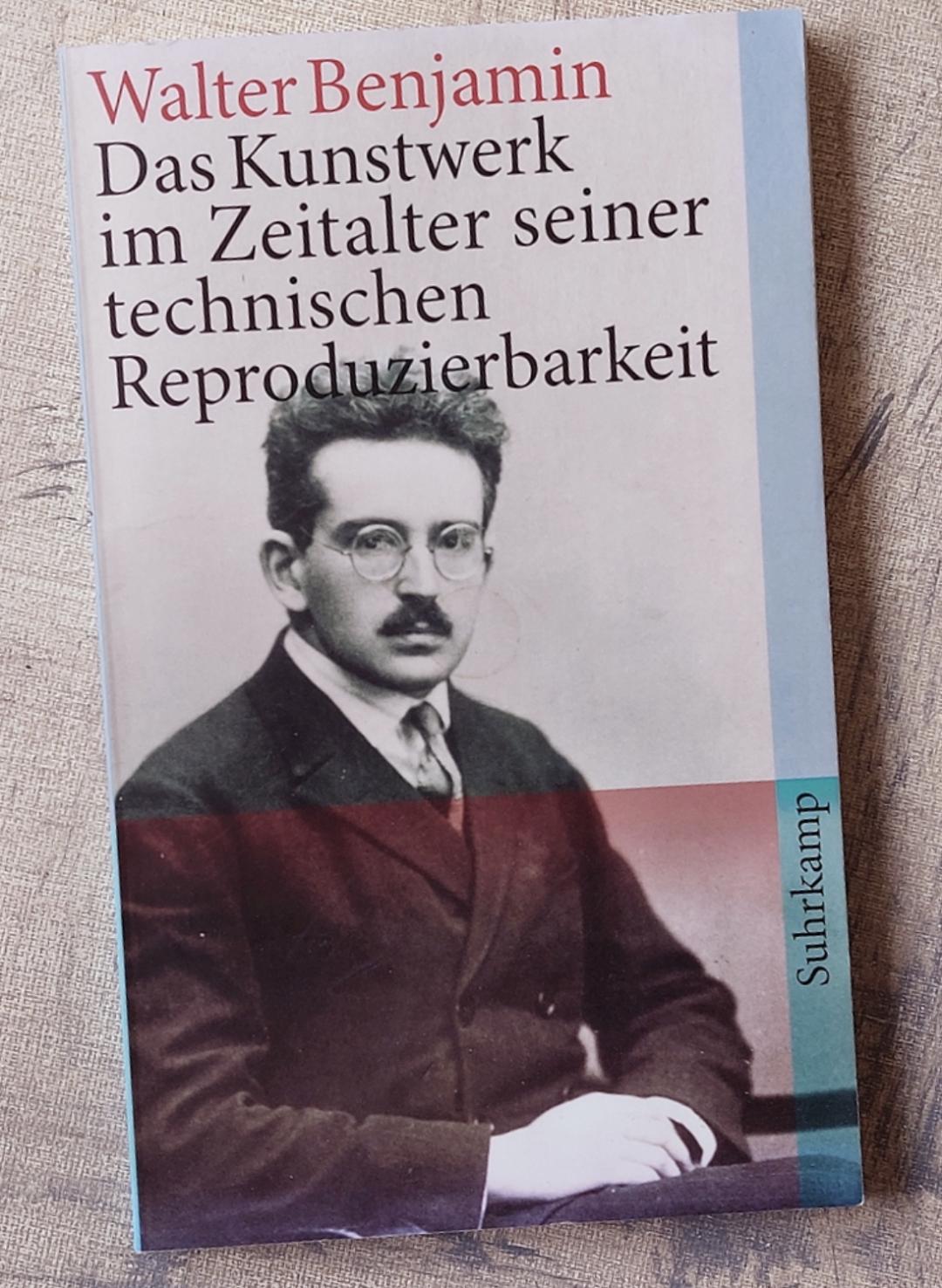
Walter Benjamin discussed in *The Work of Art in the Age of Mechanical Reproduction* that replication technology will strip the "aura" of the artwork that comes from its unique existence in time and space, but what he talked about was only the replication of the same work. Generative AI replicates the act of "writing a book", and pushes its marginal cost down to nearly zero.
In the Kadrey v. Meta case in 2025, Judge Vince Chhabria ruled in favor of Meta in June 2025. It is hard to imagine that using copyright-protected books to train a product that generates billions of dollars in revenue while continuously producing substitutes that compete with original works can be regarded as fair use.
The plaintiffs at that time could not produce empirical evidence of "market dilution", and this study exactly fills in that previously missing category of evidence.
AI Takes Full Control of Romance Novels
Romance fiction in Europe and the United States, and fast-paced wish-fulfillment web novels in China — the first categories to collapse are always those that rely most heavily on fixed formulas.
From print books to e-books, from self-publishing to serialized distribution, romance fiction has always been the most sensitive category to new technologies and the first to embrace new technologies in the entire publishing industry. It has a huge readership, extremely fast update frequency, and plots that are highly dependent on fixed formulas.
Theodor Adorno and Max Horkheimer used the term "culture industry" in the past to refer to standardized, predictable, mass-produced cultural commodities. Genres that have long been highly industrialized are the easiest to be taken over by AI.
Fantasy, supernatural and horror books have the lowest AI penetration rate; in this category, the revenue per book of works with no detectable AI content has not decreased but increased, by about 35%.
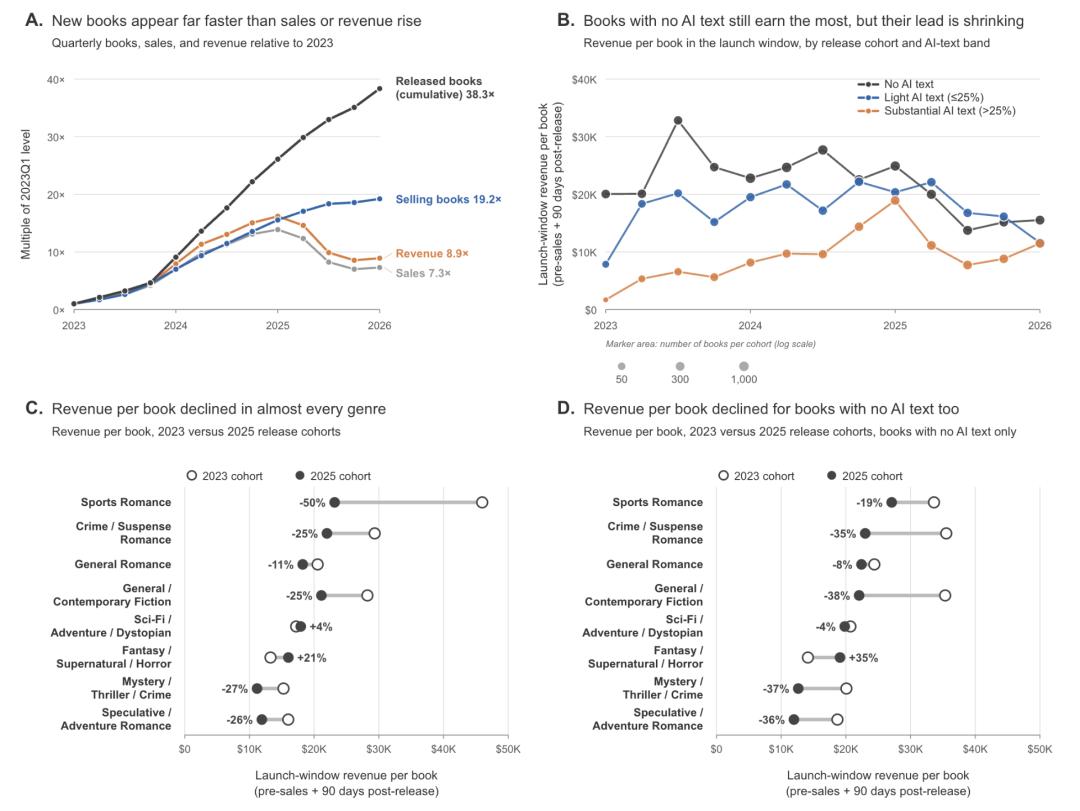
The researchers used this counterexample to refute the claim that "everything is just a general decline of the entire market".
The more a work leans towards literary fiction, the less trace of AI can be found. The researchers also counted the degree to which AI books rely on "rare expressions in previously published books": the top 50 highest-earning books with high AI content use rare expressions to cover nearly half of their text; while among award-winning or award-nominated novels, this proportion is only 19.1%.
Within AI books, for every tenfold increase in revenue, this overlap with existing works rises by 7.6 percentage points, a correlation that cannot be observed in human-written works.
AI, "you are also jealous of human creativity and whims, so you always like to pretend to be human by spouting nonsensical gibberish".
After the release of DeepSeek-R1 on January 20, 2025, the number of "First Show" events on the web novel platform Tomato Novels rose sharply — the so-called First Show refers to a round of algorithmic recommendation on the platform. Authors can only apply for it after their new work reaches 100,000 words, and after passing the review, the work will be recommended to a large number of readers, and the author can start to get advertising revenue share.
The daily number of First Show events for male-oriented web novels jumped from around 1000 on ordinary days to 3549 on March 1.
It is not that so many new authors have suddenly poured in, but AI-generated texts and a large number of web novel studios that want to profit from this trend have swarmed into the platform.
In April 2025, Tomato Novels announced that it would launch long-term governance of low-quality content that uses AI in large proportions, and raised the threshold for signing authors in May; as early as July 2023, China Literature had already released its own large language model and writing assistant. China Literature, Jinjiang Literature City and Tomato Novels now mostly allow AI to help outline the plot, but prohibit using AI to write the main text paragraphs on behalf of human authors.

Tomato Novels has not been overturned by AI, but as the total number of works increases, the average traffic allocated to each book becomes thinner. Once competition intensifies, authors are forced to pay more attention to the appeal of the first few chapters. On platforms that are already known for fast-paced wish-fulfillment stories, the narrative pace is pushed even faster, making it harder for slow-burning works that try to explore new paths to stand out, and new authors are less likely to be noticed by readers.
Only Read Books Published Before 2022
For ordinary readers, the biggest difficulty is not the large number of AI books, but the inability to distinguish high-quality works from low-quality ones.
(Sorry. I have quit using the "not...but..." sentence pattern, I just typed it out by mistake.)
On Amazon, authors do have to declare whether they have used AI when publishing through Kindle Direct Publishing, but the platform will not pass this information on to buyers.
Only buying books published before 2022 is a solution proposed by some people.
Ultimately, this is a kind of retreat. It pulls readers back from a present where it is hard to tell real from fake, to a past where they can at least confirm that the author is a human being.

Because writing AI books is profitable, Coral Hart is still selling courses to this day.
Her PlotProse is said to have taught more than 1600 people, with supporting software that charges 80 to 250 US dollars per month, and can generate a full book in 45 minutes during demonstrations.
Some time ago, a writer said in an interview: In my new novels published this year, AI writing can account for half of the total content. The editor at the publishing house kept praising me for my good writing this year: "This paragraph is really well written, it made me tear up." A reader also gave feedback yesterday: "The second volume of the novel feels more attractive to children." In fact, readers cannot tell which parts are written by AI.
Sharing the evaluation of an industry editor @Mr. Winter Melon Who Can't Write Bestsellers on this topic:
Humans have inertia, and once people get lazy, their passion for work will also decline.
For writers, writing is this kind of work that squeezes the self and is full of pain. Once AI can help you polish those messy marginal texts into smooth and beautiful ones, you will naturally rely on it more and more, and you will be extremely fond of the generated content.
Now, real literature is starting to escape towards inefficiency, hesitation, and even clumsy, unpolished edges.
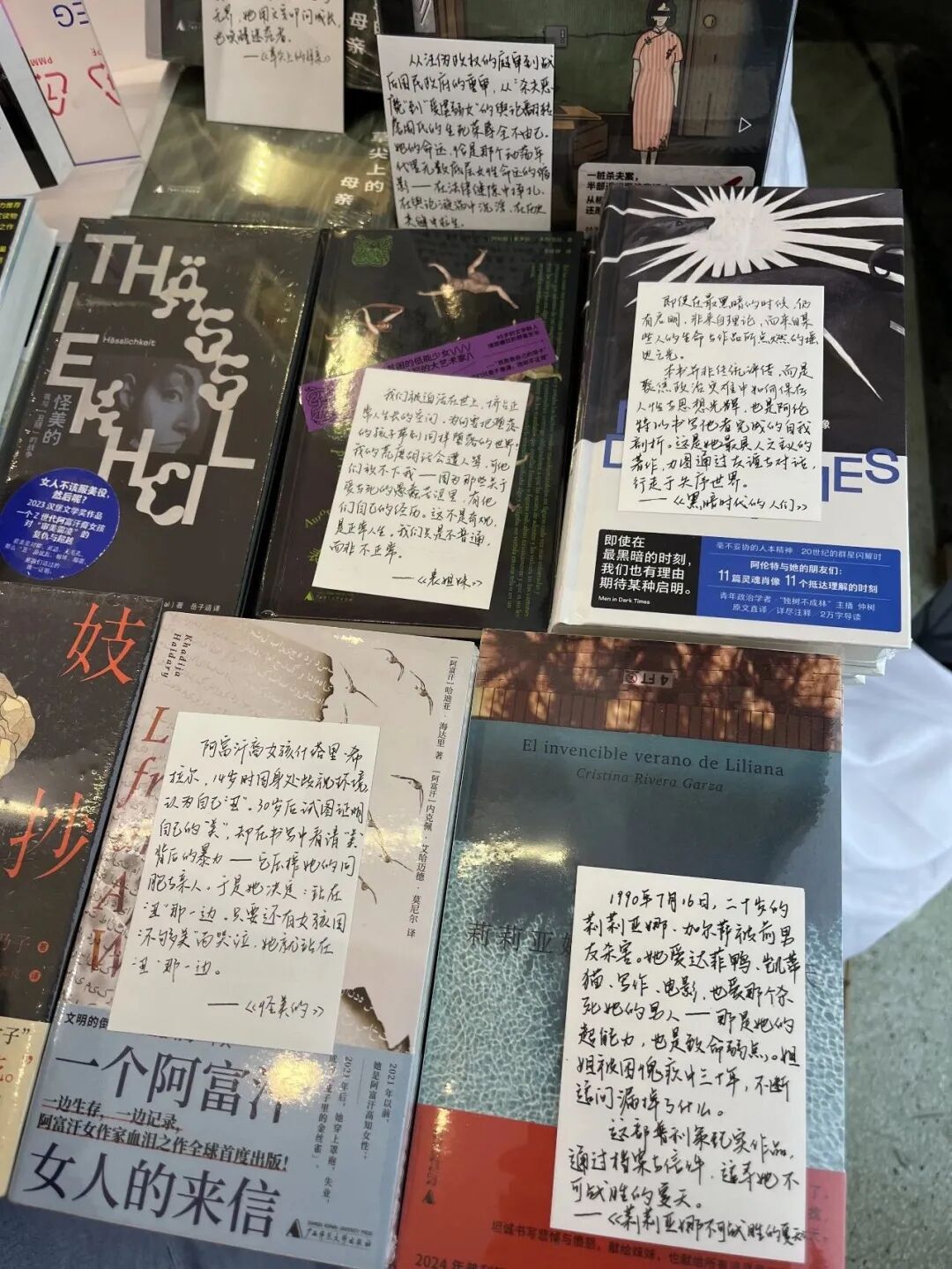
At the Shanghai Book Fair, Guangxi Normal University Press pastes a handwritten note on the book @Jiemian Culture
Related References ✍️:
https://the-decoder.com/ai-generated-books-are-flooding-amazon-and-tanking-sales-for-human-authors/
https://mp.weixin.qq.com/s/rlCBbSjJZmPbsbNOcK5ohg
This article is from the WeChat Official Account "APPSO", the author is the team that discovers tomorrow's products, and is republished with authorization from 36Kr.