Unitree Robotics achieves a high-profile listing, and Wang Xingxing has come through the long dark night.
At 1:21 p.m. on July 4, 2019, 29-year-old Wang Xingxing sent a business plan of Unitree Robotics to an investor.
"Are you interested in projects like this?" he asked on WeChat, then added a follow-up line: "It's similar to Boston Dynamics, making quadruped robots."
At 1:40 p.m., the other party replied: "This is a bit too early-stage for us."
Wang Xingxing replied with two words: "Got it."
Unitree Robotics was founded in Hangzhou, Zhejiang Province in August 2016. 27-year-old Wang Xingxing had just started his business, and Yin Fangming became his first investor, taking 15% of the shares. In early 2018, Unitree Robotics fell into a severe capital crisis. The first 2 million yuan of financing Wang Xingxing obtained was about to be exhausted, and the subsequent investor withdrew their capital, making the situation even worse. The company only had about 100,000 yuan left on its books. Wang Xingxing suspended his own salary and used his personal savings to pay his employees.
A turning point soon came. In 2018, institutions including Variable Capital, Aunchip Investment, and Binhe Investment successively invested in Unitree Robotics, becoming the company's earliest batch of institutional investors. Unitree Robotics thus survived its first severe capital crisis since its founding.
However, Unitree Robotics focused on quadruped robots, which required very high early R&D costs. By 2019, the company was in a critical period of production and R&D for its second quadruped robot, Alien Go, and its capital situation became tight again. A large amount of capital did not enter Unitree Robotics until after 2020, when investment institutions including HSG Seed Fund, Shunwei Capital, and Matrix Partners China successively joined, and Unitree Robotics' financing officially entered the VC rhythm.
Before 2024, Unitree Robotics relied on continuous financing to maintain R&D and team expansion. In 2024, the company completed nearly 1 billion yuan in financing, introducing institutions such as Meituan, Source Code Capital, Shenzhen Venture Capital, and China Internet Investment Fund. With the funds in place, Wang Xingxing began to have the ability to build the robot kingdom he envisioned. After the technology side stabilized, market expansion and implementation came naturally.
According to Unitree Robotics' prospectus, as of September 2025, its revenue reached 1.699 billion yuan, with a net profit of 591 million yuan. On August 19, 2026, Unitree Robotics was officially listed on the Sci-Tech Innovation Board of the Shanghai Stock Exchange, with an issue price of 150.80 yuan per share, corresponding to a market value of about 61 billion yuan. When the market opened at 9:30 a.m. that day, the stock price rushed directly to 1,100 yuan, and the company's market value once exceeded 440 billion yuan. The capital market quickly gave a new valuation the moment Unitree Robotics went public.
The ten years of Wang Xingxing's entrepreneurship coincided exactly with the decade of rapid expansion of China's robot industry. In 2015, the output of industrial robots in China was only 33,000 units; by 2024, this figure had grown to 556,000 units. During the same period, China has maintained its position as the world's largest industrial robot market for 12 consecutive years. In 2025, China became a net exporter of industrial robots.
It is hard to say whether Wang Xingxing caught up with the era of robots, or the era of robots caught up with Wang Xingxing.
Looking back, it was his unyielding spirit that perfectly collided with China's huge and highly efficient manufacturing supply chain. One dares to innovate, the other is capable of manufacturing, and the two eventually move forward together.
Inferiority, Confidence
Many entrepreneurs spend half their lives looking for the fulcrum that they "love and are good at", but for Wang Xingxing, the answer emerged when he was only a few years old. However, the cruelest joke of fate is that it bestows extreme talent on a person early, but throws him into an evaluation system that cannot accommodate this talent, making him carry a sense of inferiority through a long period of life.
In 1990, Wang Xingxing was born in Yuyao, Ningbo, Zhejiang Province. The earliest hint of fate happened when he was in kindergarten, before he could even recognize all the characters.
One day, Wang Xingxing, who had never learned to draw, casually drew a butterfly that looked very realistic. His parents were so shocked that they even called neighbors to their home to watch it. Faced with praise, the young Wang Xingxing was a little confused: "At that time, I only did one thing, I just drew the details well. Isn't drawing just copying what you see? I just drew exactly what the reference showed."
After entering primary school, Wang Xingxing's insight into physical details turned into hands-on ability. Before the age of ten, Wang Xingxing's main hobby after school was watching documentaries about aviation, aerospace, biology and other disciplines introduced on TV. It was also while watching TV that Wang Xingxing learned his first English word in life: NO.
It was also at that time that Wang Xingxing chatted with a classmate, and for the first time had the ideal for his future. He wanted to become a scientist, but his classmate told him that he wanted to become an entrepreneur when he grew up, because entrepreneurs could hire scientists to do scientific research for them. Those words changed Wang Xingxing's mind.
The young man's desire to create was an uncontrollable fire. During his three years in junior high school, he almost spent all his time figuring out how to make a micro turbojet engine; when he reached high school, he was already making rechargeable batteries and doing chemistry experiments on his own. Once, he did an electrolysis of water experiment at home. After turning on the power, bubbles began to form in the water. He watched for a while and then went upstairs to sleep. When he woke up the next day, the whole downstairs was filled with pungent chlorine gas. Because chlorine gas is heavier than air and did not drift upstairs, he narrowly escaped the accident.
However, in the education evaluation system centered on exams and scores, creativity cannot be converted into test scores. English became Wang Xingxing's natural enemy. He could not remember words well, and his dictation results were even worse. His lopsided academic performance made him feel very depressed at school, with no sense of achievement at all. Once during a parent-teacher meeting in junior high school, the English teacher coldly said to his parents in front of Wang Xingxing: "This kid is a little stupid."
The word "stupid" was like a heavy stone, pressing on the young boy's heart day after day. Due to his extremely lopsided academic performance, he entered high school with one of the lowest scores in his grade.
The main line of both high school and junior high school is learning, but the overall evaluation mechanism is completely different. There are more subjects, more content to learn, more diversified evaluation systems, and more fulcrums for personal strengths. In particular, the increased proportion of math, physics and chemistry scores in the total score gave Wang Xingxing breathing space, and his original abilities received new recognition in the high school environment.
Chen Weiguo, Wang Xingxing's high school head teacher and physics teacher, mentioned that Wang Xingxing has a reserved personality, speaks little, has strong concentration, and meticulous thinking. Starting from the second semester of his first year in high school, his talent and advantages in physics began to show, and his grades in math, physics and chemistry could rank among the top few in his class, even in his grade. In the second semester of his third year in high school, he scored 270 points out of a total of 300 in a comprehensive science mock test in Yuyao City.
Scores gave him the confidence to solve problems, but did not resolve the inherent inferiority in his bones. The turning point came in 2009, when he was admitted to the major of mechatronics at Zhejiang Sci-Tech University.
Wang Xingxing's activity track in college was fixed between the dormitory, classroom, library and laboratory. Compared with his middle school days, college gave him full control of his time.
He borrowed 120 professional books from the school library, covering machinery, electronics, control, programming, artificial intelligence and other fields. Among them, the book *Artificial Intelligence Techniques for Games Programming* was borrowed 7 times.
College also released space for Wang Xingxing to explore his interests and practice hands-on. During the winter vacation of his first year in college, he spent more than 100 yuan buying parts and made a biped robot.
After that, Wang Xingxing devoted most of his time to the laboratory. His tutor Jia Wenchuan recalled that when encountering problems, Wang Xingxing often stayed in the laboratory until late at night, and did not leave even during holidays. One day, at 3 a.m., when he was debugging the robot in the laboratory, he was mistaken for a thief by the patrolling security guard.
At that time, global robotics research was at a watershed. The hydraulic drive led by Boston Dynamics had strong power, but it was costly and cumbersome to maintain; electric drive robots had low cost and were easy to control, but due to insufficient performance of joint power units and insufficient output torque, they had long been in a marginal position.
Wang Xingxing judged that if the performance bottleneck of electric drive joints could be improved, quadruped robots would have the possibility of stepping out of the laboratory and entering the market.
During his sophomore and junior years, Wang Xingxing applied for 10,000 yuan of scientific research funds from the school to tackle the key problems of the multi-degree-of-freedom force feedback device for fingers, and applied for his first patent in life based on this project.
When he entered the stage of undergraduate graduation design, he chose the R&D of brushless motor drivers as his topic. He completed the production of this controller in the laboratory. This experiment did not completely eliminate the industry limitations of electric drive joints, but the test data verified the feasibility of the high-performance electric drive solution.
The undergraduate graduation design also determined his subsequent R&D path. He decided to give up hydraulic power and devote himself to the R&D of electric robots. This provided the technical foundation for his later R&D of the XDog quadruped robot and the founding of Unitree Robotics.
One important reason why Wang Xingxing chose to pursue postgraduate studies was that he wanted to solve more profound problems. In 2013, Wang Xingxing applied for Zhejiang University. Although his total postgraduate entrance examination score met the requirements, he failed to pass the English single subject line, and then was transferred to the major of mechanical engineering at Shanghai University. After entering the postgraduate stage, he shifted his focus from biped robots to quadruped robots, and re-searched for more suitable power and control solutions.
While looking for a more suitable power solution, Wang Xingxing continued to deepen along the direction of electric drive, and redesigned the power unit around the motor and drive system. The quadruped robot uses an AC permanent magnet synchronous motor, equipped with a miniaturized motor control board, which directly controls the joint torque through information such as current and rotor position. Compared with the hydraulic scheme, this system has a simpler structure and lower cost.
The year 2015 was a crucial year for Wang Xingxing. In the middle of the year, Wang Xingxing faced the window of graduating with a master's degree. But his robot dog, which was his graduation work, was only half finished. Therefore, he applied for delayed graduation. In the same year, he announced the electric drive scheme of XDog, while Boston Dynamics, the American robotics company, would not announce their electric drive scheme until a year later. Before that, Boston Dynamics had always adhered to the hydraulic scheme.
In August of the same year, all his classmates had graduated one after another. Wang Xingxing, who had delayed graduation, took XDog alone and signed up for the International Intelligent "Star Creator" Competition held in Shanghai.
The disc outer rotor brushless motor used by XDog was re-modified by Wang Xingxing based on drone motors. The matching small-size motor driver, the whole machine's mechanical structure and control algorithm were also designed and developed by himself. Almost all the code of the control system was written by him line by line.
In 2015, in Shanghai, Wang Xingxing took XDog to participate in the International Intelligent "Star Creator" Competition. Facing many intelligent hardware projects completed by teams, this quadruped robot system completed by him alone was particularly rare.
Wang Xingxing and XDog broke into the top six from more than 200 projects, finally won the second prize, and received a bonus of 80,000 yuan. In order to make this robot, he invested more than 10,000 yuan. After deducting R&D and production costs, there was a sum of money left. This was the first time Wang Xingxing obtained direct economic returns relying on robot technology, and it also became the earliest start-up capital for his future entrepreneurship.
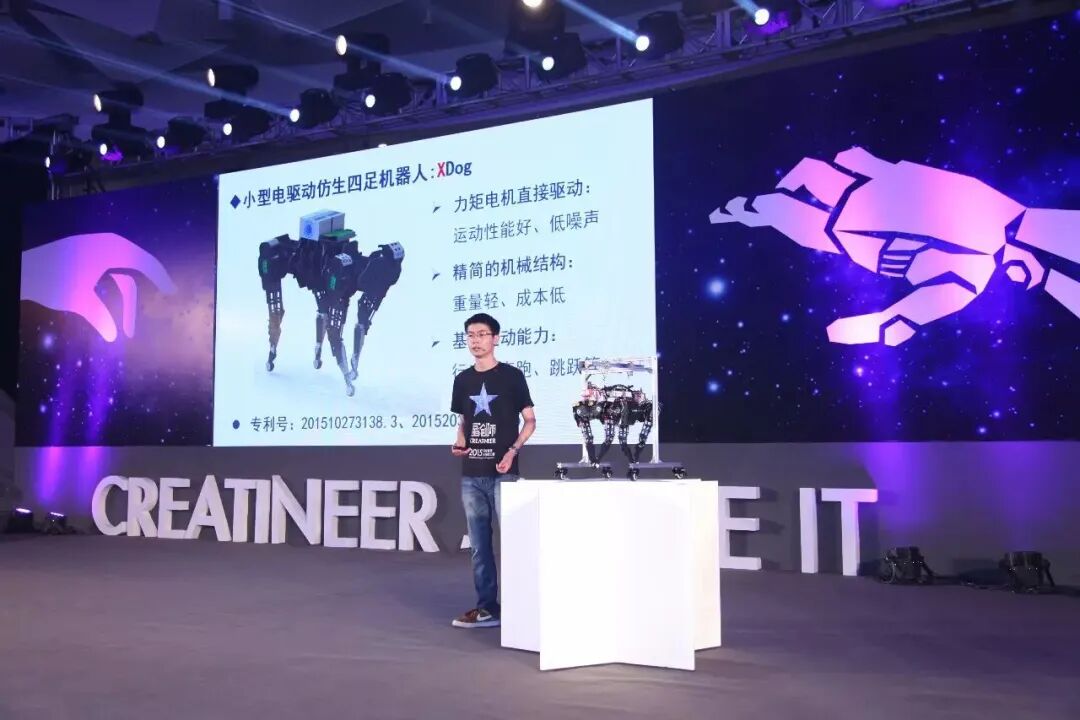
On August 3, 2015, Wang Xingxing at the 2015 International Intelligent Star Creator Competition
Winning the award made XDog enter a wider industry vision. The test video was subsequently spread on domestic and foreign online platforms, and potential customers and investors came to contact one after another. A MIT doctoral student even took the initiative to contact him, asking for his master's thesis *Development and Testing of a New Electric Drive Quadruped Robot*.
At that moment, the sense of inferiority that had been pressing on Wang Xingxing's heart for many years finally loosened. For the first time, he was convinced that what determines the height of an engineer is not which school he graduated from, but whether he can make a real product.
"You will find that people from top schools are nothing special," Wang Xingxing later admitted in an interview, "The XDog I made basically pioneered a technical solution with the idea of low cost and high performance in the world. It is even better than the professors and laboratories of the top overseas schools, which greatly built up my confidence."
Vertical Integration
After winning the award, Wang Xingxing got an offer from DJI with XDog. At that time, many people envied him for being able to join such a star company like DJI. In June 2016, he officially graduated from Shanghai University and went south to Shenzhen. But two months later, he resigned, stayed in Shenzhen for another month specifically to talk about investment, and then returned to Hangzhou.
The reason was that in April of that year, he uploaded the video of XDog to Youku. In June, IEEE Spectrum reposted the video. A few days later, a YouTuber reposted his video, and the influence surged all at once. Along with that came inquiry calls and investment inquiries. The idea of starting a business that Wang Xingxing had during his college days finally ushered in external opportunities. He went north to Hangzhou to prepare for starting a business.
Starting a business was not as smooth as imagined. The financing had not been implemented for a long time, the company had not been registered yet, and Wang Xingxing had no income. During that period, he lived at a friend's house and slept on the sofa in the living room. The sofa was too short, and his legs were sore every day when he woke up.
A turning point soon came. Yin Fangming took the initiative to find Wang Xingxing and invested 2 million yuan in his personal name, allowing him to officially embark on the road of entrepreneurship. This was also the first external fund Unitree Robotics received. Wang Xingxing recalled that the investment conditions were very loose at that time. When the funds arrived, the two sides had not even signed a formal agreement.
Unitree Robotics started in this way.
In October 2017, the company released its first quadruped robot, Laikago. The name comes from the Soviet space dog Laika. In 1957, Laika took "Sputnik 2" into space, becoming the first animal to orbit the earth, and never returned to the earth. Wang Xingxing named the first-generation product Laikago, hoping that it would be like that space dog, stepping into no man's land first and opening up the road.
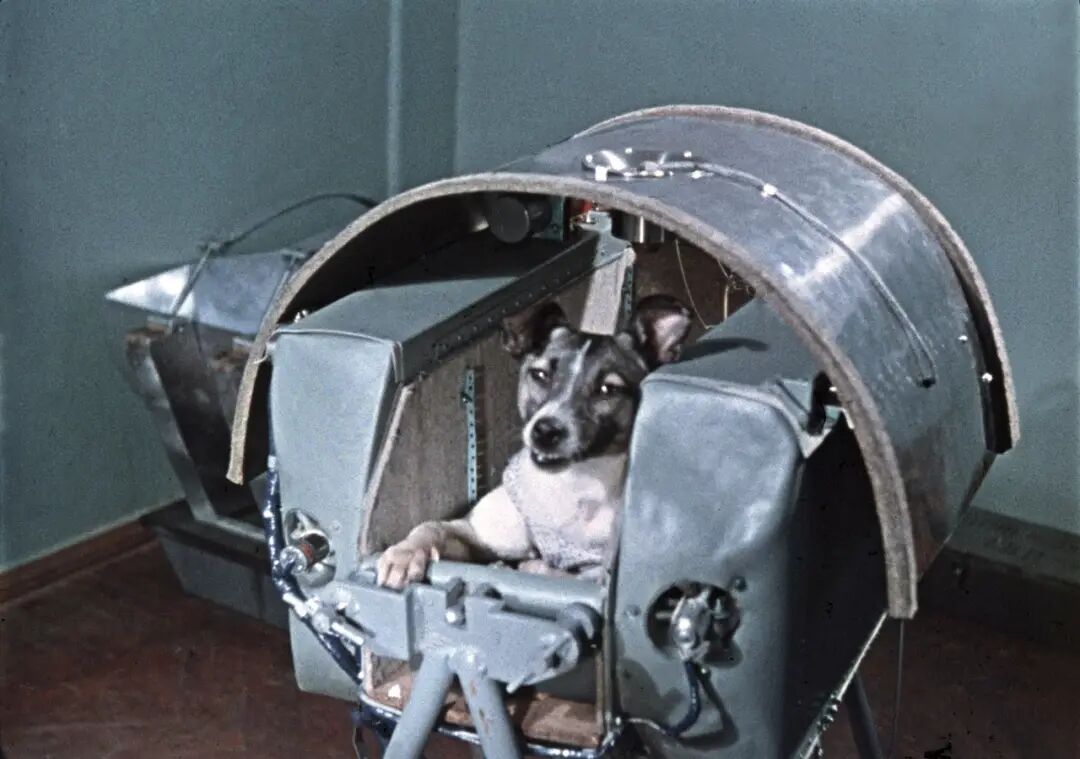
Laika was a Soviet space dog, one of the earliest animals in history to enter space, and also the first animal to enter