Cursor has just changed its "surname" to Ma, and it is already poised to take down GitHub.
Cursor launched its own code hosting platform Origin at the most opportune moment.
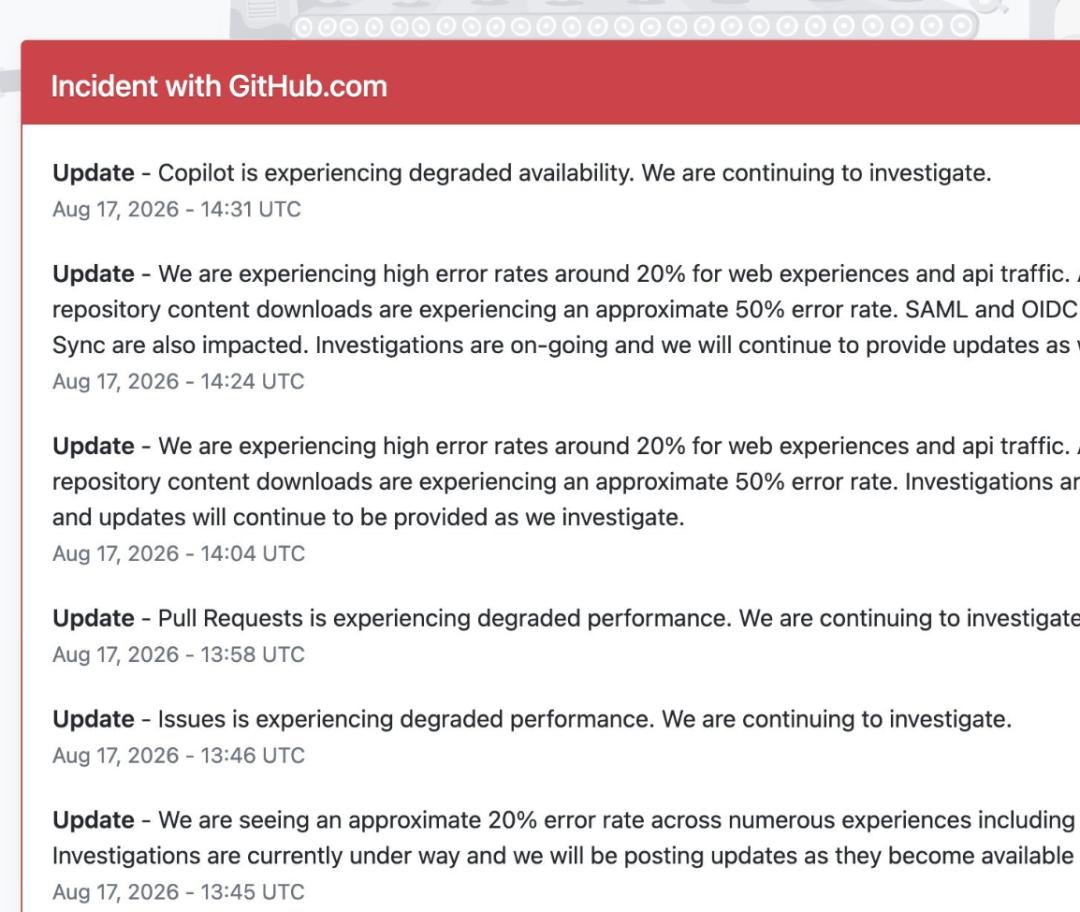
Today, GitHub suffered an outage of nearly seven hours, which rendered all submitted branches, single sign-on functionality, and Copilot services completely inoperable.
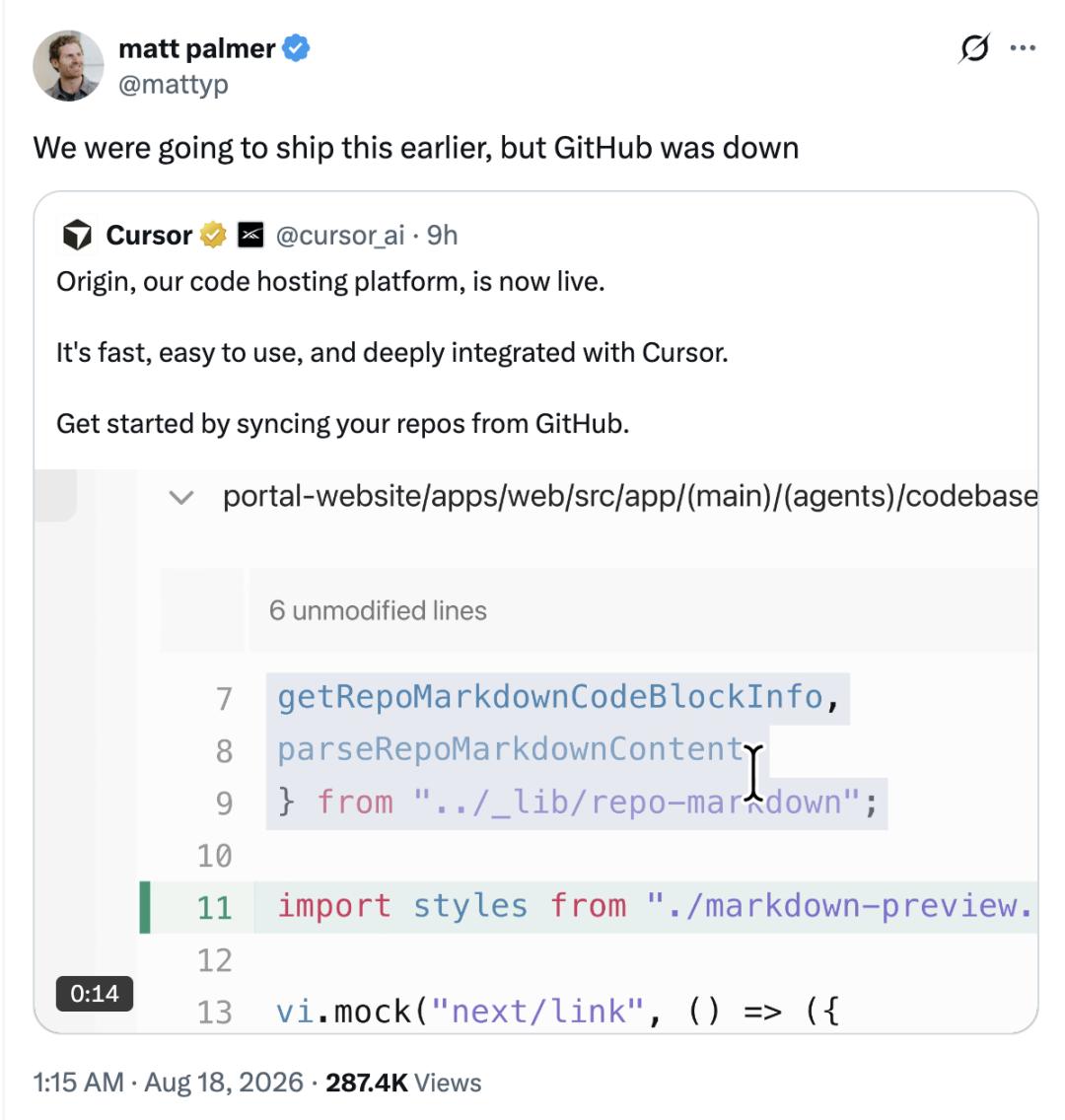
At this point, any decent solution will be taken very seriously.

According to Cursor, with Origin, you can create repositories, perform Git commits and pulls, or mirror code from GitHub. You can browse and search code, open and merge pull requests, and attach cloud agents to the same remote server.
GitHub for Agents
At the code repository level, Cursor has added a new "Codebase" tab in the client for unified management of repositories on Origin. After users click "New" and name their team, the URL of all subsequent repositories will carry this organization name, for example, cursor.com/codebase/acme-corp. After installing the Origin CLI, the cloning and pushing processes are almost identical to those of other Git hosting services.

At the PR level, Origin provides a complete timeline, commit history, check items, and file change view. The entire workflow of reviewing diffs, leaving comments, and merging can be completed directly within Cursor.
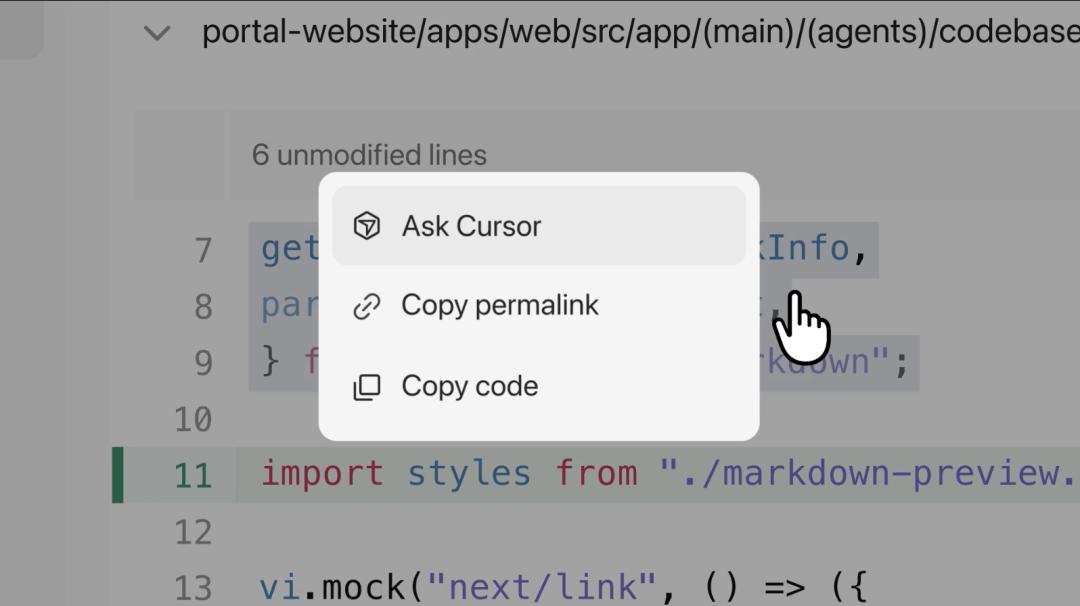
Comments in Cursor are synced to GitHub, and emoji reactions and replies on GitHub will appear on the Cursor side within a few seconds. Code review tasks assigned to developers can be processed and merged directly in Cursor.
At the agent level, Cursor centralizes code, PRs and Agents in the same interface. Users can directly ask Cursor questions about the code they are currently browsing, ask it to answer questions, modify files, update PRs, or push branches.
At the application extension level, Origin has initially integrated Vercel, Depot and Buildkite. After connecting Vercel, each PR will automatically get a preview deployment environment; after connecting Depot or Buildkite, teams can not only run their existing GitHub Actions workflows, but also run native Buildkite pipelines. The last mile of CI/CD has been paved in advance by Cursor.

In addition, each repository has an independent configuration page, where users can check the GitHub synchronization status, manage access permissions, and view which third-party applications are currently connected.
The biggest difference between Origin and GitHub is that it places agents at the core of the product architecture, rather than treating them as an add-on feature.
"Today's source code control infrastructure was originally designed for human reading, human review, and human merging. And agents are changing all of this."
According to internal data disclosed by Cursor, 35% of the PRs that have been merged on the Cursor platform were autonomously submitted by Agents running in cloud virtual machines. This does not mean that the development process has completely entered a "fully automated" stage.
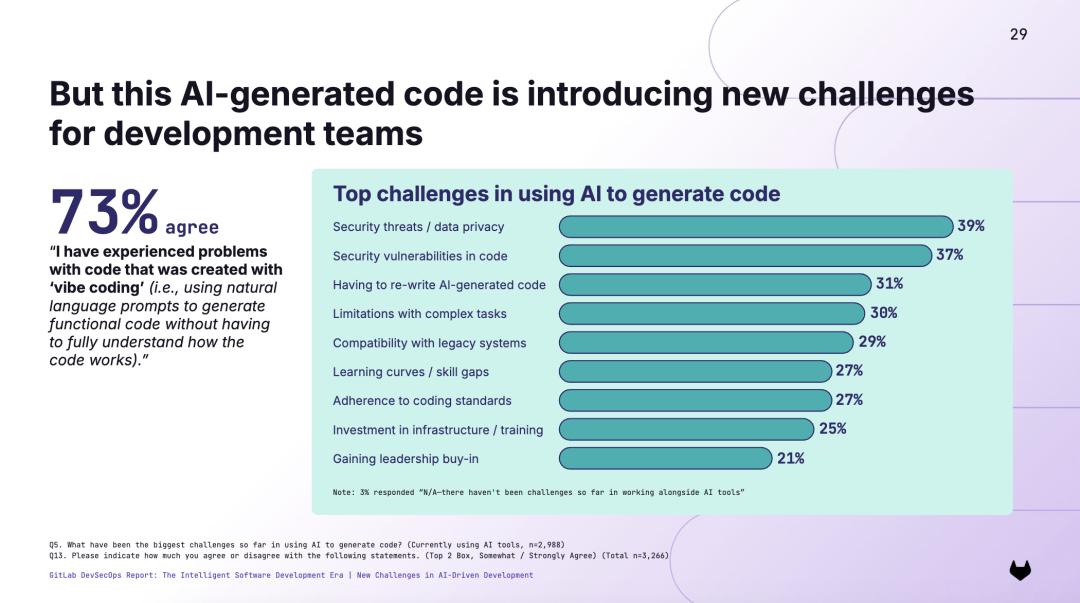
GitLab's 2025 DevSecOps survey found that 73% of respondents have encountered problems caused by outputs from vibe coding, 70% of respondents believe that AI has made compliance management more complex, and only 37% of respondents are willing to let AI handle daily tasks without human review.
In other words, agents are increasingly involved in writing code, but humans still firmly hold the final gate of merging, reviewing and taking responsibility.
Cursor's Cloud Agents already have the ability to run independently in an isolated environment, modify code, run tests, operate browsers and tools, and create PRs, without requiring local machines to stay online. Developers can also make multiple Agents work in parallel. When a mid-sized team may push hundreds of branches every hour, the workflow of traditional Git platforms will be instantly overwhelmed.
Cursor once demonstrated a throughput of 22.6 commits per second in its demo, which is almost meaningless in the era dominated by humans.
Origin gives Cursor a complete closed loop. If the Agent generates code, enters the repository hosted by Cursor, produces a PR, gets reviewed, and finally merged, the entire link no longer needs to repeatedly interact with external platforms.
Cursor's official reply on HN also confirms this path. The R&D team wrote that more Agent-related capabilities will be launched in the coming weeks, including understanding of code written by Agents, and automatically making PRs ready for merge, etc.
If we continue to imagine along this path, the updated form of Origin may include the following capabilities: hundreds of parallel Agent branches, automated review and testing, PRs directly generated by Agents, resident Agents bound to specific repositories, automatic pipelines from Issue to code, and collaborative scheduling between Agents.
How Can This Be Considered a Competitor
After the launch of Origin, the most heated discussion focuses on its relationship with GitHub.

Users can connect their GitHub organizations to Cursor, select the repositories they want to sync to Origin, and disconnect at any time. Synced repositories will be updated in real time, allowing users to browse, search, and pull code in Origin, while pushes are still sent to GitHub.
For activities initiated in GitHub, GitHub remains the authoritative source. A small icon next to each repository name identifies whether the repository is hosted by Cursor or mirrored from GitHub.
Thomas, a member of the Cursor team, replied half-jokingly, You need to at least link your GitHub account to open Origin, how can this be considered a competitor.
Origin publicly emphasizes coexistence with GitHub, but is quietly taking over the most important workspace for developers in private.

At present, Cursor has capital, self-developed models, cloud Agents, mobile control capabilities, development environments, and code review features. Now it has added code hosting to its product matrix.
However, Origin is not completely free like GitHub.
Both the official Cursor documentation and release update logs state that Origin (Cursor's native code hosting/git Forge) is only available on paid plans: Pro, Teams, and Enterprise.
GitHub's advantages are: it owns the world's largest developer community, Microsoft's distribution capabilities, and the huge ecosystem built around Actions, Packages, Copilot, and Advanced Security.
However, since October 2025, GitHub has been in the process of migrating from traditional data centers to Azure, and the semi-migration state has become a continuous source of instability.
On July 19, a DNS reconfiguration caused 2 hours and 11 minutes of service degradation for GitHub and its data residency environments; on August 6, Actions and Pages went through a recovery process that lasted 10 hours and 20 minutes. For a platform that the industry generally regards as core infrastructure, such availability performance has led more and more teams to re-evaluate their technical base.
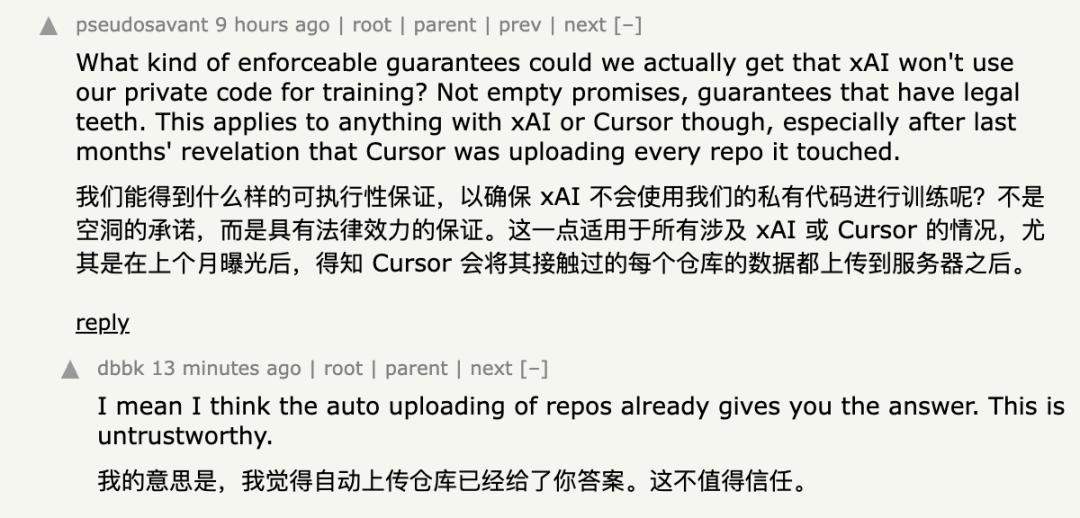
I Will Never Share My Code With Elon Musk
"I will never share my code with Elon Musk. I have also stopped using Cursor and switched to Claude Code and Codex. GitHub does have some problems, but I hope all of this can be resolved smoothly in the end."
In June, SpaceX and xAI jointly completed the $60 billion acquisition of Anysphere, which changed Cursor's ownership structure. For many enterprise development teams, the ownership and access boundary of source code is a red line that cannot be touched.
Having an AI company act as the code host, model trainer, and Agent executor at the same time means that source code may be used for product improvement, model training, or even internal testing.
Even though Cursor has provided training data isolation commitments in its enterprise solutions, many teams bound by compliance requirements still prefer to keep their repositories on established platforms with independent audit reports and clear compliance statements.
Can Origin really shake GitHub's position?
Both VentureBeat and SecureSlate pointed out in recent reports that GitHub's long consecutive outages have objectively provided new impetus for multi-cloud code hosting strategies within enterprises. Platforms such as GitLab, Bitbucket, Gitea, and Codeberg have all gained varying degrees of public attention as a result.
Of course, a single outage is not enough to overthrow GitHub's 20 years of accumulation, and a Beta product is probably still far from winning the trust of developers immediately.
However, in the AI era, the cycle for building and breaking moats is shortening rapidly. At this time last year, who could have imagined that Grok would be able to dethrone Gemini from the "top three AI players"?
Related References📄:
https://x.com/ericzakariasson/status/2089466749943152806
This article is from the WeChat public account "APPSO", written by the discoverer of tomorrow's products, and published with authorization from 36Kr.