Ten years, Wang Xingxing's counterattack: Unitree reaches a valuation of 400 billion.
In the summer of 2019, in a nondescript office building in Binjiang, Hangzhou, 29-year-old Wang Xingxing was demonstrating his quadruped robot to visiting investors. At that time, the company only had hundreds of thousands of yuan left in its account, and was in urgent need of a capital injection.
Standing opposite him was Li Yannan, Managing Director of HSG. Looking at the waddling, head-swaying quadruped robot in front of him, he vaguely sensed a far greater possibility.
Soon, Wang Xingxing took his quadruped robot to Beijing to attend the HSG investment committee meeting. To give investors a more intuitive experience, he offered to bring the robot for an on-site demonstration. However, as the robot's battery exceeded the safety limit, he could not take high-speed rail or flights, so Wang Xingxing eventually traveled more than ten hours on a sleeper train from Hangzhou to Beijing.
Seven years have passed in a blink of an eye.
Today (August 19), Hangzhou Unitree Robotics Co., Ltd. (referred to as Unitree) was officially listed on the Sci-Tech Innovation Board, becoming the "first A-share humanoid robot stock" — its issue price is 150.80 yuan per share, the opening price surged by more than 500%, and its market value is about 400 billion yuan.
The young man who once squeezed on a sleeper train has become the post-90s entrepreneur with the highest net worth on the Sci-Tech Innovation Board; HSG, which made its first investment in 2019, has continuously increased its bets and become the independent private equity investment fund with the highest shareholding ratio in Unitree.
This is the most exciting comeback story in the venture capital circle over the past decade, and it is also a victory for passion, persistence and faith.
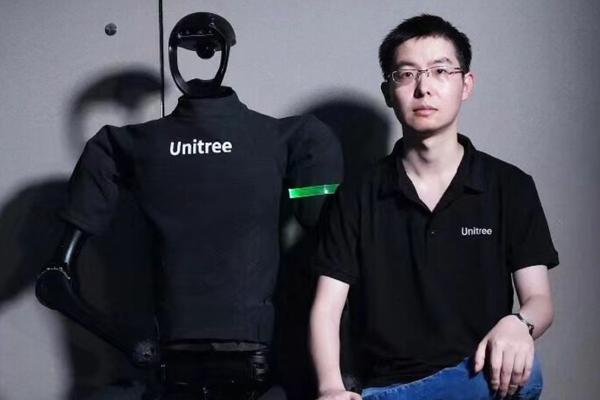
Seven Years Ago, the HSG Investment Committee Meeting
The acquaintance between HSG and Unitree started with a QQ email address.
It was July 2019, Li Yannan heard about Unitree and a young man named Wang Xingxing from a senior alumnus at Zhejiang University.
Born in Ningbo, Zhejiang in 1990, Wang Xingxing is not a top student in the traditional sense. He was extremely poor at English and was once regarded as a "poor student" by teachers. But he has extremely strong hands-on ability: when he was an undergraduate at Zhejiang Sci-Tech University, he spent only more than 200 yuan to build a 14-degree-of-freedom biped small robot by himself; during his postgraduate study at Shanghai University, he developed XDog, a low-cost, pure electric-driven quadruped robot, with the total machine cost of only 20,000 yuan. At the Shanghai Robot Competition, Wang Xingxing won the second prize and a bonus of 80,000 yuan, and began to stand out.
After graduating with a master's degree in 2016, Wang Xingxing joined DJI, resigned after more than two months, moved to Hangzhou and started his robotics entrepreneurship. He successively developed products such as Laikago and AlienGo, and gradually gained a reputation in the geek circle.
But unlike the grand occasion today, Unitree's early financing did not go smoothly. Investors thought the quadruped robot was too niche, or that the founder was not "elite" enough.
The turning point came in the summer of 2019.
Li Yannan found Wang Xingxing by searching for his WeChat ID through the QQ email address on Unitree's official website, and made an appointment to visit the company to see the products. At that time, Unitree's office was located in Jinxiu Center. At their first meeting, Wang Xingxing showed his quadruped robot — it could jump and flip, with neat and agile movements.
What impressed Li Yannan was not only the product, but also Wang Xingxing himself: his passion for technology, in-depth thinking about robots, and the extreme concentration he showed. He immediately judged that this investment was worth advancing as soon as possible.
The subsequent progress was faster than expected. The Saturday after meeting Li Yannan, Wang Xingxing met the partner of HSG at Shanghai Airport, and received the investment term sheet the next day. In this way, 29-year-old Wang Xingxing took his quadruped robot to the HSG Beijing investment committee meeting.
But the investment committee meeting was not easy.
"Unitree in its early stage was an enterprise with both obvious strengths and obvious weaknesses, and we had many heated discussions and collisions of different opinions internally." Li Yannan recalled. In 2019, high-performance quadruped robots were regarded as a "niche direction for geeks" by most people, without clear demand scenarios. Drones had gone from the geek circle to the mass market, giving birth to DJI, but at that time, it was still a big question mark whether quadruped robots could replicate that path.
What finally impressed the investment committee was still Wang Xingxing himself.
At the meeting, he described a seemingly whimsical vision : to build a robot taller than a mountain, to build a robot that can enter blood vessels, and to use robots to manufacture robots. Those words sounded a little distant at that time, but behind them was a young man's purest belief in robots.
"Many great companies in history were very controversial at the very beginning." Li Yannan said with emotion. In HSG's scoring system that day, the investment committee gave 9 points (full score 10) in the two dimensions of Outlier and Vision. Soon, HSG made its first investment in Unitree's Pre-A round through its seed fund, becoming one of the earliest institutional investors of the company.
After that, HSG increased its holdings three times in Unitree's Pre-A+, Series B and Series C rounds, and Unitree has also become a typical case of HSG's full-stage investment from seed to later stage. According to the prospectus, HSG holds 7.11% of Unitree's shares, making it the independent private equity investment fund with the highest shareholding ratio.
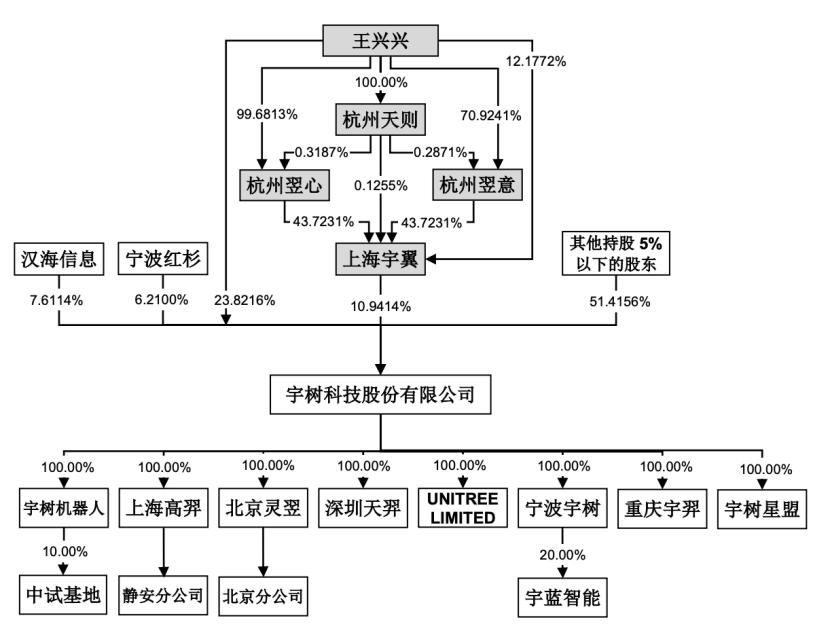
With Unitree's IPO today, HSG's seed fund has ushered in its second IPO since it was separately established in 2018, and it is also the first IPO project invested by RMB fund.
Half of the Investment Circle Showed Up
Li Yannan later learned that when he first met Wang Xingxing in 2019, Unitree's situation was already quite urgent — DJI gave up the transaction at the last minute, Unitree's financing round failed, and the cash flow on the account was almost exhausted.
The day before the investment committee meeting, a mutual friend left a message on Wang Xingxing's WeChat Moments, asking what he was busy with recently. He replied with a joke: "I feel like I can't keep the startup running anymore, I'll go back to Shenzhen to work for others if it doesn't work out."
But at the investment committee meeting the next day, he did not look like he was ready to give up at all — he was calm, confident and talked with full enthusiasm. Li Yannan still remembers the look in his eyes when he looked at his own work as he demonstrated the robot to everyone in the conference room.
Later, whenever there was an opportunity to display products, Wang Xingxing was full of passion. In 2019 and 2020, he offered to bring his quadruped robot products to HSG CEO Summit many times. Without an exhibition booth, he waited outside the venue holding the quadruped robot. Those scenes, when recalled now, show the most simple love of an entrepreneur for what he is doing, which is still touching even today.
Before that, Unitree's institutional investors were only a few, including Variable Capital and DCM Ventures. Later, with HSG's shot, Unitree's financing situation gradually opened up:
Famous institutions such as Sequoia Capital China, Innoangel Fund, Shunwei Capital, Matrix Partners China, Shenzhen Venture Capital, Royale Ventures, Dunhong Asset, GoldenStone Investment, Source Code Capital and Jinqiu Fund entered the market one after another; local state-owned capitals such as China Internet Investment Fund, Beijing Robot Industry Investment Fund, Zhongguancun Science City and Shanghai Science and Technology Innovation Fund also followed up; leading Chinese Internet and industrial capitals including Meituan, Tencent, Alibaba, Ant Group, China Mobile and Geely Capital all participated in the investment.
In the last financing round in June 2025, Unitree's post-investment valuation reached 12.7 billion yuan. The prospectus shows that Meituan acts as a concert party through three companies: Hanhai Information, Chengdu Longzhu and Galaxy Z, holding a total of about 9.65% of the shares, making it the external shareholder with the highest shareholding ratio in Unitree.
And HSG's support is far more than just providing capital.
"After years of contact, Wang Xingxing is a very genuine person." Li Yannan recalled to the investment community. Wang Xingxing makes decisive and accurate decisions in the fields he is good at, and he will also hesitate in unfamiliar fields, but he never hides it, but takes the initiative to seek help. That's why he can gather so many people to move forward together.
The investment community learned that almost all of the FAs for Unitree's early financing, as well as the brokers, law firms and accounting firms for its subsequent IPO, were recommended by HSG. The HSG team accompanied him to meet all parties, interviewed together, gave suggestions, and helped him find the right direction in unfamiliar fields.
"A typical outlier, the evangelist of quadruped robots in China." HSG wrote in its investment memorandum for Unitree.
With a non-elite educational background, he started his business right after graduation; he is young and aggressive, without prominent academic or professional achievements as endorsement, and even lacks capital and resources, but in the extremely risky entrepreneurship, he has become the one who laughs last. Inside HSG, there is a special term to describe this kind of entrepreneur — outlier.
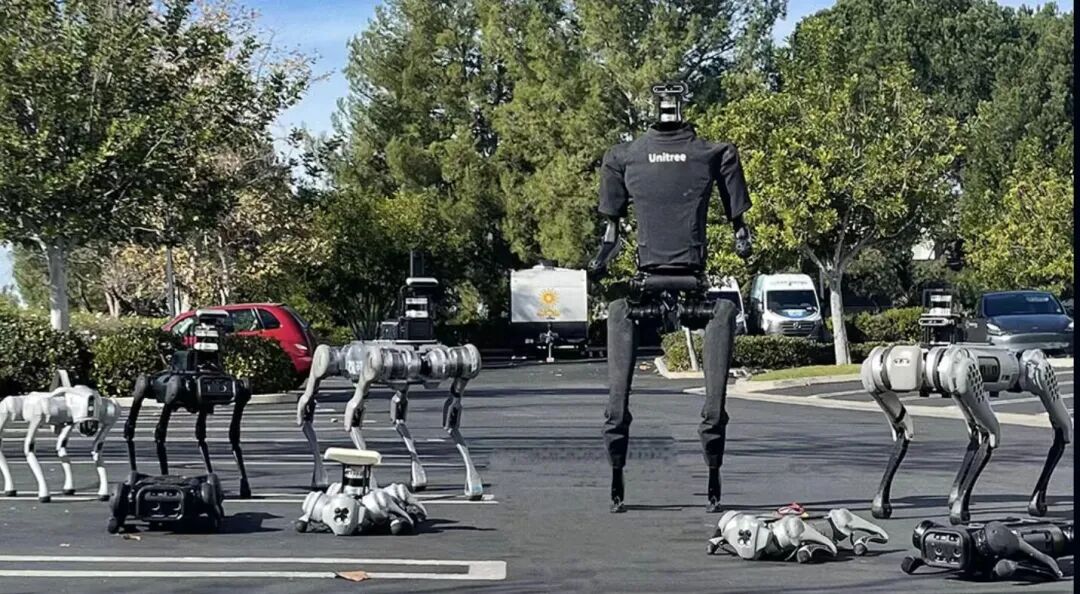
Wang Xingxing is a typical outlier. With an almost grassroots background, he spent ten years building Unitree into the humanoid robot company with the largest shipment volume in the world, with an annual revenue of about 1.7 billion yuan.
Looking back on the seven years of HSG and Unitree, from the QQ email address to the IPO bell-ringing stage, this is undoubtedly a victory for "non-consensus". The most extreme portrayal of investing in "outliers" is no more than this — to bet heavily on someone who is not understood by most people, and accompany him until he is seen by all.
After Unitree
Unitree's IPO is only a part of HSG's embodied intelligence layout.
As early as around 2013, HSG started its layout from drones, intelligent mobility and other fields, successively invested in companies such as DJI and Ninebot, and was one of the earliest investment institutions in China to bet on this track. In the following more than ten years, HSG has been tracking along the context of technological evolution, and its investment territory has continued to expand.
Unitree's Pre-A round was a starting point, after that, Flexiv, Megvii, Hai Robotics, Pudu Robotics, Unitree Robotics, Fourier Intelligence and other companies successively entered HSG's investment scope.
The pace has accelerated significantly in the past two years — from brain to cerebellum, from body to core components, HSG has invested in a robot army: behind star companies such as Agibot, NextGen Robotics, Qianxun Intelligence, Qiongche Intelligence, Tstone Robotics, StarMega, Genesis, Sharpa, Wuji Robotics and Lingxin Qiaoshou, there are all traces of HSG's investment.
Right now, the robot industry is ushering in an IPO boom: Leju Robotics and Deep Robotics have entered the A-share IPO process; 10-billion-yuan valuation unicorns such as Agibot, Galaxy Universal, Zhifangzhou, Fourier Intelligence, Zhongqing Robotics, Xinghaitu and Songyan Power have also entered the IPO preparation sequence.
In this huge lineup, Unitree's IPO undoubtedly provides a verifiable valuation anchor point for the entire industry. Some investors described that the greatest significance of Unitree's listing is: it finally provides a referable pricing coordinate for the primary market and the secondary market — how much is an embodied intelligence company worth?
However, Unitree's IPO also means that the industry reshuffle is accelerating, and at least the listing opportunities for embodied intelligence companies on the Sci-Tech Innovation Board will become more scarce. In the fierce competition, some people will get the dividends of landing on the capital market, while others will face life-and-death elimination. This is the inevitable law of the industry moving towards maturity, especially this year, embodied intelligence players are collectively standing at the watershed from technical verification to large-scale commercial application.
What is of far-reaching significance is that China's embodied intelligence industry is being redefined.
"The successful listing of Unitree, from the perspective of enterprise growth, is a phased important achievement and milestone, but from the perspective of the development of embodied intelligence, this is only a starting point." As Li Yannan said, the current embodied intelligence is still in a relatively early stage, how to scale the shipment volume from thousands of units to thousands of households, and how to achieve real universal generalization in thousands of industries, there are still too many problems to be solved, and companies like Unitree are needed to explore more "no man's lands".
Humans may be passers-by in the universe, but technology is eternal. Recalling the sentence Wang Xingxing left to the public : "The torrent of technology is surging forward, and I am willing to be a small boat in it."
When Chinese robots start to move to the global stage, behind them is not only Unitree, but also a generation of young people like Wang Xingxing who believe that technology can change the world. At the forefront of the trend, the Chinese narrative of embodied intelligence has just begun.
This article is from WeChat official account "Pedaily" (ID: pedaily2012), written by Zhou Jiali, authorized for release by 36Kr.