Unitree Technology surged 629.44% at the opening of trading, and investors who won one lot of new share allotment can earn 474,600 yuan.
On the 19th, Unitree Robotics, the "first stock of humanoid robots", was officially listed on the Sci-Tech Innovation Board, with its opening price surging 629.44% to 1100.00 yuan per share. Calculated at the current price, investors who win one allotment can earn 474,600 yuan.
As one of the most high-profile A-share IPOs this year, Unitree Robotics launched simultaneous online and offline subscription on August 10, attracting 9.78 million investors to participate in the new share subscription online.
According to the announcement on the evening of the 10th, the initial effective online subscription multiple of Unitree Robotics reached as high as 8288.82 times, exceeding the 100-times trigger line for the callback mechanism. After the callback mechanism was activated, the final number of shares issued online was 9.707 million, and the final online winning rate rose to 0.01809759%. This means that out of every 10,000 valid subscription numbers, less than 2 can finally win the allotment.
"Participated with the mindset of buying a lottery ticket"
The IPO issue price of Unitree Robotics this time is 150.80 yuan per share, and winning one allotment (500 shares) requires a payment of 75,400 yuan. This issue price ranks second among new stocks on the Sci-Tech Innovation Board since the beginning of this year, second only to Pinzhun Laser's 186.88 yuan per share.
However, the relatively high payment threshold has not dented investors' enthusiasm for subscribing to new shares.
Boasting the title of "the first A-share humanoid robot stock" and superimposed with the prominent money-making effect of A-share new stocks since the beginning of this year, Unitree Robotics is regarded by many investors as a potential "high-profit new share".
Due to the extremely low winning rate, a large number of "cyber wish-making" phenomena of praying for winning the allotment have emerged on social platforms. An investor told China News Finance before the winning results were announced: "It is extremely difficult to win the allotment of Unitree Robotics, so I can only participate with the mindset of buying a lottery ticket."
After the winning results were released, some netizens posted their winning records on social platforms. Xiaohong (pseudonym) said on the social platform that she won the allotment of both Unitree Robotics and Changxin Technology recently. When asked about her new share subscription experience by China News Finance, Xiaohong said: "No special experience, it's purely luck." Another netizen who won the Unitree Robotics allotment posted that "I'm going to change my car, windfalls should be enjoyed in time."
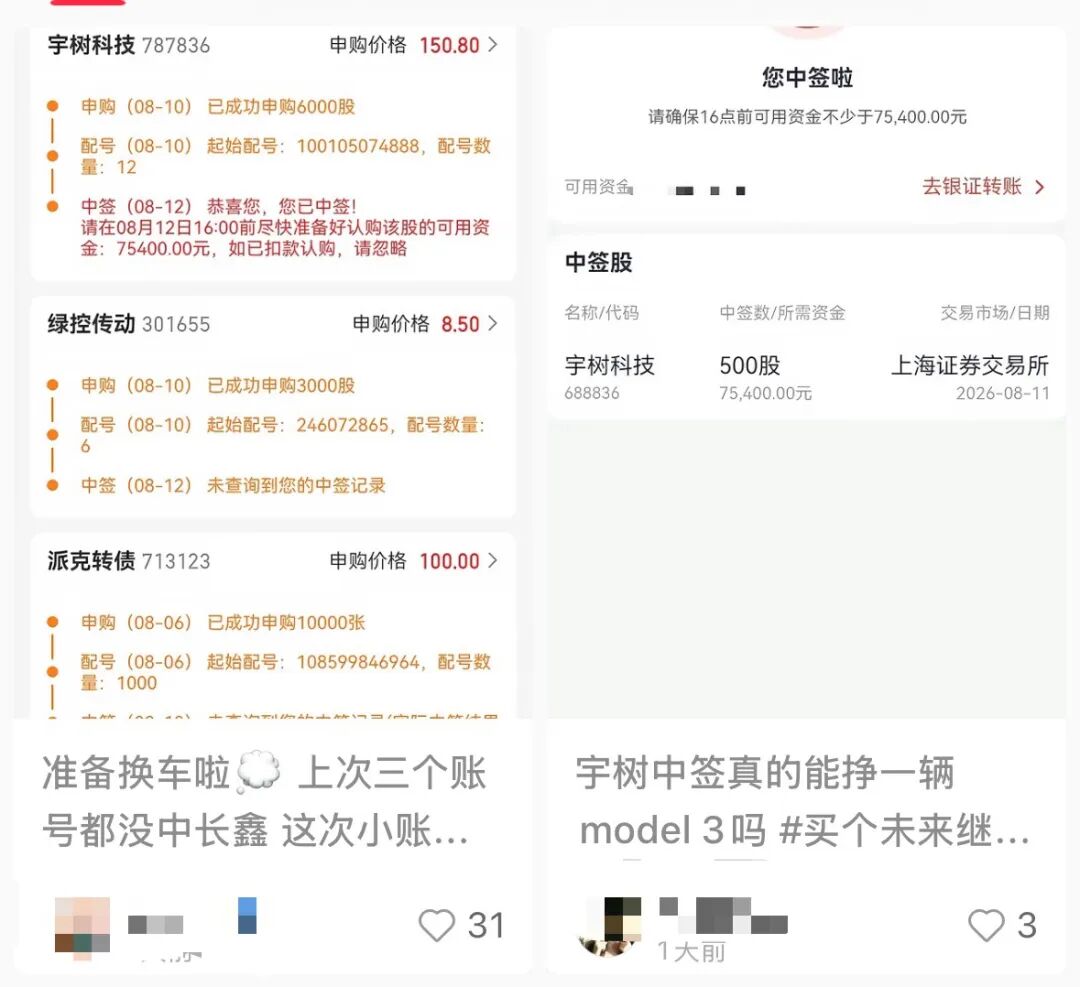
Screenshot source: Social platform
More netizens received the message "Sorry you did not win the allotment this time". Multiple investors interviewed by China News Finance also said that although they subscribed with the maximum allowed quota, none of them won the allotment.
Wind data shows that the new share winning rate of Unitree Robotics has set the lowest record among enterprises listed since the Sci-Tech Innovation Board was launched. Compared with the 0.4714% winning rate of Changxin Technology listed earlier, the difficulty of winning the allotment of Unitree Robotics can be described as "epic level".
The P/E ratio of issuance is far higher than that of comparable companies
Wind data shows that since 2026, the average first-day gain of A-share new stocks on their listing day has reached 276.04%. If calculated by this figure, the book profit of winning one allotment of Unitree Robotics is expected to exceed 200,000 yuan. In addition, CCB International previously predicted that the market value of Unitree Robotics after listing may reach 109 billion yuan, corresponding to a gain of about 79% on the first trading day, with a profit of about 59,000 yuan per allotment.
However, behind the high return expectation is an issue P/E ratio of 219.23 times, which is far higher than that of comparable companies. According to the latest research report of Soochow Securities, UBTECH and Dobot are both major players in the humanoid robot industry, with business layouts relatively similar to that of Unitree Robotics; Zhongda Transmission and Harmonic are core component suppliers for robots, and the average 2026 P/E valuation of the aforementioned comparable companies is about 64.0 times.
During the roadshow of Unitree Robotics on August 6, some investors asked whether this valuation is reasonable. Wang Xingxing, Chairman, General Manager and Chief Technology Officer of Unitree Robotics, said that calculated based on the company's non-recurring profit and loss deducted net profit in 2025, the P/E ratio corresponding to the issue price this time is 92.92 times. In contrast, most comparable listed companies and to-be-listed companies in the industry with main businesses similar to the company have not yet achieved profitability, while the company has achieved strong profitability, especially in the field of humanoid robots. At the same time, the embodied intelligence industry where the company is located has broad market space and application scenarios. As a result of market-oriented pricing, the issuance valuation this time is in line with the company's operating conditions and industry development.
Li Guoping, a professor at Central University of Finance and Economics, pointed out to China News Finance that the issue P/E ratio of Unitree Robotics this time is significantly higher than the average level of its peers, and its issue price far exceeds the previous market expectation of about 104 yuan per share, indicating that investors' enthusiasm during the roadshow was relatively high, which pushed up its pricing to a certain extent.
He pointed out that the revenue and profit of Unitree Robotics in the first quarter of 2026 have already declined, so it is not appropriate to measure with past performance. More attention should be paid to the forward P/E ratio, that is, the expected profit in the next 12 to 36 months. For technology enterprises in the high-growth stage, a forward valuation framework is more reasonable.
Financial data shows that the operating revenue of Unitree Robotics increased from 159 million yuan to 1.699 billion yuan from 2023 to 2025, with a compound annual growth rate of 226.78%. The reviewed operating revenue in the first quarter of 2026 was 423.8 million yuan, a year-on-year increase of 68.49%, and the growth rate declined compared with the previous year.
The company's net profit growth rate has slowed down significantly. The non-recurring profit and loss deducted net profit attributable to owners of the parent company of Unitree Robotics in 2025 was 591 million yuan, while it dropped to 40.2536 million yuan in the first quarter of 2026, down 52.55% year on year. The main reason is the rapid growth of period expenses such as R&D expenses and sales expenses.
Performance test under high valuation
Will the listing of Unitree Robotics significantly increase the valuation of its sector? Li Guoping pointed out that referring to cases such as Cambricon and Changxin Technology, the fluctuation of a single company after listing will not significantly change the valuation logic of the entire sector -- companies with good performance will still rise, and those with poor performance will still fall, and the differentiation within the sector is the norm.
Li Guoping pointed out that the issue price of 150.8 yuan is already on the high side. If the performance growth rate continues to slow down, the stock price of Unitree Robotics in the later period may face upward pressure. He suggested that investors who are concerned about Unitree Robotics should focus on core indicators such as revenue growth rate, gross profit margin, net profit and its growth rate. "In the follow-up, we can observe whether its revenue can achieve rapid growth. If the sales revenue declines, we need to be alert; the gross profit margin reflects the depth of its moat and pricing power. If the net profit cannot keep up with the revenue, it means that the expense side is out of control or the product competitiveness is insufficient."
Li Guoping believes that it is possible for Unitree Robotics to rise 100% to 200% on its first trading day, and it is relatively difficult to rise further, because its stock price base is high. If the stock price doubles, buying one board lot (200 shares) will cost more than 60,000 yuan. For investors who have won the allotment, he suggests taking profit when the price rises; for secondary market investors who have not won the allotment, it is better to wait for the stock price to pull back before considering intervention, to avoid chasing high on the first trading day.
He pointed out that under the background of global technological competition and national policy support, the valuation premium of hard technology companies with real technical barriers and performance support is expected to continue. However, it should be noted that many high-tech companies in A-share history issued at high premiums taking advantage of industry trends, and their subsequent performance could not support the stock price, leading to continuous decline in the end. Such cases are not uncommon.
"Therefore, the key still lies in the gold content of 'hard technology' and the actual performance delivery, rather than pure concept hype. For example, if Changxin Technology makes a breakthrough in the HBM field, its premium will have support; Unitree Robotics needs to prove the real value of its products and scenarios, otherwise the high valuation will be difficult to maintain for a long time." Li Guoping said.
At the previous roadshow, some investors also asked whether the decline in Unitree Robotics' profit was caused by phased increase in R&D investment, or by structural changes in industry demand. In response, Wang Xingxing responded that as the company's revenue base has increased significantly, industry popularity has gradually moderated and market competition has become increasingly fierce, the year-on-year growth rate of the company's revenue in 2026 has slowed down. In addition, the increase in current R&D expenses and the large amount of new current sales expenses led to a year-on-year decline in the company's net profit in the first quarter of 2026.
The views in this article are for reference only and do not constitute investment advice. Investment is risky, so be cautious when entering the market.
This article is from the WeChat official account "China News Finance" (ID: jwview), written by Luo Kun, edited by Dong Wenbo, chief editors in charge: Wei Wei, Chang Tao, published with authorization from 36Kr.