Is Xiaomi underestimated?
Xiaomi released a financial report marked by "squeezed profit margins and AI still in its initial stage".
On August 18, Xiaomi announced its performance for the second quarter of 2026: revenue hit 108.9 billion yuan, down 6.1% year-on-year; adjusted net profit reached 6.2 billion yuan, down 42.6% year-on-year; the overall gross margin dropped to 19.8% from 22.5% in the same period last year. The gross margin of mobile phones fell to 8.5%, IoT revenue decreased by 19.2% year-on-year, and innovative businesses including automobiles and AI recorded an operating loss of 2.6 billion yuan.
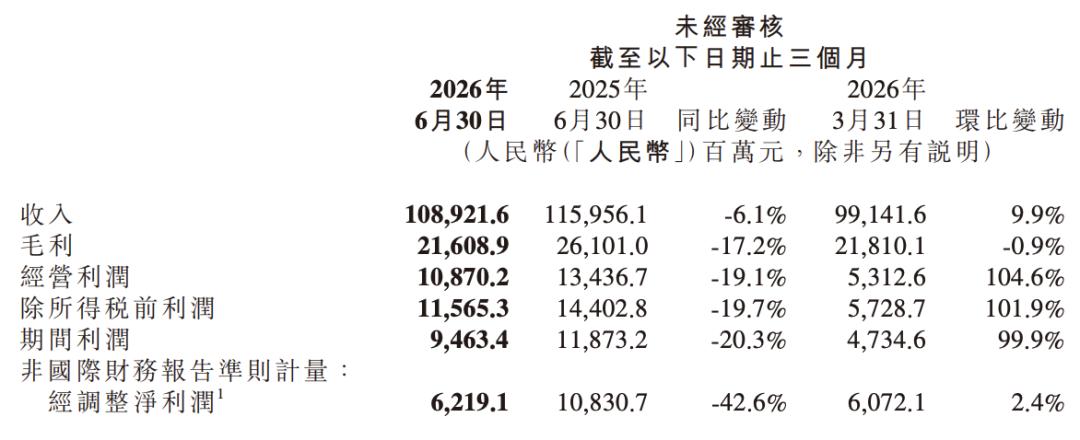
Image source / Xiaomi 2026 Q2 Financial Report
In the second quarter of last year, Xiaomi's adjusted net profit increased by 75.4% year-on-year, and the high base amplified the year-on-year decline this year. The reasons for the profit decline are also quite clear: the price increase of core components such as semiconductors has compressed mobile phone profits; the phasing out of home appliance subsidies has affected the sales scale of IoT and lifestyle consumer products; automobile deliveries are still growing, but changes in vehicle model structure, rising component prices and AI-related investment have still suppressed the gross margin of this segment.
Looking at the first half of the year, Xiaomi's revenue reached 208.06 billion yuan, down 8.4% year-on-year; adjusted net profit was 12.29 billion yuan, down 42.8% year-on-year. Xiaomi's performance has shifted from high growth last year to declining profits. For the full year of 2025, Xiaomi's revenue was 457.29 billion yuan, up 25% year-on-year; net profit attributable to owners of the company was 41.64 billion yuan, up 76% year-on-year.
However, this quarter is not without bright spots: mobile phone average selling prices have risen, AIoT devices are still increasing, and automobile deliveries continue to grow.
Xiaomi also explicitly named the Xiaomi MiMo large model series for the first time in its financial report, stating that the growth of revenue from other related businesses partially comes from Xiaomi MiMo related AI businesses, but MiMo revenue is not disclosed separately.
In the past year, Xiaomi's stock price has fallen by more than half from its high point. In August 2025, the stock price was around HK$53; as automobile delivery data improved and AI expectations heated up, it once hit HK$59.5 on September 25. Subsequently, the market turned its attention back to mobile phone gross margin, IoT demand and automobile profitability, and the stock price fell all the way, hitting a low of HK$21.4 in June 2026. It rebounded to HK$31 in July, and by August 18, it returned to around HK$26.3.
The fall in stock price reflects more than just how much less money was earned this quarter. The market is more eager to know whether high automobile deliveries can be converted into profits, and when AI investment can generate returns in products and revenue.
01. Rising mobile phone prices, IoT under pressure
Let's start with mobile phones, IoT and internet services. They determine how much profit Xiaomi's existing businesses can generate.
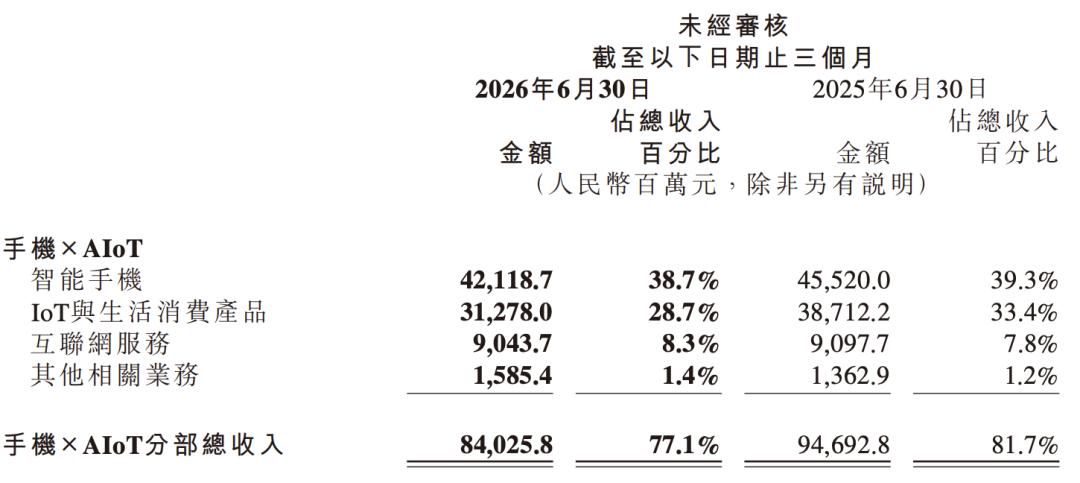
Revenue proportion of Xiaomi's three traditional businesses in the second quarter of 2026, image source / Xiaomi 2026 Q2 Financial Report
The most obvious change for Xiaomi's mobile phones this quarter is that the average selling price has increased.
The mobile phone ASP reached 1351 yuan, up 25.9% year-on-year, hitting a record high. The sales proportion of mobile phones priced above 3000 yuan in Chinese mainland reached 32.1%, up 4.5 percentage points year-on-year. Quarterly shipments were 31.2 million units, and Xiaomi still ranks among the top three globally.
After storage prices rose, Xiaomi actively cut shipments of low-end models, prioritizing product structure and profit. During the earnings call, Lu Weibing, President of Xiaomi Group, said that the company will no longer simply pursue mobile phone volume in the short term, but seek a balance between scale and profit.
However, mobile phone revenue this quarter was 42.1 billion yuan, down 7.5% year-on-year, and the gross margin also dropped from 11.5% to 8.5%. While ASP rose, storage costs rose even faster, offsetting part of the benefits brought by high-end transformation.
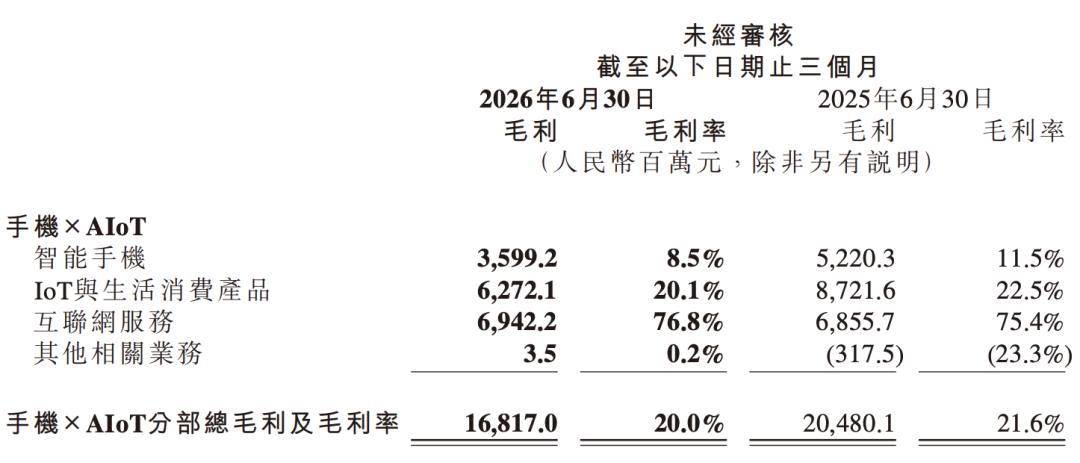
Gross margin of Xiaomi's three traditional businesses in the second quarter of 2026, image source / Xiaomi 2026 Q2 Financial Report
Lu Weibing judged that the increase in memory costs will slow down in the third quarter, but it is likely to continue rising slowly in the fourth quarter, with prices remaining at a high level. Xiaomi will continue to adjust its product structure and release rhythm, and enter a dense new product release period in September. Whether mobile phones can generate more profits will depend on storage prices and high-end product sales in the next stage.
Revenue from IoT and lifestyle consumer products was 31.3 billion yuan, down 19.2% year-on-year, and the gross margin dropped from 22.5% to 20.1%. The company explained that the main reason is the phasing out of home appliance subsidies in Chinese mainland.
As of the end of June, the number of connected devices on Xiaomi's AIoT platform reached 1.16 billion, and the number of users with five or more connected devices reached 24.6 million.
The growth focus of IoT is changing: overseas sales of tablets, smart TVs and wearable products are still growing due to the expansion of overseas channels and the increase of product categories. The earnings call also mentioned that Xiaomi will showcase its full "people-car-home" ecosystem at IFA, and large home appliances will fully enter the European market.
Internet service revenue was 9 billion yuan, down 0.6% year-on-year, with a gross margin of 76.8%, up 1.4 percentage points year-on-year. Among them, advertising revenue was 7.2 billion yuan, up 4.8% year-on-year; revenue from games and other value-added services declined, offsetting part of the advertising growth. Global MAU reached 770 million, up 4.8% year-on-year.
Calculated by segment data, the gross profit of internet services is about 6.9 billion yuan, exceeding the roughly 6.3 billion yuan of IoT, making it the business with the highest gross profit contribution this quarter. In the same period last year, the gross profit contribution of IoT was still higher than that of internet services.
Mobile phones and IoT have not yet resumed growth, and although internet services contribute more gross profit, they still rely on users and devices from the first two businesses. Next, the market will turn its attention to automobiles, AI and global expansion.
02. Automobile business still on the growth track, global expansion and AI not yet taking over the growth baton?
Xiaomi is investing more funds in automobiles, AI and related infrastructure. In the second quarter, Xiaomi's capital expenditure was 3.62 billion yuan, of which the capital expenditure for innovative businesses such as smart electric vehicles and AI was 2.38 billion yuan, up 59.5% from the first quarter; the capital expenditure for Mobile × AIoT dropped from 1.78 billion yuan to 1.24 billion yuan.
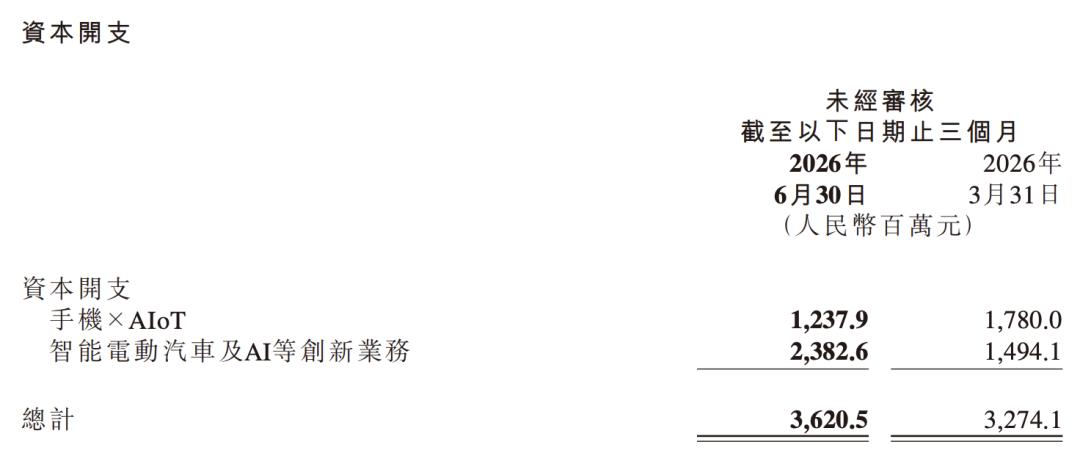
Capital expenditure structure of Xiaomi in the second quarter of 2026, image source / Xiaomi 2026 Q2 Financial Report
First look at the automobile business: the scale has been built, but profits have not kept up.
Xiaomi delivered 104,000 vehicles in the second quarter, up 28.2% year-on-year; automobile revenue was 23.9 billion yuan, up 15.9% year-on-year. During the same period, the total retail sales of passenger vehicles in Chinese mainland fell by 22.0% year-on-year, and Xiaomi Auto is still snatching users from other brands.
As of the end of July, Xiaomi delivered about 216,000 vehicles in the first seven months. If the full-year target of 550,000 vehicles remains unchanged, about 334,000 vehicles need to be delivered in the remaining five months, with an average monthly delivery of about 67,000 vehicles, meaning the delivery rhythm will be significantly faster than that in the first half of the year.
The average selling price has declined: the automobile ASP in the second quarter was 229,000 yuan, down 9.6% year-on-year. The high-priced SU7 Ultra model accounted for a higher proportion in the same period last year, while the delivery proportion of this model decreased this year, and the change in vehicle model structure pulled down the overall ASP. The price increase of core components also continues to squeeze profits.
The gross margin of innovative businesses including automobiles and AI dropped from 26.4% in the same period last year to 19.2% in the second quarter, with an operating loss of about 2.6 billion yuan; the loss expanded significantly from 300 million yuan in the same period last year, but narrowed compared with the roughly 3.1 billion yuan loss in the first quarter.
Next, the Pengcheng series is the focus of the automobile business. The management said that the Kunlun technology architecture released in July has been applied to two extended-range SUVs, the Pengcheng N90 MAX and N70 MAX, with pre-sale prices of 300,000 yuan and 260,000 yuan respectively, and the official release is scheduled for September. The management judged that the family users and multi-person travel scenarios targeted by Pengcheng have low overlap with the existing SU7 users.
Whether Pengcheng can bring both sales volume and better profits remains to be seen from the order, delivery and vehicle model structure data after its launch. The market will focus on two key points: whether Pengcheng can bring new users beyond existing SU7 users; what the overall automobile ASP and gross margin will be after the new model achieves high-volume delivery.
The timetable for Xiaomi Auto's global expansion has been further clarified. The earnings call revealed that Xiaomi Auto's official overseas launch is still planned for the second half of 2027, and at least seven or eight top overseas dealers have taken the initiative to contact the company. The overseas channels for mobile phones and IoT can provide a sales foundation, but the automobile business still needs an independent after-sales, spare parts and maintenance system, and also needs to build brand trust.
In addition to whether the automobile business can improve profits, whether AI can form independent revenue is also the key concern of the market. Xiaomi's financial report disclosed that the revenue from other related businesses in the segment of innovative businesses such as smart electric vehicles and AI was 1 billion yuan, including revenue from smart electric vehicle after-sales services and AI business revenue related to the Xiaomi MiMo large model series. The specific revenue scale of MiMo is not disclosed separately.
The management mentioned that API calls and Token solutions have started to contribute revenue, but at this stage, the company will still prioritize expanding model capabilities and application scenarios, and integrate AI into the "people-car-home" ecosystem. MiMo has been integrated into products and services such as HyperOS, Super Xiao Ai and local smart features in Mi Home. Whether it can evolve from a product feature to stable API, Token or subscription revenue, and when its revenue and gross profit can be disclosed separately, are the key concerns of the market.
In addition to large models, Xiaomi is also advancing the development of humanoid robots, and has started testing them in its own automobile factories. At present, the robots have been deployed in workstations such as material feeding and final assembly, with a task success rate of over 90% for some operations. During the earnings call, the management said that Xiaomi will publicly display a full-size humanoid robot about 1.7 meters high for the first time at the 2026 World Robot Conference.
The automobile business depends on vehicle model structure and gross margin, global expansion depends on whether the sales and service network can be successfully implemented, while AI and robots need to prove that product progress can bring tangible revenue.
03. Is Xiaomi undervalued?
As of the close on August 18, Xiaomi's stock price is around HK$26.3, corresponding to a price-to-earnings ratio of about 15-17 times. This valuation is not high, but it cannot be used as the only basis to judge that Xiaomi is undervalued. The value of automobiles, AI and the global ecosystem ultimately depends on whether it can be converted into revenue and profits.
Xiaomi's asset base and share repurchase actions provide certain support for its valuation. The financial report discloses that as of the end of June, the company held about 92 billion yuan of book assets in invested companies; Goldman Sachs estimates that its net cash is about 176 billion yuan, equivalent to about HK$10.5 per share. As of August 13, Xiaomi has repurchased about HK$11.7 billion within the year, and has approved a new repurchase plan of up to HK$20 billion.
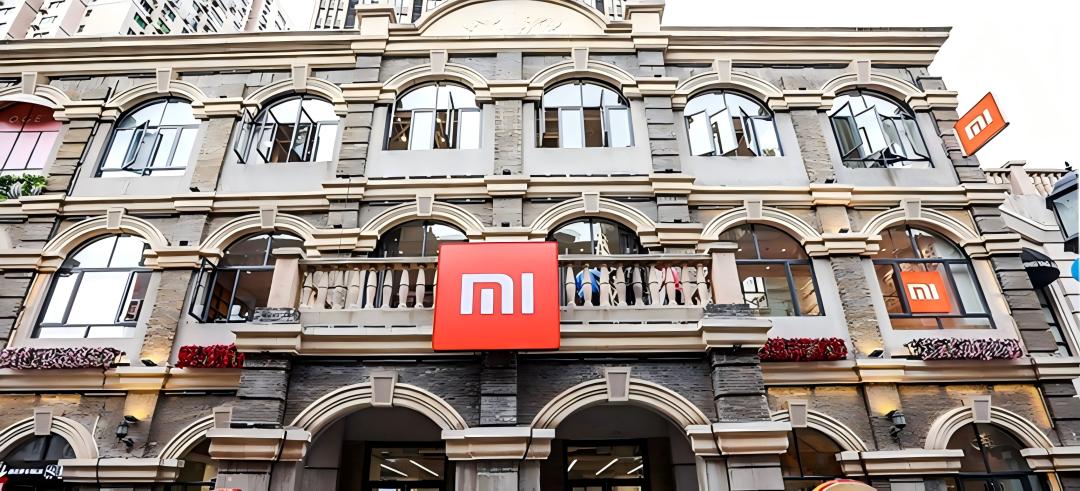
Image source / Xiaomi official website
An investor who has long focused on Xiaomi believes that the market is currently pricing Xiaomi mainly according to the logic of a hardware company. Mobile phones and IoT determine current profits, while automobiles and AI are placed in the category of "to be evaluated in the future". This pricing logic has its rationality, but if automobiles, AI, and Xiaomi's existing user and ecosystem resources can truly generate more revenue in the future, today's valuation may not reflect its long-term value.
Therefore, whether Xiaomi is undervalued cannot only depend on the current price-to-earnings ratio, but also on whether it can deliver better performance in the next few quarters: stabilizing traditional businesses, improving automobile gross margin, and disclosing MiMo revenue separately. If these changes emerge one after another, the market will have reasons to re-evaluate Xiaomi.