SpaceX tells a story about space, while China sees a completely different future.
Recently, following SpaceX's public listing, the future vision it depicted around "space data centers" and "space computing power" has once again drawn widespread attention from the capital market and the industrial community. From planning and constructing space data centers to building an industrial chain covering communications, computing power, manufacturing and deep space exploration, the ideas that once only existed in science fiction novels are gradually becoming an important direction of commercial aerospace.
What exactly is space computing power? Why may future data centers be built in orbit? How should China find its own development path?
Focusing on these questions, we interviewed Qin Guijun, Co-founder of Space Byte and General Manager of the Infrastructure Construction Department. As one of the domestic entrepreneurs who put forward the concept of space data centers relatively early in China, he has been deeply engaged in the aerospace system for more than 10 years, participated in major special projects of Beidou Navigation and the construction of commercial satellite constellations successively, and has long focused on the development of space data infrastructure. In his view, what is truly worth paying attention to for space computing power is not moving more computing power into space, but building the next generation of space data infrastructure.
The Development Trajectory of Space Computing Power
The germination of China's space computing power can be traced back to around 2021, when the country explored the 6G integrated space-terrestrial network. At that time, relevant domestic universities and research institutes began to try to deploy part of core communication capabilities in space when studying the next generation of communication infrastructure, so as to enhance the independent and controllable capability of the network.
In September of the same year, Wang Wei, Founder of Space Byte (former Co-founder of Exa Tech), first put forward the industrial vision of "building a complete space data center" to the industry in Shenzhen. But at that time, commercial aerospace was still in the high-cost stage, and links such as rocket launch and satellite manufacturing did not have the conditions for large-scale deployment. This concept was mostly limited to a forward-looking industrial assumption and did not really enter the industrial vision. It was not until the end of 2024, with the outbreak of global large AI models, that the gap between ground energy supply and computing power became increasingly prominent. With the support of NVIDIA, the overseas startup Starcloud put forward the grand plan of building a 5GW (gigawatt) level space data center.
In 2025, China's space computing power track ushered in a dense outbreak: in May, Zhejiang Lab launched 12 satellites equipped with computing chips similar to NVIDIA Orin to explore the "space data processed in space" satellite-ground data integration; in the same month, Beijing University of Posts and Telecommunications re-launched a new generation of technology verification satellites after its early exploration; in June, Beijing Orbit Dawn announced that it planned to build a 16GW level space data center within 10 years, benchmarking against more than 5300 computing satellites expected to be launched by Starcloud. In November of the same year, Starcloud successfully launched its first test satellite Starcloud-1, sending the NVIDIA H100 chip into low Earth orbit for the first time and carrying out large model training.
However, what really made space computing power widely known is the sci-fi level "communication - computing power - manufacturing - deep space exploration" industrial chain story told by Elon Musk to boost the valuation of his SpaceX. From the initial statement of adding data processing modules to Starlink V3 satellites, to planning to deploy 100kW (kilowatt) level space data centers every year and applying for a low-orbit constellation containing millions of satellites, then to preparing for the construction of the ground chip super factory Terafab, and even conceiving to rely on the lunar forward base to carry out computing satellite manufacturing and orbital launch deployment based on photovoltaic and robots...
Beneath the sci-fi appearance, Musk's space computing power actually has realistic logic. Relying on the low-cost and high-frequency reusable rocket technology, SpaceX has greatly diluted the satellite launch cost. The tens of millions of users accumulated by Starlink provide it with massive data interaction scenarios. After the initial closed loop of communication infrastructure is completed, the superposition of AI computing power can add value to the infrastructure built by SpaceX.
What Kind of Infrastructure Does Space Computing Power Need?
Communication is the prerequisite for the implementation of all space computing power applications. The data generated by spacecraft is limited by the transmission bandwidth between air and ground, and the transmission rate is limited. Before the emergence of commercial aerospace, limited by the high launch cost, the design of satellite systems was extremely tilted to the core payload, lacking the on-orbit data processing and service capability. For example, remote sensing satellites are only responsible for collection and fast return, while communication satellites act as nodes of the communication network.
Although the low-orbit constellation represented by Starlink has built a high-frequency, small-bandwidth access network for tens of millions of users, there is still a gap in the satellite-ground backbone transmission of massive data, which is difficult to transmit the massive graphic data required for training, and this limits the training of space AI models. Qin Guijun introduced that at present, most of the computing power carried by domestic computing satellites is only equivalent to that of a new energy vehicle, which is mainly used for cutting-edge technology verification or improving the energy efficiency of specific aerospace missions.
Wang Wei formally put forward the concept of space data center in China in September 2021. His co-founder Qin Guijun entered the Shanghai Engineering Center for Microsatellites of Chinese Academy of Sciences in 2013, deeply participated in the major special project of Beidou Navigation, and accumulated solid experience in satellite system design. Later, he joined Geely's Geespace and participated in the construction of China's largest narrowband IoT constellation. At the end of 2024, "Space Byte" was officially established. The space data center it tries to build is a general-purpose and reusable infrastructure, consisting of 216 satellites. Like the ground data center, it carries basic functions such as storage, management, processing and distribution.
At present, most players in China's space computing power track are derived from scientific research experts and industrial veterans in the aerospace field, and they are jointly exploring the new boundary of the aerospace economy. For example, Yiyu Aerospace incubated by the BUPT team, StarSense Future founded by a doctor of the Department of High Energy Physics of Tsinghua University, and Zhongke Tianjisuan with the background of the Institute of Computing Technology of Chinese Academy of Sciences. The technologies of these enterprises have been widely applied in on-orbit data processing of special payloads such as large-scale remote sensing. Taking remote sensing satellites as an example, by deploying models and algorithms on orbit, key target information such as ships, aircraft and airports can be directly extracted and quickly returned, which greatly improves the data value. This model of "serving the data in space first" directly gave birth to the first stage of space computing power development: "space data processed in space".
If "space data processed in space" solves the problem of data processing efficiency, then in the next stage, the competition will no longer only focus on the computing power of a single satellite, but on who can take the lead in building a complete space information infrastructure.
The development of the information industry essentially relies on three types of infrastructure: network, storage and computing. Among them, network and storage belong to general-purpose and reusable underlying facilities, while computing mostly serves specific applications. For this reason, Space Byte does not focus on simply stacking computing power, but hopes to take the lead in building data centers and communication networks in space. Qin Guijun further explained that unlike the United States, which is worried that it cannot meet the energy consumption demand after the development of AI due to the lack of energy, China does not lack energy at present, so we do not need to stack computing satellites like the United States.
Another difference in the China-US space computing power competition lies in the ultimate goal. Musk emphasizes that all human activities and the future will be centered on space, deriving grand sci-fi stories such as brain-computer interfaces, humanoid robots and Mars bases from living in space, aiming to break through the physical ceiling of earth resources.
China takes the space industry as the carrier to achieve a breakthrough across all industries. For example, if the semiconductor industry is linked with space computing power, semiconductors will become the biggest beneficiary. In addition, photovoltaic, new materials, satellite manufacturing, rocket launch, thermal control and heat dissipation, as well as AI application and communication industries can all find their own ecological niches in space computing power.
Perhaps there will be no giant like SpaceX that covers the whole industrial chain in China. On the contrary, cross-border integration and ecological collaboration will become the norm. At present, mature ground industries (such as photovoltaic and semiconductor) and diversified capitals are accelerating their penetration into the aerospace field. From rocket manufacturing and core chips to computing power operation, players in multiple ecological niches are jointly weaving an industrial network with deep interconnection between upstream and downstream. The blossoming network pattern is in line with the national strategic orientation of diversifying the cultivation of future science, technology and industry.
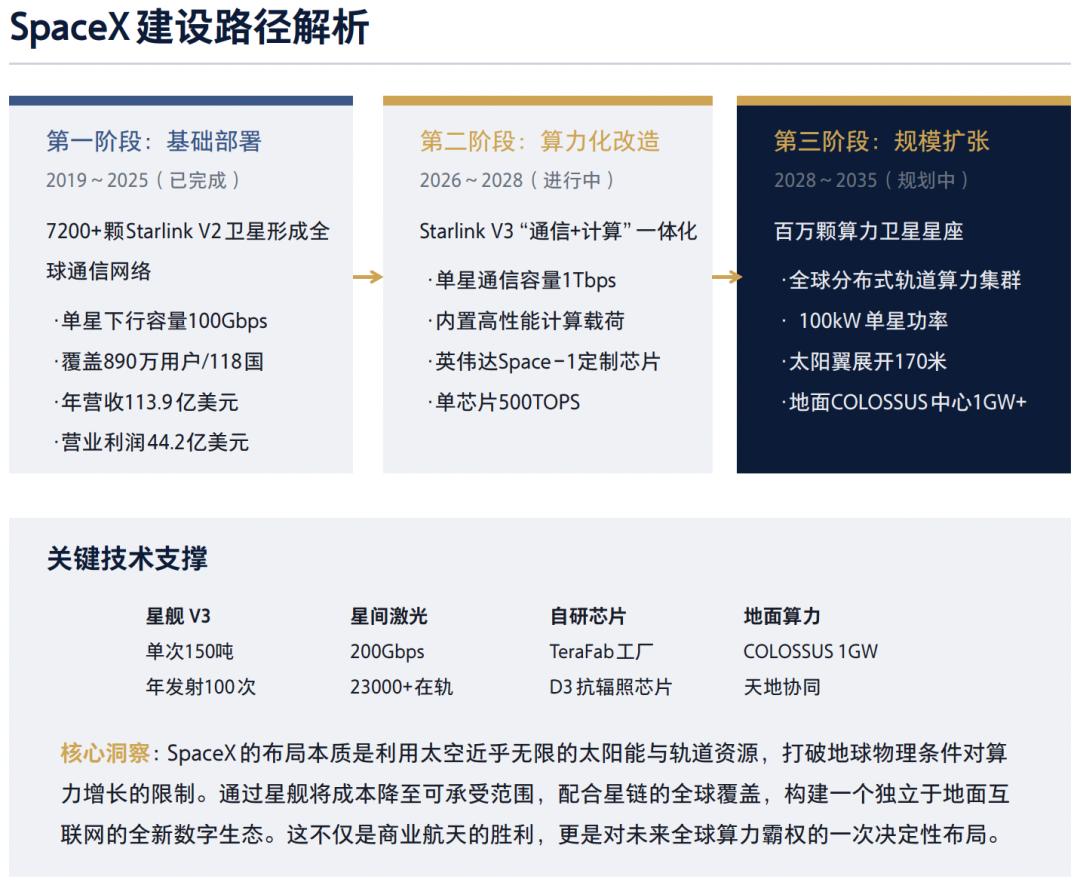
Image source: *iCare Weekly*
The "Systematic Generation Gap" in China-US Space Infrastructure Construction
Although China's space computing power track is booming, Qin Guijun soberly pointed out that there is still a systematic gap between China and the United States in technology and application, and China also has a clear catch-up target.
Reusable rockets determine the upper limit of launch cost and opportunity of commercial aerospace. At present, Musk's Starship V3 has been successfully launched. If the shuttle-style launch is realized in the future, it will theoretically have no pressure to deploy 100kW level space data centers. In contrast, China's benchmark model has just completed differentiated recycling through breakthroughs, and there is still a gap between the two sides in launch frequency and maturity.
The payload capacity of satellites is limited by power supply capacity. Musk has made the solar wing of his Starlink satellite about 105 square meters, with an estimated power of 5kW. A more significant difference comes from the underlying materials. According to analysis, SpaceX widely uses ground-grade monocrystalline silicon and even the next generation of crystalline silicon routes, directly reusing Tesla's ground photovoltaic supply chain, achieving an extremely low cost per kWh. However, limited by launch cost and area, China still mainly uses expensive "triple-junction gallium arsenide", which costs about 200,000 yuan per square meter, equivalent to 2000 yuan per watt, and the cost is three orders of magnitude higher than that of ground photovoltaics.
In terms of on-satellite computing power, the peak computing power load of the AI satellite planned by Musk reaches 150kW, with an average power consumption of 120kW, which is equivalent to moving the ground NVIDIA 72-card GPU cabinet into space. Before that, most of China was in the integrated exploration stage of "space data processed in space", and the computing power carried by a single satellite was mostly at the level of one NVIDIA Orin, equivalent to the computing power of ground intelligent vehicles, or a cluster of a few cards, and there was a generation gap in the overall computing power scale.
At the operation level, SpaceX's Starlink already has the operation and maintenance capability to provide stable direct internet service for more than 10 million users. However, due to the extremely developed ground 5G network in China, the commercial logic for satellite internet to acquire tens of millions of C-end users in China still needs to be explored, and there is also an obvious gap in large-scale on-orbit operation, maintenance and service capabilities.
Facing the gap, we should be full of hope for the future of China's aerospace industry based on the following three reasons: First, after the digital industry logic of "infrastructure first, application later" of ground internet repeats in space, new infrastructure will release application capabilities; Second, ground industrial-grade, vehicle-grade and even consumer-grade electronic components, such as ordinary chips replacing expensive aerospace-grade devices, are pouring into the aerospace field through system-level reliability design, which greatly reduces the cost of space infrastructure construction; Third, the huge application gap in space is attracting mature players from ground electronics, computing, photovoltaic and other fields to enter across boundaries.
Taking Storage as the Foundation to Open Up the Satellite-Ground Data Link
Based on the current industrial form and technological progress, moving a large amount of computing power to space will face a series of engineering challenges. To this end, Space Byte has chosen a more pragmatic solution, that is, to take core large-capacity and high-reliability storage as the core. This is consistent with the judgment of the foreign startup Lonestar, which believes that the energy consumption of storage can be 15% lower than that of computing, and storage can quickly bring infrastructure for data services.
In view of the current problem of narrow space-ground communication bandwidth, Space Byte has established a Joint Laser Communication Laboratory with Harbin Institute of Technology to overcome atmospheric laser communication algorithms and ground station transformation, trying to build a satellite-ground high-speed symmetric data uplink channel. The next step is to deploy 300TB level large storage on storage satellites, completely change the situation that traditional satellites are only equipped with 1TB to 2TB of attached storage, realize the space disaster recovery disk for massive data, and use the unique attributes of extreme safety and physical isolation in space to provide off-site disaster recovery supplement for ground cold data. At present, this service has obtained contracts from leading large manufacturers, and has been started for more than 40 times in total.
When talking about future products, Qin Guijun pointed out that the pain point is that the demand is not clear enough, and the way to break the situation is to lower the threshold of trial and error. Just like buying a humanoid robot as a front desk when humanoid robots are not mature, we can gradually build market trust through more interactions, laying a foundation for full access to the space computing power network in the future. The company also tries cross-border cooperation with pan-entertainment IPs such as literature and art, so that space is not only a carrier of data and computing power, but also a new space to stimulate human inspiration and reshape cultural expression.
Looking into the future, with the explosive growth of the scale of low-orbit satellite constellations, intelligent management of space traffic has become an industrial gap to be filled urgently. As the orbit of Musk's Starlink satellites is reduced from 500km to 350km, the collision risk brought by satellite orbit adjustment is increasingly prominent. To this end, Musk launched an intelligent space traffic management system named Stargaze, which allows everyone to see the satellite trajectory, which is equivalent to creating risks while controlling and preventing risks.
In fact, space security policies often lag behind the development of technology and industry. When computing satellites are deployed on a large scale, a large number of silicon-containing components carried on the satellites cannot be completely burned up when re-entering the atmosphere. Some silicon debris will fall to the ground, and the vaporized silicon particles will also remain in the upper atmosphere, which will have a certain impact on the ecology and atmospheric environment. The reason why no one pays attention to this problem at present is that the launch volume is too small. But from the perspective of long-term civilization evolution, the ultimate environmental protection value of the space industry lies in expanding high-energy-consuming industrial activities to the "fourth space", realizing "in-orbit collection, in-orbit manufacturing and in-orbit utilization", placing heavy industry that damages the environment in space, so as to fundamentally alleviate the resource and environmental pressure on the earth.
In addition, facing the overflow of domestic ground energy and photovoltaic production capacity, the export of space computing power related hardware and technologies will become an inevitable option. Many manufacturers of different ecological niches at different levels in the commercial aerospace industry are making attempts. Despite the complex geopolitics and international trade barriers, China's determination to develop the information industry, digital industry and AI industry is very strong. Once a good application or implementation effect is formed, it may bring huge development growth and market gap.
At present, the space computing power industry is on the eve of the outbreak, where bubbles appear before the real industry takes shape. Despite multiple challenges such as technical barriers, blurred application scenarios and lack of trust, as a new type of infrastructure extended by mankind to the "fourth space", space data centers will surely reshape the future digital economy, AI computing power pattern and energy system. For China's commercial aerospace, relying on the advantages of the ground industrial chain, adhering to pragmatic infrastructure construction and cross-border integration will be the key to winning this space race.
Interviewee | Qin Guijun, Co-founder of Space Byte, General Manager of Infrastructure Construction Department
Article | Guo Ruidong, Special Contributor to *iCare Weekly*
This article is from the WeChat official account "Harvard Business Review" (ID: hbrchinese), Author: *iCare Weekly