Kicking off with 1 billion US dollars as the starting scale, almost all ventures in this track have secured financing this year.
"Just after the Spring Festival this year, the track suddenly seems to heat up, with several projects officially announcing financing news." Wang Yixuan, who just obtained her doctorate in July, also serves as the Chief Technology Officer of Huayuan Zhiyin.
This virtual cell company, founded in August 2025, completed tens of millions of yuan in seed financing a month ago.
In China, the current capital environment for virtual cell enterprises is extremely loose. As long as they have competitive virtual cell technology, almost all enterprises, no matter how new they are or how young their founders are, can easily obtain considerable seed round or angel round financing.
For Wang Yixuan and Huayuan Zhiyin, such an external environment has brought a noticeable change: they can access investors outside the vertical field and discover opportunities that were previously out of reach.
VentureBeat tried to contact an investor who had just invested in a virtual cell enterprise to understand this new trend from a different perspective. The response was that it was inconvenient to speak for the time being, as he had invested in another virtual cell enterprise that had not yet been officially announced.
The boom of virtual cells is coming one after another. The unlimited potential of AI drug discovery may thus be completely reshaped.
Can all virtual cell enterprises secure financing?
The current boom of virtual cells dates back to 2024.
That year, led by two top venture capital firms ARCH Venture Partners and Foresite Labs, gathering scholars from Stanford University and former executives of MNCs such as Roche and Pfizer, a new company named Xaira Therapeutics was established and immediately secured $1 billion in financing.
This amount is rare in early-stage Biotech financing. What makes Xaira unique is its plan to reshape AI drug discovery with a brand-new technical paradigm, which is the AI virtual cell.
Right after the 2026 Spring Festival, Xaira officially launched X-Cell, a virtual cell model with 4.9 billion parameters. The preprint paper released simultaneously clearly disclosed that on the Tahoe-100M drug dataset, the Pearson index of X-Cell reached 0.31, significantly better than the 0.22 of the STATE model, with the core performance up to 5 times higher than that of the STATE model.
The Pearson index is a core performance indicator specifically used in the field of AI virtual cells to measure the model's prediction effect on "perturbation", namely the Pearson correlation coefficient. The closer the value of the Pearson correlation coefficient is to 1, the higher the consistency between the perturbation change trend and amplitude predicted by the model and the real experimental results.
It should be noted that previously, the Pearson correlation coefficient of 0.22 of the STATE model was already the mainstream benchmark performance in the industry. X-Cell completed this industry-level performance breakthrough in less than a year, which means the development of virtual cell models has entered the fast lane, and capital has followed suit.
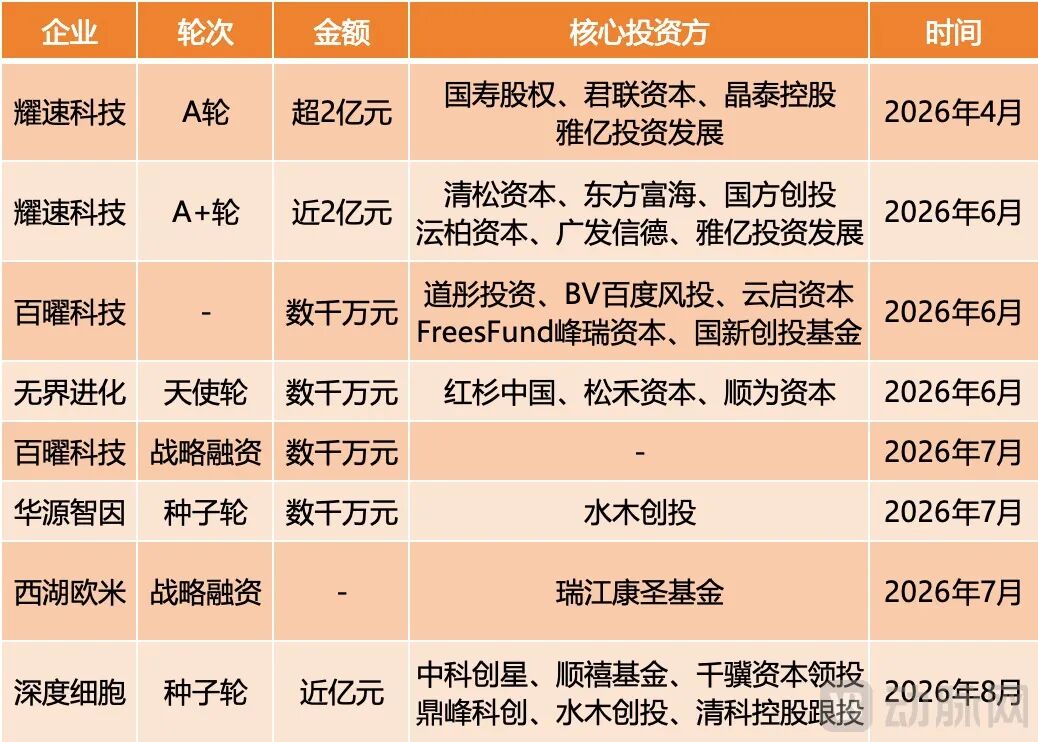
Data of domestic AI virtual cell projects that completed financing since 2026 Source: vcbeat Database
According to statistics from vcbeat Database, since April 2026, nearly 10 financing events have occurred in China's virtual cell track. Top professional investment institutions and state-owned investment institutions including HSG, Legend Capital, BV Baidu Venture Capital, and Guoxin Venture Capital Fund have all entered the market, with hundreds of millions of yuan pouring into the industrialization wave of this emerging technology.
Among them, except for Yaosu Technology and Westlake Omics, the virtual cell enterprises that completed this round of intensive financing are all in a relatively early entrepreneurial stage.
It is worth noting that these virtual cell enterprises have respectively chosen differentiated application scenarios and technical paths.
For example, Baiyao Technology adopts a platform-based approach of "large database + general basic model", trying to lay out target discovery, drug screening, iPSC differentiation cell therapy, etc. Wujie Evolution focuses on full-stack large-model-driven virtual cells, covering full-scale simulation from molecules to cells, with a unique layout in the direction of synthetic biology chassis cell design. Huayuan Zhiyin avoids the popular links of target screening and molecular generation, and focuses on preclinical efficacy evaluation. Deep Cell, which has just completed financing, starts from the underlying dimension of molecular interaction to build virtual cells, and its technical path is more oriented to basic scientific research.
In a sense, at the moment when the industry boom has just taken off, almost all early-stage virtual cell projects in various directions can smoothly complete early financing.
Deconstructing the pattern of domestic AI virtual cells: The new arena of BAT
The so-called virtual cell refers to simulating part or even all of the biological behaviors of a cell on a computer.
"With the development of multi-omics technology, we have accumulated a large amount of data about cells, but most of these data are still scattered and static." Guo Tiannan, Professor of Westlake University and Founder of Westlake Omics, described the original intention of virtual cell research to vcbeat, "Can we integrate genome, transcriptome, proteome, as well as spatial, temporal and perturbation data to build a model that can describe cell states, predict cell changes, and be continuously verified and revised through experiments?"
In short, the current virtual cell needs to do two things: describe the state of the cell, and predict the impact of external perturbations on the cell state.
Turning back to the United States, in the same year that Xaira was founded, another virtual cell company was quietly established dozens of kilometers away in the San Francisco Bay Area, and released the 1.0 version of the virtual cell model AIDO.Cell-100M at the end of that year.
This company, named GenBio AI, was founded by Song Le, a domestic expert in large biological model technology. Shortly before that, Song Le stepped down as the Chief AI Scientist of BioMap, and was one of the founders of BioMap's AI capabilities.
During his tenure at BioMap, Song Le led the construction of the xTrimo life science foundation large model system, starting from protein pre-training, and gradually expanding to unified modeling of multi-scale biological data such as DNA, RNA, and cells. Earlier, Song Le worked at Ant Financial and Alibaba DAMO Academy.
■ Baidu, the most deeply rooted player
In China, from large biological models to virtual cells, BioMap and its behind Baidu are names that cannot be ignored.
Earlier, xTrimo, the self-developed life science foundation large model of BioMap, has been iterated to V4 version with 268 billion parameters, making it one of the world's largest full-modality life science foundation large models.
BioMap is also unwilling to lag behind in the leap from large biological models to virtual cells. In 2025, relying on its self-developed xTrimo SCPerturb single-cell perturbation calculation model, BioMap defeated more than 1200 teams around the world in the first Global Virtual Cell Challenge and won the first place globally. Interestingly, Wang Yixuan, the CTO of Huayuan Zhiyin mentioned earlier, used to work at BioMap.
In October 2023, the team of Li Xin from the Institute of Zoology, Chinese Academy of Sciences, first announced the relevant research results of GeneCompass. This biological model pre-trained on more than 120 million single-cell transcriptomic data of humans and mice is one of the world's early cross-species gene regulation foundation models.
In October 2025, the open source code repository of the GeneCompass model was officially launched on the GitHub platform, open to researchers around the world. In the same month, Baiyao Technology, a virtual cell model company with the GeneCompass model as its core technology, completed tens of millions of yuan in angel round financing. In June 2026, BV Baidu Venture Capital acquired shares in Baiyao Technology.
From developing models in-house to transporting industry talents, and then to investing real capital, before the dawn of the industry truly emerges, Baidu, the veteran internet giant, has taken deep root in the virtual cell track.
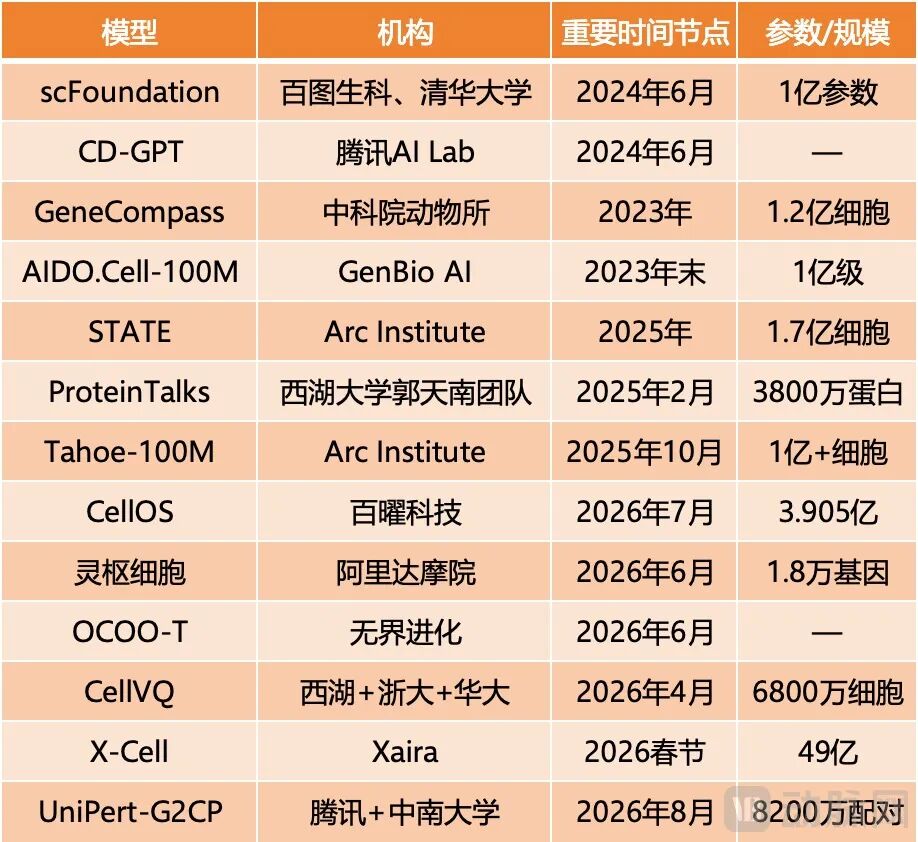
Data of some important models related to virtual cells Source: Sorted out by vcbeat based on public information
■ Tencent, the player with the widest reach
Meanwhile, in Shenzhen in southern China, Tencent has not missed the virtual cell track.
In June 2024, Tencent AI Lab officially released the open source code repository of CD-GPT on GitHub. This is China's first innovative biological foundation large model modeled on the central dogma of biology.
In August 2026, the joint research led by the team of Yao Jianhua from Tencent Life Sciences Lab and the team of Professor Li Min from Central South University was published in Cell. They proposed a unified cell perturbation modeling framework UniPert-G2CP, establishing a new unified paradigm for cell perturbation modeling from multi-modal molecular representation to cross-domain phenotype transfer.
However, Tencent's layout in the virtual cell field goes far beyond that.
In 2015, Tencent participated in the Series A financing of XtalPi. In the following 10 years, Tencent continued to increase its investment. Before XtalPi's IPO, Tencent was already its largest external institutional shareholder. XtalPi is an important force behind China's AI virtual cell enterprises.
In November 2025, under the deep incubation of XtalPi, Zhao Yalong, head of AI algorithms at XtalPi Innovation Center, founded Wujie Evolution, a virtual cell enterprise. In June 2026, the paper on the OCOO-T virtual cell model independently developed by Wujie Evolution was officially published on the arXiv platform.
According to Wujie Evolution, the OCOO-T model has reached the industry's state-of-the-art (SOTA) level on three major perturbation benchmarks. In the same month, Wujie Evolution completed tens of millions of yuan in angel round financing, introducing top investors including Shunwei Capital, HSG, and Songhe Capital.
Earlier in April 2026, XtalPi made a strategic investment in Yaosu Technology. Founded in Boston at the end of 2021, this company explores the integration of organoid chips, high-content 3D cell imaging, computer vision and AI.
Through this investment, XtalPi extended its reach to the physical verification scenarios of virtual cells. How to close the loop from prediction to verification and then back to prediction is exactly the biggest difficulty in the commercialization of AI virtual cells at present.
■ Alibaba, the fastest runner
The third pole of China's domestic virtual cell track lies in the Yangtze River Delta.
This region is home to Alibaba DAMO Academy and Westlake University. Another interesting point is that Huang Buwei, the youngest co-founder of Xaira mentioned earlier, graduated from Zhejiang University located in Hangzhou.
In June 2026, Alibaba DAMO Academy officially launched the Ling Shu Cell model, and demonstrated gene perturbation prediction on site. In the gene perturbation benchmark test of the Virtual Cell Challenge participated by 25 top teams, Ling Shu Cell ranked first overall, with core indicators better than traditional models such as STATE.
It is understood that this model has been connected to the "Damo Ling Shu" Scientific Research Agent platform for public testing. It has previously assisted scientific research teams in predicting 68,000 potential superconducting materials, and can be directly used for pre-screening in the drug R&D process in the life science field.
Of course, the Yangtze River Delta's virtual cell innovation highland is not limited to Alibaba DAMO Academy.
On June 17, 2026, the team of Professor Guo Tiannan from Westlake University, in collaboration with the School of Medicine of Shanghai Jiao Tong University, Harbin Medical University and other institutions, systematically mapped the human proteome spatial atlas with the highest resolution and widest coverage to date, which was published in Nature.
In July 2026, the team of Professor Guo Tiannan, together with many international and domestic research institutions, published a forward-looking review article titled Towards the construction of a virtual yeast in Nature, proposing a systematic construction framework for virtual cells that is verifiable, iterative and transferable. Taking Saccharomyces cerevisiae as the model organism, the article proposes to integrate prior biological knowledge, cell spatial structure and dynamic perturbation data to build a cellular AI agent with both biological constraints and predictive capabilities. This methodology is not limited to yeast, but can be transferred to various cell systems such as human, animal, plant and microbial cells.
Professor Guo Tiannan once said that he hopes to combine this static protein "map" with dynamic changes in the time dimension, and use AI to build a predictive, interactive "virtual cell" model.
Earlier in February 2025, the team of Professor Guo Tiannan released ProteinTalks, the first foundation model for constructing virtual cells based on dynamic proteomics, which performs large-scale proteome modeling based on 38 million pieces of perturbation data. In July 2026, Westlake Omics founded by Professor Guo Tiannan received strategic investment from Rujiang Kangsheng Fund.
In addition, in April 2026, the team of Li Ziqing from the School of Engineering of Westlake University, in collaboration with Zhejiang University and BGI Research, published the important research result CellVQ model in Nature Communications. This is a single-cell foundation model with both comprehensiveness and interpretability. A lightweight plug-in tool CellVQ-Graph was launched simultaneously, which solves the industry pain points of poor generalization and weak interpretability of single-cell AI models.
Virtual cells in the course of history
The original concept of virtual cells was born in the era when systems biology emerged. The goal of researchers was very pure, that is, to write all biochemical reactions and gene regulatory relationships inside the cell into mathematical formulas, and completely reproduce all behaviors of a living cell in the computer.
In 1999, Japanese scientists launched the famous E-Cell project, building the first virtual cell prototype in human history. To reduce the difficulty, the team selected a hypothetical minimal bacterium with only 127 genes, manually wrote a large number of differential equations, and manually entered the parameters of each metabolic pathway, finally enabling the virtual cell to complete the digital division cycle.
However, this model has an inherent fatal flaw: every time a gene or a reaction pathway is added, researchers need to manually calibrate the parameters. Therefore, E-Cell can only stay at the stage of the minimal hypothetical organism, which is far from the application of human cells and drug R&D.
In 2012, the team of Professor Covert from Stanford University delivered the peak achievement of traditional mechanism modeling, namely the whole-cell model of Mycoplasma genitalium. Mycoplasma genitalium is one of the bacteria with the smallest number of genes in nature, with a total of 482 genes. The research team integrated genome, metabolism and gene knockout experimental data to build a complete simulation system, which can simulate bacterial growth and division, and even predict the changes of cell phenotype after gene knockout. It was regarded as a milestone in computational biology at that time.
However, the model can only run on the simplest bacteria, and cannot be transferred to human cells that are several orders of magnitude more complex. A large number of biochemical reaction parameters have not been accurately measured by experimental methods so far, and the simulation results are difficult to verify through large-scale wet experiments. The entire project has always been a university laboratory topic, and no commercial company has been derived from it.
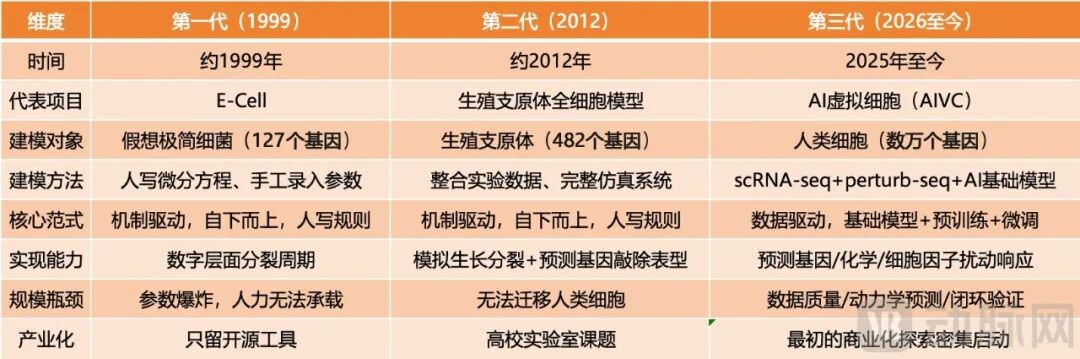
Virtual cells in the course of history Source: Sorted out by vcbeat based on public information
"In fact, around 2023, large biological models have been widely used in computational biology research, but the generalization ability of these models between different cell types is limited." Wang Yixuan pointed out.
The real paradigm shift took place after the co-maturity of single-cell sequencing, large-scale perturbation experiments and AI algorithms, coupled with the accumulated demand and