Worries about AI debtification in the US stock market are escalating. How much is the future of AI actually worth?
On August 18, a notable cooling of risk appetite emerged again in the US stock market. The S&P 500 index fell by 0.67%, the Nasdaq index dropped by 1.33%, and the Dow Jones Index slid by 0.22%. All three major indices closed lower for the third consecutive trading session, hitting new two-week lows at the same time. The Nasdaq became the major index with the largest decline, and what is really worth noting is not the index itself, but where capital is withdrawing from and where it is flowing to.
This time, the market's focus is clearly directed at tech stocks, especially the AI industry chain. The Philadelphia Semiconductor Index fell by about 5.6% in a single day, marking one of the most drastic sector adjustments in recent times. Companies related to storage, optical communications, AI servers and high capital expenditure were almost fully sold off. Micron MU fell by about 7%, SanDisk SNDK dropped by about 9%, Western Digital slid by more than 7%, Marvell, AMD, Intel and other similar stocks also weakened significantly, and optical communications companies such as Coherent and Credo even posted double-digit declines.
If today's market movement is simply interpreted as "tech stocks have risen too much, so profit-taking is happening", the significance of this adjustment is actually underestimated.
What has really changed is the bond market.
Over the past year, the most prominent feature of AI investment is the continuous expansion of capital expenditure. Microsoft, Amazon, Google, Meta and a large number of AI infrastructure companies are all accelerating the construction of data centers. Behind data centers, not only GPUs, network equipment, optical modules, storage and power are required, but also huge amounts of capital.
After AI infrastructure has become increasingly dependent on debt financing, AI is no longer just a tech industry story, but has begun to turn into a credit market story.
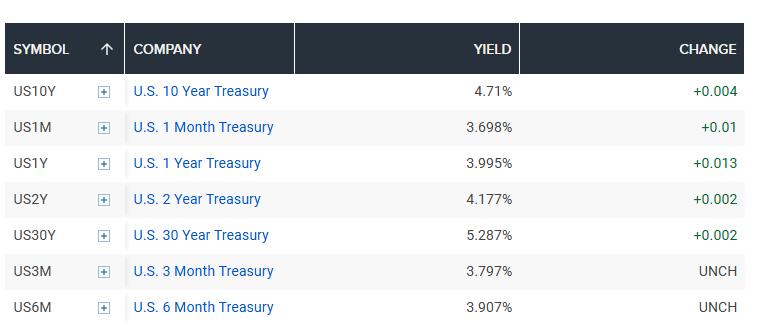
This is also why the most noteworthy figure for investors today is not the 1.33% drop of the Nasdaq, but the fact that the yield on long-term US Treasury bonds has once again risen to a very sensitive level.
According to information obtained from Tradesmax, the yield on the 30-year US Treasury bond peaked at about 5.337% during the session, hitting a new high since June 2007; the 10-year yield once rose to about 4.748%, and then fell back following the release of weak economic data.
What does this mean?
In simple terms, Wall Street is currently recalculating one thing: whether the cash flow generated by AI in the future can cover the capital cost incurred today for building AI infrastructure.
This is no longer the same question as the traditional "is there demand for AI".
The demand for AI certainly still exists, and it is very strong. NVIDIA has even started cooperating with large capital institutions such as Apollo, BlackRock, Blackstone, Brookfield, Goldman Sachs and KKR, hoping to establish a financing platform that will mobilize more than 500 billion US dollars in third-party capital for AI infrastructure construction in the future.
But precisely because AI infrastructure has entered a capital-intensive stage, the market has begun to pay attention to financing itself.
Goldman Sachs previously disclosed that by mid-July, the global AI-related debt issuance scale since the beginning of 2026 has reached about 489 billion US dollars, significantly exceeding the scale of about 322 billion US dollars for the whole of 2025. Among them, investment-grade bonds exceeded 411 billion US dollars, and leveraged financing exceeded 77 billion US dollars. AI-related financing has become a very important source of new bond supply in the US dollar credit market.
In other words, AI is moving from the "buying chips" stage to the stage of "building factories, building data centers, purchasing power, and rolling out networks".
And the most prominent feature of infrastructure expansion is capital intensity.
When the yield on the 30-year US Treasury bond approaches or even breaks through 5.3%, the economic return model for enterprises to finance the construction of a data center with a life cycle of more than ten years will naturally be affected.
This is also where the market's real concern lies today.
Because stock investors usually focus on revenue growth, profit growth and future orders, while bond investors focus on cash flow, leverage ratio, debt solvency and capital cost.
When the bond market begins to reprice the financing cost of AI companies, the stock market will eventually have to re-answer one question: how much real free cash flow can these AI infrastructure investments generate?
Therefore, the decline of tech stocks today is not a simple valuation compression. More accurately, the market has begun to conduct a stress test on the AI capital expenditure model.
It is particularly worth noting that fairly obvious signals have emerged in the credit market. The scale of AI-related debt issuance is growing rapidly, and the credit spread of high-yield tech bonds has also begun to widen. This indicator is important because the credit spread does not reflect how optimistic investors are about the future revenue growth of companies, but how much additional financing cost the market is willing to require enterprises to pay.
Once the credit spread continues to widen, the first to be impacted are often not tech giants with abundant cash and extremely strong free cash flow, but data center operators, AI cloud service providers and infrastructure enterprises with extremely high capital expenditure intensity that need continuous financing for expansion.
This is also why AI infrastructure-related stocks such as CoreWeave, TeraWulf and NBIS posted significantly larger declines than large tech companies today.
The market has begun to distinguish between "the people who make money from AI" and "the people who spend money on AI".
NVIDIA itself has extremely strong profitability and cash flow, so its ability to resist high interest rates is completely different from that of an AI cloud service provider that needs to continuously issue bonds to build data centers.
But a very interesting change has emerged here. NVIDIA itself is getting more and more deeply involved in the AI infrastructure financing system.
This month, NVIDIA announced cooperation with large Wall Street asset management institutions, planning to mobilize more than 500 billion US dollars in third-party capital through a financing platform. NVIDIA defines AI computing infrastructure as a new investment category similar to infrastructure assets.
Research from Tradesmax shows that from the perspective of industrial logic, this is a very reasonable step, because AI computing power is evolving from simple chip sales to infrastructure that can generate continuous cash flow.
But from the perspective of the capital market, this also means that the next stage of the AI industry will be increasingly constrained by the interest rate and credit market.
This is probably one of the biggest changes in the AI investment logic in 2026.
In the past, the market asked: "Who can sell more GPUs?"
Now the market is starting to ask: "Who can turn these GPUs into truly return-generating AI infrastructure with sufficiently low capital cost?"
This change is very important for US stock investors.
Because once capital cost becomes a constraint, the valuation system within the AI industry chain will also begin to diverge.
Companies that truly have pricing power, cash flow and high return on capital may still be able to continue to enjoy the AI super cycle.
But for those companies that rely on external financing, have rapidly expanding balance sheets, and need to continuously issue debt to maintain the growth of capital expenditure, their valuations will increasingly depend on the bond market.
This is also one of the reasons for the collective sell-off in the semiconductor and optical communications sectors today.
In the past, the market was willing to pay for the valuation of "AI demand in the next five years" in advance.
But after the long-term risk-free interest rate continues to rise, the cash flow in the next five years needs to be recalculated with a higher discount rate.
For high-valuation tech stocks, a change in the discount rate from 4% to 5% is by no means a simple one-percentage-point change.
It will directly change the entire valuation model. So a very typical market phenomenon has emerged today.
Economic data is getting worse, but bond yields fell in the late trading session.
In July, US housing starts fell by 12.4% month-on-month, significantly weaker than market expectations; pending home sales continued to decline, and industrial production also slowed down. These data indicate that the US economy is not without signs of cooling.
According to the trading logic of the past few years, the worse the economic data, the more the market should bet on the Federal Reserve to cut interest rates, the long-term Treasury yield should fall, and growth stocks should rise.
But now this logic is becoming less and less smooth.
Because what the market is facing is no longer just the issue of "economic growth", but the long-term financing pressure driven by fiscal deficits, government debt, energy prices and corporate capital expenditure.
· The US government needs to issue a large number of Treasury bonds.
· AI enterprises need to issue a large number of corporate bonds.
· Energy prices may push up inflation again.
When these three factors appear at the same time, long-end interest rates will naturally become very sensitive.
Therefore, what the current market is really worried about is not whether the Federal Reserve will cut interest rates next time, but where the equilibrium capital cost of the US economy will eventually settle.
If the long-term real interest rate continues to stay at a high level, then the valuations of many assets supported by low interest rates in the past need to be recalculated.
This is also why the trend of the bond market today is more worthy of attention than the stock index itself.
Another very important signal comes from the energy market.
The oil price itself did not get out of control and surge today. WTI is trading at around 85 US dollars, and Brent crude oil is at about 91 US dollars. What has seen abnormal changes is refined oil products, especially diesel.
This shows that what the market is currently worried about may not be "global crude oil inventories will be exhausted immediately", but the bottlenecks in refining capacity and refined oil supply.
StockWe.com would like to specially point out that the latest market data shows that the US diesel crack spread has once broken through 100 US dollars per barrel recently, hitting a new all-time high. Therefore, compared with the early intraday data of "69.9 US dollars", the actual pressure on the market is significantly greater at present. Supply disruptions as well as geopolitical risks related to the Middle East and the Russia-Ukraine conflict are simultaneously affecting global refining and refined oil supply.
Why is this matter important?
Because diesel is not just an energy trading commodity.
Diesel is directly related to truck transportation, agricultural machinery, construction equipment, industrial production and global logistics.
If diesel prices continue to rise sharply, it will eventually enter the inflation data through transportation costs, food costs and industrial costs.
This forms a very tricky combination.
On the one hand, US real estate and industrial data have begun to weaken.
On the other hand, energy and refined oil prices are rising again.
If the combination of "slowing growth + resurging inflation" is finally formed, the Federal Reserve will fall into a very awkward situation.
This is also why the bond market is so sensitive to long-term interest rates at present.
At the same time, capital is clearly migrating to the energy and defensive sectors. On the same day, the S&P 500 Energy Index rose by about 1.8%, while defensive sectors such as healthcare and consumer staples also significantly outperformed tech stocks. The energy sector even hit a new high since March.
This does not mean that Wall Street suddenly no longer believes in AI. On the contrary, AI remains one of the most important industrial trends in the coming years.
What has really changed is that the market has begun to shift from "is there growth in AI" to "how much does AI growth cost".
These are two completely different questions.
One of the biggest mistakes investors made in the past two years was to treat the AI industry chain as a whole.
But now, the AI industry chain increasingly needs to be analyzed separately.
GPU suppliers, network equipment, optical communications, storage, data centers, AI cloud, power generation, power transmission, cooling and financing platforms, although all belong to the AI ecosystem, have completely different capital structures.
In a low interest rate environment, the market can temporarily ignore capital cost.
In an environment where the yield on 30-year Treasury bonds exceeds 5%, it can no longer be ignored.
Therefore, the sharp drop of the semiconductor index today cannot directly lead to the conclusion that "the AI bubble has burst".
In fact, the Philadelphia Semiconductor Index still rose by about 70% earlier this year. Today's plunge is more like a drastic repricing of the rise in long-term interest rates and capital cost against the backdrop of high valuation and large gains.
What really needs to be guarded against is that if this adjustment extends from one day to a week, transmits from the stock market to the credit market, and then transmits back to corporate capital expenditure from the credit market, the market logic will really change.
We have not reached that point yet.
Today is more like a warning.
In particular, NVIDIA is about to release its financial report on August 26, and the market will pay extremely high attention to the next stage of AI demand, the Rubin product cycle and capital expenditure intensity. Wall Street currently still expects NVIDIA's fundamentals to remain strong, but as its share price has risen significantly recently, the market's requirements for its financial report are also getting higher and higher.
Therefore, what investors should really observe next is not whether the Nasdaq will rise or fall tomorrow.
Instead, it is whether the three markets can stabilize again.
First, whether the yield on 30-year US Treasury bonds can return to around 5% and stabilize.
Second, whether the credit spread of tech companies can stop continuing to widen.
Third, whether energy prices, especially the diesel crack spread, can fall back from extreme levels.
If all three indicators improve at the same time, today's plunge in tech stocks is likely to be just a rapid deleveraging of high-valuation assets, which may instead bring new layout opportunities for high-quality AI companies.
But if the yield on long-end US Treasury bonds continues to move towards 5.5% or even higher, while AI-related credit spreads continue to widen, and energy prices continue to push up inflation, the market will need to re-evaluate the valuation foundation of this 2026 AI bull market.
Because by then the question will no longer be "does AI have a future". Instead, it will be "how much is the future of AI really worth".
This is probably the question that investors have to answer after the current US stock market truly enters the next stage.
For US stock investors, the most dangerous approach right now is not misjudging the market movement for a single day in the short term, but treating all AI stocks as the same type of asset without understanding the changes in capital cost.
The AI super cycle may be far from over, but the financial environment that supported AI valuations in the era of low interest rates has been significantly different.
The companies that can really survive this round of volatility next are likely not the ones that tell the biggest stories, but those that can truly translate AI demand into revenue, profits and free cash flow, and do not need to rely on increasing debt continuously to prove their growth.
This article is from the WeChat official account "Tradesmax" (ID: tradesmax), author: StockWe.com, published with authorization from 36Kr.