Unitree Technology IPO, Five Key Judgments
Today, the highly anticipated Unitree Robotics will officially make its debut on the STAR Market of the Shanghai Stock Exchange.
The capital market's enthusiasm for humanoid robots barely needs any proof. From dense financing in the primary market to expected hype in the secondary market, this track has been repeatedly brought to the table, yet the market has never found a core anchor for pricing this sector.
Unitree's prospectus provides the most complete "draft" to date. Today, starting from fundamental factors, we will talk about the huge tension between "sci-fi fantasy" and "commercial reality".
According to the prospectus, on the revenue side, Unitree Robotics achieved a revenue of 16.99 billion yuan in 2025, a year-on-year increase of 332.3%; its gross profit for the full year of 2025 was 10.27 billion yuan, with a gross profit margin of 60.4%, up 3.1 percentage points year on year. Its net profit attributable to owners of the parent for the full year of 2025 was 278 million yuan, a year-on-year increase of 65.8%, and the net profit margin reached 16.4%.
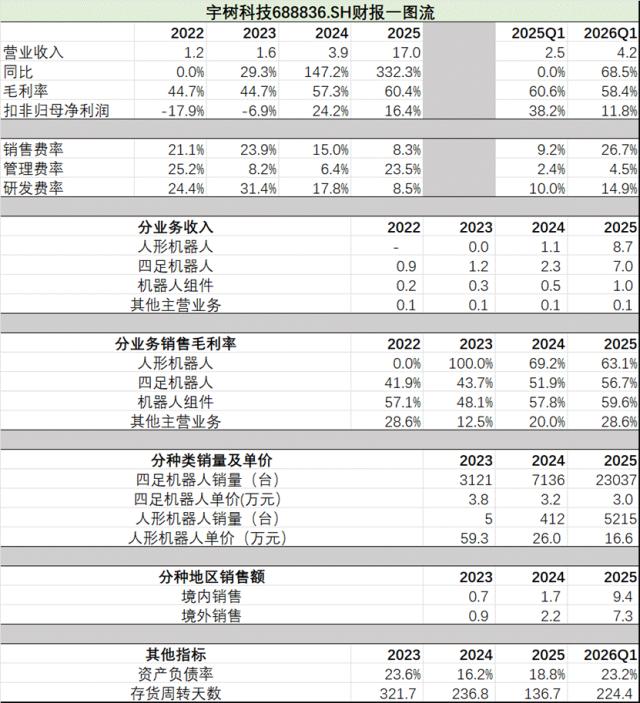
(The full financial chart is shown above, all data are sourced from the prospectus, compiled by Financial Report Record)
To start with the core conclusion, in our view, cost is the first principle of humanoid robots at the current stage, and Unitree has a cost advantage far exceeding its peers at this stage, with a clear understanding of its own strengths and weaknesses. As for the pricing of the capital market, the transformation from technological revolution to economic paradigm has never been a single-point event, and dwelling on the current commercialization results has little practical significance.
From Quadruped to Humanoid, Annual Revenue Grows More Than Twice
Unitree's story starts with a prototype. Wang Xingxing developed XDog during his master's degree studies. In 2017, Laikago, the first commercial product reconstructed based on XDog, was delivered, marking the official start of the quadruped robot business.
In the following years, Unitree fully implemented the "trade price for volume" strategy on quadruped robots. In 2020, A1 first pushed the price into the consumer-grade range. In 2021, Go1 entered the mass market with a retail price of 16,000 yuan, and appeared on the CCTV Spring Festival Gala in the same year. In 2023, Go2 broke the 10,000-yuan mark for the first time with a price of 9,997 yuan.
Nowadays, this underlying logic has been applied to humanoid robots.
In 2023, Unitree directly migrated the motion control algorithms accumulated in the quadruped era and self-developed core components to humanoid robots. The two product lines share the same underlying system for joint drive, mechanical structure, battery management and software algorithms. This explains the two seemingly abnormal figures in the later financial report: the humanoid robot had a gross profit margin of 87.67% right after its launch, and the iteration from the first full-size humanoid H1 to the mid-sized G1 took only 9 months.
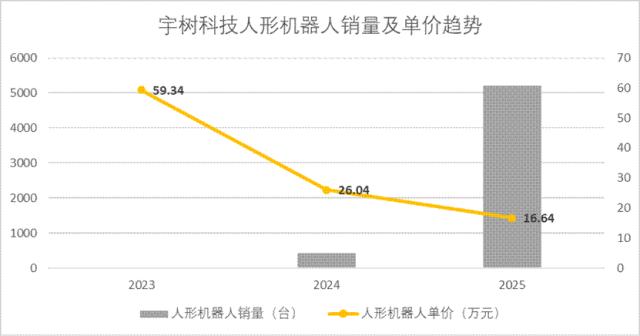
H1 was launched in August 2023, with only 5 units sold that year at an average price of 593,400 yuan, which was a typical scarcity-based pricing. By 2025, the unit price of humanoid robots had dropped to 166,400 yuan, while sales volume surged to 5,215 units.
The explosive figures in Unitree's financial report are the results of the past year. The total revenue in 2024 was only 393 million yuan. In the first quarter of 2026 alone, the revenue reached 423 million yuan, surpassing the full-year revenue of 2024. The full-year revenue in 2025 reached 16.99 billion yuan, a year-on-year increase of 332.3%.
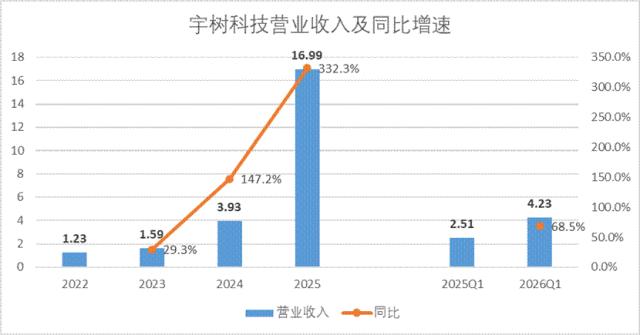
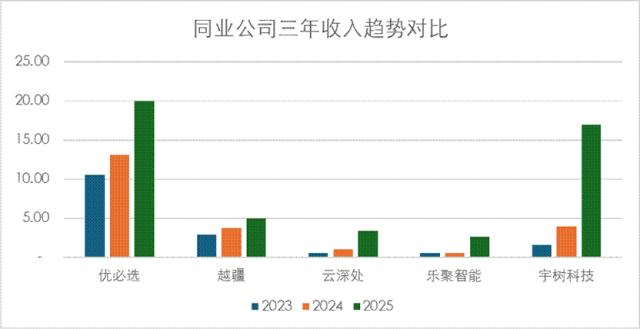
Across the industry, UBtech ranked first in industry scale with a revenue of 2 billion yuan in 2025; Unitree Robotics followed closely with 1.699 billion yuan, but its three-year compound growth rate of 226.8% far exceeded that of its peers, and its explosive growth of 332.3% in 2025 made it jump from the fourth to the second place in the industry.
In terms of revenue by business segment, the doubling of robot revenue drove the total revenue to surge, among which the revenue of humanoid robots reached 868 million yuan in 2025, a year-on-year increase of 711.2%; the revenue of quadruped robots reached 698 million yuan, a year-on-year increase of 202.2%.
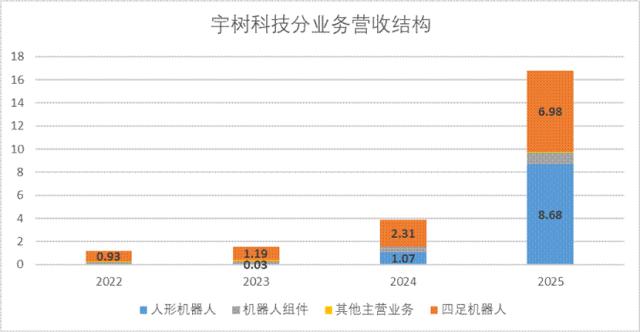
Prior to that, the revenue of quadruped robots had always been far higher than that of humanoid robots. 2025 was the first year that the revenue of humanoid robots surpassed that of quadruped robots, accounting for 51.09% of the total revenue, more than half.
The explosion of humanoid robots in 2025 was the result of three overlapping factors.
The first one was the Spring Festival Gala. At the 2025 Year of the Snake Spring Festival Gala, 16 H1 robots performed the "Yang BOT" show, achieving nationwide exposure, and the proportion of domestic revenue jumped from 44.26% in 2024 to 56.35% in 2025.
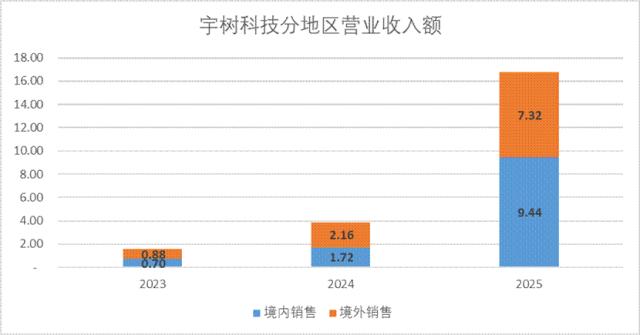
The second one was product downward penetration. In July 2025, R1 was launched with a starting price of 39,900 yuan, pushing the price to the threshold of consumer-grade products, and was named one of Time magazine's Best Inventions of 2025. In October, H2 was released, positioning itself in the full-size high-end market with 31 degrees of freedom. The four models thus covered the full price range from 39,900 yuan to 499,800 yuan.
The third one was competition verification. In May, G1 became the only participating model in the world's first humanoid robot fighting competition. In August, at the first World Humanoid Robot Games, H1 won 11 medals in total.
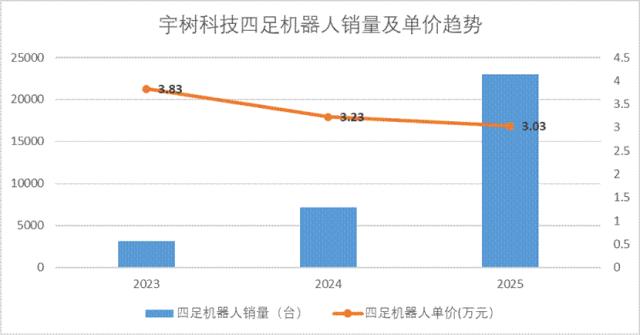
The result of the three-fold acceleration is reflected in the shipment volume. In 2025, the sales volume of Unitree's humanoid robots increased from 412 units to 5,215 units, up 1166%, with a total annual shipment of 5,511 units, ranking first in the world. The sales volume of quadruped robots reached 23,037 units, a year-on-year surge of 222.8%.
Cost Is the First Principle of Humanoid Robots
There is an open secret in the robot industry: the hardware solutions of humanoid robots are converging. Rotary joints, dexterous hands, LiDAR, the BOM lists of different companies are becoming more and more similar, and everyone is open-sourcing their motion control algorithms. Judging only from the technical route, there is no generation gap between the current players.
But the cost gap is widening. Looking at the profit side, we will find a prominent figure when comparing with peers.
The gross profit margin of Unitree Robotics reached 60.4% in 2025, which is 20 percentage points higher than the industry average. The gap in gross profit margin is widening year by year. Back in 2023, the gross profit margin of Unitree Robotics was still 44.8%, staying at the average level of the industry.
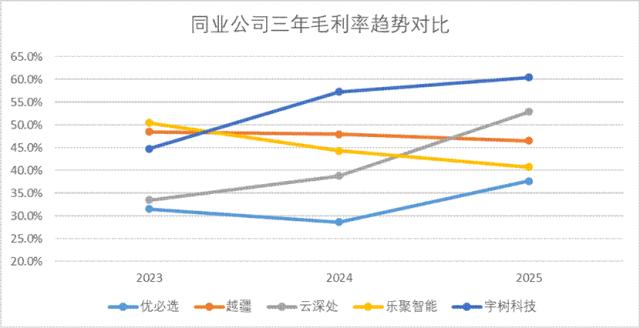
We analyzed three dimensions of Unitree's cost advantage.
The first dimension is route selection. Since the XDog era, Unitree has bet on the rotary joint solution of motor drive plus planetary reducer, bypassing the two huge cost mountains of hydraulic systems and planetary roller screws. The screw is one of the most expensive components on Tesla Optimus's cost reduction path, and has long relied on imports. Unitree's integrated joint encloses the motor, reducer, driver and sensor in the same housing. The planetary reducer has self-developed tooth profiles for leg-foot impact conditions, reducing the number of parts and thus the cost of each single joint.
The second dimension is self-developed and self-produced core components. The high cost of purchasing high-precision motors, reducers and sensors from outside the industry is an industry threshold clearly stated in the prospectus. Unitree turned this threshold into its own profit: core components are self-developed and self-produced, and the price difference that others pay to suppliers is retained in its own accounts. In 2025, Unitree's raw material procurement amounted to 794 million yuan, of which mechanical components accounted for 403 million yuan, or 50.8%. Customized procurement of non-core parts such as machined parts and die-cast parts accounted for half, and all core parts are manufactured by itself.
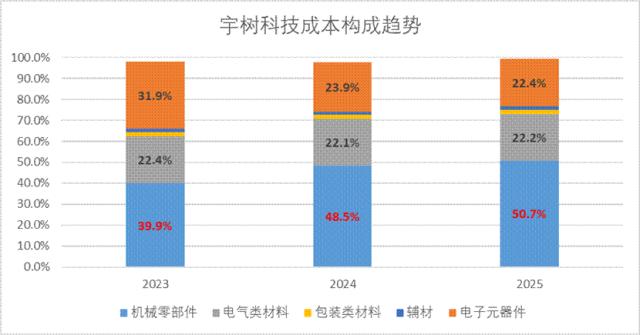
The third dimension is reuse and scale. Humanoid robots and quadruped robots share joint drives, mechanical structures, battery management and software algorithms, and the scale effect is reflected in the cost structure. In 2025, the proportion of direct materials in the main operating cost rose to 81.73%, direct labor was diluted from 13.97% in 2023 to 8.08%, and the annual capital expenditure was only 50 million yuan.
The combined result of the three dimensions can be verified by a reverse calculation. Estimated by average price multiplied by (1 - gross profit margin), the unit cost of humanoid robots dropped from about 80,000 yuan in 2024 to about 61,300 yuan in 2025, a decrease of 23.46% in one year. In the same period, the unit cost of quadruped robots decreased by 16.03%.
There is only one question left: how long can this cost curve be maintained. The gross profit margin of humanoid robots has dropped from 87.67% in 2023 to 63.18% in 2025, indicating that Unitree is actively converting its cost advantage into price and market share. Quadruped robots have proved that this strategy can work: the price decreased by 6.27%, the cost decreased by 16.03%, and the gross profit margin instead rose from 43.71% in 2023 to 56.72% in 2025. Humanoid robots are still in the middle of this conversion process.
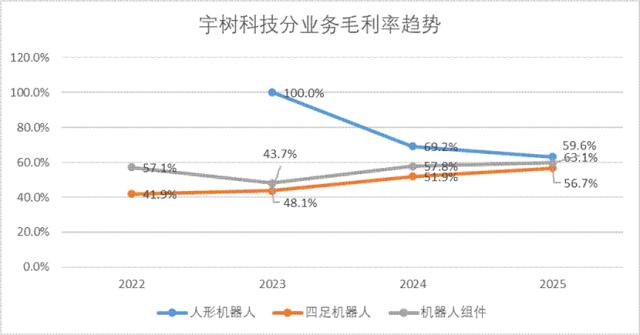
Unitree's moat is a typical "cost advantage + economies of scale". The gross profit margin of humanoid robots has become the decisive factor to demonstrate the cost advantage at the current stage. If it can be maintained, the cost moat will continue to deliver value; if not, the industry will change from "Unitree's cost game" to "everyone's price game".
A Devoted Disciple of Peter Drucker
Peter Drucker, the father of modern management, believes that an enterprise only has two things to do: one is innovation, and the other is marketing.
Let's look at one figure first. In 2025, Unitree's net profit attributable to owners of the parent was 278 million yuan, and its non-recurring profit and loss deducted net profit attributable to owners of the parent was 591 million yuan, more than double the difference. The main part of the difference is a 349 million yuan share-based payment, which is fully counted into administrative expenses without any cash outflow. This accounting treatment pushed the administrative expense ratio to 23.52%, and after exclusion, it was only 2.97%.
