A large number of influencers have collectively stopped updating their content, and the bubble of AI comic dramas has finally burst.
History has proven countless times that every technological wave follows a cycle of frenzied influx, bubble burst and eventual rational return, and AI manhua dramas are exactly at the inflection point of this cycle.
The boom of AI manhua dramas is receding far faster than it surged.
Recently, the topic "A large number of AI creators have stopped updating their accounts" has hit the top trending list on Weibo. From AI manhua dramas to AI painting and AI tutorial content, a large number of accounts have collectively announced suspension of updates or business transformation.
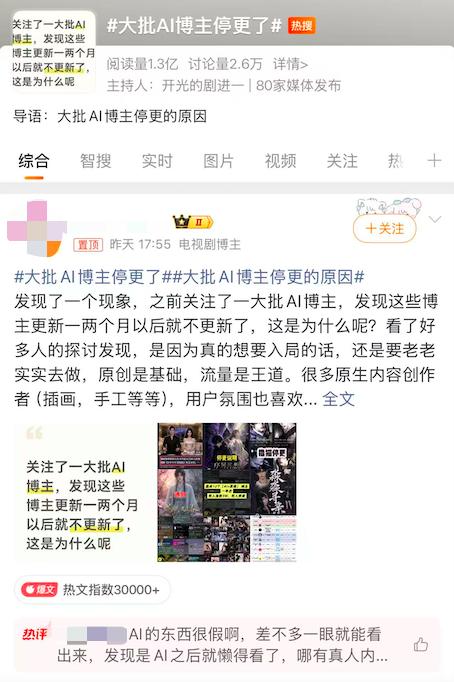
Beneath this trending topic, two completely different voices have emerged in the comment section: some people applaud the trend, while others express their reluctance to see it go. This division precisely reflects the real current state of the AI manhua drama industry: it is not "completely dead", but the extensive era where people could easily monetize by using templates and chasing traffic has indeed come to an end.
Behind the Update Suspension Trend: Low-end Creators Can No Longer Make Profits
The wave of account suspension is not triggered by a single fuse, but more like three major pressures falling at the same time window.
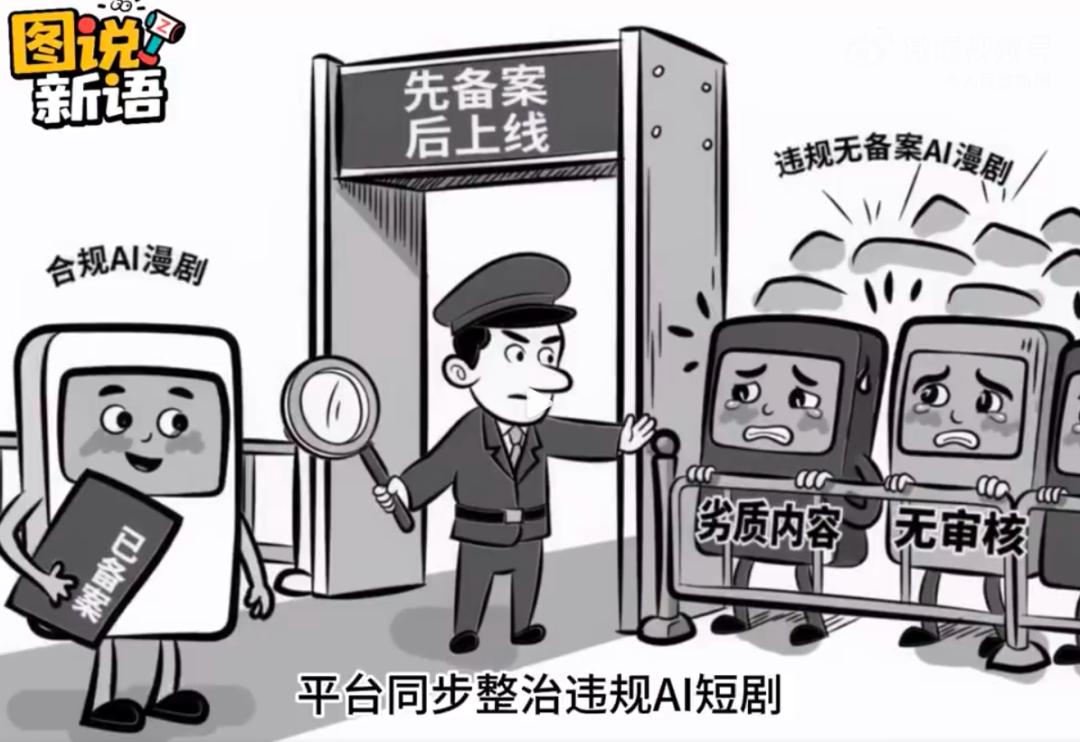
The regulatory measure landed first. Starting from April 1 this year, the National Radio and Television Administration requires that all AI manhua dramas be filed before going online, and unfiled content will be removed from the entire platform. Platforms also followed up quickly: the new AI content rules of Tomato and Hongguo clearly stipulate that the duration of each episode shall not exceed 15 minutes, the adapted plot shall not exceed 10% of the original work, and the compilation format of collected episodes is prohibited. Hongguo removed a total of 1718 non-compliant AI manhua dramas in the first quarter, and the subsequent special governance of low-quality manhua dramas blocked and punished another 3522 works within one week.
The most fatal blow in this process falls on copyright. In the past, a large number of AI manhua dramas adopted the route of "unauthorized reproduction", directly adapting online novels without obtaining authorization or paying copyright fees. Now mainstream AI models have fully embedded invisible watermarks, which can trace and hold accountable for face fusion, voice cloning and unauthorized adaptation. For individual creators who want to make an adapted work in compliance with regulations, it may take a whole month just to get the authorization of a single online novel. The threshold has suddenly risen to such a high level that many people cannot even get the admission ticket to the industry.
While the regulatory tightening is one aspect, the second mountain that crushes creators is that the revenue can no longer cover the cost.
There has long been an illusion outside the industry that AI content creation is "zero-cost entrepreneurship", but in fact every link on this production line is burning money. To make an AI video of dozens of seconds, from selecting the model, writing prompts, repeatedly generating frames, to editing and fine-tuning, it takes at least three to five hours. The scrap rate is surprisingly high, often exceeding 50%. The computing power cost is also rising: starting from April 18, the AI computing power prices of Alibaba Cloud and Baidu Intelligent Cloud increased uniformly, and the computing power cost of one episode of AI manhua drama rose from 17-18 yuan in the early stage to 80-100 yuan.
What about the revenue side? In the first half of 2025, creators could get 80 to 100 yuan for 10,000 views on platforms, and they could make stable profits by producing works in batches. But in 2026, the revenue for 10,000 views has plummeted to 5 to 10 yuan, shrinking by 10 times. One company made 11 AI short dramas, and the total revenue it finally obtained was only 9.6 yuan. Industry insiders calculated that the dividend of AI cost reduction has hardly fallen into the pockets of producers: most of the profit is taken away by tool providers and traffic platforms, and more than 90% of manhua drama companies in the industry cannot make money.
The third pressure comes from the market no longer accepting low-quality works. When AI manhua dramas first emerged, audiences were curious and very tolerant of plot loopholes, stiff expressions and thin character settings. But when AI manhua dramas keep using the same character faces and the same set of story templates over and over again, the patience of audiences is being exhausted rapidly. Last December, there were more than 50,000 manhua dramas being broadcast in China, but only 96 of them had more than 100 million views. By February this year, the total number of released works surged to 120,000, but the number of works with over 100 million views was less than 150. The output more than doubled, but the hit rate was cut in half.

With the superposition of the three pressures, the assembly-line produced AI content can no longer sustain itself.
Chaos Intensifies, Overcapacity, Algorithms Abandon Assembly-line Content
Chaos has always existed since the rise of AI manhua dramas.
For example, the problem of "identical AI faces" once pushed the topic "Physiological Disgust towards AI Faces" to the trending list on Weibo, with nearly 4 million views, which reflects the current perception of the market. The reason for identical faces is still cost. Computing power costs real money: to generate a completely independent character image, creators need to repeatedly generate frames, and each generation consumes computing power and burns money. For producers who need to control the cost of each episode to dozens or hundreds of yuan, directly applying existing templates is the most cost-effective choice.
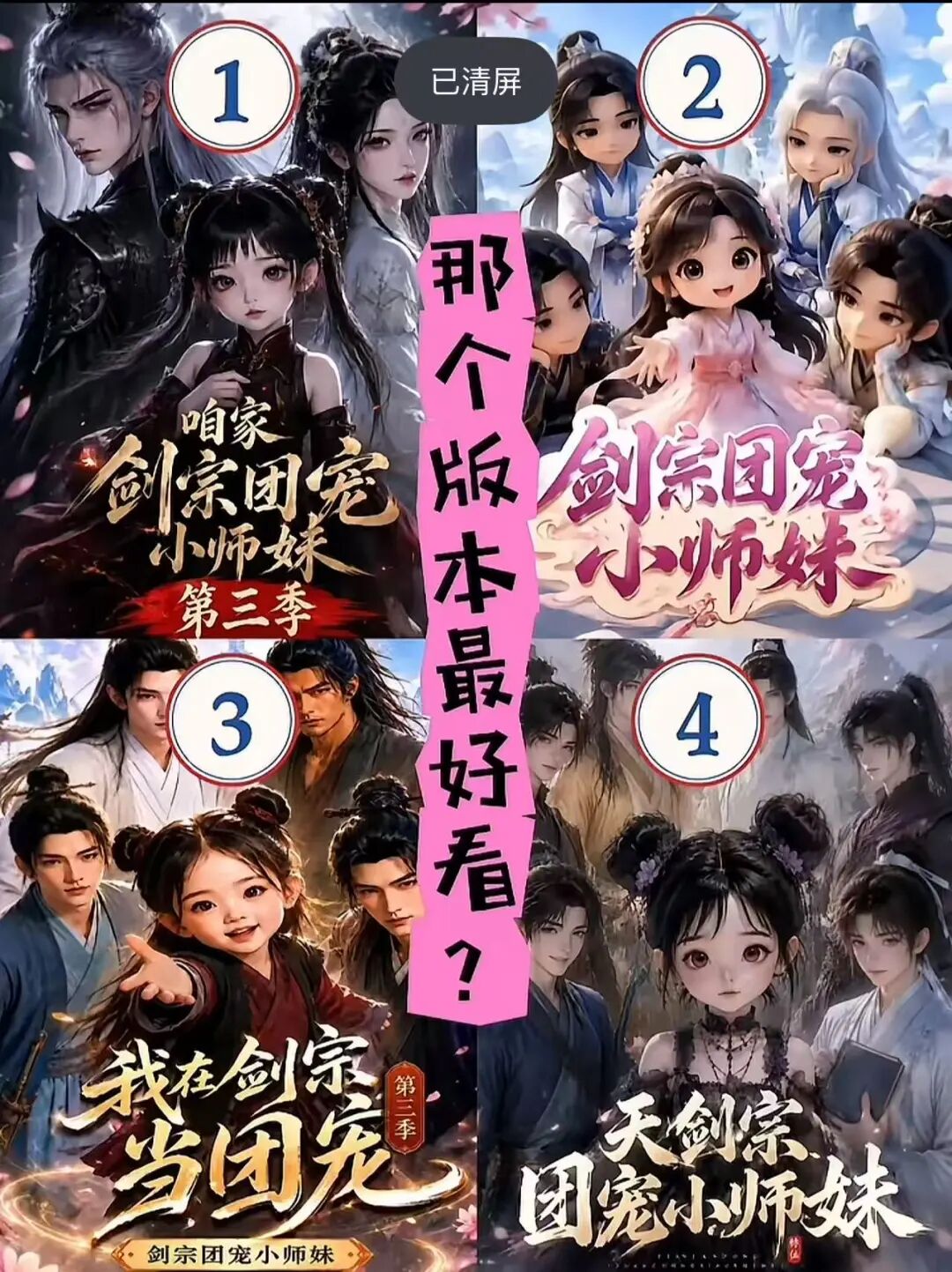
More fatal than "identical faces" is that the stories are also highly similar. The explosive growth of AI manhua dramas is essentially based on "low-cost reproduction" of online novel IPs: the three themes of "rebirth", "time travel" and "entering the system" are repeatedly used, and after changing the name of the protagonist, it becomes a new drama. Some creators directly steal exciting clips from online novel platforms, do not get adaptation authorization, and go online directly after slightly modifying a few lines of lines; others copy the framework of already popular short dramas, change the names and backgrounds, and retain all the reversal plots. There are often more than a dozen works with highly similar core content and only different pictures in the market. When 10,000 "Rebirth of XXXX" works appear in the information flow at the same time, audiences will swipe away faster and faster.

However, face theft, content plagiarism and plot copying are not the main contradiction at present. What completely deprives assembly-line content of traffic is that homogeneous overcapacity has completely exhausted user patience and the algorithm weight of the platform.
This year, platform algorithms have been fully iterated, completely overturning the previous rules of "encouraging production capacity and supporting updates", no longer giving exclusive traffic tilt to AI content, and putting AI manhua dramas and live-action short dramas into the same competition system. The algorithm no longer rewards high-frequency updates and batch production, but only retains high-quality content with high completion rate, high interaction and high user retention.
This directly leads to 90% of individual creators' content completely losing exposure: the stereotyped routines of counterattack, rebirth and group favorite, stiff AI expressions, homogeneous character settings, and extremely low user completion rate will be directly judged as low-quality content by the algorithm, and will be continuously limited or cut off from traffic. Even if creators update for free and produce content continuously, there will be no natural traffic, let alone revenue.
According to the latest industry data in 2026, a total of 221,900 new AI manhua dramas were added across the network in the first half of the year, with more than 1200 new works launched every day. Massive assembly-line content keeps pouring into platforms, but the viewing duration and click capacity of users are fixed. The infinitely growing production capacity collides with the fixed user demand, leading to the collapse of involution in the track.
Squeeze out the Bubble, and Keep Moving Forward
If you only focus on the update suspension trend and industry chaos, it is easy to think that AI manhua dramas are "completely dead". On the other side of the fact, top players are still making profits quietly.
According to data from Flush, 221,900 new AI short dramas were launched across the network in the first half of this year, of which 1055 works have more than 100 million views. Although the hit rate is as low as 0.47%, there are indeed people making money.
A post-95 couple in Bazhong, Sichuan, made the work "Exiled to the Border, the Criminal Wife Develops Land and Raises a War God". Since it was launched in June, it has gained 2.127 billion views in a single month, the peak popularity on Hongguo is close to 100 million, and it has reached 4.1 billion views in two months. The reason for its success is that they are not in a hurry, and polish the work slowly. AI-generated frames often have overlapping characters, wrong standing positions and broken faces, and they patiently modify every frame, formally apply for IP from Hongguo's copyright library, buy professional equipment at their own expense, and pay to unlock advanced AI tools.

Top projects in the track such as "The Eighth Season of the Record of Ten Thousand Demons" and "Super Favorite Four-and-a-half Year Old" can still get tens of millions of popularity and attract a large number of audiences. These cases prove one thing: AI manhua dramas are not unprofitable, and whether you can make profits depends on how you operate.
Top teams will invest manpower in original modeling, and have screenwriting teams to polish scripts. For individuals or small teams, they can slow down and refine the content. In other words, only sufficient investment can bring possible returns. AI is ultimately just a tool, and the era of making quick money with tools has passed.
In the first quarter of this year, the number of active contractors in China's AI manhua drama industry dropped from 1216 to 698, and more than 40% of the teams left the market. But most of those who left are speculators who want to "chase a little traffic" by producing low-quality content in batches.
Luan Tianxing, CEO of Xin Vision Media, believes that the decline in the hit rate of AI short dramas "is the inevitable result of multiple superimposed factors, and it is the necessary pain for the industry to transform from extensive expansion to high-quality development. I don't think this is the "failure" of AI short dramas, but the retreat of bubbles and the return of value."
History has proven countless times that every technological wave follows a cycle of frenzied influx, bubble burst and eventual rational return, and AI manhua dramas are exactly at the inflection point of this cycle. The burst of bubbles is not necessarily a bad thing, which means that the industry finally begins to develop in a down-to-earth way.
This article is from the WeChat official account "Du Yu" (ID: yiqiduyu), the author is Suanxiang Zhezhejiao, and 36Kr publishes it with authorization.