Geely: Speeding Full Steam Ahead in Overseas Expansion, Can It Replicate the Next "BYD"?
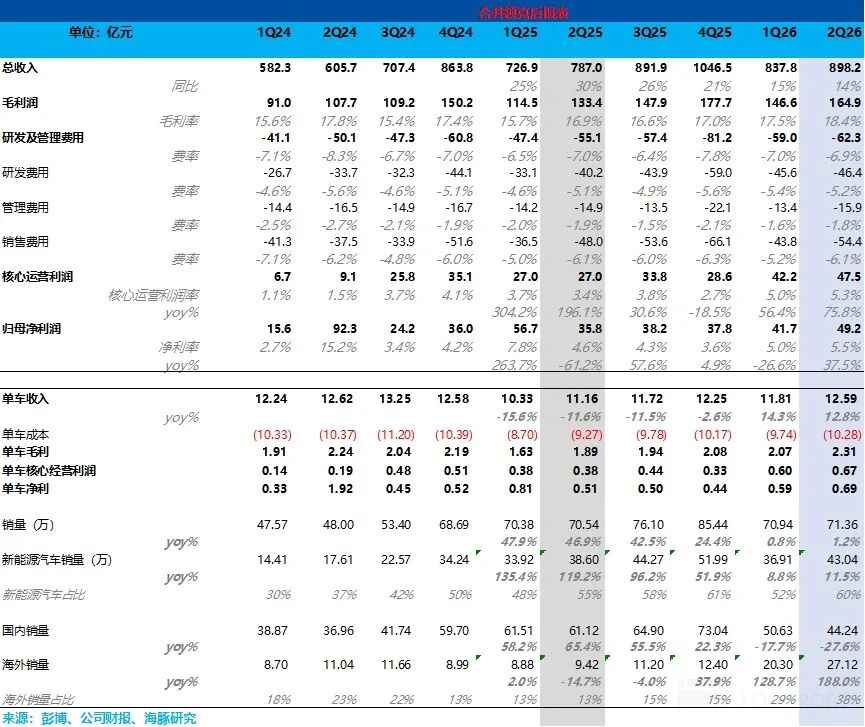
Geely Auto released its 2026 Q2 report during the midday trading session of Hong Kong Stock Exchange on August 17, 2026 Beijing time. Overall, Geely delivered a strong performance this quarter, with its core gross margin and per-vehicle operating profit continuing to rise, showing extremely strong operational resilience:
1. Total revenue increased by 14% year-on-year, mainly driven by higher per-vehicle revenue: Geely's total revenue reached 89.8 billion yuan this quarter. Against the backdrop that total sales volume only increased by 1.2% year-on-year, the 14% year-on-year growth of total revenue was mainly contributed by the 12.8% year-on-year increase in per-vehicle revenue, which was rooted in the rising proportion of high-end models and overseas sales.
2. Per-vehicle revenue increased both year-on-year and month-on-month: The per-vehicle revenue in Q2 reached 126,000 yuan, up 12.8% year-on-year and 6.6% quarter-on-quarter, mainly boosted by the sharp increase in the proportion of high-priced overseas models. The proportion of overseas models has risen by 25 percentage points from 13% in the same period last year to 38% this quarter; the sales proportion of Zeekr, Geely's high-end model line, also increased from 7% in the same period last year to 14% this quarter (driven by the strong sales of Zeekr 8X), which jointly pushed the overall per-vehicle revenue to continue rising year-on-year.
3. Gross margin continued to improve quarter-on-quarter: The overall gross margin in Q2 reached 18.4%, up 0.9 percentage points quarter-on-quarter. On the one hand, it benefited from the sharp increase in the proportion of high-gross-margin overseas and high-end models; on the other hand, it benefited from Geely's strong cost reduction initiatives (the cost reduction completion rate in Q1 was nearly 80%, and it is expected to fully meet the target in Q2), which effectively offset the adverse impact of rising prices of bulk commodities such as lithium carbonate, copper and aluminum (the per-vehicle cost is expected to be affected by about 2,000 yuan), in line with Geely's previous guidance of stable or slight quarter-on-quarter increase in Q2 gross margin.
4. Three expenses rose by 14% year-on-year, mainly driven by increased R&D and sales expenses: Sales expenses in Q2 reached 5.44 billion yuan, up 13.4% year-on-year, mainly due to the large-scale expansion of overseas channels and promotion for new car launches.
While R&D expenses reached 4.64 billion yuan, up 15.6% year-on-year, which was mainly used for:
· New model R&D: Launched models including Zeekr 8X, Lynk & Co 10/10+, Geely Galaxy V900/M7, Xingyao 7/A7 EV, Xingjian 7 EV, etc. during the period; there are still multiple new product plans in the second half of the year such as Galaxy TT, Galaxy Battleship 700, Lynk & Co 07GT, Zeekr 9X Guanghui, etc.;
· Intelligentization investment: Released the World Action Model (WAM), the new-generation assisted driving system "Qianli Haohan G-ASD", and the cabin-driving integrated super agent "Super Eva"; at the same time, made forward-looking layouts for cutting-edge technologies such as power semiconductors, digital chassis, embodied intelligence, and large models;
· Electrification investment: Released the new-generation "i-HEV Smart Hybrid" technology, continued to iterate the 800V high-voltage architecture, new-generation electric drive and battery technologies, covering all technical routes of pure electric, plug-in hybrid and gasoline hybrid.
5. Core per-vehicle operating profit continued to improve: Benefiting from the gross margin increase brought by overseas sales and high-end models, although the three expenses rose due to increased R&D and sales investment, driven by the leverage of overall sales volume, the core operating profit increased significantly by 76% year-on-year, and the core per-vehicle operating profit rose quarter-on-quarter from 6,000 yuan in the previous quarter to 6,700 yuan.
6. Despite the negative drag from exchange gains and losses, the net profit attributable to owners of the parent still increased significantly: Geely recorded an exchange loss of 550 million yuan in the first half of 2026 (with an exchange gain of 2.64 billion yuan in the first half of 2025), which dragged down the net profit attributable to owners of the parent. However, the overall net profit attributable to owners of the parent still rose by 37.5% year-on-year to 49.2 billion yuan, and the per-vehicle net profit also rose significantly from 5,100 yuan in the same period last year to 6,900 yuan this quarter.
Dolphin's Viewpoint:
Overall, Geely's financial results for Q2 performed well. Although the overall vehicle sales volume only increased by 1.2% year-on-year (the overall passenger car sales volume of the whole market declined by 5% year-on-year), driven by the breakthrough of per-vehicle revenue from high-end layout and accelerated overseas expansion, the overall revenue still recorded a positive year-on-year growth of 14%.
Similarly, benefiting from the two-wheel drive of "high-end layout and overseas expansion" (the proportion of overseas sales in the model structure has risen to 38%) and Geely's excellent strong cost reduction capability, Geely not only stabilized its per-vehicle ASP in the high-pressure market environment of negative growth, but also significantly improved the gross margin and per-vehicle net profit level. Geely's per-vehicle net profit has also increased from only 5,000 yuan in the same period last year to nearly 7,000 yuan this quarter.
In terms of the most important accelerated new energy transformation, against the adverse background that the new energy vehicle purchase tax reduction policy was phased out and the overall new energy vehicle sales volume of the industry declined by 4% year-on-year, Geely's new energy vehicle sales rose against the trend by 12% year-on-year to 430,000 units.
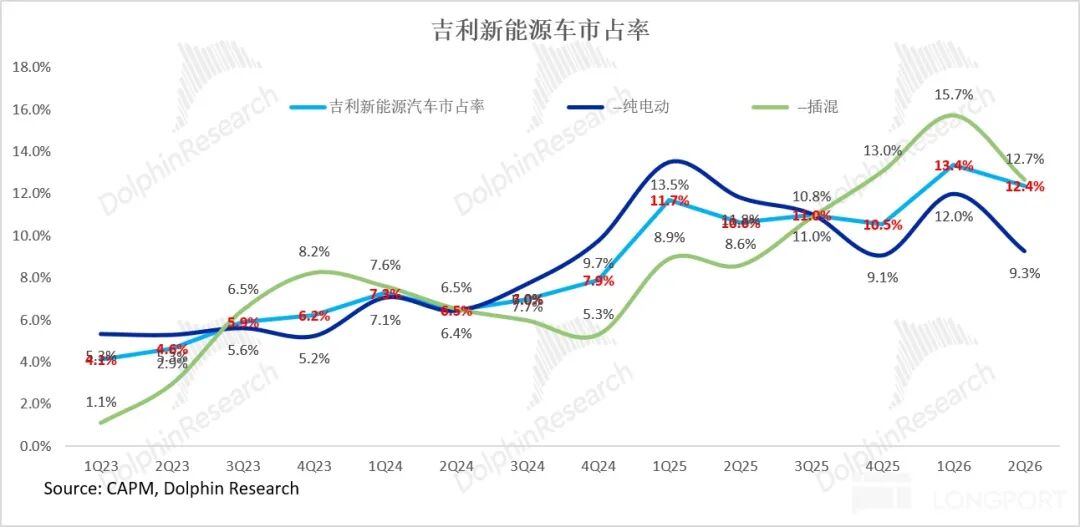
Its new energy vehicle penetration rate has climbed to 60%, up 5 percentage points year-on-year; the domestic new energy market share has also increased from 10.6% in the same period last year to 12.4% this quarter. The overall acceleration of transformation marks that Geely has officially entered a development stage dominated by "new energy driving" in 2026.
Breakdown by brand:
a. Galaxy Series: New energy sales in Q2 reached 140,000 units, up 14% year-on-year. The Galaxy brand returned to positive year-on-year growth this quarter, mainly driven by the launch of new models Galaxy M7, Xingyao 7 and Galaxy A7 EV, as well as the recovery of old models Galaxy E5 and Galaxy Xingjian 7 plug-in hybrid models.
b. Lynk & Co: New energy sales declined by 11% year-on-year to 43,000 units. Although the proportion of new energy models in Lynk & Co's total sales increased by 9 percentage points year-on-year to 68%, Lynk & Co did not launch new models in Q2, and the sales of the old hit model Lynk & Co 08 also declined quarter-on-quarter from 17,000 units in the previous quarter to 8,600 units this quarter due to product aging.
c. Zeekr: New energy sales increased by 105.4% year-on-year to 101,000 units, mainly driven by the popularity of the new Zeekr 8X, which sold 14,000 units this quarter, as well as the sales recovery of Zeekr 007.
Finally, Geely's new energy vehicle sales in Q2 reached 430,000 units, up 12% against the trend year-on-year, and the current completion rate of the 2.22 million annual sales target for 2026 is 36%.
As for the outlook for 2026:
Geely is embracing a relatively strong "Davis Double Click" and is expected to deliver its own alpha return: high gross margin business represented by high-end layout and overseas expansion will continue to increase profits (boosting EPS), while the fully accelerated new energy transformation will open the valuation ceiling (raising PE).
① Profit Engine 1: Continue the strong product cycle, high-end layout drives ASP upward
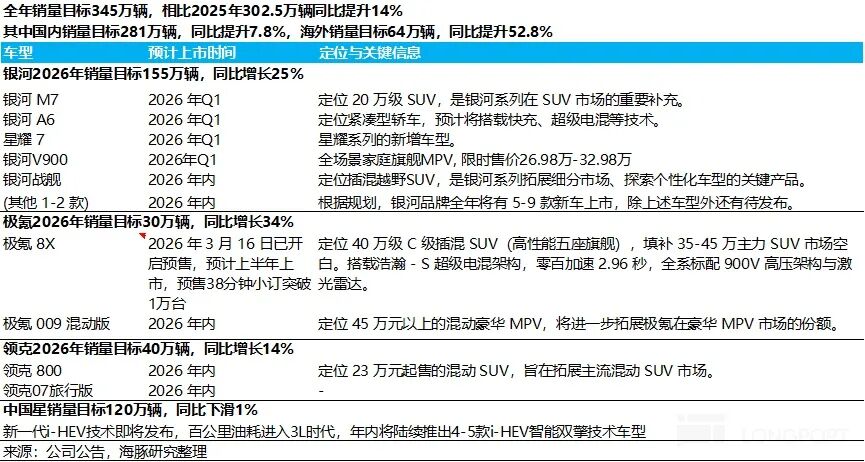
The company has set a total sales target of 3.45 million units for 2026, up 14% year-on-year, and the growth structure is characterized by "new energy leading, overseas market making efforts".
Among them, the new energy vehicle sales target is 2.22 million units, up 32% year-on-year, the new energy vehicle penetration rate will continue to rise by 8.5 percentage points year-on-year to 64%, while the fuel vehicle sales target is 1.23 million units, down 8% year-on-year.
In terms of the planning of each brand, Geely will launch nearly 10 new models in the 2026 lineup to promote the achievement of the sales target:
Geely Galaxy (core volume base): Target new energy sales of 1.52 million units, up 23% year-on-year, relying on multiple new models such as M7 and Xingyao 7 to consolidate the mainstream market.
Zeekr (high-end profit contributor): Target sales of 300,000 units, up 34% year-on-year, with incremental sales mainly coming from the sales ramp-up of Zeekr 8X (launched in April) and the continuous sales growth of Zeekr 9X. With the leading architecture homologous to Zeekr 9X, Zeekr 8X forms a high-end product line together with Zeekr 9X, driving the increase of the brand's ASP and gross margin.
Lynk & Co: Target sales of 400,000 units, up 14% year-on-year, driven by new energy transformation (current penetration rate has exceeded 60%) and new models (such as Lynk & Co 800).
② Profit Engine 2: Explosive growth in overseas markets, bringing the highest profit elasticity
The overseas market has become the segment with the strongest growth certainty and the largest profit elasticity for Geely in 2026. The company has significantly raised its 2026 overseas sales target to 920,000 units (up 120% year-on-year). Considering that Geely has already exported 474,000 units, it has completed half of the raised annual export target. The current overseas sales volume has stabilized at 100,000 units (nearly 1.2 million units on an annualized basis), which is mainly due to the increase in the proportion of new energy vehicle exports: among the current 100,000 sales volume, there are 30,000 fuel vehicles and 70,000 electric vehicles (10,000 Zeekr 007/Zeekr X, 10,000 Lynk & Co, 45,000 Galaxy Xingjian 7 and Galaxy E5).
Under the circumstance that Geely's main export product Galaxy series has only launched two models, it has achieved rapid sales growth. Dolphin expects that Geely will most likely exceed its annual target, and the total export sales volume in 2026 is expected to reach 1.1 million units.
At the same time, it is expected that in 2027, Geely's HEV products will also rely on the cost advantage of being 3,000 US dollars lower than Toyota's HEV, and the export scale will continue to rise to 1.5-1.6 million units.
The high-profit feature of overseas expansion is the key to driving the group's profit pool: compared with the data of 2025, the overseas per-vehicle ASP (176,500 yuan) has reached 1.7 times of the domestic level, the gross margin is about 10 percentage points higher than that of the domestic market, and the per-vehicle net profit is nearly 12,000 yuan. With the accelerated expansion of overseas channels (plan to exceed 2200 stores) and the accelerated proportion of new energy vehicle exports (expected to reach more than 50%), the high-dimensional momentum of overseas business will be the main driver to increase the company's profits.
③ Cornerstone of cost reduction and efficiency improvement: "One Geely" releases systematic dividends
With the completion of Zeekr's privatization at the end of 2025, the "One Geely" strategy has entered a full delivery period. The highly integrated R&D, procurement, manufacturing and management platforms will significantly dilute the overall operating cost. It is expected that the ratio of sales, management and R&D expenses will continue to decline throughout 2026, escorting profit release.
Accelerated new energy transformation raises the PE center:
Based on the strong fundamentals of the company's accelerated "overseas expansion + high-end layout" transformation, although the current domestic sales volume is lower than expected (domestic sales in 1H26 declined by 23% year-on-year to 950,000 units), Dolphin therefore lowered the 2026 annual total sales target to 3.32 million units (of which domestic sales are expected to be 2.15 million units, down 18% year-on-year). However, driven by the strong overseas growth momentum, Dolphin expects Geely's overseas sales in 2026 to reach 1.1 million units (accounting for 33% of the total annual sales), and Geely's overseas per-vehicle net profit is around 12,000 yuan, which is 2-3 times of the 4,000-5,000 yuan per-vehicle net profit of domestic models.
This article is from the WeChat Official Account "Haitun Research" (ID: haituntouyan), author: Dolphin, authorized for release by 36Kr.