No longer clinging to standalone apps, Alipay's AI exploration is still ongoing.
Super apps with massive traffic will not have an easy time in the AI era. On the contrary, they may face greater anxiety over how to iterate and upgrade themselves.
Two months ago, Alipay launched Bao, the AI-powered super service agent. Back then, the development path of the AI version of Alipay was still unclear. Some voices pointed out that the user experience of the AI-powered Alipay remained to be improved. According to observations from Jiemian News, the AI version of Alipay sets up two core sections, "Assets" and "Bao". After entering the app, users can directly talk to the AI assistant Bao to complete daily life services including social security inquiry, hospital appointment registration, food ordering, and bill payment. From this experience perspective, "Bao" is more like an AI assistant that can call the original services of Alipay.
Despite the sky-high popularity that made access invitation codes extremely hard to get during the internal test phase, it still takes time to change the usage habits of hundreds of millions of users.
However, Alipay cannot slow down its pace in the AI race among major tech giants.
01
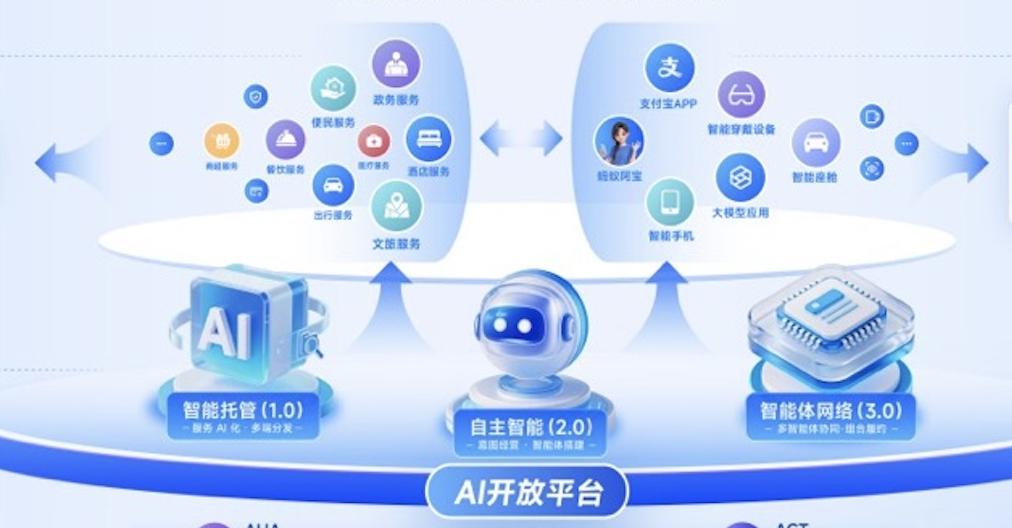
On August 17, Alipay held its first AI Ecosystem Conference, disclosing the latest progress of "Bao". According to Alipay's introduction, Bao has now completed AI-enabled access to more than 10,000 services, with cross-device service support covering 5 mobile phone brands and 16 mainstream automotive enterprises. Alipay also released the full-stack intelligent agent business base and the AHA protocol system for cross-device interconnection of multi-agents, and co-built the intelligent agent interconnection ecosystem with more than 20 enterprises including Qwen, Huawei, OPPO, Xiaomi and Geely.
The protocol is designed to pave the way for merchants to join the ecosystem. With this protocol, after completing the AI transformation of their operations, merchants can access intelligent terminals through "Bao" to serve all end users.
Tu Lu, head of the cross-device interconnection business for Ant Group's Bao, told media including Jiemian News in an interview after the conference that merchants are eager to reduce costs when docking with different terminals. With the aforementioned protocol, merchants only need to finish developing their own AI service capabilities in the future to gain access to different terminals. Meanwhile, hardware devices no longer need to dock with different merchants, and Alipay will act as the middle layer connecting both sides.
Before the AI version of Alipay sees explosive growth among C-end users, this seems more like a strategy that prioritizes ecosystem construction. In fact, the first problem Alipay needs to solve when carrying out AI transformation within its own platform is the supply side issue.
In 2026, technology companies are competing on the landing capability of AI, and competition in the Agent field has accelerated sharply, becoming the core battlefield for major tech giants in the AI track. In the office agent track, Tencent's WorkBuddy has reached 20.97 million monthly visits, ByteDance's Coze has occupied a leading market position in the intelligent agent development platform sector, and companies including Baidu are also integrating their product lines to boost the exposure and adoption of Agents.
02
Different from other major tech giants that choose to cut into AI from scenarios such as office work and content, Ant Group's AI layout can hardly be separated from its existing application ecosystem.
In the layout of independent apps, the company has already bet on Ant Afu, a health vertical app, and has made phased progress in user scale. In 2024, Ant Group once tried to develop another life-oriented AI app called "Zhi Xiaobao", but the progress did not go smoothly. As a national-level life service app, the service ecosystem and payment mindset that Alipay has accumulated over the years are not only its advantages for AI layout, but also an important factor that it cannot easily ignore.
The launch of Bao proves that Ant Group has formed a relatively clear idea of how to develop AI on Alipay. After the public beta in July this year, the iteration pace of "Bao" has accelerated significantly: Alipay first launched the AI Open Platform, opening up AI access capabilities to merchants, institutions and service providers, and then announced the completion of AI upgrade for the "Tap to Connect" feature. After the release of the protocol system this time, the strategic positioning of the AI version of Alipay has gradually become clear.
Han Xinyi, CEO of Ant Group, put forward a judgment at the AI Ecosystem Conference on that day: the intelligent agent business will see explosive growth in the next 6 to 12 months. He attributed the arrival of this critical point to the "simultaneous maturity" of three conditions: the evolution and improvement of AI technical capabilities, the leap of user demand, and the formation of a sustainable value closed loop.
Han Xinyi believes that every technological revolution will give birth to the roads and facilities belonging to that era. The role of Alipay is to pave this "road" for the intelligent agent business — to provide product and technology base, as well as infrastructure support including trust facilities, AI payment, blockchain, AI database and privacy computing.
Shi Zhen, head of the Ant Bao business, explained the meaning of intelligent agent business as that every user has their own C-end Agent, which can actively or even independently judge user demands based on users' intentions and needs, and decide which kind of intelligent agent to assign for execution. This process will generate new operational increment beyond the conversion of traffic transactions.
This will to some extent overlap with general-purpose large model applications such as Qwen and Doubao, which have also begun to access merchants to realize transactions. But Alipay believes that its own differentiation advantage lies in multi-terminal collaboration. Tu Lu explained that for example, Qwen may have original service supply, and the merchants it accesses may also have their own Agents, whose service logic is different from that of Alipay. Alipay emphasizes multi-terminal collaboration, aiming to complement "user intention" together with other players and give full play to its own characteristics around this core.
No matter which way it chooses to participate in the competition, users' attention and usage time are always limited.
In different scenarios, intelligent agents are all competing for the same "conversation entry". Today, when numerous technology companies have already been listed in the AI Agent rankings, Alipay's AI exploration is still in the first stage. Regarding the issue of commercialization, Tu Lu said that the whole industry is still in the process of building infrastructure, and the current task is to make the ecosystem thrive. It is too early to discuss "how to charge and how to draw commission" before that goal is achieved.
This article is from the WeChat official account "Jiemian News", written by SHE Xiaochen, edited by WEN Shuqi, and published with authorization from 36Kr.