Jensen Huang, Sam Altman and Masayoshi Son have maintained a close alliance for 20 years.
OpenAI is locking in computing power for the next 20 years in advance, and NVIDIA is extending its reach beyond chips.
On August 17 local time in the United States, NVIDIA, OpenAI and SB Energy under SoftBank confirmed a cooperation to build a large-scale data center in the United States. Among them, SB Energy is responsible for development and operation, OpenAI will become the customer, and the data center will fully adopt NVIDIA's computing power.
In this tripartite transaction, the most widely concerned role is the one NVIDIA plays. It is not only a computing power supplier, but also provides a backstop guarantee of up to 105 billion US dollars for OpenAI's long-term lease, and directly invests in project construction. The transaction that originally belonged to developers, tenants and financing institutions now has an extra participant that is a chip company.
Why does NVIDIA take such risks, and why does OpenAI lock in a 20-year computing power lease?
One fact and trend is that under the expansion of computing power demand, land, electricity and data center capacity have become "bottleneck restricting" resources, triggering all parties to compete for layout. But in Jensen Huang's view, the balance sheets of cutting-edge AI labs are not as strong as cloud giants, which leads to the model of "chip companies participating in guarantee".
But in fact, cloud giants are also "advancing under heavy burdens".
According to the Wall Street Journal's analysis of the latest financial statements of 9 large technology companies, the total AI-related off-balance-sheet commitments of these companies (not included in the balance sheet, mainly from forward payment obligations for chip procurement and long-term data center leases) have approached 3 trillion US dollars, 3 times the sum of current lease liabilities and long-term debts.
01 10GW Lease, NVIDIA Provides Guarantee
The data center project co-developed by OpenAI, SoftBank's SB Energy and NVIDIA is located in the PORTS-Pike campus in Ohio, USA. It is planned to build at least 10GW of new energy power generation capacity. After the campus is completed, NVIDIA's computing infrastructure will be exclusively deployed, and eventually form an AI factory capacity of about 8GW.
The project construction is divided into two phases. The planned capacity of the first phase is 4.25GW, of which the first 800MW is expected to be put into use in 2028, mainly using the existing AEP Ohio infrastructure. After that, the project needs to continue to build power plants, transmission lines and other power grid facilities, and then expand the data center capacity to the predetermined target.
NVIDIA can also exercise the capacity guarantee for another 3.75GW according to future demand, but this part currently has uncertainties in infrastructure, permission approval and other aspects, and NVIDIA has no obligation to lease all of them.
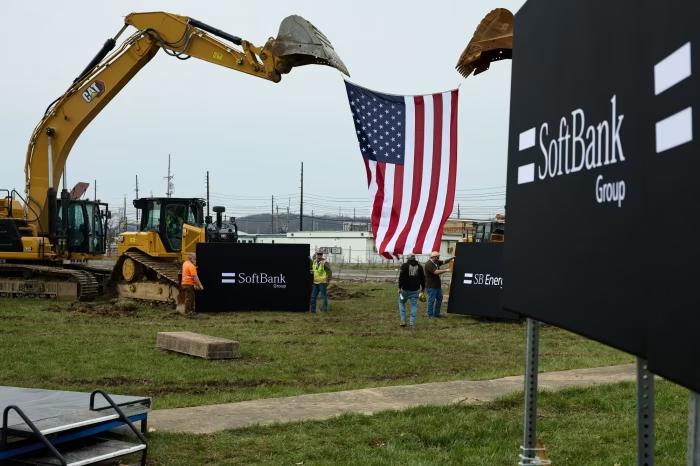
The southern Ohio data center campus broke ground in March this year
SB Energy and SoftBank plan to invest at least 4.2 billion US dollars in the construction of new regional power grid infrastructure. SB Energy is responsible for the construction, ownership and operation of the data center, and OpenAI uses the capacity that has been completed and delivered.
At present, OpenAI has signed a 20-year lease with SB Energy. The agreement states that OpenAI will not start paying rent until the corresponding capacity is completed and available for lease.
Signing a long-term capacity agreement in advance allows OpenAI to lock in its future computing power demand first. But this does not mean that NVIDIA has to pay all the 20-year rent for OpenAI.
According to the agreement, the maximum payment liability (or the upper limit of total payment obligation) NVIDIA assumes for this transaction is 105 billion US dollars, which is mainly used for the costs of land, power, data centers and other infrastructure.
NVIDIA adopts a residual value guarantee structure: if OpenAI stops leasing, SB Energy will find the next tenant. If there is no new lease, it will consider selling the relevant assets. Only when the above methods still cannot cover the agreed minimum value, NVIDIA will make up the difference.
Therefore, the 105 billion US dollar guarantee corresponds to the residual value of the completed data center assets, and will take effect in phases along with project construction and put into use, roughly covering the period from 2028 to 2030. As OpenAI pays rent and data center capacity goes online one after another, the actual risk exposure NVIDIA bears will gradually decrease.
The key reason why NVIDIA is willing to do so lies in this risk exposure. Even if OpenAI reduces its usage in the future, the completed computing capacity can still be transferred to cloud service providers, enterprises, AI labs and startups.
02 "Seize" Land and Power in Advance
On the same day the above news was released, Jensen Huang wrote an article explaining why NVIDIA participated in such a project. His judgment is based on the fact that AI factories need more and more resources. In the past, advanced chips, packaging, memory and networks were the main inputs of AI infrastructure. Now, land, power and data centers must also be secured in advance.
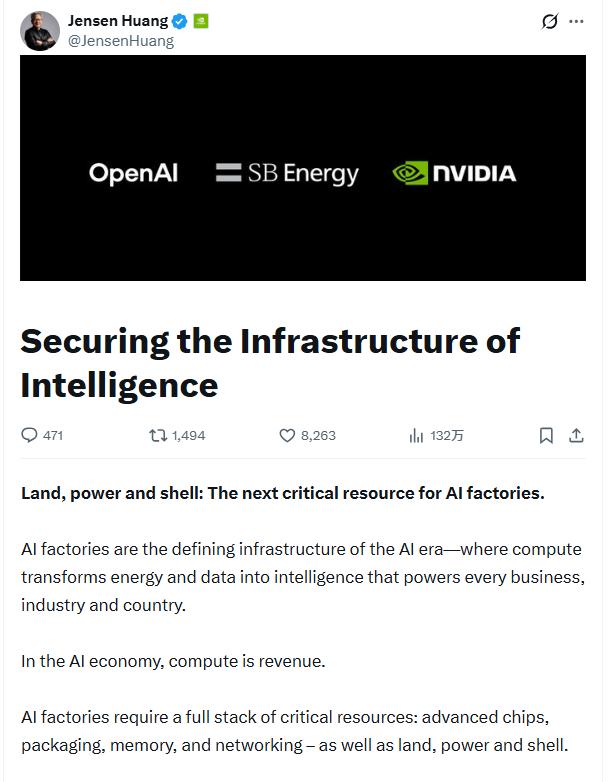
In Jensen Huang's view, large cloud service providers and investment-grade enterprises usually have large enough balance sheets, and the ability to sign long-term contracts and build infrastructure on their own. But cutting-edge AI labs may not have such conditions.
These companies' training and inference demands are growing rapidly, and their revenue may increase accordingly. But to lock in land, power and data centers for decades in advance, they still need stable cash flow and strong enough financing capabilities, which is exactly what many AI labs currently lack.
As a result, a new bottleneck has emerged.
Jensen Huang wrote that the growth of these companies is "not limited by algorithms or customer demands, but by the availability of computing power".
NVIDIA's involvement in data center infrastructure (LPS, Land, Power and Shell) is to solve this problem. However, this does not mean that NVIDIA is prepared to provide similar services to all customers. Jensen Huang emphasized that NVIDIA will only select a small number of high-quality sites with clear, long-term computing demands.
Jensen Huang revealed that each generation of NVIDIA AI factory systems deployed in the PORTS-Pike campus may correspond to about 1.5 million NVIDIA GPUs, or about 150 billion to 200 billion US dollars in revenue for NVIDIA.
The phrase "each generation" here is very important. For NVIDIA, during the 20-year agreement period, what it locks in is actually the infrastructure that carries its computing systems for a long time, rather than a fixed order for a certain generation of GPUs.
OpenAI's long-term commitment further amplifies this opportunity.
Jensen Huang said that OpenAI's existing and planned commitments correspond to about 12GW of NVIDIA computing power. If PORTS-Pike continues to expand, the relevant capacity will further increase. According to this scale, by 2030, OpenAI-related deployment opportunities will correspond to approximately 6 trillion US dollars of NVIDIA's computing power value.
In the past, chip companies took equity stakes in customers, triggering discussions on circular financing. Now the relationship between the two sides has gone a step further: chip companies directly deploy data centers and provide backstops for data center construction. On the one hand, this provides "guarantee endorsement" for the computing power demand of cutting-edge labs, and on the other hand, it also brings continuous orders to themselves from data center construction.
03 3 Trillion US Dollars in Off-Balance-Sheet Commitments
The computing power story of PORTS-Pike is not only about NVIDIA and OpenAI.
Over the past two years, AI companies and large technology companies have been frantically building data centers, but more and more infrastructure is not directly purchased by them, but locked in advance through leases, long-term procurement agreements, joint ventures and other financing structures.
The Wall Street Journal recently analyzed the latest securities filings of 9 large technology companies including Alphabet, Amazon, Microsoft, Meta, Oracle, NVIDIA, Broadcom, SpaceX and AMD, and found that as of the most recent filing, the total AI-related off-balance-sheet commitments of these companies amounted to about 3 trillion US dollars.
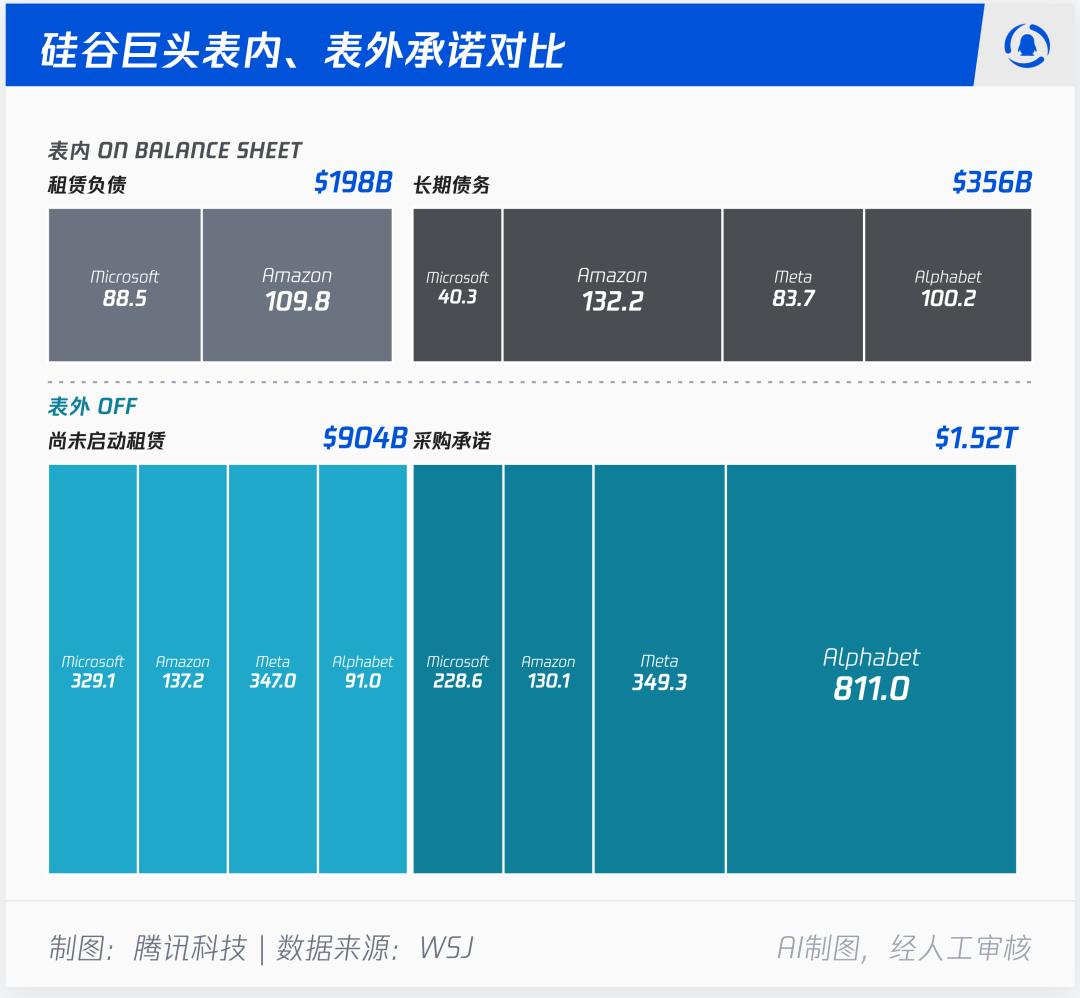
Compared with the capital expenditure of about 600 billion US dollars in the past year, the scale of off-balance-sheet commitments signed by these companies is much larger.
Meta's Hyperion data center is a typical case.
This Louisiana data center covers an area equivalent to 1700 football fields, and is constructed by a joint venture held by a fund managed by Blue Owl Capital. Meta is a minority partner and also the tenant, and its rent provides cash flow for bondholders.
Before starting to pay rent, this part of the obligation will not be fully reflected in Meta's balance sheet. As of June this year, Meta disclosed that the total uncommenced lease obligations reached 347 billion US dollars, including the Hyperion project.
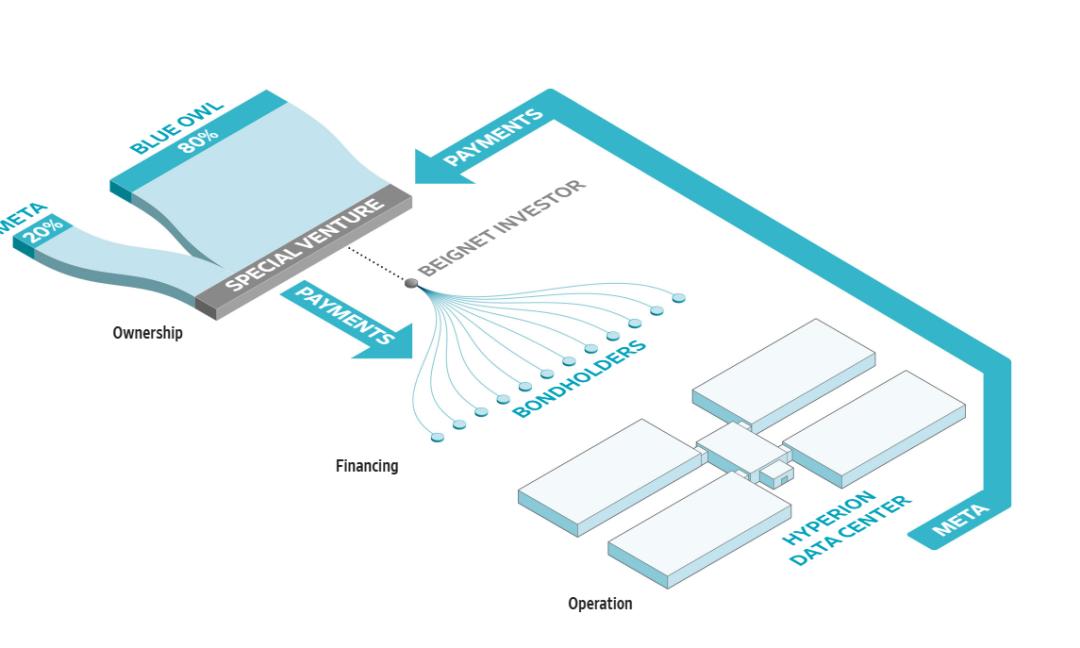
As of June, Meta has leased the Hyperion data center in Louisiana, but the rent has not yet started to be paid, and the relevant lease obligations have not been fully included in the balance sheet
According to statistics, the total uncommenced lease payment commitments of the 9 companies amount to about 1.2 trillion US dollars, about 4 times the amount disclosed a year ago. Purchase commitments and other contractual obligations reach about 1.9 trillion US dollars.
Among them, the change of Alphabet is particularly obvious.
As of June 30, Alphabet's purchase commitments and contractual obligations reached 811 billion US dollars, compared with 332 billion US dollars three months ago. Alphabet explained that these obligations mainly involve "technology infrastructure and inventory", as well as agreements to ensure the energy supply of data centers. Some energy agreements even last until 2054. But Alphabet did not explain in detail why the relevant commitments increased by nearly 480 billion US dollars in just one quarter.
The expanding risks are not only from data center leases and chip procurement. Some companies' commitments also include buying stocks of other companies, or providing guarantees for other tenants' leases. NVIDIA itself has committed to make 27 billion US dollars in equity investments between April 26, 2026 and the end of the 2027 fiscal year.
But another risk lies in the expansion of debt. Some technology companies have begun to frequently enter the capital market for debt financing. In the recently announced performance of Alphabet and Amazon, free cash flow is negative, and capital expenditure has exceeded the cash generated from operating businesses.
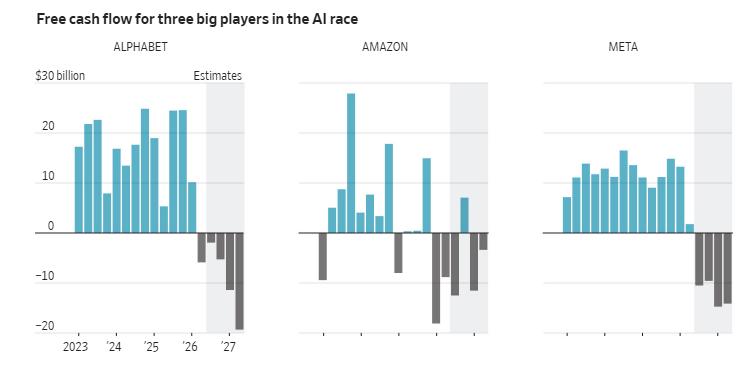
Alphabet, Amazon and Meta's originally healthy cash flow (cyan bars) is expected to turn negative collectively for the rest of 2026 and in 2027 (gray bars)
And these figures do not fully reflect the cash flow pressure that trillions of dollars in off-balance-sheet commitments may bring in the future. What's more troublesome is that many purchase commitments and long-term leases cannot be easily cancelled. That is to say, even if AI demand does not meet expectations in the future, they still have to pay for the signed agreements. In this case, the giants will be forced to cut other expenditures, and may borrow more money to maintain these infrastructures.
Morgan Stanley's accounting analysts reminded in a report in April that as such off-balance-sheet commitments become more frequent, larger in scale and more complex in structure, it will become increasingly difficult for investors to judge a company's real leverage level.
Now, PORTS-Pike is at the forefront of this trend. But who can guarantee that the demand for computing power will always expand aggressively without slowing down?
This article is from the WeChat official account "Tencent Tech", written by Worth Paying Attention To, and published by 36Kr with authorization.