Will Anthropic be the first $10 trillion company in history?
Just this morning, Bloomberg was the first to disclose that Anthropic informed investors that by the end of July this year, the company's annualized revenue run rate had exceeded 650 billion US dollars (equivalent to 4.381 trillion yuan).
Compared with 470 billion US dollars in May this year, Anthropic's annualized revenue has increased by nearly 40% in just over two months; if compared with the level of about 90 billion US dollars at the end of 2025, this figure has soared to more than 7 times the original level within 7 months.
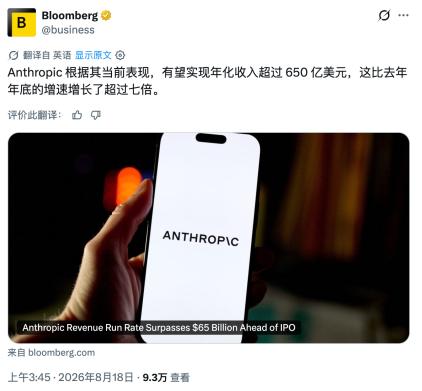
The just-concluded second quarter is equally astounding. According to reports, Anthropic's preliminary revenue in the second quarter has exceeded 115 billion US dollars, with a year-on-year increase of at least 14 times.
This means that Anthropic is no longer the kind of AI startup that achieves high growth based on a low base — it is maintaining the growth rate that usually only belongs to early-stage startups on a revenue scale of tens of billions of US dollars.
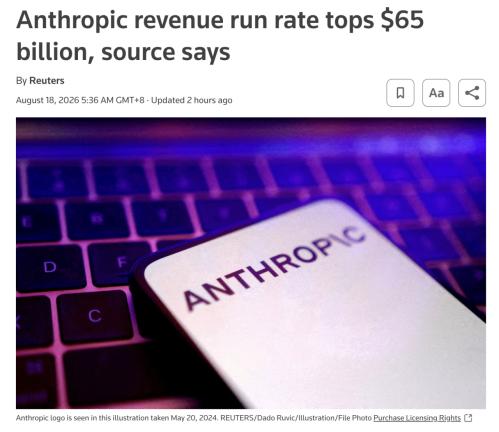
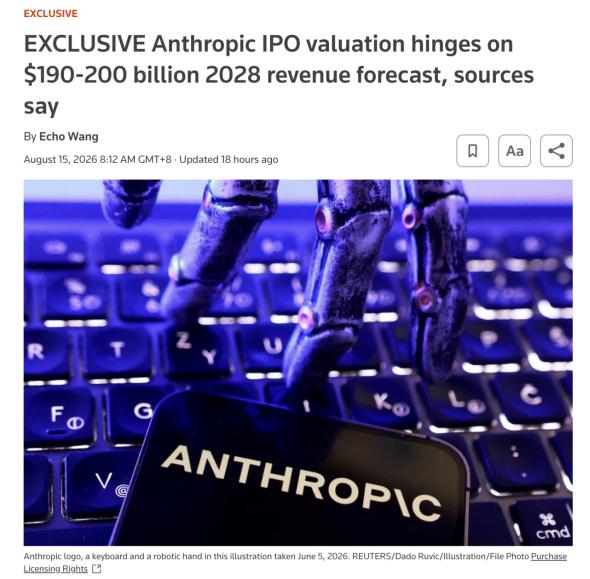
A few days ago, Reuters disclosed that Anthropic set a revenue target of 1.9 trillion to 2 trillion US dollars for 2028.
When preparing for its IPO pricing, Wall Street no longer focuses on current profits, but directly builds valuation models based on revenue two years later. High-valuation companies such as Palantir, Cloudflare and SpaceX have been listed as comparable targets, and the potential IPO valuation discussed in the market has exceeded 2 trillion US dollars; some Anthropic investors even believe that 3 trillion US dollars is not out of reach.
We might as well go one step further according to the logic presented by these numbers.
If Anthropic really achieves 200 billion US dollars in revenue in 2028, and then gives it an extreme but not unprecedented 50x price-to-sales ratio, its market value will reach 10 trillion US dollars.
Will Anthropic become the first $10 trillion company in human history?
01
So far, no company has ever reached a market value of 10 trillion US dollars.
As of last weekend, NVIDIA, the company with the highest market value in the world, was about 5.49 trillion US dollars, and Apple was about 4.50 trillion US dollars. In other words, a $10 trillion company is roughly equivalent to putting today's NVIDIA and Apple into the same shell.
But those numbers that are taken for granted later in business history almost all seem absurd when they first appear.
In August 2018, Apple became the first listed company in the United States with a market value exceeding 1 trillion US dollars. At that time, the "trillion-dollar club" itself was a record enough to be recorded in business history.
By 2022, Apple first touched 3 trillion US dollars.
In July 2025, NVIDIA was the first to break through the 4 trillion US dollar mark; just three months later, it left the 5 trillion US dollar threshold behind.
From 1 trillion to 5 trillion US dollars, it took only seven years in total.
10 trillion US dollars is not an upper limit written in the laws of physics. It is more like the 10-second mark in the 100-meter dash: in 1960, the men's 100-meter world record reached exactly 10 seconds for the first time, and no one broke through it for eight years, until Hines broke it with 9.95 seconds in Mexico City in 1968. By 2011, 78 athletes had officially run under 10 seconds.
A line that was once regarded as the limit of human speed has become one of the thresholds for top sprinters decades later.
The same may be true of corporate market value. In 2018, 1 trillion US dollars was still a historic record; today, 5 trillion US dollars has emerged. Although 10 trillion US dollars seems exaggerated now, it will not be exaggerated forever.
If Anthropic really achieves 200 billion US dollars in revenue in 2028, then 10 trillion US dollars corresponds to a price-to-sales ratio of about 50 times.
This figure is not unprecedented. According to LSEG data, the current valuation of Palantir is about 53 times its expected 2026 revenue, and both SpaceX and Cloudflare are around 41.6 times. That is to say, if Anthropic rushes to 10 trillion US dollars at a 50x revenue valuation, the multiple is roughly between today's Palantir, SpaceX and Cloudflare.
More importantly, these three companies are already being used by bankers and investors as valuation references for Anthropic's IPO.
SpaceX even provided a more extreme case: when SpaceX went public in June this year, its offering valuation reached 1.77 trillion US dollars, while the company's total revenue in 2025 was only 186.7 billion US dollars, corresponding to a price-to-sales ratio of nearly 94 times. After listing, on June 16, SpaceX's stock price hit an intraday high of 225.64 US dollars, and its market value once reached about 2.97 trillion US dollars.
If we still roughly calculate based on 2025 revenue, when SpaceX's intraday market value was close to 3 trillion US dollars, the corresponding price-to-sales ratio was already close to 160 times.
The above cases are sufficient to show that 50 times revenue has not broken the imagination of today's capital market. At least from a numerical point of view, Anthropic's 10 trillion US dollars is not completely unworthy of discussion.
Of course, the limit of a company cannot be supported by valuation multiples after all. What is really worth asking is: what kind of technology can expand the economic boundary of a company several times again?
PCs made software a production tool, the Internet moved global information and business onto the screen, and the mobile Internet put all of this into everyone's pocket. Every platform iteration redefines the ceiling of company size.
At present, it is obvious that AI is the most likely to rewrite this boundary again.
02
To answer where the 10 trillion US dollars comes from, you may need to shift your attention away from Anthropic first.
Thirty years ago, there were two very representative companies in the PC era: one was Intel, and the other was Microsoft.
Around 1999, Intel and Microsoft stood at the core of the PC industrial chain together. Intel sold processors, while Microsoft sold Windows.
According to Intel's 1999 calendar year financial report, the company's revenue reached 29.4 billion US dollars, net profit was 7.3 billion US dollars, and the net profit margin was about 24.8%. Microsoft's revenue for the 1999 fiscal year ending June 30, 1999 was only 19.747 billion US dollars, but it achieved a net profit of 7.785 billion US dollars, with a net profit margin close to 39.4%. That is to say, Microsoft made more profits with about two-thirds of Intel's revenue.
The attitude of the capital market is also obvious: Microsoft's market value record at the peak of the technology bubble in 1999 was about 620.8 billion US dollars; Intel reached its historical high of about 495 billion US dollars in 2000. Comparing their respective peaks, Microsoft is about 25% higher than Intel.
Intel sold more hardware, but Microsoft made more profits with less revenue and also obtained a higher capital market valuation.
The reason is not difficult to understand. Intel is of course one of the most important companies in the PC era, but it is essentially just a shovel seller, providing processors and selling computing power; Microsoft is the real gold digger standing in the PC gold mine, turning computing into productivity that can be sold repeatedly.
A similar stratification is emerging in today's AI industry.
NVIDIA is undoubtedly the most direct winner in this round of AI wave. Before and after the release of ChatGPT, NVIDIA was still a chip company with an annual revenue of less than 30 billion US dollars. In fiscal year 2023, the company's total annual revenue was only 26.97 billion US dollars, of which data center business revenue was about 15 billion US dollars; three years later, in the first quarter of fiscal year 2027 alone, NVIDIA's single-quarter revenue reached 81.6 billion US dollars, equivalent to 3 times the total revenue of fiscal year 2023; among them, data center revenue of 75.2 billion US dollars is 5 times the total data center revenue of fiscal year 2023.
The return given by the capital market is even more exaggerated. In May 2023, NVIDIA first touched a market value of 1 trillion US dollars; in July 2025, it broke through 4 trillion US dollars, and in October it became the first 5 trillion US dollar company in human history. As of now, its market value is about 5.49 trillion US dollars.
Since the release of ChatGPT, NVIDIA's stock price has risen by more than 1200%, and its market value has expanded from about 350 billion US dollars at that time to about 5.49 trillion US dollars today. In less than four years, AI has added more than 5 trillion US dollars in market value to a company that sells computing power infrastructure.
Training models requires GPUs, running models requires GPUs, and OpenAI, Anthropic, Google, and global cloud vendors are all competing for more chips and computing power.
But GPUs are ultimately a kind of infrastructure.
If selling machines that produce intelligence can already create a 5 trillion US dollar company, then the layer that actually converts the computing power provided by these machines into intelligence, software and productivity will theoretically be even more valuable.
And the model layer has a more dangerous and attractive feature than the past software industry: it may be more concentrated than the past software industry.
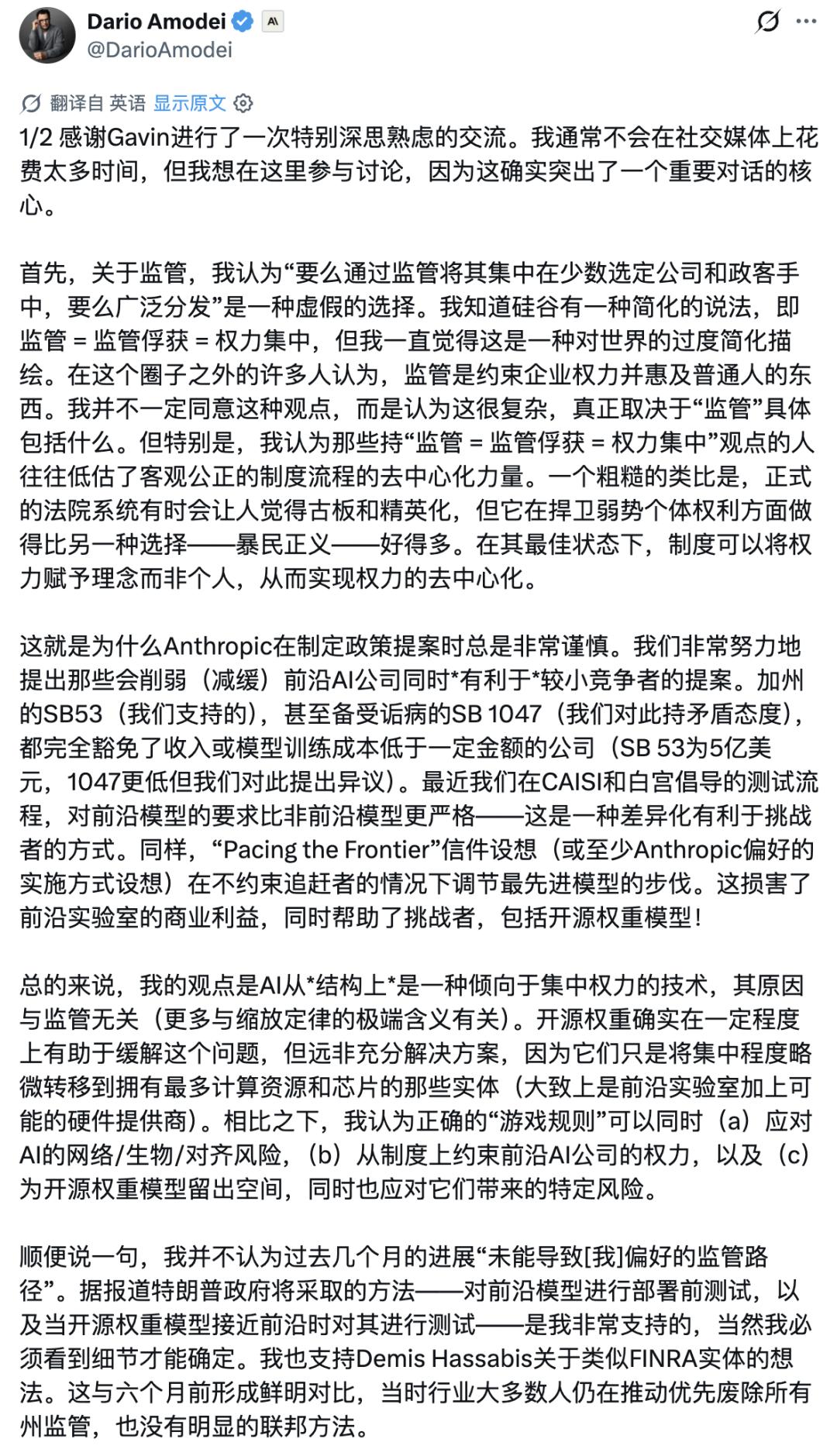
Just a few days ago, Dario Amodei, CEO of Anthropic, who rarely makes long speeches on social media, rarely came forward in person to respond to investor Gavin Baker's doubts about Anthropic's regulatory position.
Baker previously revealed on the All-In Podcast that he heard from multiple credible sources that Amodei once expressed an extremely exaggerated judgment internally: Anthropic may one day become "the only remaining private company in the world".
Amodei himself did not directly confirm or deny this statement in his long article, but he explicitly acknowledged a premise that is quite close to this statement.
Amodei believes that AI is structurally a technology that tends to centralize power.
Moreover, in his view, this concentration is not even caused by regulation, but by the law of scale itself: the more cutting-edge models require larger chips and computing power, and fewer and fewer companies can afford these costs. Even opening up models can only partially alleviate this, because power will eventually concentrate on those who have the most computing power and chips.
If the most important product of AI is intelligence, and the most advanced intelligence is continuously concentrated in a few companies due to computing power, capital and scale effects, then the largest company in the AI era will theoretically be larger than the giants in the PC and Internet eras.
Microsoft used Windows to control how computers are used back then; today, OpenAI and Anthropic are competing for the intelligence layer of more and more software, code, scientific research and even knowledge work.
NVIDIA has proved that AI can push the shovel seller to 5 trillion US dollars; what Amodei is really betting on is that the gold mine will eventually be concentrated in a few gold diggers — and Amodei seems to truly believe that "Anthropic will be one of the final winners", and even possibly "the only winner".
03
Interestingly, the capital market has begun to allocate funds around a clear premise: leading model companies such as OpenAI and Anthropic will continue to expand, requiring more GPUs, more data centers, and purchasing more computing power in the future.
This year, Alphabet, Amazon, Meta, Microsoft and Oracle's total spending on data centers is expected to reach about 750 billion US dollars. By the beginning of August, Microsoft, Meta, Oracle, Amazon and Alphabet have signed about 1.09 trillion US dollars of future lease payment commitments that have not yet been executed, a large part of which is related to AI data centers. Many data centers have not even been powered on, and rent obligations for the next ten years or even longer have been signed in advance.
The reason why these funds are dared to be invested in advance is based on a simple assumption: someone will definitely need these computing power in the future.
At the forefront of demand are exactly the cutting-edge model companies like OpenAI and Anthropic.
The relationship between Anthropic and Amazon is a very typical example. In April this year, Amazon announced that it would further invest up to 250 billion US dollars in Anthropic; at the same time, Anthropic promised to spend more than 1 trillion US dollars on AWS in the next ten years to obtain up to about 5GW of AI computing power. While Amazon invests in Anthropic, it builds more AI infrastructure, and Anthropic's future growth will become AWS's future cloud revenue.
Money flows from Amazon into Anthropic and then flows back to AWS in the form of computing power expenditure. What really supports this cycle is that both sides believe that Claude will need far more computing power in the future than today.
Further upstream, even the "money for buying computing power" itself has begun to be financialized.
On August 10, NVIDIA announced the establishment of an AI computing power infrastructure financing platform in cooperation with Apollo, BlackRock, Blackstone, Brookfield, Goldman Sachs and KKR, hoping to gradually leverage more than 500 billion US dollars in third-party capital. The funds will eventually flow into AI data centers, cloud vendors and AI laboratories to help them purchase more GPUs and build more computing infrastructure. NVIDIA may even provide support for up to 25% of the financing depending on the project situation.
Even just yesterday, NVIDIA agreed to provide up to 105 billion US dollars in guarantees for a large OpenAI data center located in Ohio. The project is ultimately planned to reach 8GW, and OpenAI will sign a 20-year lease.
This forms a very special capital cycle:
The market believes that OpenAI and Anthropic will become larger and larger, so it is willing to build more data centers and buy more GPUs; data centers and GPUs can obtain more financing, because investors believe that there will be a larger OpenAI and Anthropic in the future to absorb these computing power.
Precisely because of this, the more important OpenAI and Anthropic are, the more they become the most critical part of the entire AI capital cycle that cannot go wrong.
Steve Eisman, the investor who is the prototype of "The Big Short", recently called OpenAI and Anthropic the possible "Achilles' heel" of the