AI eliminates middle management first: an organizational purge that entrepreneurs dare not admit to
"Who Will AI Replace?"
This question has been discussed for more than two years, and the initial answer was highly unanimous: AI will replace junior frontline employees. Almost every business owner's first thought when they first encountered AI was "I can cut my customer service team by half" and "I don't need to outsource copywriting work anymore." Standardized work could already be partially replaced in the digital age, and now it can almost be directly taken over by AI. These thoughts are so natural that no one thinks they need to be demonstrated.
But what is actually happening is the exact opposite of the intuition of business owners.
Amazon is cutting management layers, Meta has expanded its management span directly to 1:50, Google has transferred a group of managers to individual contributor roles, and JD has eliminated the C4 and C5 management tiers. A more extreme case is that of Supcon Technology, where the board of directors adjusted 6 senior executives within one day — 2 senior vice presidents and 4 vice presidents, all of whom were removed from their senior management positions. The reason stated in the official announcement is clearly written: "Accelerate the transformation to an AI-native organization." A traditional industrial control enterprise that has been operating for 30 years announced by laying off half of its senior management team that the old organization, at least in terms of structure, is no longer compatible with the AI era.
The Economist's cover article "The Jobs Apocalypse" published on May 16, 2026, tore off this fig leaf: the most drastic impact of AI on the job market does not fall on blue-collar workers, but on middle managers.
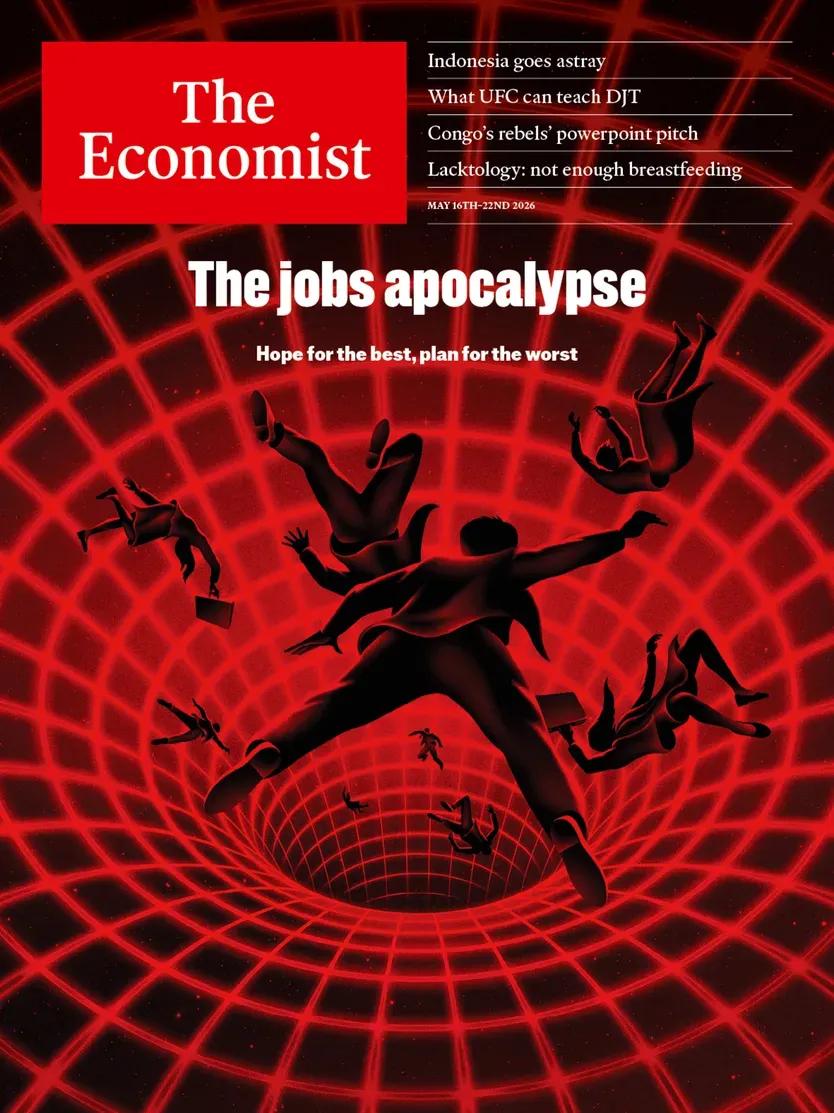
The harsh truth that business owners dare not admit is that this is not a cyclical layoff, but a structural reckoning. The first group of targets of this reckoning are the people who have been most favored by "modern management", "MBA" and "business schools" in the past two decades.
01 The Moat of Middle Managers Is the "Information Gap"
Let's break down the work of a typical middle manager, and it basically falls into four categories:
The first is to transmit information upwards and downwards, that is, reporting to superiors and conveying instructions to subordinates.
The second is cross-departmental coordination, either one-on-one communication with peers (building personal connections) or holding meetings to align progress.
The third is to assign tasks within the department and track progress.
The fourth is to conduct performance evaluations based on the task completion status of department members.
These four tasks have one thing in common — the core is all about processing information. And large language models are exactly the magic tool for information processing.
Middle managers have a vivid title in the English context, called MOM, Manager of Managers. This term itself explains the problem: these people do not manage business, they manage managers; what they contribute is very likely not the result of value, but the execution process itself.
I have always held an unpopular judgment: The power of middle managers never comes from their abilities, but from their positions — they happen to stand on the only path that information must pass through.
This is like a toll station on a highway. The value of the toll station does not lie in the fact that it built the road, but in the fact that it is stuck on the road. When ETC appears, the fate of the toll station is already doomed, which has nothing to do with whether the toll collector works hard or has a good attitude.
Some people will refute: Truly competent middle managers can give professional judgments in the process of information transmission and add value. What I focus on is that even if they do not do such valuable things, they can still stay in the enterprise as a pretender who holds a post without doing any real work. It is very easy for them to muddle along in the organization by using empty corporate jargon, suppressing subordinates, and focusing on trivial details such as "the chamfer of the app button".
Others will refute: Middle managers work very hard. They have morning meetings in the morning and write weekly reports at night, and they get blamed from both sides. This is a fact. But can "middle managers work very hard" deduce that "middle managers are very valuable"? The answer is no. Hard work is a cost, not value. This sentence is common sense in management, but it is the hardest sentence to accept in the workplace. The problem is that even the most bureaucratic enterprises will admit that "we cheer for the process and pay for the result". Are these unacceptable words not the truth?
The data from Musheng Consulting has long given a warning: the flatness index of a considerable number of enterprises is below the threshold, and they have set unnecessary middle manager positions, which have become organizational redundancy. In fact, in the cases we studied, setting too many levels in functional departments is also a common problem for enterprises. Many middle managers do not need to exist at all.
The problem is that many middle managers keep complaining that they are "too tired". What is going on here?
No one will smash their own rice bowl, so they either package trivial things as valuable work, or show their leadership authority to torture the people who actually do the work below, or "obsess over processes hysterically" to reflect their value to the company. In more extreme cases, different departments even toss each other and compete with each other to create a busy scene, and tacitly create employment opportunities for each other. All these tosses eventually turn into various unnecessary costs and expenses for the enterprise.
The phrase "too tired" from the mouths of a considerable number of middle managers may be their last self-protection. But the problem is, AI does not engage in empty formalities, and it never says "I'm too busy".
02 The First Reaction of Business Owners Is Completely Wrong!
Back to the initial intuition: cut the junior employees first.
What is wrong with this intuition? There are at least three flaws.
First, junior employees are responsible for the "last mile" work, which is exactly the kind of hands-on work that AI finds hardest to replace.
On-site maintenance technicians, salespeople who eat and drink with clients, and team leaders on the production line who deal with abnormal situations, their work contains a large number of unstructured parts that require physical presence and on-the-spot judgment. You can let AI write a perfect customer visit plan, but AI cannot decide to hold back the words the second the customer frowns.
Second, middle managers are the biggest resistance to change. Without adjusting middle managers, AI cannot be implemented successfully.
Middle managers regard the departments under their control as their own territory. If you want AI to take over information aggregation, progress tracking, and initial performance evaluation, it is equivalent to taking the scepter out of their hands. They will have ten thousand reasons to resist — data is not safe, the business is too special, employees are not adapted, and a certain company tried it last time and failed. Many middle managers, when giving these reasons for opposition, will even play the role of loyal advisors with sincere feelings, exaggerating their reasons as if everyone else is confused and only they are the ones who really care about the company.
In fact, the history of "smashing the Jenny loom in anger" is repeating itself in every enterprise that promotes AI. The only difference is that today's way of resistance is more civilized, which is called "postpone the promotion", "implement step by step" and "act after careful planning".
Third, this is the most realistic point: the cost structure has changed, and real enterprises cannot resist this trend.
In the past, the targets of enterprise optimization were "cheap and replaceable" people, because those people were easy to replace. But the most striking change in 2026 is: the people being optimized have become "expensive and replaceable". In a large enterprise, the annual cost of a middle manager may be 800,000 RMB. If you replace him with AI plus a junior employee, the annual cost is 300,000 RMB, and the effect is almost the same — any CFO or CEO can figure out this account.
Enterprises spend a lot of time negotiating with dozens of junior employees, bear huge termination costs, and only save a small amount of money in the end. It is better to cut a few middle managers decisively and save a large sum of money.
Guess what? Before being laid off, middle managers not only need to earn their own salaries, but also ask the enterprise for various resources, frequently increase the headcount, and the budget is like a broken faucet that keeps rising every year. Since enterprises do not pay attention to efficiency (human efficiency, capital efficiency), a large amount of expenditure cannot bring reasonable results. After cutting middle managers, the business owners are no longer disturbed by trivial complaints, the enterprise budget is under control, the business does not decline at all, and the efficiency is even higher. Thinking of their previous inaction, business owners almost pinch their own thighs blue with regret.
Faced with the huge temptation of this cost saving, business owners can of course turn a blind eye to it. After all, having a huge team of middle managers can bring them the pleasant feeling of being surrounded by followers in the Liangshan Heroes' gathering hall. But the problem is, when your competitors start to save costs by eliminating ineffective middle managers, can your enterprise really remain indifferent? As long as someone fires the first shot, this reckoning movement has already begun, and no enterprise can avoid it.
Let me tell you a striking case: Oracle cut its DBA team from 47 people to 3, and all the remaining people are core architects, none of whom are pure management positions. The operation of the team is still as smooth as before. This case clearly shows that AI can not only replace "execution", but also replace "supervision of execution".
Facts have proved that the attention of business owners to AI replacing junior employees is completely wrong.
03 Cutting Middle Managers to Get a "Flatter Pyramid"?
Having said that, if you think I am cheering for this reckoning, you are misunderstanding me.
What I am really worried about is two points:
First, the vast majority of enterprises will regard "cutting middle managers" as "organizational change", and then stop there with a clear conscience.
Imagine this scenario: you compress the management level from seven levels to four, the reporting line is straightened, meetings are reduced, and report processing is faster. But what about the incentive mechanism? It is still the old set of "post salary + performance salary + bonus". The salary is still decided by the leader, the budget is still approved by the superior, and promotion still depends on personal impression.
What will the result be? The optimal strategy for employees is still to "please the leader", except that the leader they need to please is now closer, and employees have no space to hide at all. In this case, the power of the remaining middle managers becomes more concentrated, their bureaucratic style may double, and their information routing ability remains unchanged. At this time, if they still stay at the information "toll station", the efficiency of the enterprise cannot be improved.
Such enterprises do not flatten the pyramid, they just press the pyramid into a harder brick.
Second, after cutting middle managers, the enterprise's talent echelon is completely broken, and it can no longer cultivate elites who can collaborate with AI.
In traditional organizations, junior employees learn to make judgments by observing middle managers up close, which is an effective empowerment of middle managers. It would be even better if middle managers can take on the role of mentorship. But in the AI era, technical tasks are compressed, and agents can produce the output that used to take several hours in 30 minutes. The judgment that middle managers are proud of has not yet been fully developed, and their subordinates have no time to learn it, this function has already been taken over by AI.
In the past, what we worried about was "talent gap", but now the problem is much more serious, that is, "judgment discontinuity". If an organization only has top decision-makers and bottom operators, and the entire apprenticeship period of "watching others make decisions" is completely deleted, where will the enterprise's senior executives come from ten years later? Will they be generated by AI?
If we confirm that AI must be controlled by elites, where will these elites come from in the future? If there are no elites to control AI, will the future organization get out of control and become mediocre?
It is said that after a large internet company extensively uses AI, another kind of bureaucracy has emerged within it: all departments use AI to generate plans, throw these plans at each other in meetings, and even use AI-generated plans and opinions to quarrel. Since everyone uses "nuclear weapons" in this way, no one can gain an advantage, the enterprise becomes chaotic, and the efficiency is even lower than before. At this point, human employees have become puppets, and the enterprise pays expensive token fees for endless internal friction. Think about how terrible this is.
So my attitude is: What should be reckoned with for middle managers is their "function", not the people themselves; what should be deleted is the post attribute of "information routing", not those tens of thousands of specific people.
04 Two Ways Out and One Dead End for Middle Managers
If we confirm that all enterprises will transform into agent organizations, then we need to examine the mechanism of middle managers under this organizational model. The core of the agent organization is still a platform-based organization. In the three-architecture of the platform-based organization, the middle and back office supply capabilities to the front office through standardized interfaces, and the front office splits into small business units.
In this organizational model, where should middle managers go? When we carry out organizational change projects, the answers we give are usually two paths.
The first path is to move forward and become an operator.
These business units are composed of BPs dispatched by the middle and back office and front-line backbones. They invest together, take responsibility for performance, and share profits through performance betting. To put it bluntly, these business units are small companies, they obtain enterprise resources, and then directly convert resources into operating results.
The original front-line department manager can completely become the "small boss of a startup" of this kind of business unit. He no longer relies on occupying a territory to show his existence, but relies on the profits earned from customers to prove his value.
The second path is to move backward and become an expert.
Middle managers with professional expertise, such as those who truly understand supply chain, actuarial science, and process technology, cannot be replaced in the short term. But their work focus must change — they no longer directly manage people, but train models in their professional fields, design human-machine collaboration processes, and define the quality standards of AI output. They are more like experts, not full-time managers.
The department managers of the middle and back office will become "small supplier bosses" who serve the business units. They no longer rely on administrative approval and torturing the front office to show their existence, but obtain operating dividends by empowering the front office, which actually makes them operators as well.
As for the third path, it must be a dead end — continuing to only transmit information upwards and downwards.
We believe that a considerable number of middle managers will not actively face the above challenges, and will still stay in their comfort zones. They are not unable to see the gray rhino of AI, but they are betting that business owners will still consider personal relationships. There is no shortage of old antiques who clearly know that the flood is coming but still stick to their homes, in fact, there are too many of them. But the problem is, they don't want to change, but the business owners don't think so. When it comes to the survival of the enterprise and the interests of the business owners, all top leaders will eventually become cold decision-makers.
If the cold decision is really made, and the enterprise really decides to move towards the agent organization, there must be a standard to judge whether this transformation is successful. Here, I want to give all the business owners who are promoting AI transformation a very simple test method — no need to look at PPT, no need to listen to reports, just ask one question:
Is there anyone in your company who has actually received more money because they completed a task with AI?
If the answer is no, then all the "AI strategy", "agent planning" and "three-year blueprint for digital transformation" are just a beautifully made document. Because the greatest value of AI is never saving a few people, but that for the first time the rules can be hardened, automatically executed, and settled at millisecond level — the internal marketization that we have been shouting for ten years but cannot achieve suddenly has a feasible tool. If you don't use this chip, but only use it to lay off employees, it is really a waste of great value.
Conversely, if this change really happens, the remaining middle managers will truly complete the two personal transformation paths mentioned above. This is their luck, and also the luck of the enterprise. Their transformation may be the result of their self-innovation