Countdown for the Mega Project: The Once Underperforming "Major Coastal Province" Is Poised for a Full Turnaround
Located in southwest China, the long-awaited megaproject is finally coming to fruition.
Recently, the top Party and government leader of Guangxi conducted an inspection in Qinzhou and chaired a promotion meeting in Nanning for the 30-day countdown to the opening of the Pinglu Canal, demanding to ensure that the century-old canal with a total length of 134.2 kilometers and a total investment of 72.7 billion yuan is completed, opened to navigation and operated at a high level on schedule with safety and high quality. This means that this historic canal is about to embrace its landmark moment.
As the only western provincial region in China that has access to the sea, Guangxi boasts a coastline of approximately 1,628 kilometers. However, due to its unique geographical conditions and altitude drop, most of the rivers within its territory cannot flow southward to the sea nearby. The historical fate of "being adjacent to the sea but having no access to it, connecting to rivers but failing to reach the ocean" once put Guangxi's "coastal" identity in an awkward position.
This separation of rivers and sea also led to the independent development of Guangxi's two major economic plates, the Xijiang Economic Belt and the Beibu Gulf Economic Zone, for many years in the past, with a lack of coordination. But now, the Pinglu Canal will connect the river-side and coastal sectors, supporting the regional economic framework of Guangxi to evolve into an I-shaped structure.
Shortly before this promotion meeting, the "15th Five-Year Plan for the Development of Guangxi's Marine Economy" was issued, which proposed to coordinate land and sea resources, focus on building the core economic zone of the Beibu Gulf, accelerate the construction of the Pinglu Canal Economic Belt, and actively develop a number of key parks that gather marine-related industries, leading the entire region to pursue sea-oriented development.
In the first half of this year, Guangxi's GDP reached 1450.636 billion yuan, a year-on-year increase of 3.5%. This growth rate has slowed down significantly compared with last year, and is 1.2 percentage points lower than the national average growth rate, highlighting a strong sense of urgency.
Can this framework reshaping driven by the Pinglu Canal become the key to unlocking the transformation of economic momentum?
Reshaping the Framework
Guangxi has nurtured its dream of integrating coastal and river-side development for decades.
As early as the end of 2009, the State Council issued the "Several Opinions on Further Promoting the Economic and Social Development of Guangxi", promoting the leading development of coastal and river-side areas, and the pattern of "two zones and one belt" covering the Beibu Gulf Economic Zone, the Xijiang Economic Belt, and Western Guangxi region was initially established. Later, these regions were incorporated into national strategies under the names of the Pearl River-Xijiang Economic Belt and the Beibu Gulf Urban Agglomeration respectively, forming two-way driving forces for eastward and southward development.
Statistics show that in 2025, the combined GDP of the seven cities in the Xijiang Economic Belt (Nanning, Liuzhou, Wuzhou, Guigang, Baise, Laibin, Chongzuo) reached 1.72 trillion yuan, accounting for 57.75% of the total GDP of Guangxi. The combined GDP of the six cities in the Beibu Gulf Economic Zone (Nanning, Beihai, Qinzhou, Fangchenggang, Yulin, Chongzuo) reached 1.51 trillion yuan, accounting for 50.77% of the regional total.
This almost forms the foundation of Guangxi's economic development. However, in recent years, the growth divergence between the Xijiang Economic Belt and the Beibu Gulf Economic Zone has become increasingly obvious —
In the past five years, the proportion of the GDP of cities in the Xijiang Economic Belt in the regional total dropped by 1.76 percentage points, while the proportion of cities in the Beibu Gulf Economic Zone rose by 2.5 percentage points. In terms of absolute growth, Guangxi's GDP increased by 757.076 billion yuan in five years, with the two major plates accounting for 52.59% and 58.08% respectively. Cities in the Beibu Gulf Economic Zone have become a more important growth engine.
The rise and fall reflect the insufficient coordination between land and marine industries. In the past few years, coastal cities such as Fangchenggang and Qinzhou have become the main growth drivers relying on their port advantages, while traditional manufacturing hubs like Liuzhou and Baise have encountered crises in industrial transformation, failing to fully translate their sea-oriented advantages into actual development momentum.
Not long ago, Guangxi issued a document to promote the high-quality development of the sea-oriented economy, which also pointed out prominent problems in the past such as the separation of land and sea, uncoordinated development of river and coastal areas, and unclear paths for sea-oriented development.
The north-south Pinglu Canal is becoming the turning point.
It is reported that after the completion of the Pinglu Canal project, it will connect the main stream of the Xijiang River with the Beibu Gulf, shortening the sea voyage for the middle and upper reaches of the Xijiang River by about 560 kilometers. Goods from the upstream areas no longer need to go to sea via the Pearl River and the Yangtze River, and can directly reach the sea from the Beibu Gulf. For enterprises along the route, the freight cost can be saved by about 18% to 40%.
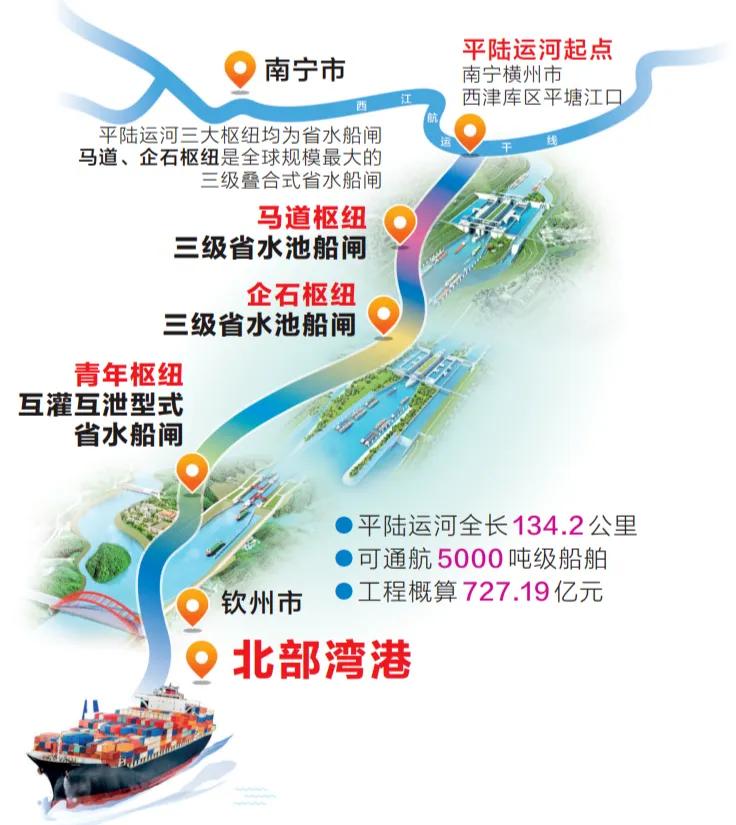
Image source: Guangxi Daily
Looking ahead to the next five years, driven by the Pinglu Canal, Guangxi will attract water-adapted industries such as raw material processing to cluster along rivers and waterways, promote the formation of the I-shaped economic belt of "Pear River-Xijiang Economic Belt - Pinglu Canal Economic Belt - Coastal Economic Belt", and activate new momentum for regional development.
This is also the solid foundation supporting Guangxi to reshape its regional economic framework.
Industrial Division
In 2025, the total marine economic output of China exceeded 11 trillion yuan for the first time, accounting for 7.9% of the country's gross domestic product.
At the same time, Guangxi's gross marine product increased from 137.7 billion yuan in 2017 to 268.78 billion yuan in 2025, with its proportion in the regional total rising from 7.7% to 9%.
Behind these two sets of data, the marine economy is evolving from a "supporting role" in the national economy to a "growth pole", and Guangxi is obviously on a development track with stronger momentum.
This is the core anchor for Guangxi to strengthen its sea-oriented development, which refers to building the core economic zone of the Beibu Gulf, accelerating the construction of the Pinglu Canal Economic Belt, and actively developing a number of key parks that gather marine-related industries, leading the entire region to pursue sea-oriented development.
In the core economic zone of the Beibu Gulf, Beihai will build a modern marine city and an international, modern coastal famous city; Qinzhou will build a strategic hub of the New International Land-Sea Trade Corridor in the western region and a modern coastal canal city; Fangchenggang will build a modern port-side industrial city and an international hub port facing ASEAN; Yulin will build a pilot demonstration zone for the integrated industrial development of the "Two Bays" and an emerging port-side industrial city.
This is a repositioning of Beibu Gulf cities, as well as a distinct Guangxi coordinate on the map of the marine economy.
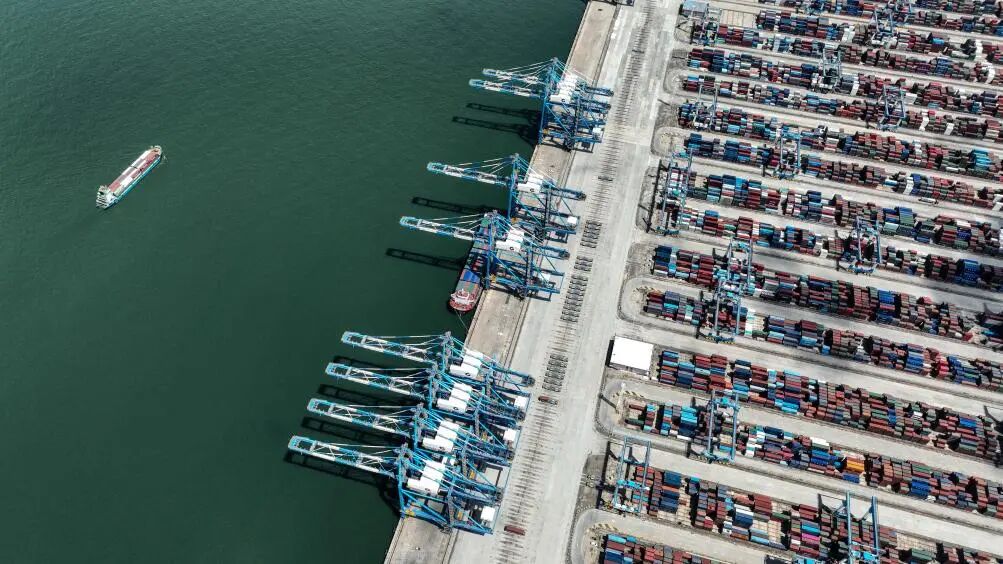
Image source: Xinhua News Agency
In the first 5 months of this year, 103 new projects with a total investment of over 50 million yuan were signed in 10 pilot areas of Nanning's Pinglu Canal Economic Belt, with a total investment of 41.93 billion yuan, covering industries including new energy and batteries, high-end equipment manufacturing, and artificial intelligence.
In the first half of the year, leveraging its "port in front, factory behind" advantages, Qinzhou saw 21 projects in the industrial chains of green chemical industry, new energy, new materials, modern light industry and equipment manufacturing start construction or be completed, and 56 new projects were signed and introduced.
As the only gateway city in China connected to ASEAN countries via land, sea and river, Fangchenggang is fully committed to building a "3+4+N" modern port-side industrial system, with the output value of the non-ferrous metal industry increasing by 55.3% year on year.
These are vivid epitomes of Guangxi's efforts to strengthen its sea-oriented development.
Furthermore, relying on the core economic zone of the Beibu Gulf, Guangxi will take 33 counties (cities, districts) along the coastal areas, the Pinglu Canal, the Xijiang shipping trunk line and the Zuojiang and Youjiang river valleys as pilot areas, promote a "vein-shaped" layout of sea-oriented industries, and support the ten modern pillar manufacturing industries to develop towards the sea.
From this perspective, the Pinglu Canal is not only a physical channel connecting the Xijiang River and the Beibu Gulf, but also an economic artery that promotes the gathering and flow of production factors. The close connection between rivers and the sea will release greater development potential.
New Development Landscape
Not long ago, the half-year economic reports of 31 provincial-level regions were released one after another, showing obvious characteristics of K-shaped differentiation. The research report of China Galaxy Securities pointed out that the regional economic growth pattern has changed from the past "slow in the east, fast in the west" to "fast in the east, slow in the west", and the leading advantage of the eastern region over the central and western regions has further expanded, strengthening the K-shaped trend of regional economy.
Guangxi is a prominent example. Statistics show that the growth rates of Guangxi's industrial added value above designated size, fixed asset investment, total retail sales of consumer goods and exports are 4.8%, -25%, -0.1% and 2.7% respectively, all ranking beyond the 20th place. This reflects the structural dilemma behind the slowdown of Guangxi's economic growth.
Behind this differentiation lies the divergence in the speed of industrial momentum transformation. When the "three troikas" of investment, consumption and exports all face sluggish performance, Guangxi's old path of "inland hinterland + undertaking industrial transfer" is no longer sustainable, and it must be equipped with a brand-new engine.
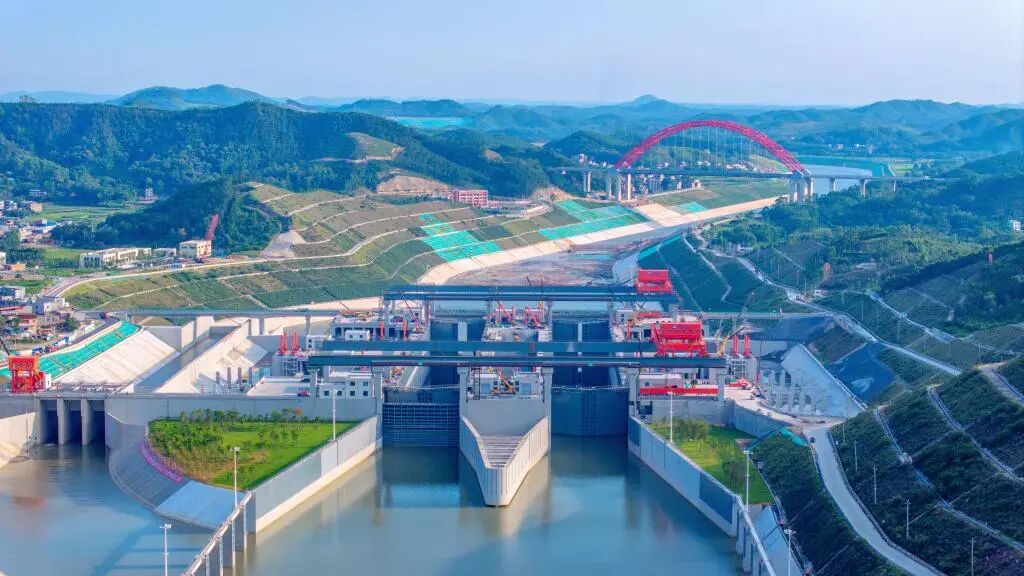
Image source: Xinhua News Agency
Obviously, the marine economy has become a key area for development.
According to Guangxi's plan, by 2030, the proportion of gross marine product in regional GDP will reach 10%, and the cargo throughput of Beibu Gulf Port will reach 700 million tons, up by 0.96 percentage points and 214 million tons respectively compared with 2025. At the same time, the average annual growth rate of total import and export trade with ASEAN countries will reach 10%, 2 percentage points higher than that in 2025.
This is a systematic sea-oriented upgrade, which supports Guangxi's ambition to build itself into a strong marine region and a highland for sea-oriented economic cooperation facing ASEAN.
But to be frank, "strengthening development towards the sea" is a medium and long-term strategy, and there are still many challenges to ease short-term economic pains. The survey of "the rise of seven inland cities towards the sea" published by Guangxi Daily points out that the sea-oriented economy is still in the primary stage of development, facing constraints such as generally low industrial level, insufficient release of combined transportation efficiency, and insufficient depth of opening-up and cooperation. For example, the seven inland cities generally have problems such as missing key links in the industrial chain and lagging transformation and application of international economic and trade rules.
At present, Guangxi is making every effort to foster and expand emerging marine industries, supporting cities including Nanning, Beihai, Qinzhou, Fangchenggang, Liuzhou, Wuzhou and Guigang to develop water and sea-adapted industries such as shipbuilding and marine engineering equipment manufacturing, but the transformation between old and new momentum cannot be completed in the short term.
In the view of Wang Guowen, Vice President of China Logistics Association and Director of the Logistics and Supply Chain Management Institute of the China Development Institute (Shenzhen), the core challenge lies in the "creation of new cargo sources from scratch" and "stock transfer of existing cargo sources".
The industrial foundation of the western hinterland of Guangxi is relatively weak, and the local water-adapted cargo volume may not be enough to support the transport volume in the short term. The traditional Xijiang transport channel in the Pearl River Delta has formed a stable interest pattern and low-cost inertia. To attract the backflow of ocean route cargo sources of Beibu Gulf Port, the Pinglu Canal must have absolute advantages in comprehensive logistics costs.
Solving these problems is almost the prerequisite for the Pinglu Canal to truly play its role. Only when the Pinglu Canal has significant scale advantages can it drive the growth of Guangxi's hub economy, attract more and more water and port-adapted factors to gather in the Beibu Gulf, and then spread and transmit to the entire region through the Pinglu Canal Economic Belt.
And this is exactly the "breakthrough battle towards the sea" that Guangxi must win under the K-shaped differentiation pattern.
This article is from the WeChat Official Account "City Evolution Theory", written by Dan Zhongkui, published with authorization from 36Kr.