Will the title of Shandong's most populous city change hands?
All local economic data for the first half of this year have been released, and the performance of some cities in Shandong has revealed many noteworthy new trends.
In the first half of this year, Qingdao's GDP reached 913.818 billion yuan, up 5.5% year on year, narrowly overtaking Tianjin to temporarily rank as the "second largest city in northern China"; Jinan's GDP hit 706.531 billion yuan, growing 5.5% year on year. In addition, Yantai, Weifang, Linyi and Jining also ranked among the top 50 cities in China by GDP, with their growth rates in the first half of the year reaching 5.8%, 5.8%, 5.6% and 5.9% respectively.
Apart from economic scale, population change is also a key indicator for observing a city's long-term development and attractiveness.
At present, the three most populous cities in Shandong are still Linyi, Qingdao and Jinan, and the pattern of the top three has not changed for the time being. However, judging from the changing trends in recent years, the population trends of the three cities have shown different changes, and the future ranking is full of suspense.
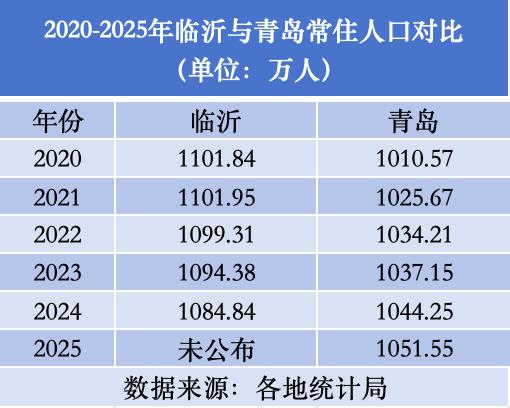
From 2020 to 2025, the permanent resident population of Qingdao increased by 409,800 to 10.5155 million; while Linyi's permanent resident population dropped from 11.0195 million in 2021 to 10.8484 million in 2024, a decrease of 171,100 over four years. Although Linyi's 2025 population data has not yet been released, the gap between Qingdao and Linyi in terms of population has narrowed significantly amid this one-increase and one-decrease trend.
At the same time, the population size of Jinan continues to expand. In 2025, the permanent resident population of Jinan reached 9.616 million, an increase of 101,000 over the previous year, with a prominent population agglomeration effect.
Although the ranking of Shandong's top three populous cities has not changed temporarily, the trends of population increase and decrease of the three cities have shown obvious differences. In the next few years, it is worth paying attention to whether Qingdao can further narrow the population gap with Linyi and whether Jinan can maintain its population growth.
Qingdao is Catching Up Fast, Linyi's Advantages Are Narrowing
For a long time, Linyi has been firmly ranked first in Shandong in terms of permanent resident population. At the 7th National Population Census in 2020, Linyi's permanent resident population reached 11.0184 million, an increase of nearly 980,000 compared with 2010, accounting for 10.85% of the total population of the province.
Linyi's large population size is related to its vast municipal area and huge county-level population base.
Linyi has a total area of 17,191.2 square kilometers, accounting for about one-tenth of the total land area of Shandong, making it the prefecture-level city with the largest area in the province. The 7th Census data shows that among the 13 counties and districts in Linyi, 2 have a population of more than 1 million, and 9 have a population between 500,000 and 1 million.
At the same time, Linyi's total economic output has ranked among the top in Shandong for many years, and it is also an important national logistics turnover center and commercial wholesale center. The development of industries such as commercial logistics has also provided a large number of jobs, attracting people to work and live locally.
However, after Linyi's permanent resident population peaked at 11.0195 million in 2021, it began to show a downward trend. It dropped to 10.9931 million in 2022, 10.9438 million in 2023, and further to 10.8484 million in 2024. Over the four years, the permanent resident population decreased by 171,100.
Behind this, there are both changes in natural population growth and population mobility factors.
Shandong's natural population growth rate dropped to -1.67‰ in 2024 and further to -3.05‰ in 2025, and the province's population has entered a negative growth stage. Although Linyi has not released relevant data, it is also facing a similar general population trend. In addition, Linyi has a high proportion of traditional industries, with relatively insufficient high-level and high-paying jobs, which may also lead to the outflow of some young population.
In contrast, the permanent resident population of Qingdao continues to maintain growth.
From 2020 to 2025, the permanent resident population of Qingdao increased from 10.1057 million to 10.5155 million, an increase of about 410,000 in five years. Among them, the population increased by 71,000 in 2024 and 73,000 in 2025, maintaining rapid growth for two consecutive years.
The sustained population growth of Qingdao is backed by the support of its economy and industries.
In 2025, Qingdao's GDP reached 1.76 trillion yuan, and the added value of industries above designated size increased by 7.9%. Industries such as automobile manufacturing, chemical industry, shipbuilding and aerospace have grown rapidly, and the added value of the equipment manufacturing industry increased by 11.8%. At the same time, the added value of the service industry accounted for 63.6% of GDP, and the modern service industry also maintained rapid growth.
What industrial development brings is not only economic increment, but also continuous expansion of jobs. In 2025, Qingdao added 373,000 new urban jobs, of which the private economy absorbed 315,000, accounting for 84.4%.
The population gap between Linyi and Qingdao is narrowing. If this trend continues, the most populous city in Shandong may change hands in the next few years.
Jinan is Sprinting for a Population of 10 Million
Similar to Qingdao, Jinan has maintained rapid population growth in recent years.
In 2025, the permanent resident population of Jinan reached 9.616 million, an increase of 101,000 over the previous year, hitting a new high of population increment in the past five years. With an additional 78,000 people added in 2024, Jinan has been the city with the largest population increment in Shandong for two consecutive years.
Against the background of the overall population change in Shandong, Jinan's population growth in the past two years is even more prominent.
In 2025, the permanent resident population of Shandong decreased by 370,000, while Jinan's permanent resident population bucked the trend and increased by 101,000. It is worth noting that the natural population growth rate of Jinan has dropped to -0.2‰, which means that the number of births is less than the number of deaths. Under the condition that natural population growth has turned negative, Jinan's population can still maintain growth, which is mainly driven by population inflow.
This benefits from Jinan's continuous efforts in recent years to lower the settlement threshold and increase the intensity of talent introduction and cultivation.
In 2020, Jinan took the lead among all sub-provincial cities in China to implement the "zero-threshold settlement" policy, removing restrictions such as social security and residence years, further lowering the threshold for people to settle in the city. Since then, Jinan has continuously upgraded its talent policies. In 2022, Jinan released the "Double 30" talent policy, improving the talent support system covering talent treatment, housing security, children's schooling and medical services, and iteratively upgraded it in subsequent periods.
Judging from the results, the speed of talent agglomeration in Jinan has indeed accelerated. By the end of 2025, the total amount of human resources in Jinan reached 3.1 million, an increase of nearly 800,000 compared with the end of the 13th Five-Year Plan period. It has been rated as "China's Annual Best Talent Attraction City" for 4 consecutive years and selected as "National Talent-Friendly City" for 2 consecutive years.
But Jinan has not stopped there.
In the newly upgraded "Double 30" talent policy of Jinan (2026 Edition) released this year, the policy is further integrated with industrial development. New contents are added to provide purchase subsidies for doctors and masters who graduated 5 to 10 years ago and are recruited by "specialized, refined, differential and innovative" private enterprises, with the standards of 100,000 yuan and 70,000 yuan respectively. It is understood that this is also the first inclusive support measure in China specially targeting master and doctor talents working in "specialized, refined, differential and innovative" private enterprises.
With the continuous growth of population, Jinan is getting closer and closer to becoming a city with a population of 10 million.
According to the "Long-term Medium-term Plan for Population Development of Jinan (2021-2030)", by 2025, the permanent resident population of Jinan is expected to reach about 10 million, and by 2030 it will reach about 10.75 million. Now, the permanent resident population of Jinan has reached 9.616 million, and there are still about 384,000 people short of the 10 million mark. This means that Jinan needs to continuously attract population inflow to cross the 10 million population threshold.
The talent policy solves the problem of "attracting people to come", but whether they can really stay depends on how many employment opportunities the city can provide and whether the industry can provide continuous development space for people of all levels.
In terms of economic development, Jinan's total economic output has continued to expand in recent years, but it still faces certain pressures. In the first half of this year, Jinan's GDP reached 706.531 billion yuan, with a growth rate of 5.5%. Compared with the first quarter, Jinan's ranking dropped by 2 places to 19th, overtaken by Hefei and Fuzhou.
Looking at the industry, in 2025, the total operating revenue of Jinan's two emerging industries, automobile manufacturing and computer, communication and electronic equipment, reached 405.41 billion yuan, accounting for 37.6% of the operating revenue of all industries above designated size in the city. Although it is significantly higher than the 31% in 2024, it is still less than 40%.
This means that Jinan's industrial structure is being adjusted, but the emerging industries that can provide more high-quality jobs, especially attract young people and high-level talents, still need to be further expanded and strengthened.
Whether people can finally stay also depends on whether public services such as education, medical care and housing can keep up with the population growth. For Jinan, crossing the 10 million population threshold is not a simple growth of population scale, but a test of the city's industrial development, employment carrying capacity and public service capacity.
This article is from the WeChat official account "City Reading Studio", written by Li Hang, and authorized for release by 36Kr.