National Bureau of Statistics: New home prices in first-tier cities have stopped falling for 6 consecutive months
On the afternoon of August 17, 2026, the National Bureau of Statistics of China released relevant data on the macroeconomy and real estate sector for July 2026.
In terms of the real estate industry, multiple indicators including new home transactions, price indices, inventory scale and development investment have continued the trend of stabilization.
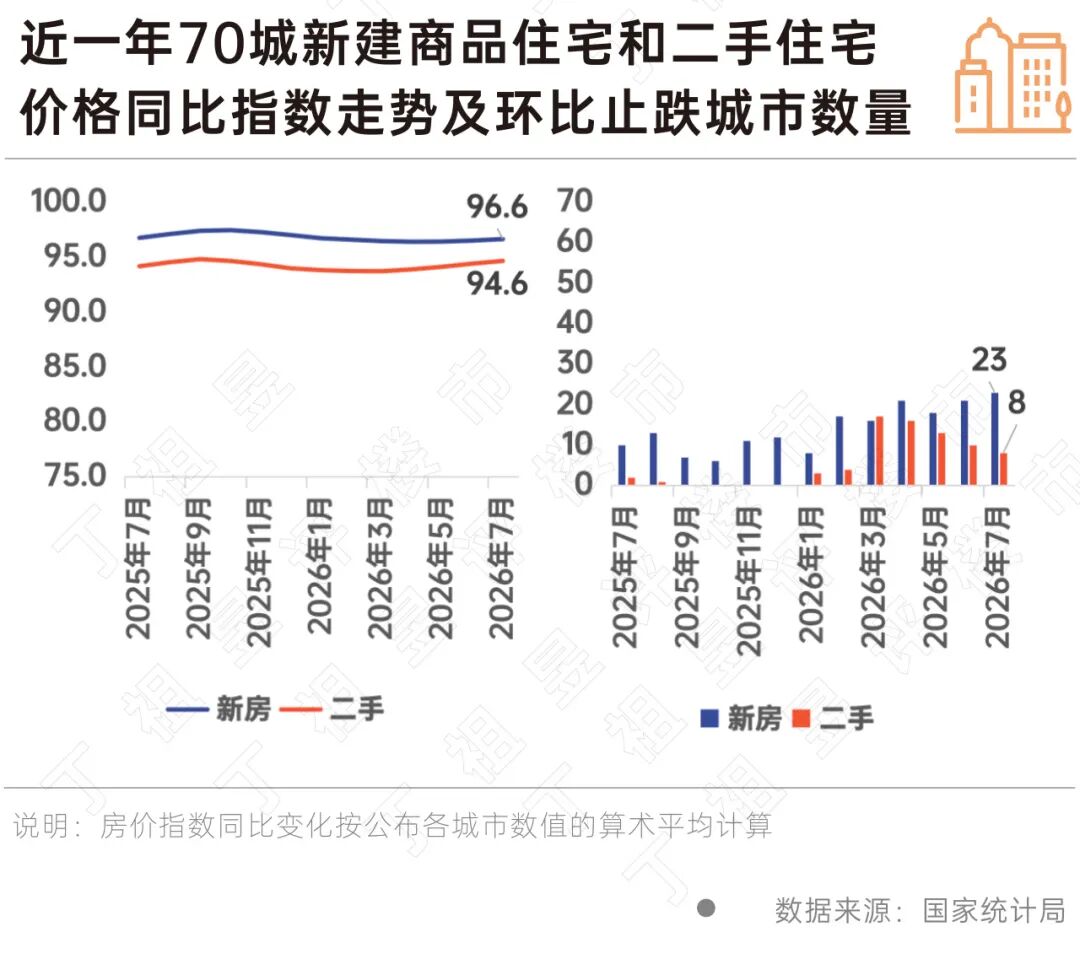
In terms of housing price performance, first-tier cities have stopped falling for 6 consecutive months, and the number of cities with flat or rising month-on-month housing prices has reached 23, which is a further increase compared with the previous month.
On the transaction side, the year-on-year decline in the total transaction value of new homes in July narrowed significantly. A batch of high-unit-price properties in core cities were concentratedly filed for online signing, and the number of new home transaction units in Beijing, Shanghai, Shenzhen and other places all achieved year-on-year growth.
At present, the short-term inventory destocking pressure in the industry is continuously easing, the popularity of land auctions across the country continues, and the national average premium rate has stood at 10% for two consecutive months.
Judging from the overall industry data from January to July 2026, the real estate industry has shown the characteristics of structural stabilization.
01
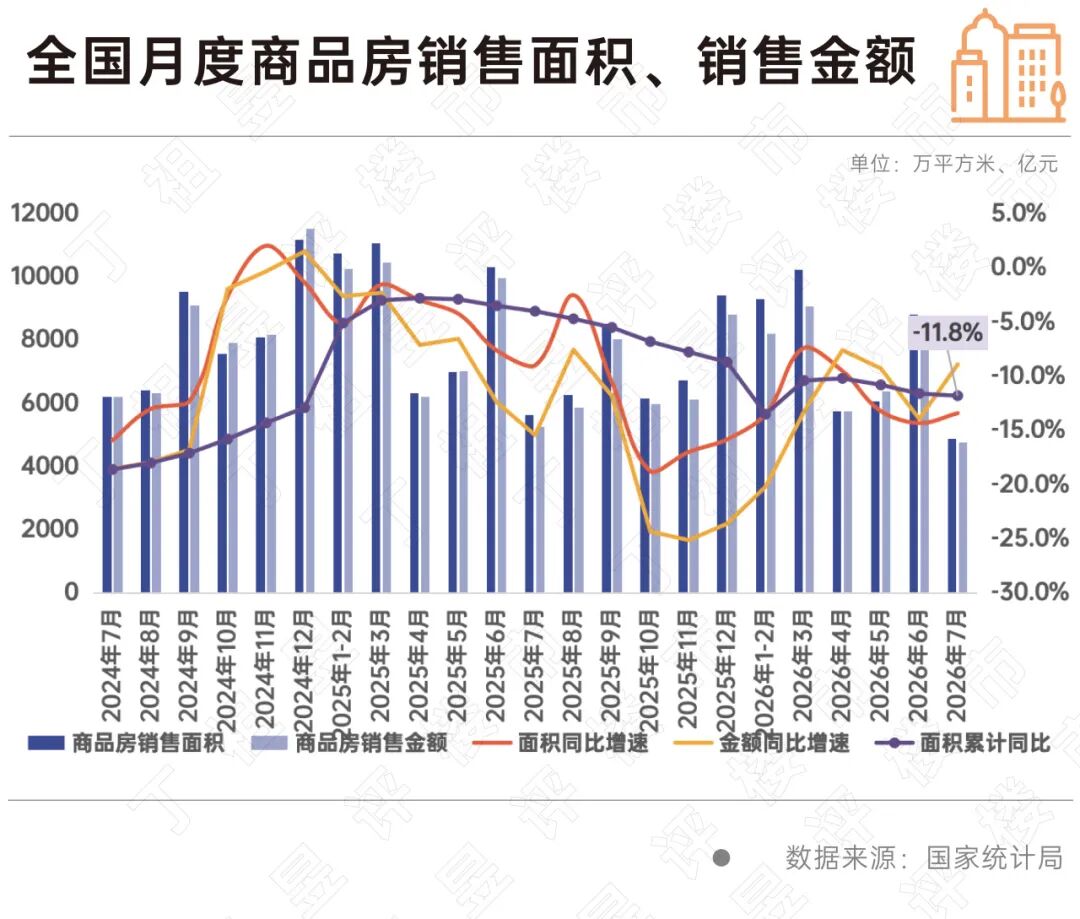
Data from the National Bureau of Statistics show that from January to July 2026, the sales area of newly built commercial housing was 450.21 million square meters, down 11.8% year on year; among which the sales area of residential housing decreased by 12.7%. The sales volume of newly built commercial housing reached 4.2718 trillion yuan, down 13.1%; the sales volume of residential housing decreased by 13.2%.
Calculated based on the data released by the National Bureau of Statistics, the monthly transaction value of newly built commercial housing in July was 477.3 billion yuan, down 8.9% year on year. The decline narrowed by 5 percentage points compared with June, which is mainly attributed to the concentrated transactions of high-unit-price projects in core cities, driving the structural upward trend of the average transaction price of new homes in July, with a year-on-year increase of about 5%.
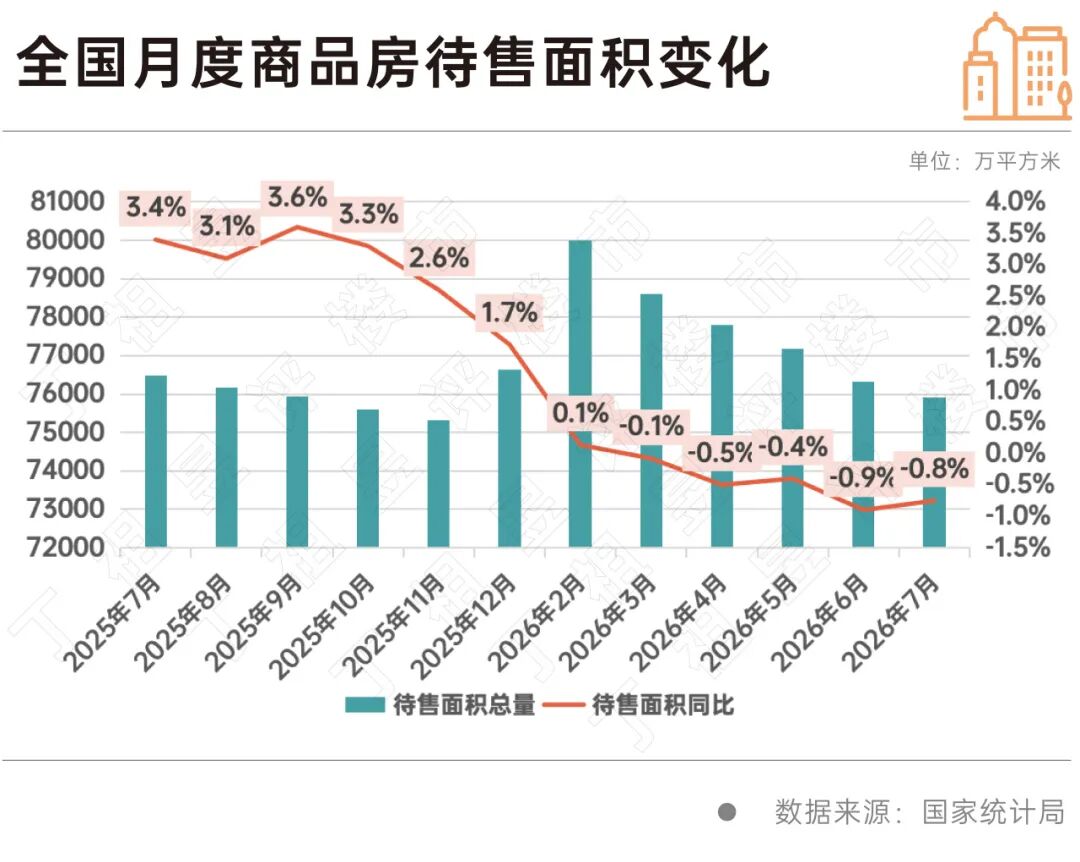
At the end of July, the area of commercial housing for sale was 759.11 million square meters, down 0.8% year on year. Among them, the area of housing that has been for sale for less than 3 years was 555.59 million square meters, down 3.6%, and the decline expanded by 0.1 percentage point compared with the end of June. Inventory pressure continues to be cleared.
At the same time, the funds available to real estate enterprises continue to improve marginally. The individual mortgage loans in the first 7 months amounted to 604 billion yuan, down 23.5% year on year, and the decline narrowed by 1.4 percentage points compared with the first half of the year.
Driven by the intensive introduction of market-stabilizing policies by the central and local governments, as well as the successive launch of high-quality new properties for sale, the effect of market stabilization in first-tier cities is gradually emerging recently.
According to PTI monitoring data, the year-on-year growth rate of the transaction floor area of new residential properties in Beijing and Shenzhen in July both exceeded 20%. After entering August, both the new and second-hand housing markets in Shenzhen picked up simultaneously, and the month-on-month growth rate of transactions of new and second-hand housing in the first ten days both exceeded 10%. Beijing also received positive feedback after launching the new policy on August 7. Driven by policies such as the relaxation of purchase restrictions and the increase in the provident fund loan quota, new home transactions in last week (August 10 to August 16) rose 5% month on month, and second-hand home transactions rose 10% month on month. The number of second-hand housing viewings increased, and the number of visits to new properties also rose. The willingness of home buyers to enter the market has increased, and market confidence has been restored.
02
In July 2026, among the 70 large and medium-sized cities, the sales prices of commercial residential properties in first-tier cities generally went up month on month, while those in second-tier and third-tier cities decreased month on month, and the year-on-year decline of commercial residential property prices in first-tier, second-tier and third-tier cities continued to narrow on the whole.
In terms of new home prices, the sales prices of newly built commercial residential properties in first-tier cities rose by 0.05% month on month. Among them, Shanghai, Guangzhou and Shenzhen rose by 0.2%, 0.1% and 0.2% respectively, while Beijing fell by 0.3%. The sales prices of newly built commercial residential properties in second-tier cities changed from flat in the previous month to a 0.1% month-on-month decline. The sales prices of newly built commercial residential properties in third-tier cities fell by 0.3% month on month, and the decline was the same as that of the previous month.
Among the 70 large and medium-sized cities, 23 cities saw month-on-month rising or flat sales prices of newly built commercial residential properties, an increase of 2 over the previous month, hitting the highest number in the past 15 months. Among them, housing prices in 7 cities including Shanghai, Guangzhou, Shenzhen, Hangzhou, Ningbo, Yinchuan have risen month on month for 4 consecutive months or longer; new home prices in Nanjing, Urumqi, Huizhou, Sanya and Dali have turned from decline to rise this month.
In terms of year-on-year performance, the year-on-year decline in sales prices of commercial residential properties in first-tier, second-tier and third-tier cities continued to narrow on the whole. Among them, the sales prices of newly built commercial residential properties in first-tier cities fell by 1.1% year on year, and the decline narrowed by 0.2 percentage point compared with the previous month.
In terms of second-hand home prices, the sales prices of second-hand residential properties in first-tier cities rose by 0.2% month on month, and the growth rate dropped by 0.1 percentage point compared with the previous month. Among them, Shanghai, Guangzhou and Shenzhen rose by 0.3%, 0.4% and 0.2% respectively, while Beijing remained flat. The sales prices of second-hand residential properties in second-tier and third-tier cities fell by 0.3% and 0.4% month on month respectively, and the declines were the same as those of the previous month. Among the 70 large and medium-sized cities, 8 cities saw month-on-month rising or flat sales prices of second-hand residential properties, a decrease of 2 over the previous month.
Comprehensive market data shows that current housing prices are entering a channel of structural repair.
03
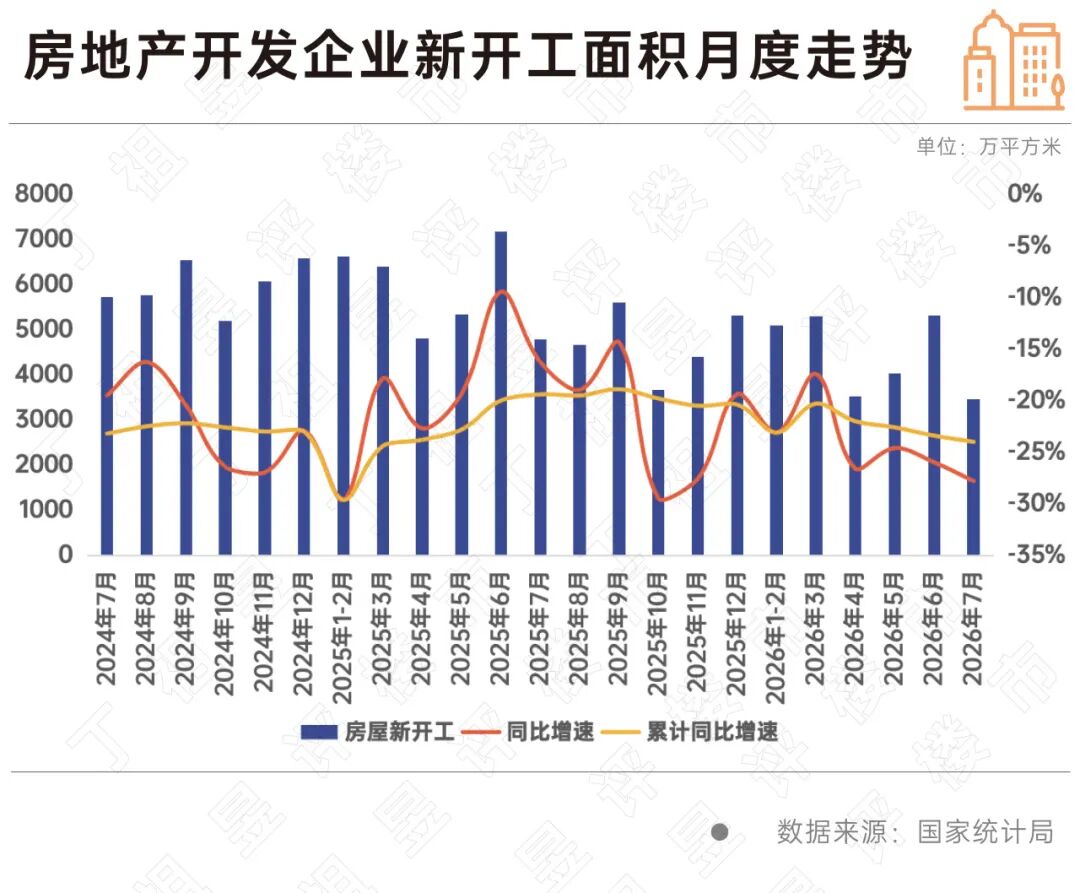
Data from the National Bureau of Statistics show that from January to July 2026, the floor area of houses under construction by real estate development enterprises nationwide was 557.572 million square meters, down 12.7% year on year. Among them, the floor area of residential buildings under construction was 387.051 million square meters, down 13.0%. The floor area of newly started construction of houses was 26.7 million square meters, down 24.0%. Among them, the floor area of newly started residential buildings was 19.49 million square meters, down 24.6%. The completed floor area of houses was 19.195 million square meters, down 23.2%. Among them, the completed floor area of residential buildings was 13.443 million square meters, down 25.5%.
In the first 7 months of 2026, the scale of newly started housing construction was 59.3% of the scale of new home sales, up 1.4 percentage points compared with the first half of the year, still at a historically low level.
The phase-wise bottoming out of the new-start-to-sales ratio indicator on the one hand reflects the recovery of investment confidence on the development side, as real estate enterprises prudently adjust the construction start rhythm according to market demand; on the other hand, it also reflects that stock renewal projects are gradually implemented, driving the relevant construction start data to rise. With the implementation of the 15th Five-Year Plan related to urban renewal, a number of projects related to livelihood projects and development projects are being accelerated. The parallel progress of stock revitalization and new development will continuously reshape the industry supply structure, help the real estate industry to accelerate the construction of a new supply-demand order adapted to the development characteristics of the new era, and promote the market to move towards a new development pattern that gives equal weight to incremental and stock markets.
04
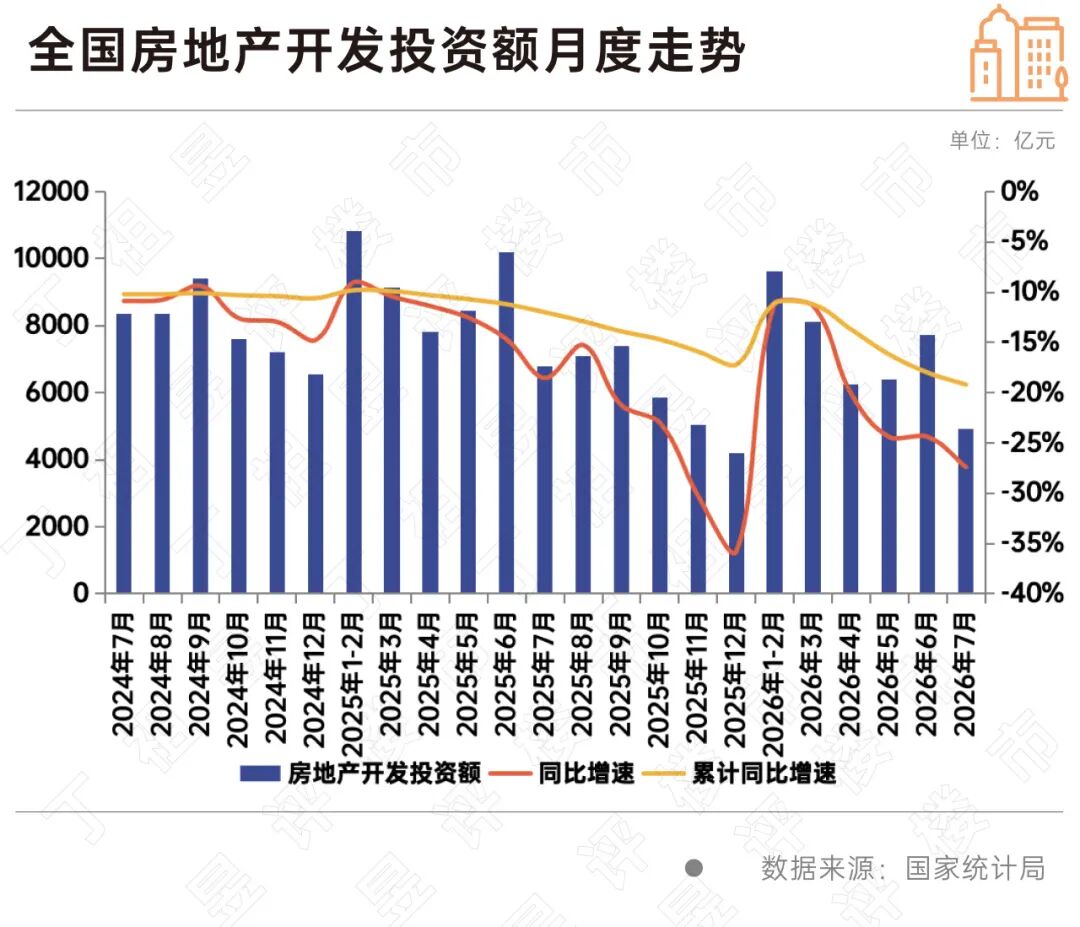
Data from the National Bureau of Statistics show that from January to July 2026, the national real estate development investment reached 4.3009 trillion yuan, down 19.2% year on year (calculated according to the comparable caliber); among which residential investment reached 3.3172 trillion yuan, down 19.1%.
In terms of monthly performance, the completed real estate development investment was 493.5 billion yuan, down 27% year on year. At present, all regions are accelerating the promotion of high-quality urban development and actively revitalizing stock land, but the overall investment scale remains rational. In the past two months, multiple high-premium high-quality residential land parcels have been transacted. The development investment in July alone was only equivalent to 103% of the new home sales volume, and the supply and demand scale is still in a reasonable dynamic balance range.
The popularity of the land market remains at a high level in the past year. The overall premium rate of residential land across the country in July reached 10.6%, breaking through 10% for two consecutive months. There were 19 residential land parcels with a transaction base price exceeding 1 billion yuan in July, of which 15 were transacted at a premium, and the proportion of premium transactions hit a new high for the year.
The meeting of the Political Bureau of the Central Committee held on July 30 clearly put forward the goal of "stabilizing the real estate market", marking that the real estate market has fully entered the stage of stabilization. It is expected that the subsequent development focus of the industry will shift more to the efficient allocation of resources in the field of urban renewal and the construction of "good houses", so as to consolidate the certainty on the investment side.
From the perspective of policy orientation, high-quality promotion of urban renewal has become an important starting point for urban modernization. With the gradual implementation of the 15th Five-Year Plan for urban renewal, stock projects such as old community renovation, original demolition and reconstruction, and idle asset revitalization will continue to be implemented. The parallel progress of incremental development and stock revitalization will reshape the real estate supply structure. On the one hand, the livelihood projects and development projects brought by urban renewal will expand the effective investment space of the industry, guide the development and construction to transform to quality orientation, vigorously promote the construction of "four goods" including good houses, good communities, good neighborhoods and good urban areas, and improve the supply quality of housing products. On the other hand, the revitalization of stock resources will also drive the optimized reallocation of land and housing resources, and release the demand for housing improvement within cities.
On the whole, in the second half of the year, the industry will take urban renewal as an important starting point, through improving the quality and efficiency of stock assets and optimizing the quality of housing supply, balancing risk prevention and control and people's livelihood security, to promote the stable operation of the real estate market towards a new development order with adapted supply and demand and controllable risks.
This article is from the WeChat Official Account "Ding Zuyi Comments on Real Estate Market", author: Pure Real Estate Research, published by 36Kr with authorization.