Regulators have launched successive heavy-handed crackdowns to rectify the "disguised commission rebate" practices of securities brokerages.
In August a year ago, a 100-million-yuan-level commission rebate case involving collusion between employees of quantitative private funds and practitioners of leading securities firms shocked the entire industry. Now this type of irregularity has once again come into the industry's spotlight through regulatory penalty notices.
Reporters noted that since July this year, multiple local CSRC regulatory bureaus have successively issued penalty notices targeting disguised commission rebates, directly pointing to the violations committed by securities firm business departments, including illegally extracting commissions through brokers, transferring commission payouts, and falsely listing consulting service fees to carry out disguised commission rebate practices.
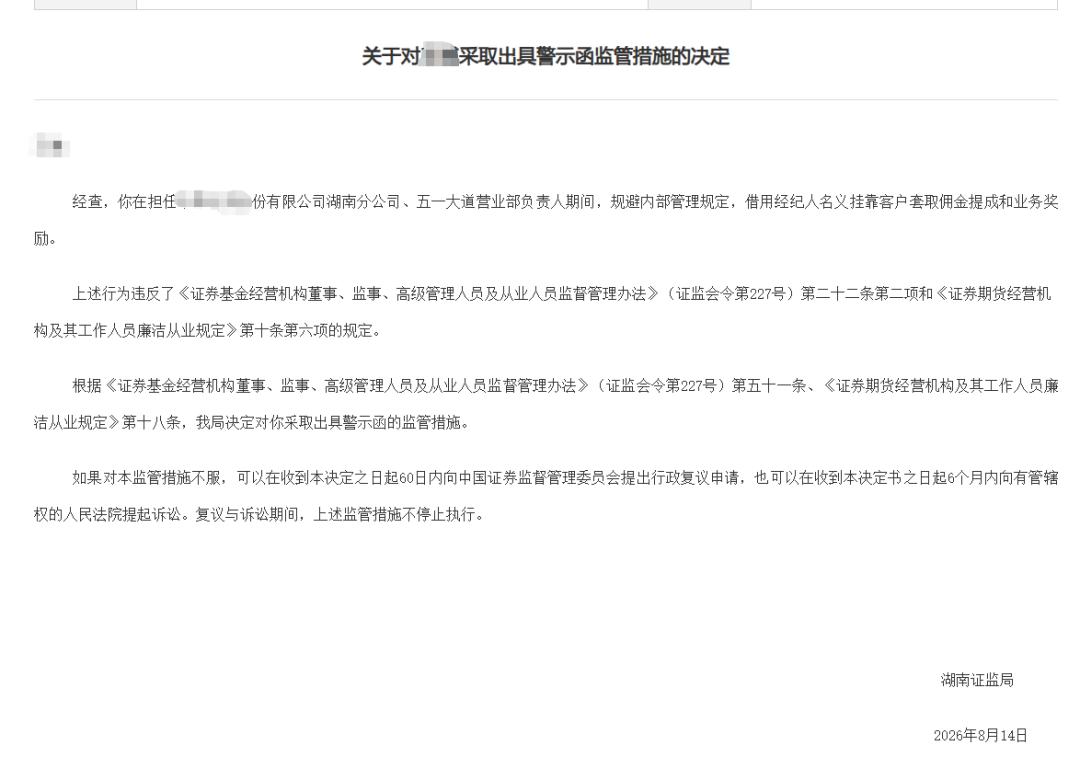
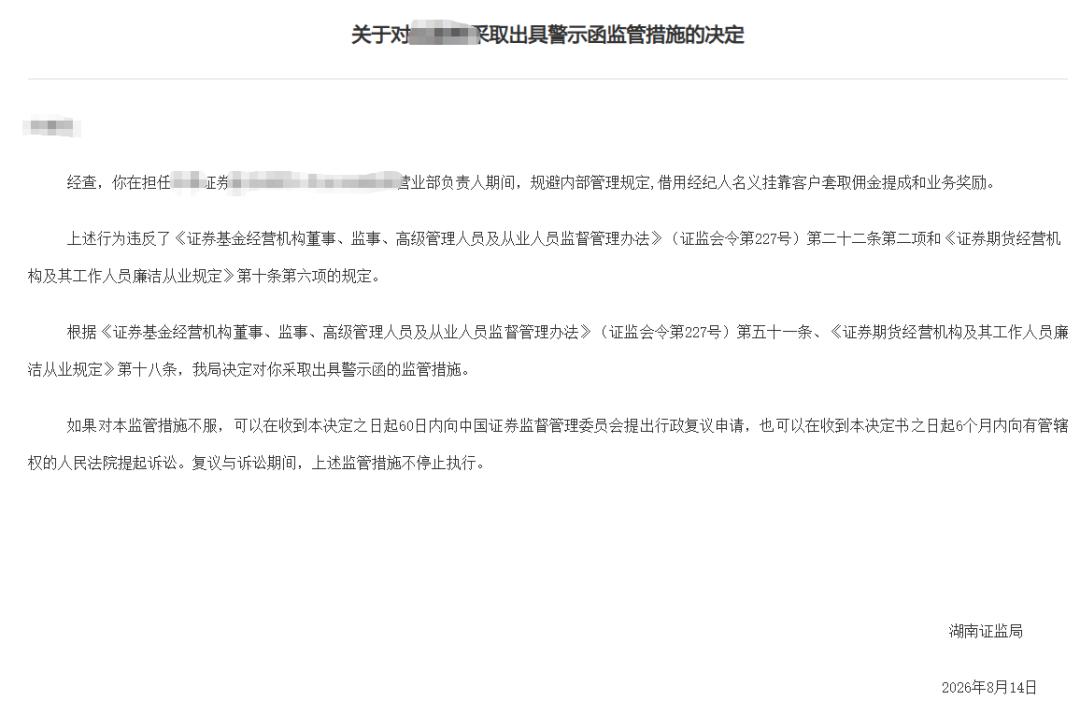
The first case involves a Hunan branch of a securities firm and two heads of its business departments, who were issued warning letters for evading internal management rules, using brokers' names to register clients under false pretenses, and siphoning off commission payouts and business rewards.
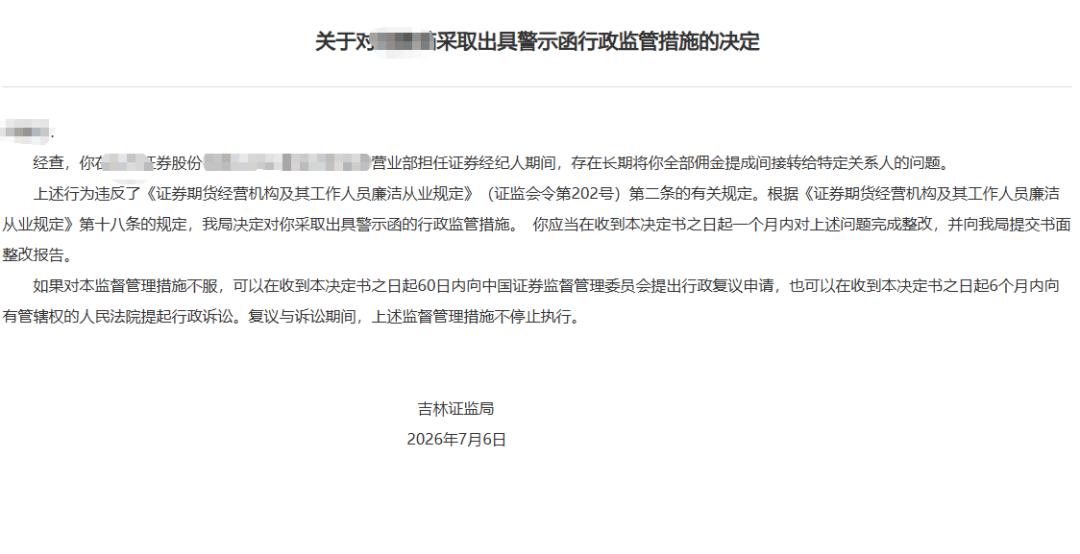
The second case involves a securities broker at a Changchun business department of a certain securities firm, who was found to have indirectly transferred all commission payouts to specific related parties for a long time during their tenure. This act violated the relevant regulations on clean practice of securities and futures operating institutions, so the broker was taken regulatory measures of being issued a warning letter and required to complete rectification within a specified time limit.
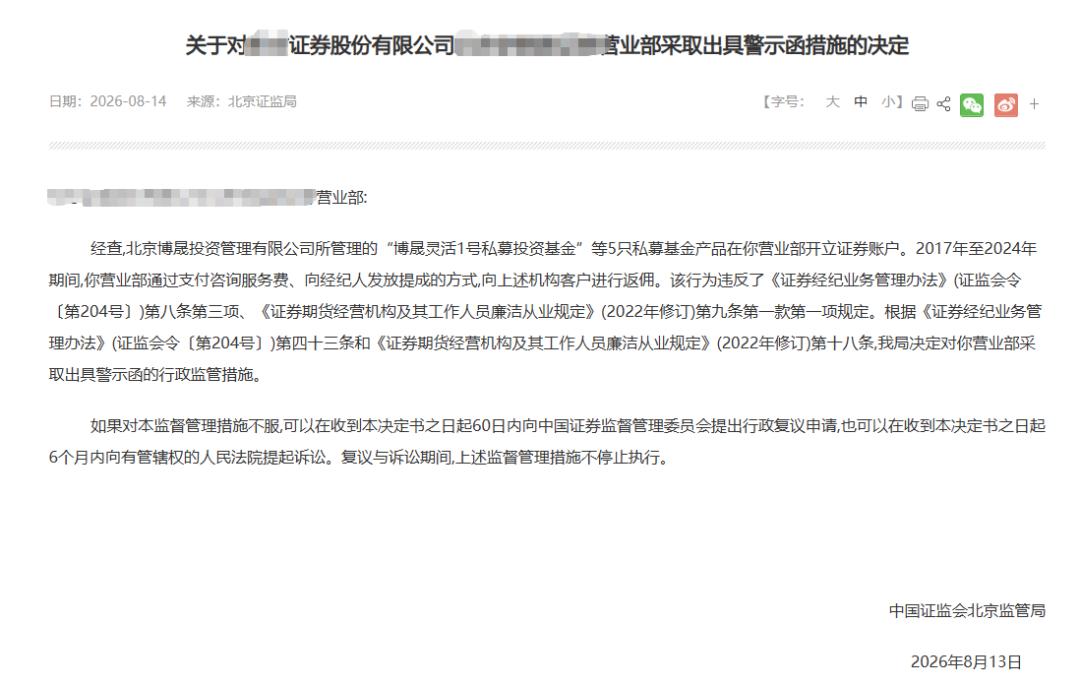
The third case refers to a Beijing business department under the same aforementioned securities firm, which provided trading channels for 5 private fund products managed by a private fund institution in Beijing for as long as 8 years from 2017 to 2024. During this period, the business department carried out commission rebates to the institutional client through two methods: paying consulting service fees and distributing payouts to brokers.
The fourth case involves a securities broker at a Ningbo branch of a certain securities firm, who was found to have indirectly transferred part of their commission payouts to interested parties for a long time, and was issued an administrative regulatory measure of a warning letter by the regulator.
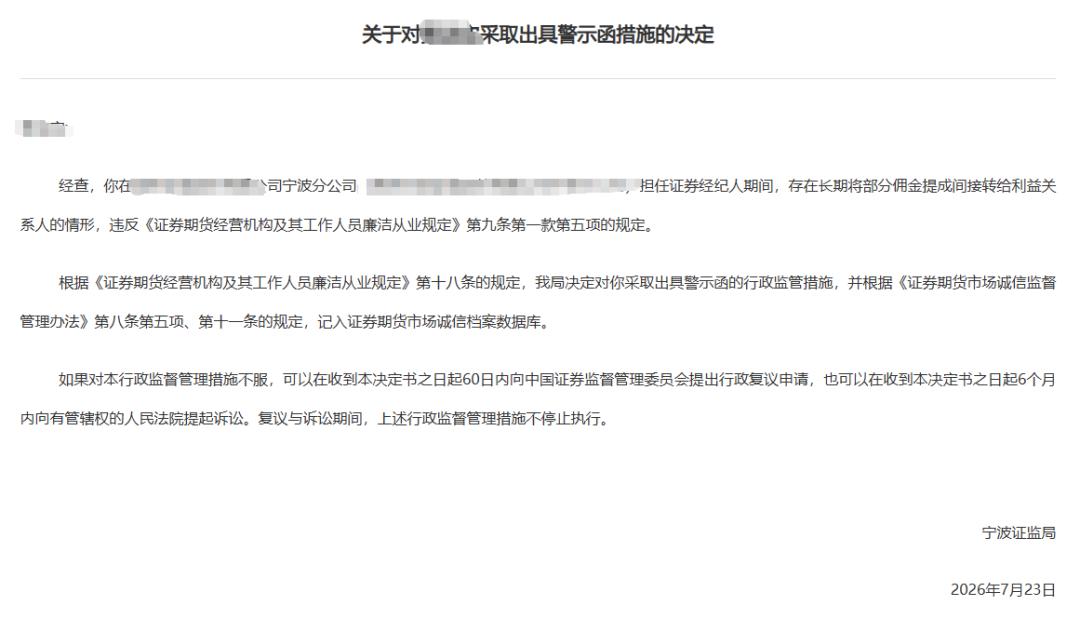
Far from only since July this year, in the year following the aforementioned 100-million-yuan commission rebate case, a large number of commission rebate cases and irregular practices have been exposed through regulatory penalty notices, with nearly 10 penalty notices issued, involving different amounts of money and varying severity of commission rebate problems. Some views hold that the regulation targeting disguised commission rebates is continuing to tighten, and a severe crackdown is imminent.
"After the commission rebate case involving leading quantitative institutions and securities firms, the industry has restrained a lot. Most of the current penalty notices are tracing cases that happened in the past, which shows that the regulator's tolerance level has been very low." A head of a securities firm's branch believes that the regulatory penalties for disguised commission rebates will only become stricter. According to the tracking reports of CLS over the past year, the regulatory authorities have included key verification of institutional client commission pricing, broker qualifications, and authenticity of service fees into the scope of institutional self-inspection, with the core focus on standardizing the listing of service expenses.
Under the high-pressure regulation, the cost of violations has continued to rise. Reporters learned that relevant practitioners of leading securities firms have been held criminally liable for participating in the transfer of interests through commission rebates, with huge amounts of money involved, which has sounded a legal alarm for practitioners across the whole industry.
Indirectly Transfer All Commission Payouts to Specific Related Parties
Among the disclosed penalty notices, "commission payout transfer" at the individual broker level is the most common form of violation, and the two cases in Changchun and Ningbo fall into the same category.
A securities broker at a Changchun business department of a certain securities firm was punished for the act of indirectly transferring all commission payouts to specific related parties for a long time during their tenure; a securities broker at a Ningbo branch of a certain securities firm was punished for indirectly transferring part of their commission payouts to interested parties for a long time.
The regulator did not point out who the specific related parties are in these cases, but the methods used are very clear.
"This is a very typical 'broker channel' practice." An interviewed person from a securities firm explained to reporters that according to the management rules for securities brokers of securities firms, brokers can extract a certain proportion of payouts from the trading commissions generated by clients under their name. Under normal circumstances, the payouts correspond to the labor remuneration for client development and client service. But in violation scenarios, brokers only act as a "channel", do not participate in any actual business expansion, are only responsible for receiving the payouts issued by the securities firm, and then transfer the money to designated persons through private transfers and other methods to realize the off-system circulation of commission interests.
The "specific related parties" mentioned in regulatory penalty notices have long formed several high-frequency forms in industry practice, corresponding to different violation motives and interest chains, mainly including four categories:
The first category is former peers, or former colleagues and industry counterparts. Practitioners privately take over the client resources of resigned personnel, and continuously transfer the corresponding commissions to them. Such resigned personnel have formed a continuous interest sharing relationship due to client resources, which is a typical specific related party. Meanwhile, this act is also suspected of privately trading client assets and assisting unqualified personnel to obtain securities business income.
The second category is high-value clients themselves or their designated related parties. To retain large-volume trading clients, some brokers will transfer all their personal commission payouts to clients or their designated third parties, so as to reduce the actual trading cost of clients and form a commission price advantage.
The third category is actual business handlers without practice qualifications. Personnel who have client resources but no securities practice qualifications use the compliant identity of brokers to carry out business, while the brokers only hold the title and do not perform their duties in practice, and transfer all commission income to the actual handlers. Such "behind-the-scenes actual controllers" have formed deep interest alignment through nominee business and nominee income holding.
The fourth category is channel referrers and business middlemen. Some brokers transfer commission payouts to channel intermediaries and business referrers as "drainage fees" in order to continuously obtain bulk client resources. Although such channel middlemen have no practice qualifications, they have formed a stable interest transfer relationship with practitioners, and will also be identified as specific related parties. This act also constitutes privately paying channel fees.
Business Department Leads Commission Rebates, Lasting for 8 Years
Looking at the third case, this case is more prominent and typical. Compared with the individual violation in the second case, this penalty notice presents an institutional client commission rebate mode led by the business department at the department level, with more hidden methods.
It is worth mentioning that the penalty notices for the third case and the second case are from the same securities firm. A Beijing business department under this securities firm provided trading channels for 5 private fund products managed by a private fund institution in Beijing for as long as 8 years from 2017 to 2024. During this period, the business department carried out commission rebates to the institutional client through two methods: paying consulting service fees and distributing payouts to brokers.
Specifically, the case of this Beijing branch adopts a combined method of "service fee + payout": compared with the simple transfer of broker payouts, expenses listed in the name of consulting services and technical services are often covered by the cloak of compliant contracts, making verification more difficult. According to previous cases, some securities firms will sign false service agreements with clients, packaging rebate funds as "research consulting fees", "system operation and maintenance fees", "data service fees", etc. Even if the service content is seriously mismatched with the charges, it can form formal compliance on the financial books.
This case is relatively similar to the huge quantitative private fund commission rebate case exposed in 2025, but one is a transaction between individuals, and the other is led by the business department level, lasting for 8 years, and adding a public service fee channel in addition to broker payouts.
The 100-Million-Yuan Commission Rebate Case Becomes a Watershed for the Industry
In fact, commission rebate is not a new thing in the industry, similar to practitioners illegally trading stocks. It was the huge quantitative private fund commission rebate case exposed in 2025 that pushed the scale and harm of this gray operation to the peak, and became an important turning point for the escalation of regulatory rectification.
According to the case details disclosed by judicial authorities, the then marketing director of a quantitative private fund colluded with the general manager of a securities firm's business department and the headquarters management personnel to siphon off interests by using the broker commission payout system of the securities firm. In the specific operation, the general manager of the business department arranged their relatives to be registered as the "exclusive broker" of the aforementioned quantitative private fund, the headquarters personnel cooperated to place the private fund's trading channel in this business department, and the marketing director was responsible for directing the company's transactions to the corresponding seat.
In the whole chain, the named broker never participated in client development and service, but relied on the huge commission volume generated by the quantitative high-frequency trading of private funds to continuously extract high payouts. Over the six years from 2018 to 2023, the gang cumulatively siphoned off 118 million yuan in commission payouts, and the involved personnel divided the money privately in proportion, and all were eventually transferred to judicial authorities for handling.
Earlier, a securities firm person told reporters that the most shocking part of this case for the industry is that it turned a long-existing gray area into a systematic operation that lasted for many years and involved more than 100 million yuan. For a period of time, most of such violations were defaulted to be "small-scale and trivial", and it was not until the exposure of this case that the whole industry realized how big the risk of this model is.
It is worth noting that in addition to quantitative institutions, some large private funds with active transactions and individual high-net-worth clients have also often become the targets of commission rebates. The operation methods are also iterating with the regulatory requirements: from the early direct cash rebate, to the later broker payout transfer, and then to the packaging by falsely increasing service fees. The methods are becoming more and more hidden, and the chains are getting longer and longer, which brings considerable challenges to regulatory verification.
This article is from the WeChat official account "CLS", author: Lin Jian, authorized for release by 36Kr.