The leading lithium iron phosphate producer Hunan Yuneng has recently filed for a Hong Kong IPO. Both BYD and CATL previously reduced their stakes in the company, and its performance has shrunk by 80%.
Hunan Yuneng has submitted its listing application to the Hong Kong Stock Exchange, facing multiple challenges including customer concentration and cash flow pressure.
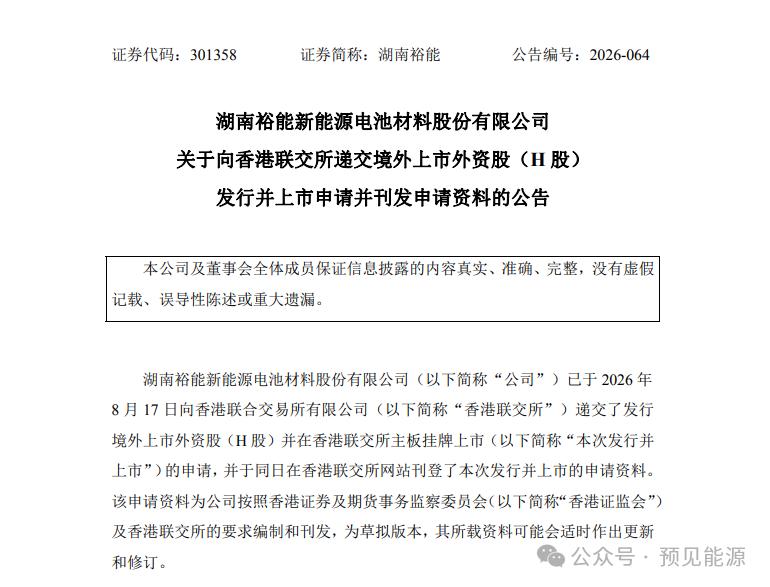
Energy Insight learned that on August 17, 2026, Hunan Yuneng submitted its H-share listing application to the Hong Kong Stock Exchange. The company, which has ranked first in global shipments of phosphate cathode materials for six consecutive years, only spent three and a half years since its landing on the A-share ChiNext Board in February 2023. Back then, its stock price surged by 165.88% on the first trading day of listing, enjoying unparalleled glory.
Over the past three years, as the lithium battery industry evolved from rapid expansion to overcapacity and then to structural recovery, Hunan Yuneng's performance has been on a roller coaster ride. Its net profit peaked at RMB 3.01 billion in 2022, but plummeted to only RMB 594 million in 2024, shrinking by more than 80%. Now its first-quarter profit of RMB 1.356 billion has exceeded the full-year figure of last year, and the company chooses to knock on the door of the Hong Kong stock market at this very point.
However, the capital market has given a far more cautious response this time. Two months before submitting the listing application, Shanghai Jinsheng New Materials, the second-largest shareholder, and CATL, the third-largest shareholder, simultaneously announced share reduction plans, with a total proposed reduction of no more than 5.5%. The "retreat" of major shareholders at the gate of H-share listing is a signal that cannot be ignored.
The moat formed by the close tie where CATL and BYD are both shareholders and customers is getting shallower
The rise of Hunan Yuneng is inseparable from its deep ties with the two industry giants. In December 2020, CATL took a stake at RMB 3.34 per share, and BYD entered the company at the same time. The combined shareholding of the two parties still accounts for nearly 10% to this day. This "equity + order" model is an absolute moat during the industry's upward cycle — in 2025, the top five customers contributed 71.38% of the total revenue, and CATL and BYD have long accounted for the majority of the revenue.
In 2026, the company expects to sell products such as lithium iron phosphate worth RMB 26.733 billion to CATL. Adding the estimated RMB 14.48 billion in sales in the first five months of 2027, the total amount will exceed RMB 40 billion. Such deterministic orders are what small and medium-sized manufacturers can only dream of obtaining.
However, CATL's share reduction in June broke this narrative of "absolute stability".
The announcement stated that the move was for "normal investment arrangements and capital management needs", but the timing fell right in the sensitive period when the company was planning its H-share listing. Calculated based on the closing price of RMB 82.72 on June 3, if CATL reduces its holdings by the maximum allowed 3%, the cashout amount may exceed RMB 2 billion. With a share acquisition cost of only RMB 3.34 per share, the return is extremely substantial.
The deeper problem is that CATL itself is also extending its business to upstream materials. When the largest customer is also a potential competitor, how long can the certainty of this relationship last? In January 2026, Ronbay Technology announced that it had reached a long-term strategic cooperation with CATL, which means Hunan Yuneng is not the only option. The order moat is being gradually eroded by competitors.
Performance recovery is only a superficial phenomenon, and cash flow is the real hidden concern
In the first quarter of 2026, Hunan Yuneng recorded revenue of RMB 14.965 billion, a year-on-year increase of 121.31%; net profit reached RMB 1.356 billion, a year-on-year surge of 1337.77%, with its single-quarter profit exceeding the full-year profit of 2025. Its gross profit margin jumped from 9.1% in 2025 to 16.2%, marking the arrival of a profit turning point for the lithium iron phosphate industry.
However, the recovery of the income statement cannot hide the continuous blood loss of the cash flow statement. In 2024, 2025 and the first quarter of 2026, the net cash flow from operating activities was -RMB 1.042 billion, -RMB 1.546 billion and -RMB 1.045 billion respectively. The profits earned have not been converted into cash, but are deposited in notes receivable and inventory. The company explained that this is mainly due to differences in settlement cycles and increased taxes and fees, but the continuous negative cash flow for multiple consecutive periods indicates structural problems in its hematopoietic capacity.
The urgency of Hong Kong stock market financing largely comes from this kind of capital pressure. Two overseas projects — the 50,000-ton project in Spain and the 90,000-ton project in Malaysia — have a total investment of nearly RMB 2 billion. Coupled with the continuous advancement of the integrated mining and processing project in Weng'an, Guizhou in China, the RMB 4.788 billion raised through A-share private placement is far from enough. And this private placement itself has been significantly reduced from the initial RMB 6.5 billion plan.
Can the Hong Kong stock listing help make the overseas capacity investment profitable?
Hunan Yuneng's overseas strategy is very clear, that is, to follow its customers. The Spanish project is located in Merida, less than 400 kilometers away from the battery plant jointly built by CATL and Stellantis in Zaragoza, directly supporting the European production capacity. The Malaysian project is deployed following CATL and BYD's pace of expanding into Southeast Asia.
The core value of listing on the Hong Kong stock market lies in raising foreign currency funds that can be directly used for overseas project construction, while providing international credit endorsement for overseas projects. When acquiring land, applying for environmental assessment and negotiating for government subsidies in Spain, a Hong Kong-listed identity is more convincing than a pure A-share listed company.
However, the profitability of overseas plant construction needs to be carefully calculated. The total investment of the Spanish project is about 800 million euros. Although there is a 200 million euro government subsidy, the remaining part still needs to be raised by the company itself. The Malaysian project costs about RMB 950 million. From planning to commissioning, the two projects face four major barriers: capital, approval, construction and operation. And customers' overseas factories will not wait long for material suppliers — CATL's Spanish plant is scheduled to be put into operation at the end of 2026.
The industry has entered the era of million-ton-level competition, and the capital race among leading players has only just begun
In 2025, China's lithium iron phosphate shipments reached 3.944 million tons, a year-on-year increase of 62.5%, and Hunan Yuneng alone shipped more than 1 million tons. However, the planned production capacity of the industry has exceeded 10 million tons, and GGII predicts that the domestic lithium iron phosphate production capacity will reach 17.64 million tons in 2027.
Capacity utilization rate is a more authentic indicator. From the second half of 2025 to 2026, the industry as a whole will maintain a tight balance of 70% to 75%, but GGII predicts that it may drop below 60% in 2027. This means that after the million-ton-level capacity expansion, the market will once again face the brutal price war that took place in 2023-2024.
Hunan Yuneng chose to go public in Hong Kong at the profit peak, with a very precise timing. However, the Hong Kong stock market has a different valuation logic for lithium battery material stocks from the A-share market, and international investors pay more attention to customer concentration, cash flow quality and overseas operation capabilities. It is precisely in these dimensions that Hunan Yuneng's growth story is not perfect.
As a leading material manufacturer that relies on two major customers, has continuous negative cash flow and is still building its overseas production capacity, whether it can tell a convincing globalization story in the Hong Kong stock market will be answered by the market. The listing window will not stay open forever — after 2027, the industry may once again enter white-hot competition, and refinancing at that time will probably face a completely different situation.