In the intelligent era, do companies still need "middle management"?
In early July, three Chinese internet giants almost simultaneously launched a reshuffle targeting middle management.
Tencent Games piloted the "person-in-charge system" across its domestic publishing line and ecological development department, unifying management titles such as "director" and "team lead" into "person in charge" and "team member", and abolishing the L1/L2 management rank system. Whether an individual is positioned upstream in the reporting chain is no longer a fixed identity, but determined by their professional contributions.
At the same time, ByteDance launched its performance evaluation for the first half of 2026, incorporating the updated "leadership principles" into the assessment system. It requires all managers to deliver tangible business outputs and eliminate empty, formalistic management. The cash proportion of semi-annual incentives has also been reduced from 100% to 25%, with the remaining 75% replaced by options tied to long-term performance.
JD Retail went a step further by directly cutting two layers of management, abolishing the manager identities of C4 and C5 ranks, with relevant personnel directly reporting to C3-level staff.
This is not an isolated move by Chinese internet companies.
Across the ocean, Meta has assigned new titles such as "AI builder", "pod lead" and "org lead" to employees in its Reality Labs division, in an attempt to make the organization more "AI-native". Jack Dorsey, CEO of payments company Block, redefined managers as "player-coaches" who work alongside their teams, and publicly stated that he hopes to completely eliminate management hierarchies one day.
This is not just a wishful thinking of a handful of companies.
Researchers from Harvard Business School and INSEAD published a working paper titled "AI-Native Firms" earlier this year. After tracking data of startups supported by Y Combinator, the study found that "AI-native" startups have significantly fewer organizational hierarchies than traditional companies of the same size in the same industry: the median number of hierarchies is only 3, compared with 4 for non-AI companies, and the proportion of managers in the total number of employees is about 4 percentage points lower, yet the financing scale and valuation of these companies are not discounted accordingly.
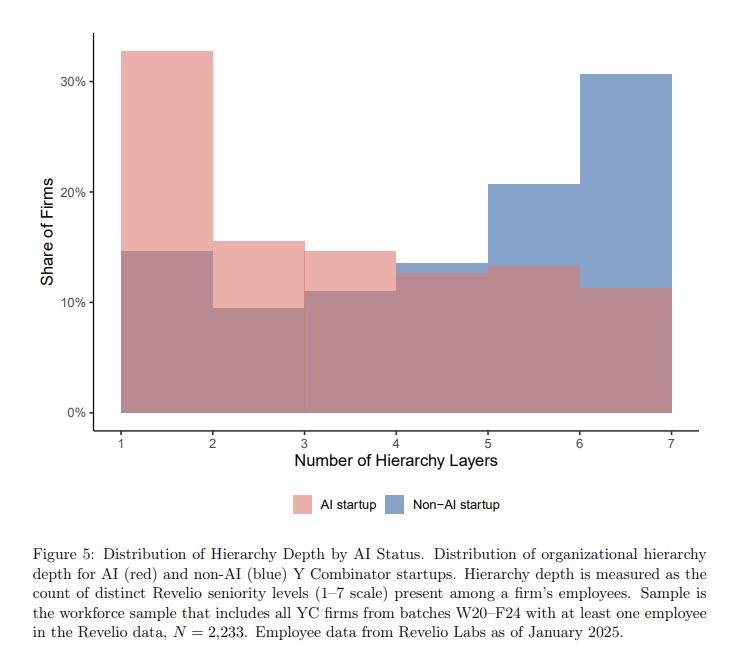
Distribution of the number of management hierarchies of YC-supported startups: the red bars represent "AI-native" companies, and the blue bars represent traditional companies. Source: https://www.hbs.edu/faculty/Pages/item.aspx?num=69077
Over the past 100+ years, the modern corporate system has become a taken-for-granted organizational form in the modern business world. Hierarchical structures, job division of labor, and management systems have been deeply embedded in our full understanding of "organization", to the point that we rarely question why organizations must operate in this way.
Today, as more and more AI-native organizations demonstrate completely different operating states, a deeper question begins to emerge:
Apart from tool upgrades, are we also facing fundamental changes in the logic of organization?
In the book *Intelligence: The Essence of Business, Organization and Strategy in the AI Era*, Zeng Ming, former chief strategy officer of Alibaba Group, answered this question.
Traditional companies are essentially a cognitive compression structure. Senior leaders are responsible for setting directions and making judgments; middle managers are responsible for translating complex strategies into executable tasks, while recompressing, sorting out and transmitting frontline information upward; frontline employees perform stably around clear goals. The entire organization is like a huge information processing machine, and hierarchy itself is the core cognitive flow structure of this machine.
Therefore, the management logic of the industrial era naturally emphasizes processes, reporting, approval, control, job boundaries and hierarchical coordination. In a world where cognitive capacity is scarce and information cannot flow freely, this is the only feasible way to maintain large-scale collaboration.
But AI has changed this premise. In the past, a large number of cognitive compression work that the operation of organizations depends on could only be done by humans in essence. Managers need to read reports, attend meetings, coordinate departments, summarize information and transmit judgments; today, large language models and agents can participate in this process.
More importantly, cognition in organizations is now possible to flow continuously.
The CEO's judgments can enter the entire organization more directly; feedback from frontline users can enter the decision-making system faster; different teams do not need to go through layers of reporting to achieve collaboration; a large number of hierarchies that existed in the past due to the cost of cognitive transmission are gradually losing their foundation for existence.
As a result, the traditional management system has seen fundamental loosening. In the past, many management actions essentially made up for the problem that cognition could not flow freely. After AI starts to reconstruct the way cognitive flows in organizations, many originally necessary processes, hierarchies and control mechanisms will increasingly become an extra cost. This is why today's AI-native organizations no longer look like companies in the traditional sense. Their most important change is not just "fewer people" or "higher efficiency", but the core purpose of the organization has also changed.
Organizational capability in the industrial era is to execute established answers at scale
The companies we are so familiar with do not exist naturally, but are collaborative structures gradually formed under specific production modes.
Before the Industrial Revolution, there were of course a large number of organizations in human society. Families, clans, guilds, merchant gangs, armies, churches, and even various temporary business partnerships could all complete collaboration at a certain scale. However, most of these organizations were built on acquaintance relationships, experience inheritance, geographical connections or power control. They could maintain local collaboration, but it was difficult to support large-scale, continuous and stable complex production.
It was the Industrial Revolution that truly changed all this.
After the steam engine, power system, assembly line and modern manufacturing system gradually emerged, for the first time, humans needed to organize a large number of strangers, machines and capital on an unprecedented scale to carry out standardized production continuously.
After entering large-scale industrial production, how to keep the entire system running stably became particularly important. How a car should be produced, how a machine should be assembled, and how a service should be delivered in a standardized way. Once these problems are clearly defined, the most important task of the organization becomes how to stably replicate these established answers ten thousand times, one hundred thousand times or even millions of times.
Under such a production mode, organizations will naturally evolve a whole set of mutually supportive specific structures:
The first is division of labor. Only by breaking down complex tasks into standardized actions can organizations maintain stability in large-scale collaboration.
The second is hierarchy. After the scale of the organization continues to expand, information and tasks cannot flow freely, and must be coordinated through a stable structure.
The last is the formation of a modern management system. Budgets, performance, processes, systems, and reporting relationships are all essentially for the same goal: to keep the system running stably.
It is in this sense that the modern corporate system can essentially be said to be one of the most important inventions of the industrial era, because it enables humans to organize stably on a huge scale and carry out complex collaboration. This is true for Ford's assembly line, General Electric's management system, and later Toyota's lean production. The common logic behind them is not how to continuously explore the unknown, but how to execute a verified solution more stably and on a larger scale at a lower cost.
Therefore, the most important organizational capability in the industrial era is to execute established answers at scale.
From this perspective, the logic behind various management practices today is very clear. Why must job boundaries be clear? Because the system needs stability. Why do hierarchical structures exist for a long time? Because the system needs coordination. Why do large companies increasingly emphasize processes? Because only processes can maintain the consistency of large-scale systems.
In other words, companies are not designed to maximize creativity. They are essentially a mechanical system built around stable execution. In such a system, the most important thing is not that everyone needs to constantly rethink problems, but that the entire organization can operate continuously, stably and efficiently around established goals.
The modern management system further amplifies this logic. From Taylor's scientific management, to the modern organizational structure established by DuPont and General Electric, and then to the global operation of later multinational corporations, the core all points to the same direction: how to make the organization run more stably on a larger scale through structure, process and management.
This system has achieved great success in the past 200 years of industrial civilization. It has not only shaped modern business, but also deeply shaped our understanding of the organization itself.
The Internet has not really changed the logic of organization
The Internet has greatly increased the speed of information flow. Information that used to be transmitted layer by layer can now be shared in real time; the high cost of cross-departmental and cross-regional collaboration in the past has been greatly reduced by instant messaging, online collaboration and digital systems; as a result, many new management practices have emerged in organizations, such as agile development, matrix organization, project-based collaboration, and more flattened structures. These changes make organizations faster and enable enterprises to carry out high-frequency collaboration on a global scale.
Compared with traditional industrial enterprises, Internet companies place more emphasis on rapid iteration, user feedback, and organizational flexibility. However, most organizations in the Internet era still essentially follow the basic logic of the industrial era, and the core task of organizations is still to execute well-understood problems more efficiently.
Product directions are usually still defined by a small number of core teams, and the organization is responsible for breaking down tasks, coordinating resources and promoting them on a large scale. Even if agile development emphasizes rapid feedback, its goal is more to improve optimization speed, rather than changing the basic way organizations handle problems.
In other words, what the Internet has changed is the efficiency of information connection, not the logic of organization.
Therefore, even in the most advanced Internet companies, we can clearly see the basic outline of industrial-era organizations: there are hierarchies, job positions, performance systems, clear responsibility boundaries, and a large number of management mechanisms built around efficiency and collaboration.
The so-called "flattening" in many cases only means reducing the number of hierarchies; the so-called "agility" essentially still optimizes execution efficiency; the so-called "data-driven" mostly enables organizations to adjust existing solutions faster. Although Internet companies are much more flexible than traditional industrial enterprises, they are still essentially execution systems.
But in the AI era, everything begins to be different.
Today, most people still feel the efficiency improvement brought by AI, but few people really realize the deeper change: when intelligence becomes a major factor of production, the basic way organizations handle problems begins to change.
Problems can no longer be defined in advance
In the past few hundred years, the basic logic for human beings to solve problems has been highly consistent: first, break down complex problems as much as possible; second, exhaust all possible problem-solving paths; third, structure and streamline the optimal solution; finally, continuously optimize execution efficiency through the improvement of organizational capabilities.
This is true for assembly lines in the industrial era, and essentially for software systems in the Internet era. Even the most complex software system follows the core logic: humans must define rules in advance, design processes, and delineate boundaries, then the system runs stably within the established logic.
But today, large language models have a completely different capability. They no longer execute established logic, but can continuously generate new solutions through understanding, reasoning and feedback in complex environments. This is the essence of agents.
Agents can understand problems in more complete scenarios, and the way enterprises work has therefore undergone fundamental changes. People no longer break down problems, but first understand the problems, then abstract and model them, turn them into problems that AI can continuously learn and optimize, and then continuously improve the ability and quality of problem-solving through feedback.
In the past, software systems were more like executing the logic that humans had already understood, while today's AI systems are beginning to participate in exploring problems that humans have not yet fully understood. This is why more and more people are mentioning "model as product" today. Because the truly important part of many products in the future will no longer be fixed functions, but the ability of the model to continuously learn, optimize and generate better solutions from real feedback.
In the past, once the product was designed, the subsequent focus was mainly on operation and optimization; in the future, the product itself will continue to evolve, the problem definition will change, the solution will change, and feedback will continue to change the system itself.
All these changes are impacting the entire organizational logic established in the industrial era.
In the past, the core premise behind the establishment of the corporate system was that problems could be defined in advance, solutions could be structured, and the most important task of the organization was to execute stably. As a result, division of labor, processes, hierarchies and management became the optimal solution. But today, as the problem definition itself begins to change continuously, the solution itself begins to generate dynamically, and feedback begins to enter the system in real time, many basic premises of traditional organizations are being continuously weakened.
In the past, organizations were more like mechanical systems operating around established goals. The most important characteristics of a mechanical system are stability, controllability and replicability. As long as the process is clear enough and the management is strict enough, the organization can continue to expand its scale.
But in the future, organizations will increasingly be like a continuously evolving cognitive network, where different people, different agents and different feedback information will continuously interact in the system, new problems will keep emerging, new capabilities will keep emerging, and new collaborative relationships will keep forming.
The task of the organization is to continuously generate new cognition, new judgments and new ways of acting.
The concept of "company" is gradually losing its explanatory power
Traditional organizations rely on division of labor to reduce complexity, while new organizations rely on cognitive synchronization to cope with complexity.
Each node is no longer just executing a certain task, but continuously participating in cognitive generation: raising questions, correcting assumptions, judging paths, and feeding back results. The connections between these nodes are no longer information transmission, but cognitive interaction, which together form a constantly changing cognitive co-creation network.
In this sense, an organization is no longer a structure composed of people, but more like a system composed of cognitive nodes. The cognitive nodes here consist of two types of subjects: one type is creative talents, who are responsible for defining problems, setting constraints, and making value judgments; the other type is AI agents, which are responsible for expanding possibilities, handling complexity, and accelerating the exploration process.
In this process, it is difficult to say who made the decision. A more accurate description is that decisions are gradually generated in the system. Once this phenomenon becomes the norm in the organization, it will bring a deeper change: cognition shifts from individual experience to continuous generation in the network.
This does not mean that individuals are no longer important. On the contrary, the requirements for individuals are even higher. Because in a cognitive co-creation system, the value of individuals is no longer reflected in their execution capabilities, but in their ability to contribute high-quality judgments in interactions. Once these judgments enter the system, they will be continuously absorbed, corrected and amplified, and finally become part of the overall cognition of the system.
It is in this sense that we can understand why these organizations will gradually present characteristics similar to holistic intelligence. It is not simply putting many smart people together, but through various mechanisms, the judgments of these people are integrated and amplified on a larger scale. At the same time, the addition of AI greatly improves the speed and depth of this process. The system can explore more paths in a shorter time, evaluate results in more dimensions, so as to form higher-quality decisions.
When this capability continues to accumulate, the organization will show a new attribute: it can learn, not individual learning, but the entire system learning. Every decision, every feedback, and every path correction will change the future behavior of the system. This kind of learning is not explicit, nor is it necessarily fully understood by someone, but it truly exists and continuously affects subsequent decisions.
If we put all this together, we will find that it is difficult for us to use the concept of "company" to describe this kind of existence. Because "company" implies a whole set of premises: a stable structure, clear division of labor, definable responsibilities, and collaboration achieved through management.
These premises are valid in a world where the core task is to execute existing cognition, but in an environment where the core is to continuously generate cognition, they are gradually losing their explanatory power.